Who Owns Downtown Westfield, NJ? Inside a Retail Real Estate Market That Just Traded $11 Million in Two Weeks
Who owns the retail real estate in downtown Westfield, NJ? Downtown Westfield's commercial real estate is overwhelmingly owned by private investors, individual LLCs, and longtime local families in small, fully-occupied mixed-use buildings — not by a single dominant landlord — with the one major exception being the roughly 14-acre former Lord & Taylor site, controlled by Saks Global's Streetworks development arm and currently paused amid Saks's 2026 bankruptcy reorganization.
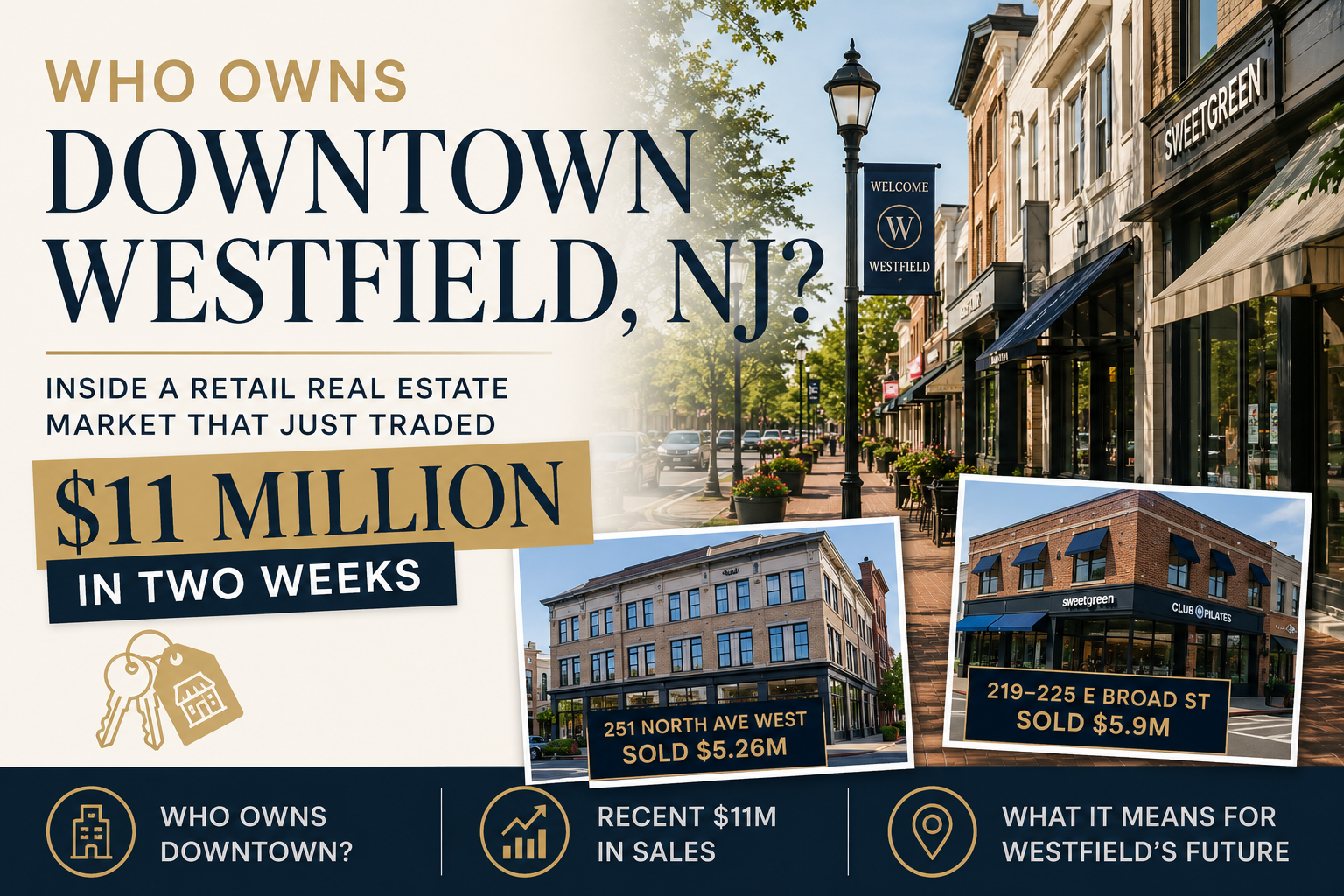
In the space of about two weeks this past August, two mixed-use buildings on Westfield's downtown commercial corridor changed hands for a combined $11.16 million. On August 13, 2026, a nine-suite, 17,831-square-foot building at 251 North Avenue West — anchored by Columbia Bank, Edward Jones, and a State of New Jersey office — sold for $5.26 million. Less than two weeks later, on August 25, 2026, a fully occupied, five-tenant building at 219-225 East Broad Street, home to Sweetgreen, Club Pilates, and the Fred Astaire Dance Studio, sold for $5.9 million. Both deals were brokered by the same Marcus & Millichap team, and both came with nearly identical language from the firm's executive managing director, Alan Cafiero, who called downtown Westfield "one of the most desirable mixed-use investment markets in New Jersey" and noted that "assets of this quality in downtown Westfield rarely become available."
We work out of downtown Westfield ourselves — our office sits at 52a Elm Street, a block or two from both of these buildings — so when a Patch headline about a mixed-use sale crosses our feed, we don't just skim it. We think about what it says about the town we sell homes in every day, and increasingly, our clients ask us the same question these headlines raise: who actually owns downtown Westfield's storefronts, is the retail market genuinely as strong as these sale prices suggest, and what does the much bigger, much more complicated story unfolding at the old Lord & Taylor site mean for the town's future? This guide walks through all three questions in detail, using the actual transaction data, leasing activity, and redevelopment history behind downtown Westfield's commercial real estate market as it stands in 2026 — because for anyone buying or selling a home in this town, the health of that four-block downtown corridor is not a side story. It is directly tied to what your home is worth.
The Deal That Started This: 219-225 East Broad Street
Let's start with the transaction that prompted this whole conversation. On August 25, 2026, Marcus & Millichap announced the sale of a two-story, 13,006-square-foot mixed-use building at 219-225 East Broad Street for $5.9 million. The building sits on a 0.26-acre lot, was renovated in 1995, and was fully occupied at the time of sale across five commercial suites, leased to Sweetgreen, Club Pilates, the Fred Astaire Dance Studio, GamifyU, and Exploratores — a tenant mix that reads like a checklist of exactly what a healthy, affluent downtown is supposed to attract: a national fast-casual chain, two fitness and lifestyle concepts, and a children's enrichment brand, none of them a discount retailer or a going-concern liquidation tenant filling space at a steep concession.
Do the simple math on that sale, and it works out to roughly $454 per square foot for a fully leased, walkable, transit-adjacent retail building — a number that, on its own, tells you almost nothing, but that becomes genuinely meaningful once you compare it to the deal that preceded it by less than two weeks.
The Deal Before It: 251 North Avenue West
On August 13, 2026, the same Marcus & Millichap brokerage team — Alan Cafiero, David Cafiero, and Damien Rance — closed a separate sale: a three-story, 17,831-square-foot mixed-use building at 251 North Avenue West, directly along Westfield's Route 28 corridor and its primary east-west spine through downtown. That building, renovated in 2014 and configured across nine suites, sold for $5.26 million, or roughly $295 per square foot. Its tenant roster leans institutional and service-oriented rather than lifestyle-and-fitness: Columbia Bank, Edward Jones, a State of New Jersey office, BAYADA Home Health Care, and Rooster Spin, a boutique fitness studio.
Cafiero's language on this deal is worth reading closely, because it's more specific than the usual broker boilerplate: he described the property's appeal as rooted in its downtown location, walkability, proximity to the Westfield train station, and — this is the phrase that matters most for anyone trying to understand this market — "limited investment inventory" that creates sustained value. In plain terms: there simply aren't very many buildings like this one that come up for sale in downtown Westfield in any given year, and when one does, it draws serious capital fast.
Two transactions in fourteen days, both fully occupied, both anchored by a mix of national and regional tenants, both closing at prices in the same broad range per square foot despite meaningfully different tenant profiles — that's not a coincidence. It's a market telling you something clearly and consistently: institutional and private capital wants into downtown Westfield's retail real estate, and there isn't nearly enough of it to go around.
So Who Actually Owns Downtown Westfield's Retail Real Estate?
This is the question we hear most often once people start paying attention to these sale headlines, and the honest answer surprises a lot of people: nobody owns "downtown Westfield." There is no single landlord, no dominant REIT, no one family or company that controls the corridor the way, say, a mall operator controls a shopping center. Downtown Westfield's retail real estate is fragmented across dozens, likely well over a hundred, of individual owners — private LLCs, longtime local families who have held a single building for a generation or more, smaller regional investment groups, and, increasingly, out-of-town private capital drawn in by exactly the kind of returns the two sales above represent.
This fragmentation is actually one of downtown Westfield's structural strengths, not a weakness, and it's worth understanding why. A downtown controlled by a single ownership entity lives and dies by that owner's capital position, leasing philosophy, and strategic priorities — if that owner overextends, pulls back on reinvestment, or simply decides to redirect capital elsewhere, the entire corridor can feel it at once. A downtown owned by dozens of independent parties, each making its own leasing and reinvestment decisions based on its own building's specific tenant mix and financial position, is far more resilient to any single owner's misstep. It's also part of why downtown Westfield's building stock looks the way it does architecturally — a real mix of eras, styles, and scale, rather than the uniform, single-developer look of a purpose-built lifestyle center.
The entity most people mistake for a "downtown owner" is the Downtown Westfield Corporation, or DWC — but the DWC is not a landlord at all. It's Westfield's Special Improvement District management corporation, a public-private partnership funded through a special assessment on downtown property owners, responsible for marketing, events, streetscape maintenance, and business recruitment across the district. Every downtown property owner pays into it, but none of them work for it, and the DWC itself owns no real estate. Its role is closer to a chamber of commerce with a dedicated funding stream than to a property owner — coordinating the corridor's collective interests rather than controlling any piece of it.
There is exactly one meaningful exception to this fragmented-ownership picture, and it happens to be the single largest and most consequential piece of downtown Westfield real estate under any one party's control: the roughly 14-acre former Lord & Taylor site and adjacent municipal parking areas, assembled under a redevelopment agreement with a subsidiary of what is now Saks Global. That story is complicated enough, and important enough, that it deserves its own section — because it's currently the biggest open question hanging over downtown Westfield's future, and it's directly tied to a corporate bankruptcy most Westfield homeowners have never heard connects back to their own town.
The One Westfield Place Story: A $350 Million Bet on Downtown Westfield
To understand where this story stands today, you need the history. In the early 2020s, Streetworks Development — the redevelopment arm of Hudson's Bay Company, the Canadian retail conglomerate that owned Lord & Taylor, Saks Fifth Avenue, and later merged with Neiman Marcus to form Saks Global — proposed a sweeping mixed-use redevelopment called One Westfield Place, centered on the vacant former Lord & Taylor department store on North Avenue and a set of adjacent, town-owned commuter parking lots near the train station.
The plan that Westfield's Town Council ultimately approved, by a 7-1 vote, called for roughly $350 to $400 million in total investment across 14 acres: adaptive reuse of the old Lord & Taylor building into approximately 100,000 square feet of Class A office space, a new mass-timber office building adding another 200,000-plus square feet, somewhere in the neighborhood of 205 residential units — the large majority age-restricted for residents 55 and older, alongside a smaller allocation of market-rate and affordable units — new parking garages replacing and expanding the commuter parking lots, roughly 27,000 square feet of ground-floor retail, and more than two acres of new public green space, including an upgraded Town Green and Town Square. The project came attached to a 30-year PILOT, or Payment in Lieu of Taxes, agreement projected to generate somewhere between $200 million and $214 million in municipal revenue over its life, plus tax-exempt bonds of up to $57 million to fund roughly $54 million in public streetscape and intersection improvements.
This was, by a wide margin, the single largest concentration of downtown Westfield real estate under one development umbrella in the town's modern history — and it did not happen without a fight. A resident group calling itself Westfield Advocates for Responsible Development argued there was "no area in Westfield that should be considered blighted," raised concerns about the project's density and its 30-year tax abatement, pointed to more than 2,500 already-planned or under-construction residential units nearby along the rail corridor, gathered over 2,400 petition signatures, and ultimately filed a lawsuit attempting to block the plan. The Town Council approved it anyway, with only one dissenting vote, from a council member who specifically flagged the train station portion of the project as "too large, too dense."
The Twist: Saks Global's 2026 Bankruptcy Pauses the Project
Here is the part of this story that most Westfield homeowners have not connected back to their own downtown, but that every buyer and seller in this market should understand: in January 2026, Saks Global — the luxury retail conglomerate that had by then absorbed Hudson's Bay Company's former Saks Fifth Avenue, Neiman Marcus, and Bergdorf Goodman brands — filed for Chapter 11 bankruptcy protection, carrying approximately $3.4 billion in debt. The U.S. Bankruptcy Court for the Southern District of Texas confirmed the company's reorganization plan in June 2026, a plan that cuts Saks Global's debt load by roughly 75% and includes $500 million in exit financing, with the company expected to emerge from Chapter 11 as a lender-owned entity by summer 2026.
The connection to downtown Westfield is direct and structural: One Westfield Place's developer entity, now operating as SW Westfield, along with the eight individual project-specific LLCs beneath it, are themselves subsidiaries of the Saks corporate family. When the parent company enters Chapter 11, its subsidiaries' major capital commitments generally freeze until the bankruptcy court process resolves — which is exactly what happened here. As of mid-2026, One Westfield Place sits, in Westfield Mayor Jeremy Berman's own words, "essentially on hold" pending the conclusion of Saks's bankruptcy proceedings, with reporting also indicating the Lord & Taylor site itself may be heading toward a sale as part of the broader reorganization, which would introduce an entirely new ownership question for this single largest parcel downtown.
Mayor Berman has been notably candid about what this means, and it's worth relaying his framing directly because it's more measured than either the boosters or the critics of this project have generally been: the pause, he's suggested, could actually create an opportunity to revisit the plan's "scale, design, and mix of uses" to better reflect current market conditions — rather than simply being read as a project in trouble. The town has also been direct about its own financial exposure, stating it holds no financial liability tied to Saks's bankruptcy, that it retains ownership of the municipal parking lots involved in the plan, and that property tax payments on the site have continued through the bankruptcy process. Westfield has separately pursued a roughly $153,000 cure claim through its bankruptcy counsel, though it's worth noting that at least one resident's attorney has publicly questioned whether that claim remains a pending objection rather than secured, collected funds — a genuinely open question as of this writing.
What This Actually Means for Westfield's Real Estate Market
Here is the framing we'd encourage every buyer and seller to take away from this story, and it's the same framing local market analysts covering the situation have converged on: downtown Westfield's fundamental strengths — its direct NJ Transit Raritan Valley Line access into Manhattan, its walkable, largely fragmented and independently-owned retail base, and a chronic, structural scarcity of available housing supply — do not depend on One Westfield Place getting built on any particular timeline. Those fundamentals were true before Streetworks proposed this project, they remain true today with the project paused, and they will remain true regardless of how Saks Global's bankruptcy ultimately resolves the Lord & Taylor site's ownership.
What has changed is simply this: for buyers evaluating a home specifically because of its proximity to a future One Westfield Place, or sellers pricing a listing partly on the promise of what that project might eventually bring to the immediate area, the right move now is to price based on downtown Westfield's real, current, on-the-ground condition — not on a rendering of a project that remains genuinely paused with its ownership in flux. Any eventual completion of some version of this project should be treated as potential future upside layered on top of an already strong market, not as a foundation your purchase or sale decision depends on. That's not a pessimistic read of the situation — downtown Westfield's retail real estate market, as the transaction data above makes clear, is trading at strong prices with essentially no vacancy right now, entirely independent of what happens at the old Lord & Taylor site.
How Strong Is Downtown Westfield's Retail Market, Really?
Set the Lord & Taylor situation aside for a moment, because it's genuinely a separate story from the health of downtown Westfield's existing, occupied retail base — and that existing base is, by every available measure, performing exceptionally well.
Vacancy Has Fallen Sharply From Its Pre-Pandemic Highs
According to reporting on the downtown's leasing activity, local developer James Ward has pointed to downtown vacancy having dropped from roughly one-third of available space in the years before the pandemic to a meaningfully tighter market in the years since — a genuinely dramatic swing for any downtown retail corridor, and one that tracks closely with a broader, well-documented national trend: suburban downtowns within commuting distance of major cities have seen outsized retail demand growth as more residents work from home some or all of the week, converting former weekday commuters into weekday shoppers, diners, and gym members in their own downtown.
JLL's own team, which has represented landlords on downtown Westfield leasing, put it directly: "Retail is thriving here in suburban New Jersey," according to JLL managing director David Townes, while his colleague Alana Friedman pointed specifically to Westfield's "established affluent population, educated workforce and connectivity that supports flexible commuting" as the underlying reason retailers keep signing leases on this specific stretch of East Broad Street — positioning Westfield less as a bedroom community people simply sleep in and commute out of, and more as a genuine daytime destination where a meaningful share of residents now live, work remotely, and spend locally throughout the week rather than only on weekends and evenings.
Who's Actually Leasing Space Downtown
The tenant rosters behind these recent building sales tell the same story from a different angle. In a single block of East Broad Street leasing activity, JLL represented landlords signing leases with 2nd Street, a Tokyo-based consignment retail brand opening its 22nd U.S. location in a 5,812-square-foot space at 167 East Broad Street; Stretchlab, an assisted-stretching fitness concept, signing a 10-year lease for 2,091 square feet at 161 East Broad Street; German Donner Kebab, a fast-casual concept, taking 1,800 square feet at 125 East Broad Street; Mochimoly, an Asian dessert concept opening its third location in 1,100 square feet at 131 East Broad Street; and Gong Cha, the international bubble tea franchise, taking a compact 350-square-foot space at 129 East Broad Street. Combined, that's over 11,000 square feet of new retail leasing on a single downtown block — a leasing pace that simply doesn't happen in a struggling retail market.
Layer that leasing activity on top of the tenant rosters from the two 2026 building sales covered above — Sweetgreen, Club Pilates, Fred Astaire Dance Studio, Columbia Bank, Edward Jones, BAYADA Home Health Care — and a clear pattern emerges: downtown Westfield's retail base is diversified across food and beverage, fitness and wellness, financial and professional services, and specialty retail, rather than concentrated in any single category that could sink the whole corridor if consumer habits shift in one direction. That diversification is itself a form of resilience, and it's exactly the kind of tenant mix institutional and private investors look for when they're willing to pay $295 to $454 per square foot for a fully-occupied downtown building, as this past August's transactions demonstrate.
Why Investors Keep Circling Back to This Specific Four Blocks
Every broker quote attached to these recent sales converges on the same handful of structural reasons, and it's worth naming them explicitly because they're the same reasons we walk homebuyers through when they ask why Westfield commands the premium it does over neighboring towns.
Direct NJ Transit Raritan Valley Line access, connecting downtown Westfield to Newark Penn Station and onward into New York Penn Station, means downtown retail tenants and downtown-adjacent residential buyers alike are drawing from a labor and customer pool that isn't limited to what a single town or even a single county can provide on its own.
Genuine, four-season walkability, with downtown Westfield's retail concentrated tightly enough along Broad Street, Elm Street, and Quimby Street that a resident can reasonably park once — or not drive at all — and handle groceries, a workout, dinner, and a haircut all within a comfortable walk, a feature that a growing share of both retailers and residential buyers actively select for rather than treat as a nice-to-have.
A structurally limited, largely built-out supply of investable downtown buildings, the exact dynamic Alan Cafiero pointed to directly in describing the North Avenue West sale — when almost no new downtown retail buildings get constructed and existing ones rarely trade, every transaction that does happen draws outsized competitive interest from capital that has nowhere else nearby to deploy at this specific combination of location and tenant quality.
Genuinely affluent, well-established local demographics, which JLL's own leasing commentary points to directly as the driver behind national and regional retail brands choosing this specific four-block stretch over dozens of other New Jersey downtowns they could have picked instead.
None of these four forces is new, and none of them appears to be reversing. If anything, the shift toward remote and hybrid work arrangements that began in 2020 has made the first and second forces — transit access and walkability — more valuable to both retail tenants and residential buyers than they were before, not less, since more residents are now spending more of their week physically present in town rather than commuting out of it five days a week.
How Westfield's Residential Wealth Feeds Its Retail Market
None of the leasing and investment activity documented above happens in a vacuum, and it's worth connecting it directly to a data point we've covered in detail elsewhere on this site: Westfield's median single-family home sale price reached $1,500,000 as of July 2026, up 16.4% year over year. That figure matters here for a very specific reason — retail site-selection teams at national and regional brands don't choose a location based on population count alone, they weight heavily toward household income, disposable spending capacity, and daytime population density, and a town with a $1.5 million home price median is, by definition, telling every retail real estate broker evaluating it that its residents carry substantial discretionary income.
This is precisely the dynamic JLL's Alana Friedman was describing when she pointed to Westfield's "established affluent population" as a driver of retailer interest — it isn't a vague marketing phrase, it's a direct reflection of the same home-price data covered in our market trends analysis. A downtown surrounded by homes appreciating at 16.4% annually, with a median sale price nearly double the national figure, is a downtown where a Sweetgreen or a Club Pilates can reasonably project strong per-location revenue, which is exactly why these brands keep signing leases here rather than in comparably-sized downtowns with softer residential price appreciation.
The relationship runs in both directions, and this is the part that matters most for our own clients: just as rising home values support stronger retail fundamentals, a thriving, low-vacancy, well-tenanted downtown supports stronger home values in return. Buyers increasingly treat "walk to a real downtown with a Sweetgreen, a boutique fitness studio, and a bank branch, not a half-empty strip of vacant storefronts" as a genuine, quantifiable amenity — not unlike a finished basement or an updated kitchen — and price their offers accordingly. When we walk a downtown-adjacent listing with a buyer today, we are, in effect, walking them through the same tenant roster and occupancy data covered in this guide, because it's part of what they're actually paying for.
A Brief History: What Used to Anchor Downtown Westfield's Retail Corridor
Understanding where downtown Westfield's retail market stands today is easier with a little historical context, because the corridor hasn't always looked the way it does now, and the shift itself tells you something about the town's underlying resilience.
For decades, the Lord & Taylor department store anchored the north end of downtown Westfield the way a traditional department store anchored countless American downtowns through the twentieth century — a single large-format retailer whose presence was assumed to be permanent, and whose eventual closure, when department store chains nationally began contracting store counts in the 2010s, left behind exactly the kind of large, single-use vacant anchor building that has proven difficult to reactivate in downtowns across the country. Westfield's version of that story is the building now sitting at the center of the paused One Westfield Place redevelopment covered above.
What's genuinely notable about downtown Westfield's trajectory, though, is that the loss of a single large anchor tenant did not drag the surrounding retail corridor down with it the way it has in many other towns. Instead, the blocks of East Broad Street, North Avenue, and Elm Street surrounding that now-vacant anchor kept attracting smaller-format tenants — the Sweetgreens, Club Pilates studios, and Stretchlabs covered throughout this guide — largely independent of what happened at the old department store site. That's a meaningful data point in its own right: it suggests downtown Westfield's retail health was never actually dependent on a single anchor tenant the way conventional downtown-planning wisdom often assumes, but rather on the broader combination of transit access, walkability, and household income covered throughout this guide. The anchor building sitting vacant and now tied up in a paused, bankruptcy-affected redevelopment is a real, visible problem for that one specific parcel — but it has not been the drag on the surrounding four blocks that a more traditional downtown, more dependent on that one large tenant, might have experienced.
Doing the Investment Math: What These Sale Prices Actually Imply
For clients who also think about downtown Westfield property from an investment angle, not just a residential one, it's worth walking through what these recent sale prices actually imply, beyond the simple price-per-square-foot figures already covered.
Neither the 251 North Avenue West sale nor the 219-225 East Broad Street sale disclosed a cap rate — the standard metric investors use to express a property's net operating income as a percentage of its purchase price — which is common for off-market or lightly-marketed transactions of this size. But the price-per-square-foot spread between the two deals is still instructive. The North Avenue West building, at roughly $295 per square foot, carries a tenant mix weighted toward longer-term, credit-quality tenants — a regional bank branch, a national financial services firm, a state government office — the kind of tenant roster that typically signs longer leases at more modest rent escalations, trading some upside for stability. The East Broad Street building, at roughly $454 per square foot, carries a tenant mix weighted toward younger, faster-growing lifestyle and fitness concepts — Sweetgreen and Club Pilates among them — which often support higher current rents in strong demographic markets like Westfield, reflecting both the categories' strong unit economics in affluent trade areas and the more limited manner in which two fast-casual and fitness-anchored buildings like this one typically come to market.
That roughly 54% premium per square foot between the two buildings is a useful real-world illustration of how much tenant quality and category can move pricing even within the same four-block downtown corridor, in the same month, through the same brokerage team. It's exactly the kind of distinction an investor evaluating any individual downtown Westfield building — or a residential seller who also happens to own a small mixed-use property downtown — should think through carefully rather than assuming a flat, townwide price-per-square-foot figure applies evenly across every building on the corridor.
What This Means If You Own — or Are Considering Buying — a Home Near Downtown Westfield
This is the part of the conversation that matters most for the actual work we do every day, and it's worth being direct about the connection: a thriving, low-vacancy, actively-traded downtown commercial corridor is not a side story to Westfield's residential real estate market. It is one of the core reasons homes within walking distance of that corridor command the premium they do.
Downtown-adjacent homes benefit directly from downtown vitality. Every one of the structural forces described above — transit access, walkability, tenant diversity, investor demand — accrues just as directly to the value of a home a five- or ten-minute walk from Broad Street as it does to the commercial buildings themselves. A buyer choosing between two otherwise comparable Westfield homes, one within easy walking distance of downtown and one requiring a drive, is very often willing to pay a real premium for the first, precisely because of everything documented in this guide: an active, well-leased, low-vacancy downtown with a genuinely diverse tenant base that isn't going anywhere.
A paused mega-project is not the same thing as a weak market — but it's worth understanding the distinction clearly if you're evaluating a home specifically because of it. If you're touring homes near the train station or the old Lord & Taylor site and a listing agent leans heavily on One Westfield Place's eventual completion as part of the pitch, ask directly about the current status of the Saks Global bankruptcy and the project's pause, and price your offer based on today's confirmed reality rather than a rendering whose developer's parent company is mid-reorganization. The upside may well still arrive eventually — but "eventually, on an undetermined timeline, from a developer currently in Chapter 11" is a meaningfully different proposition than "under active construction," and your offer price should reflect that distinction honestly.
The fragmented ownership structure of downtown Westfield's retail base is, if anything, a point in the town's favor for long-term stability. Unlike a downtown dependent on a single master developer or major anchor tenant's continued financial health, downtown Westfield's dozens of independent building owners each have their own capital, their own leasing strategy, and their own reasons to keep reinvesting in their specific properties — a structure that has proven durable through a pandemic, a sharp interest rate cycle, and now a major anchor developer's bankruptcy, without the broader retail corridor missing a beat.
If you're selling a home near downtown, lean into the specifics documented here, not vague claims. "Walk to a fully-leased downtown" is a stronger, more credible selling point when you can point to the actual tenant roster — a Sweetgreen, a Club Pilates, an Edward Jones office, a wave of 2023-and-later lease signings that have stuck — than when it's left as a generic claim any Central Jersey town could make about itself.
How Downtown Westfield Compares to Other Central and Northern NJ Downtowns
Westfield is far from the only town in our coverage area with a walkable, transit-connected downtown commercial corridor, and buyers cross-shopping these towns deserve an honest comparison rather than a claim that Westfield stands alone.
Cranford, sharing the same Raritan Valley Line and a similarly compact, walkable downtown along South and North Union Avenue, has its own active small-business corridor, generally at a somewhat more accessible price point than Westfield's, both for residential buyers and for commercial tenants and investors.
Summit, on its own direct rail line into Manhattan, supports a downtown with a comparably affluent demographic base and a restaurant-dense commercial core, generally commanding retail and residential pricing at or above Westfield's, reflecting an even tighter supply of walkable downtown inventory.
Maplewood and Montclair, both known for dense, walkable downtown business districts anchored by their own direct rail access, have each seen a similar wave of national and regional retail and restaurant interest over the past several years, driven by the same remote-and-hybrid-work-fueled shift toward suburban daytime spending documented throughout this guide.
Scotch Plains, Mountainside, Basking Ridge, and New Providence each offer a somewhat different downtown commercial profile — generally smaller in scale, less nationally-branded in tenant mix, and correspondingly more accessible on price — appealing to buyers who value being near, rather than directly within walking distance of, a dense downtown retail core.
The throughline across every one of these towns is the same one driving downtown Westfield's 2026 transaction activity: walkable, transit-connected downtown commercial corridors in this part of New Jersey are in genuinely short supply relative to investor and retailer demand, and that scarcity shows up directly in both the commercial sale prices covered throughout this guide and in the residential premium buyers consistently pay to live within easy walking distance of one.
Should You Invest in Downtown Westfield Commercial Real Estate?
We work primarily with residential buyers and sellers, but we field this question often enough from clients weighing a mixed-use purchase, or from residential sellers who also happen to own a small downtown commercial property, that it's worth addressing directly.
The transaction data covered in this guide — two fully-occupied buildings trading at $295 and $454 per square foot within two weeks of each other, both broker-described as unusually rare opportunities — points to a market where demand for downtown Westfield commercial assets meaningfully exceeds available supply. That's generally a favorable dynamic if you already own a downtown Westfield commercial property and are considering a sale: limited comparable inventory tends to support strong pricing and a faster path to a qualified buyer, exactly as both of this past August's sales demonstrated.
For someone considering buying into this market, the same scarcity that supports strong seller pricing works in the other direction for a buyer: expect real competition for any well-located, well-leased downtown Westfield property that comes to market, expect pricing in the range demonstrated by this year's actual transactions rather than a discount, and understand clearly that the properties commanding the strongest interest and pricing are the ones with diversified, resilient tenant rosters — a mix of food and beverage, fitness and wellness, and professional or financial services, rather than a single-tenant building dependent on one lease renewal decision.
And if your interest in downtown Westfield commercial real estate is specifically tied to the future of the Lord & Taylor site or the broader One Westfield Place project, treat that as a distinct, higher-risk, longer-horizon opportunity entirely separate from the existing, occupied downtown retail base — one whose ownership, scale, and timeline all remain genuinely unresolved pending the conclusion of Saks Global's bankruptcy proceedings, and one that deserves its own dedicated due diligence rather than being folded into a general "downtown Westfield is strong" thesis.
A Practical Plan If You're Selling a Home Near Downtown Westfield
- Document the specific commercial vitality near your address, not just a general claim about "walking distance to downtown." Reference actual tenants, actual recent leasing activity, and actual sale prices like the ones covered in this guide to make a walkability premium concrete rather than generic.
- Be direct with buyers about the One Westfield Place project's actual, current status if your home sits near the train station or the former Lord & Taylor site, rather than either overselling its uncertain timeline or ignoring it. Buyers doing their own research will find this story regardless, and getting ahead of the conversation builds trust rather than inviting suspicion.
- Price based on today's confirmed downtown fundamentals — transit access, walkability, current occupancy and tenant mix — not on speculative future redevelopment value that depends on a bankruptcy court process outside anyone's control.
- Work with an agent who actually tracks this corridor's commercial activity, not just residential comps, since the two are more connected in a town like Westfield than in most suburban markets.
A Practical Plan If You're Buying a Home Near Downtown Westfield
- Walk the actual corridor at different times of day and week, not just during a single showing, to get a genuine feel for the foot traffic, tenant mix, and vacancy level described throughout this guide.
- Ask your agent directly about the current status of One Westfield Place if a listing's marketing leans on its future completion, and factor in that the project remains paused pending Saks Global's bankruptcy resolution before you let that upside affect your offer price.
- Understand that a fragmented-ownership downtown, like Westfield's, tends to be more resilient long-term than one dependent on a single master developer or anchor tenant, which is a genuine, durable point in the town's favor regardless of how the Lord & Taylor situation eventually resolves.
- Compare Westfield honestly against Cranford, Summit, Maplewood, Montclair, and the other towns in this guide if downtown walkability and transit access are priorities for you, since each offers a genuinely different combination of price point, downtown scale, and commercial tenant mix worth weighing directly against your own budget and priorities.
A Short Glossary: Key Terms in This Article
Because this article leans on some specific commercial real estate and municipal finance terminology, here is a quick reference for the terms that come up most often.
Mixed-use property refers to a building combining more than one use — most commonly ground-floor retail or commercial space with office or residential space above or alongside it — which describes nearly every building covered in this guide, from the East Broad Street sale to the One Westfield Place proposal itself.
Price per square foot is a building's total sale price divided by its total square footage, used as a rough, comparable measure of value across properties of different sizes, though it does not account for differences in tenant quality, lease terms, or remaining lease duration the way a cap rate does.
Cap rate, short for capitalization rate, expresses a property's annual net operating income as a percentage of its purchase price, and is the standard metric commercial investors use to compare the relative return of different properties — a lower cap rate generally reflects a lower-risk, more stable asset, while a higher cap rate generally reflects either higher risk or a shorter remaining lease term.
A Special Improvement District, or SID, is a defined commercial area, like downtown Westfield, where property owners pay an additional assessment to fund collective marketing, events, and maintenance through a dedicated management corporation — in Westfield's case, the Downtown Westfield Corporation.
A PILOT agreement, short for Payment in Lieu of Taxes, is an arrangement in which a developer pays a municipality a negotiated amount instead of standard property taxes for a set period, often used to help finance large redevelopment projects like One Westfield Place in exchange for public infrastructure investment and long-term revenue commitments.
Chapter 11 bankruptcy is a form of U.S. corporate bankruptcy protection that allows a company to reorganize its debts and continue operating, rather than liquidating entirely, under a court-supervised plan — the process Saks Global entered in January 2026 and which directly paused the One Westfield Place project.
Adaptive reuse describes converting an existing building to a new use rather than demolishing and rebuilding it, such as the proposal to convert the vacant Lord & Taylor department store into Class A office space rather than tearing it down.
Frequently Asked Questions
Who owns most of the retail real estate in downtown Westfield, NJ? Downtown Westfield's retail real estate is owned by a large number of independent private investors, LLCs, and longtime local families in individual buildings, rather than by any single dominant landlord. The one major exception is the roughly 14-acre former Lord & Taylor site and adjacent parking areas, controlled by Saks Global's Streetworks development subsidiary as part of the paused One Westfield Place project.
Why did two downtown Westfield buildings sell for a combined $11 million in August 2026? A nine-suite, 17,831-square-foot building at 251 North Avenue West sold for $5.26 million on August 13, 2026, and a five-suite, 13,006-square-foot building at 219-225 East Broad Street sold for $5.9 million on August 25, 2026. Both were fully occupied by a mix of national and regional tenants, and brokers described both as reflecting strong, sustained investor demand for a limited supply of downtown Westfield commercial buildings.
Is downtown Westfield's retail vacancy rate high or low right now? Reporting on the corridor's leasing activity indicates vacancy has fallen substantially from roughly one-third of available downtown space before the pandemic to a considerably tighter market in the years since, driven in part by increased daytime demand from residents working from home and spending locally rather than commuting into a city center five days a week.
What happened to the One Westfield Place redevelopment project? One Westfield Place, a roughly $350 to $400 million mixed-use redevelopment proposed for the former Lord & Taylor site and adjacent downtown parking lots by Streetworks (Hudson's Bay Company's development arm), is currently paused following parent company Saks Global's Chapter 11 bankruptcy filing in January 2026. The bankruptcy court confirmed Saks's reorganization plan in June 2026, and the project remains on hold pending the conclusion of that process, with reporting also indicating the site itself may be heading toward a sale.
Is Saks Global's bankruptcy a sign that downtown Westfield's real estate market is struggling? No — the bankruptcy is specific to Saks Global's corporate debt structure and its ownership stake in the proposed One Westfield Place redevelopment, not a reflection of downtown Westfield's existing, occupied retail market, which recent transaction data shows trading at strong prices with very low vacancy, entirely independent of the paused project.
Should I buy a home near downtown Westfield because of the future One Westfield Place project? Treat any future completion of One Westfield Place as potential bonus upside rather than a reason to pay a premium today, since the project remains genuinely paused with its ownership and timeline unresolved pending Saks Global's bankruptcy proceedings. Downtown Westfield's existing fundamentals — transit access, walkability, an active and diversified retail base — already support strong home values near the corridor without factoring in that project's eventual outcome.
How does downtown Westfield's retail market compare to Cranford, Summit, Maplewood, or Montclair? All of these towns have their own walkable, transit-connected downtown commercial corridors experiencing similar demand from both retailers and residential buyers, generally driven by the same remote-and-hybrid-work-fueled shift toward local spending. Westfield and Summit tend to command pricing at the higher end of this group, Cranford and Maplewood offer somewhat more accessible price points with comparable walkability, and Scotch Plains, Mountainside, Basking Ridge, and New Providence offer smaller-scale downtown commercial cores at correspondingly more accessible pricing.
Does the Downtown Westfield Corporation own downtown Westfield's buildings? No. The Downtown Westfield Corporation is the town's Special Improvement District management organization, funded through an assessment on downtown property owners and responsible for marketing, events, and business recruitment across the district — not a property owner itself. Every downtown building remains individually owned by its own private landlord.
The Bottom Line
Downtown Westfield's retail real estate market enters the fall of 2026 in a genuinely strong position: two fully-occupied mixed-use buildings just traded for a combined $11.16 million in a two-week span, vacancy has fallen sharply from its pre-pandemic highs, and a diverse mix of national and regional tenants across food and beverage, fitness, and financial services continues to sign new leases along the corridor. Ownership of that retail base remains genuinely fragmented across dozens of independent private owners — a structural strength that has helped the corridor stay resilient through a pandemic and a sharp rate cycle — with the one significant exception being the roughly 14-acre former Lord & Taylor site, now paused amid Saks Global's 2026 bankruptcy reorganization and a possible pending sale of the property itself.
None of this is a reason to avoid Westfield, and none of it is a reason to treat the paused Lord & Taylor project as either a guaranteed future windfall or a sign of underlying weakness. It's simply the real, current, fully-documented state of a market that both commercial investors and residential buyers continue to compete hard for — and understanding it accurately, rather than relying on headline glances at either the sale prices or the bankruptcy filing alone, is exactly the kind of informed decision-making Galina and I bring to every client conversation about this town.
Reach out to The GAMA Team at Corcoran Sawyer Smith, 52a Elm Street, Westfield, NJ — right in the middle of the corridor covered throughout this guide — or call or text 908-379-0525, or connect through thegamateam.com, to talk through what downtown Westfield's commercial market really means for your own home search or sale.
Marina Fridman-Rybner & Galina Kaplan The GAMA Team | Corcoran New Jersey Real Estate | Home Sellers | Home Buyers | NYC to NJ Relocation
This article is intended for general informational purposes and reflects publicly available information as of August 2026. It is not legal, financial, or investment advice. Commercial real estate values, redevelopment project timelines, and bankruptcy proceedings are subject to change, and readers should confirm current details directly with the relevant parties, the Town of Westfield, and a licensed professional before making a transaction decision.
Sources
- Westfield Mixed-Use Property Sells for $5.9 Million — Patch
- Marcus & Millichap Sells Mixed-Use Property in Westfield for $5.9M — ROI-NJ
- Marcus & Millichap Brokers $5.26M Sale of Route 28 Property in Westfield — ROI-NJ
- Marcus: Investor Grabs 18,000 Sq. Ft. Westfield Commercial Building for $5.3 Million — Real Estate NJ
- Marcus & Millichap Brokers $5.3 Million Sale of Retail, Office Property in Westfield, New Jersey — Shopping Center Business
- JLL: Five Retailers Take 11,000 Sq. Ft. in Westfield, as Remote Workers Boost Foot Traffic — Real Estate NJ
- Hudson Bay Eyes Sweeping Redevelopment Plan for Lord & Taylor Site, Downtown Westfield — Real Estate NJ
- Westfield Pushes Ahead With Sweeping Downtown Redevelopment, Despite Opposition — Real Estate NJ
- Westfield Approves Redevelopment Ordinance for $350 Million Downtown Plan. Now What? — Yahoo News
- One Westfield Place, Paused: What the Saks Bankruptcy Means for Downtown Westfield in 2026 — Prodigy Real Estate
- Impending Sale of Lord & Taylor Site Brings Changes to One Westfield Place Project Trajectory — TAPinto Westfield
- One Westfield Place — Town of Westfield, NJ
- Downtown Westfield Corporation — Town of Westfield, NJ
Check out this article next