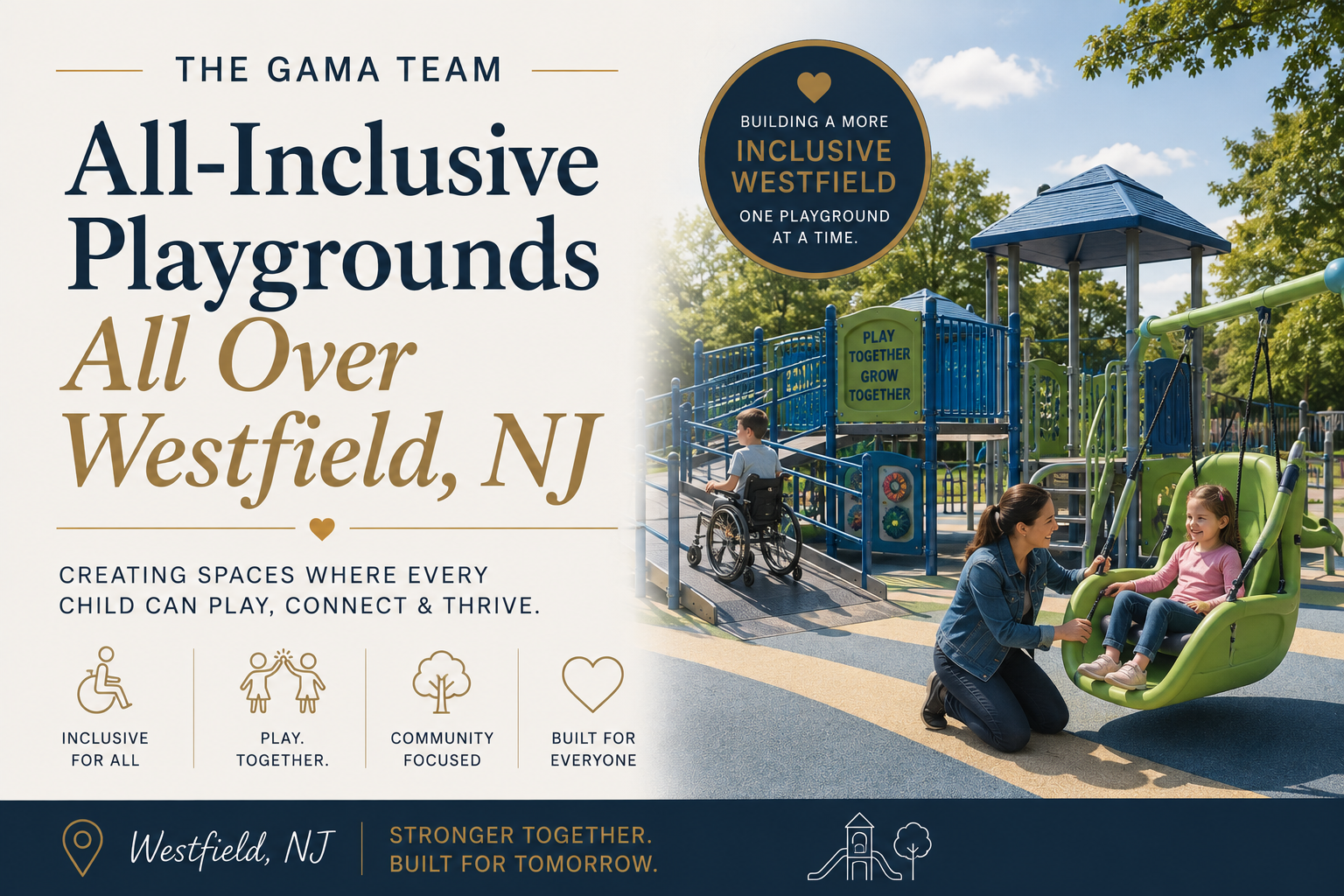
The full story of Project Playground, the Westfield, NJ movement started by three local moms that has raised over $600,000, transformed multiple school playgrounds, and reached thousands of students — and what it says about Westfield's community.
How Three Westfield Moms Built a Movement: The Real Story Behind Project Playground
Project Playground, a parent-led nonprofit initiative founded in Westfield, New Jersey in September 2022 by three local mothers — Erica Witte, Laura Skidmore, and Reema Sinha — has raised more than $600,000 from over 400 donors and transformed playgrounds at Lincoln School and Franklin Elementary School into fully accessible, inclusive play spaces, with Jefferson Elementary and additional schools following as part of a district-wide expansion now encompassing all six of Westfield's elementary schools plus Lincoln's early childhood center. What started as one mother's frustration watching her son, who uses a walker, unable to access his own school's playground has grown into one of Westfield's most visible, sustained grassroots community achievements — reaching more than 2,000 students, drawing major grants from the Westfield Foundation and the Optimist Club of Westfield, and involving Westfield High School students directly in designing communication boards and murals for the youngest, most vulnerable children in the district. Separately, and worth noting honestly, the Town of Westfield itself invested roughly $660,000 in a newly rebuilt, fully ADA-compliant playground at Memorial Park, reopened in April 2025 — a distinct, municipally funded project rather than a Project Playground campaign, but one that reflects the same broader shift in how seriously this community now takes inclusive play. Together, these efforts tell a genuinely remarkable story about what a small group of committed parents, backed by an engaged town, can accomplish in just a few years.
Some community movements start with a committee meeting. This one started with a mother standing at the edge of her son's school playground, watching him unable to join his classmates because the equipment simply wasn't built for a child who uses a walker. What happened next — the fundraising, the coalition-building, the design decisions, the ribbon cuttings — is a genuinely detailed, well-documented story worth telling in full, because it says something real about Westfield as a community, not just about playground equipment.
The Honest Bottom Line: What Project Playground Has Actually Accomplished
Before walking through the full story, it's worth stating plainly what's been achieved, since the scale of it is genuinely impressive even before getting into the details.
Project Playground has raised over $600,000 from more than 400 individual donors since its founding in September 2022, transforming the playgrounds at Lincoln School and Franklin Elementary School into fully inclusive spaces with specialized accessible equipment, sensory features, and communication tools, with Jefferson Elementary's project funded as part of an initial three-school push that crossed $400,000, and the initiative's stated scope now spanning all six of Westfield's elementary schools — Franklin, Jefferson, McKinley, Tamaques, Washington, and Wilson — alongside the Lincoln Early Childhood Center where the movement began.
This is a genuinely grassroots effort, led by volunteer parents working through school PTOs rather than a large, professionally staffed nonprofit — and it has still managed to secure major institutional backing, including a $50,000 grant from the Westfield Foundation for the Lincoln project (the Foundation's largest single contribution at the time) and a subsequent $20,000 grant for the Franklin project, alongside a $2,500 contribution from the Optimist Club of Westfield and hundreds of smaller individual donations.
It's also worth being precise and honest about scope: Project Playground is specifically a school-based initiative, working through individual school PTOs to fund playground improvements at Westfield's public elementary schools. The Town of Westfield's own separate, municipally funded reconstruction of the Memorial Park playground — covered in detail later in this guide — is a genuinely different project, funded through town ordinance and county grant dollars rather than Project Playground's fundraising, even though both reflect the same broader community shift toward taking inclusive play seriously.
How It Started: One Mother, One Walker, One Playground That Didn't Work
Every account of Project Playground's origin traces back to the same starting point, and it's worth telling in real detail, because the specificity of it is what makes the story land.
Erica Witte's son uses a walker for mobility. Watching him at his school's playground — surrounded by classmates able to run, climb, and swing freely while he was structurally excluded from most of the same equipment — crystallized something for her that she's described in genuinely direct, unguarded terms: she felt "frustrated and, to be honest, very sad, that the space was not accessible." That's not a polished mission statement. It's a parent's honest description of watching her child left out, and it's the emotional starting point for everything that followed.
Erica didn't build this alone, and it's worth crediting the two co-founders who joined her from the very beginning. Laura Skidmore brought a special education background to the founding team, and has spoken directly to why she saw this as urgent: play, in her words, is "paramount to the development of young children" — not a nice-to-have amenity, but a genuinely essential part of how young children grow, learn, and build social connection, meaning a playground that excludes some children from play isn't a minor inconvenience, but a real developmental gap.
Reema Sinha, a physical therapist and, at the time, a relatively new Westfield resident, brought a clinical perspective to the founding team specifically focused on what accessible design actually requires in practice — framing the mission directly around ensuring "independence and mobility for all children," a goal informed by her professional understanding of exactly what kind of equipment, surfacing, and spatial design genuinely enables a child with mobility challenges to move through and use a space independently, rather than requiring constant adult assistance.
Together, in September 2022, these three mothers founded Project Playground — starting not with a five-year strategic plan, but with a specific, achievable target: Lincoln School, the district's early childhood center, where the need was arguably most acute given the population it serves.
Why Lincoln School First
Understanding why Lincoln School became Project Playground's starting point requires understanding exactly who Lincoln serves — and the numbers here are genuinely striking.
Lincoln School functions as Westfield's early childhood center, serving the district's Pre-K and Kindergarten population, including through the district's Preschool Integrated Program — the same inclusive, lottery-based public preschool covered in The GAMA Team's guide to Westfield daycare and preschool options, which deliberately brings together typically developing children alongside children identified by the district's Department of Special Services as needing early intervention services.
A striking statistic drove the urgency behind starting at Lincoln specifically: roughly 70% of Lincoln's preschool students have Individualized Education Programs (IEPs) requiring therapy services — meaning the overwhelming majority of the youngest children at this specific school have documented developmental, physical, or therapeutic needs that a standard, non-adapted playground simply doesn't accommodate. For a school with that population, an inaccessible playground isn't excluding a small minority of students; it's failing to serve the actual majority of the children walking through its doors every day.
This is precisely the kind of concrete, specific need that transforms a general mission ("make Westfield more inclusive") into an achievable, fundable, first project ("raise the money to rebuild Lincoln's two playgrounds with accessible equipment") — and it's worth crediting the founders' strategic instinct here directly. Starting with the school where the need was most acute and most quantifiable gave Project Playground a genuinely compelling, specific case to bring to the Westfield Foundation, local businesses, and individual donors, rather than an abstract appeal.
Lincoln School's Campaign: Watching the Fundraising Build in Real Time
Because Lincoln's campaign is genuinely well documented across multiple points in time, it's worth walking through its actual fundraising trajectory in detail — a rare, concrete look at how a grassroots campaign like this actually builds momentum month by month.
The Lincoln School PTO set an initial fundraising target of $100,000, later reported as $125,000 as the full scope of the project's equipment, surfacing, pathways, and landscaping needs became clearer — a genuinely common pattern in capital campaigns, where an initial estimate expands somewhat as detailed planning with equipment vendors and landscape architects clarifies the true full cost.
By May 2023, roughly eight months after the campaign began, the PTO had raised $112,000 toward its $125,000 goal — leaving a specific, concrete $13,000 gap, with the PTO's own public messaging framing the remaining need directly: "Together, we can create a more accessible and more inclusive play space where children all over the Westfield community can enjoy playing together." The specific equipment still being funded at that stage included a train engine play space, a Volta-inclusive spinner, and Novo Arch benches for one playground area, and an accessible swing set, a Brava universal swing, and a Rev8 spinner for the second.
The campaign's single largest boost came in August 2023, when the Westfield Foundation announced a $50,000 grant — at the time, the largest single contribution in the Foundation's history — pushing the total raised past $128,000 from roughly 200 donors over the campaign's first eight months. Erica Witte, serving as Project Playground's chair, described the impact directly: "The Foundation's contribution accelerated all aspects of the project... we could change this space for the better." Katie Darcy, the Westfield Foundation's Executive Director, framed the grant as core to the Foundation's own mission: "We are extremely proud to play an integral role in this collaborative effort... reinforce our mission."
The Optimist Club of Westfield contributed an additional $2,500, and by the time construction was complete, total fundraising for the Lincoln project had reached more than $135,000 from more than 200 individual donors — a campaign that, in under fourteen months from founding to completion, had not only met but exceeded its original goal, funded entirely through a combination of grassroots small-dollar giving and a small number of larger institutional grants.
What Got Built at Lincoln: Six Pieces of Equipment, and a Communication System Designed by Teenagers
The Lincoln project's physical results, unveiled at a ribbon-cutting reopening on November 13, 2023, following an eight-month construction period, are worth detailing specifically, since the equipment choices reflect genuinely thoughtful, needs-driven design rather than a generic playground upgrade.
Six new pieces of accessible playground equipment were installed across Lincoln's two playground areas, alongside specialized ground surfacing designed specifically to support wheelchairs, walkers, and other mobility devices — a detail that matters enormously in practice, since traditional loose-fill surfacing like wood chips or pea gravel, common at most playgrounds, is genuinely difficult or impossible for a wheelchair or walker to navigate, regardless of how accessible the play equipment sitting on top of that surface might otherwise be. New pathways connecting the playground areas were also part of the project, ensuring a child using mobility equipment could actually move between different play zones independently rather than needing to be carried or assisted at each transition point.
Perhaps the most quietly significant addition wasn't play equipment at all: communication boards featuring colorful, accessible symbols, specifically designed to help children with limited verbal or language abilities communicate on the playground — a genuinely important piece of inclusive design that addresses communication access alongside physical mobility access, recognizing that inclusion means more than wheelchair ramps alone.
In a detail that reflects genuinely thoughtful, community-wide involvement rather than an outside vendor simply installing pre-made signage, five Westfield High School students personally designed the project's signage and communication boards: Jillian Almendral, Sophia Basaldua, Mahika Dang, Erica Donohue, and Kai Patel. This student involvement, covered in more depth later in this guide, reflects a pattern that has continued across Project Playground's subsequent school projects as well — a genuine, hands-on collaboration across the district's age range, from the preschoolers who use the finished playground to the high schoolers who helped design pieces of it.
Lincoln Principal Dr. Tiffany Jacobson captured the project's significance in a line that's been quoted widely since: "Inclusivity is not just a word; it is a promise" — a promise, in context, made directly to the school's students that they are valued and belong, regardless of physical or developmental difference.
Growing Beyond Lincoln: Franklin Elementary's Campaign
With Lincoln's success establishing both a proven model and real community momentum, Project Playground's next major campaign targeted Franklin Elementary School — and it's worth detailing how the effort scaled from its first project to its second.
Franklin Elementary's inclusive playground campaign launched as Project Playground's next major initiative, with construction ultimately completed during the 2024-2025 school year. The campaign followed a broadly similar model to Lincoln's — PTO-led fundraising, individual donations, and institutional grants — but on a larger scale: Franklin's project ultimately raised more than $175,000 from over 200 donors, meaningfully exceeding even Lincoln's already substantial fundraising total.
The Westfield Foundation again played a significant role, contributing a $20,000 grant toward Franklin's campaign — smaller than its landmark $50,000 Lincoln contribution, but still a meaningful institutional vote of confidence in the initiative's continued work, and a sign that the Foundation's relationship with Project Playground had become an ongoing partnership rather than a single one-time grant.
Franklin's finished playground includes eight new pieces of accessible equipment: an Inclusive See Saw, an Inclusive Whirl Spinner, a Tree Top Net Spinner, a Tandem Expression Swing, two Adaptive Swing units, an Arch Saucer Swing, and a Communication Board, alongside specialized surfacing, new pathways, benches, and tables — a genuinely comprehensive equipment list reflecting lessons learned and refined from the Lincoln project, including an expanded range of swing options specifically designed to accommodate different mobility and sensory needs rather than a single generic "accessible swing."
Following the pattern established at Lincoln, Franklin's project also incorporated a student-designed element: a mural created in collaboration between Franklin Elementary and Westfield High School students — continuing the cross-age, cross-school collaborative model that has become one of Project Playground's genuine hallmarks. Westfield Board of Education member Charles Gelinas specifically praised the collaborative fundraising effort behind the project: "We are grateful to the generous businesses, school PTOs and community organizations who have donated to this worthy effort" — a direct acknowledgment that this kind of project succeeds only through a genuinely broad coalition of local businesses, individual families, and community organizations working together, not any single funding source alone.
Jefferson Elementary and the $400,000 Milestone
Alongside Lincoln and Franklin, Jefferson Elementary School represents the third of Project Playground's original core school projects, and together the three campaigns marked a genuinely significant fundraising milestone.
By the time Franklin's campaign was underway, combined fundraising across Lincoln, Franklin, and Jefferson had surpassed $400,000 — a genuinely remarkable total for a volunteer-led, PTO-based initiative operating across just three schools within roughly two years of its founding. This milestone reflects something important about how Project Playground scaled: rather than each school's PTO operating in complete isolation, the initiative appears to have built genuine institutional knowledge and donor relationships across campaigns, with organizations like the Westfield Foundation becoming repeat supporters across multiple school projects rather than one-time donors to a single campaign.
This three-school, $400,000 milestone also marked a clear inflection point for the broader initiative — the moment where "Project Playground" stopped being understood primarily as "the Lincoln School playground project" and became recognized as a genuinely district-wide movement, setting the stage for the expansion to additional schools covered in the next section.
Expanding to All of Westfield's Elementary Schools
What began as a single-school campaign has grown into a genuinely comprehensive, district-wide initiative, and it's worth detailing the full current scope.
Project Playground's own current accounting lists seven schools as part of its initiative: Lincoln School (where the movement began), Franklin Elementary, Jefferson Elementary, Wilson Elementary, Washington Elementary, McKinley Elementary, and Tamaques Elementary — meaning the initiative now encompasses every elementary school in the Westfield Public Schools district, plus the Lincoln Early Childhood Center where the very first campaign started.
Across this full, expanded scope, Project Playground reports having raised over $600,000 from more than 400 donors, and having reached more than 2,000 students and the broader Westfield community — figures that reflect not just Lincoln and Franklin's completed projects, but the initiative's continued, ongoing fundraising and advocacy work across the remaining schools in its expanded scope.
This kind of full district-wide expansion — starting with a single, acute need at one school and systematically extending the same standard of inclusive access to every elementary school in town — reflects a genuinely ambitious, long-term vision from the founding team, well beyond simply solving Erica Witte's own son's immediate need at his own school. It's worth naming that distinction directly: Project Playground could have declared victory once Lincoln's own playground was fixed. Instead, the founders explicitly built an initiative designed to extend the same standard district-wide, treating inclusive access as something every Westfield family and child deserves, not simply the families whose specific children first raised the alarm.
The $75,000 Golden Impact Grant: A Turning Point for Washington, McKinley, and Wilson
While Lincoln, Franklin, and Jefferson represent Project Playground's original three-school core, the initiative's expansion to Washington, McKinley, and Wilson Elementary Schools was propelled by a single grant substantial enough to deserve its own detailed telling.
In 2025, marking its 50th anniversary of local philanthropy, the Westfield Foundation awarded a $75,000 "Golden Impact Grant" specifically earmarked to transform the play areas at Washington, Wilson, and McKinley Elementary Schools — a single grant larger than either of the Foundation's earlier Lincoln ($50,000) or Franklin ($20,000) contributions individually, and one explicitly framed by the Foundation as reaching approximately 1,000 students across the three schools combined. This wasn't a small top-off grant layered onto grassroots fundraising already largely complete; it was a foundational, headline commitment specifically designed to jump-start accessible playground work at three schools simultaneously, reflecting just how central Project Playground had become to the Foundation's own philanthropic identity by its fiftieth year.
The timing is worth sitting with for a moment: the Westfield Foundation chose to mark its own half-century milestone — a full fifty years of grantmaking in the Westfield community, having grown from an initial $2,000 in 1975 to distributing over $1 million annually today — by naming Project Playground among a small handful of "Golden Impact Grant" recipients, alongside major commitments to converting American Legion Post 3 into permanent veteran housing ($100,000), launching a Center for Creativity at the Rialto Theater ($100,000), funding a public makerspace at the Westfield Memorial Library ($100,000), and purchasing new ambulance equipment for the Westfield Volunteer Rescue Squad ($125,000). Being placed in that company — alongside veteran housing, library infrastructure, and emergency medical equipment — says something concrete about how the Foundation's leadership had come to view inclusive playground access: not as a nice-to-have amenity project, but as infrastructure-level community investment on par with housing and emergency services.
For the Washington, McKinley, and Wilson PTOs, this grant fundamentally changed the shape of their individual fundraising campaigns compared to Lincoln's and Franklin's earlier experience. Where Lincoln's PTO spent roughly eight months building toward its goal before the Westfield Foundation's grant arrived as a mid-campaign accelerant, the $75,000 Golden Impact Grant arrived as a foundational commitment for these three schools from the outset — meaning individual family donations and school-specific fundraising at Washington, McKinley, and Wilson could be understood by donors as building on top of an already-substantial base, rather than starting from zero the way Lincoln's original campaign had to.
McKinley Elementary's own PTO fundraising page frames its portion of this work in direct, values-forward language: donations are specifically directed toward "playground improvements," with the stated goal of "adding accessible equipment to playgrounds in order to foster an inclusive environment for all including those with mobility challenges." That framing — inclusion as something the whole school community fosters together, not simply an accommodation for a subset of students — echoes the same language used across Lincoln's and Franklin's campaigns, suggesting Project Playground has developed a consistent, replicable messaging approach across each new school it takes on, even as each individual campaign's specific fundraising mechanics and timeline vary.
Tamaques Elementary: Completing the District-Wide Vision
Rounding out Project Playground's full seven-location scope — Lincoln's early childhood center plus all six Westfield elementary schools — Tamaques Elementary represents the most recently added school to the initiative's stated coverage.
Project Playground's own accounting lists Tamaques Elementary among its full seven-location scope, alongside Lincoln, Franklin, Jefferson, Wilson, Washington, and McKinley — meaning that, at least in terms of stated organizational scope and intent, every single elementary school in the Westfield Public Schools district is now formally part of Project Playground's mission, not merely the three or four schools where campaigns had progressed furthest at the time this guide was researched.
It's worth being honest about the limits of what's independently documented regarding Tamaques's specific campaign progress: unlike Lincoln's detailed, multi-point fundraising trajectory or the Westfield Foundation's specific $75,000 Golden Impact Grant naming Washington, McKinley, and Wilson by name, publicly available reporting on Tamaques's individual fundraising total, specific equipment plans, or completion timeline is considerably thinner at the time of this guide's research — a genuinely normal pattern for the newest addition to a multi-year, multi-school rollout, where earlier schools naturally accumulate more press coverage, more completed milestones, and more documented history simply by virtue of having been in the pipeline longer.
What is clear is the trajectory: with six of seven locations either substantially complete (Lincoln, Franklin) or specifically named in a major recent institutional grant (Washington, McKinley, Wilson), Tamaques represents the natural next, and potentially final, major campaign in Project Playground's original district-wide vision — the moment when, if fully realized, every single Westfield elementary school will have undergone the same accessible playground transformation that began with one mother watching her son excluded from Lincoln's playground back in 2022. Families with children at Tamaques specifically interested in the campaign's current status are best served reaching out directly through the Tamaques PTO or Project Playground's own website, both covered in more detail later in this guide.
How Project Playground Actually Raises Money
Beyond the specific dollar totals covered throughout this guide, it's worth explaining the actual funding model that has made this kind of sustained, multi-school fundraising success possible.
At its foundation, Project Playground operates through individual school PTOs — the parent-teacher organizations already embedded within each Westfield elementary school's existing community structure — rather than as a single, separately incorporated citywide nonprofit running each campaign independently from scratch. This matters practically: each school-specific campaign (Lincoln's, Franklin's, and so on) has been able to draw directly on that individual school's own existing parent community, communication channels, and fundraising infrastructure (donation pages hosted through each school's own PTO membership platform), rather than needing to build separate donor relationships and communication systems for each new school from zero.
Individual, grassroots donations from Westfield families form the broad base of this funding model — Lincoln's roughly 200 donors and Franklin's roughly 200-plus donors reflect genuinely broad-based community giving, not a small handful of wealthy contributors carrying each campaign alone. This broad base matters for genuine community buy-in as much as for the dollars themselves: a campaign funded by hundreds of individual families reflects considerably more widespread community investment than one funded by a handful of large checks.
Layered on top of that grassroots base, institutional grants from organizations like the Westfield Foundation and the Optimist Club of Westfield have provided the kind of larger, single-source funding boosts that can meaningfully accelerate a campaign's timeline — the Westfield Foundation's $50,000 Lincoln grant specifically allowed the project to, in Erica Witte's own words, move faster and accomplish more than incremental small-dollar fundraising alone would have supported on the same timeline.
And, as Board of Education member Charles Gelinas's quote regarding the Franklin campaign makes explicit, local businesses and community organizations have played a real, if less individually documented, role in supporting these campaigns as well — reflecting a genuinely broad coalition spanning individual families, civic clubs, philanthropic foundations, and the local business community, all contributing toward the same shared goal.
The Westfield Foundation's Role: A Recurring Partnership
Because the Westfield Foundation has appeared as a major funder across multiple Project Playground campaigns, it's worth understanding this organization's specific role in the broader story.
The Westfield Foundation is a local philanthropic organization whose stated mission centers on supporting initiatives that enhance the Westfield community, with Project Playground representing one of its most visible, sustained funding relationships in recent years. The Foundation's $50,000 grant to the Lincoln project — its largest single contribution at the time it was awarded — represented a genuinely significant institutional bet on Project Playground's model and mission at a relatively early stage in the initiative's history, when it was still a single-school campaign without the multi-school track record it has since built.
The Foundation's subsequent $20,000 grant to the Franklin campaign reflects something meaningful in its own right: not simply a one-time grant, but a demonstrated, repeat institutional partnership, suggesting the Foundation's leadership viewed Lincoln's completed project as a genuine proof of concept worth continuing to invest in as Project Playground expanded to additional schools, rather than a single grant made and then not repeated.
Katie Darcy, the Foundation's Executive Director, has specifically framed this relationship as reflecting the Foundation's own broader mission — positioning support for inclusive playground access as core to what the organization exists to fund, rather than a departure from its usual grantmaking priorities. This kind of sustained institutional partnership, alongside the Optimist Club of Westfield's contribution and the broad base of individual family donations, illustrates exactly the kind of multi-layered, community-wide funding coalition that has made Project Playground's rapid, multi-school success possible in a relatively compressed timeframe.
That partnership deepened further still in 2025, when the Foundation marked its own 50th anniversary — a full half-century of local grantmaking in Westfield since its founding in 1975 with an initial $2,000 — by naming Project Playground among its signature "Golden Impact Grant" recipients, this time with a $75,000 commitment covering Washington, McKinley, and Wilson Elementary Schools, its single largest gift to the initiative yet. Across three separate grants — $50,000 to Lincoln, $20,000 to Franklin, and $75,000 to Washington, McKinley, and Wilson combined — the Westfield Foundation's total direct investment in Project Playground now exceeds $145,000, a scale of sustained institutional commitment to a single grassroots initiative that's genuinely unusual, and one that reflects a foundation that has grown, over fifty years, from a $2,000 starting point to an organization now distributing more than $1 million annually across the Westfield community. Today the Foundation describes itself as "a trusted steward of local philanthropy," and its Project Playground grants — spanning three separate campaigns across five different schools over roughly three years — stand as one of the clearest, most concrete illustrations of exactly what that stewardship looks like in practice.
Student Involvement: How Westfield High Schoolers Helped Design the Spaces
One of the genuinely distinctive threads running through Project Playground's story, worth its own dedicated section, is the direct, hands-on involvement of Westfield High School students in designing pieces of the finished playgrounds.
At Lincoln, five Westfield High School students — Jillian Almendral, Sophia Basaldua, Mahika Dang, Erica Donohue, and Kai Patel — personally designed the project's signage and communication boards, the accessible-symbol system covered earlier in this guide that helps children with limited verbal ability communicate on the playground. This wasn't outsourced to an equipment vendor's stock signage catalog; it was custom-designed by students from the same district these young children will eventually grow up into.
At Franklin, this same collaborative model continued through a mural project explicitly designed as a partnership between Franklin Elementary and Westfield High School students — extending the cross-age collaboration from communication-board design at Lincoln into large-scale visual art at Franklin, and reflecting Project Playground's evident interest in involving the district's oldest students directly in building spaces for its youngest.
This student involvement connects to a broader institutional relationship worth noting: coverage of the Westfield Foundation's support for Project Playground has specifically referenced engagement with Westfield High School's Innovation Lab, suggesting these student design projects may draw on the kind of hands-on, applied design and fabrication skills a program like an Innovation Lab is specifically built to teach — meaning the high schoolers involved weren't simply volunteering their time, but very possibly applying real coursework and technical skills to a genuine, high-stakes community project with a permanent physical result other students will use for years.
For the high school students directly involved, this kind of project offers something genuinely different from typical community service hours: a permanent, tangible contribution to their own school district, designed specifically to help some of the youngest and most vulnerable students in that same district communicate and connect with their peers — the kind of project that a participating student can point to years later and say, concretely, "I helped build that."
What Makes a Playground Genuinely "Inclusive"
With the specific Westfield story established, it's worth stepping back to explain, in genuine educational detail, what the term "inclusive playground" actually means in practice — since the specific equipment and design choices covered throughout this guide reflect real, established principles of inclusive playground design, not arbitrary equipment selection.
Ground surfacing is often the single most consequential, if least visually obvious, element of inclusive playground design. Traditional loose-fill surfacing — wood chips, mulch, pea gravel — is inexpensive and widely used, but genuinely difficult or impossible for a wheelchair, walker, or other mobility device to navigate reliably. Inclusive playgrounds instead use poured-in-place rubber surfacing or similar engineered materials that remain firm, stable, and level, allowing a child using mobility equipment to move across the entire play space independently rather than getting stuck or requiring assistance at the surface itself, before even reaching a single piece of equipment.
Adaptive and inclusive swings represent another core category, addressing the reality that a standard belt or strap swing seat doesn't provide adequate support or safety for many children with physical disabilities. The specific equipment covered throughout this guide's Lincoln and Franklin sections — tandem expression swings allowing a child and caregiver or peer to swing together facing each other, adaptive swing seats with additional support and safety harnessing, and universal swing designs accommodating a wider range of physical abilities — all address this specific gap directly.
Sensory equipment, including spinners and tactile elements, serves children with sensory processing differences specifically, offering controlled, self-directed sensory input in a way that supports genuine engagement rather than sensory overwhelm — a genuinely different design consideration from physical mobility access alone, and one that reflects inclusive design's broader recognition that disability and difference take many forms beyond wheelchair use specifically.
Communication boards, covered in detail throughout this guide's Lincoln and Franklin sections, address a frequently overlooked dimension of inclusion: communication access. A child with limited verbal ability, whether due to autism, a speech-language disorder, or another condition, benefits genuinely from having a shared, accessible symbol system available on the playground itself, allowing that child to communicate basic needs, preferences, and social invitations to peers without requiring adult interpretation or assistance for every interaction.
Taken together, this is what distinguishes a genuinely inclusive playground design from simply adding one or two pieces of adaptive equipment to an otherwise standard playground: surfacing, equipment variety, sensory considerations, and communication access all need to work together as a coordinated system, addressing physical, sensory, and communication access simultaneously — precisely the comprehensive, multi-element approach reflected in both the Lincoln and Franklin project scopes covered throughout this guide.
Why Inclusive Play Matters: The Real Developmental Case
Beyond the specific Westfield story, it's worth grounding this guide in the broader developmental case for inclusive play — why this specific cause has generated the kind of sustained community investment covered throughout this guide.
Play is widely recognized within child development research as a primary vehicle through which young children build physical, cognitive, social, and emotional skills — Laura Skidmore's own framing of play as "paramount to the development of young children," covered earlier in this guide, reflects a genuinely mainstream, well-established position within early childhood education and developmental psychology, not a personal opinion advanced without broader professional grounding.
For children with disabilities specifically, exclusion from mainstream play spaces compounds beyond the immediate moment of being left out — it can mean missing out on exactly the same peer socialization, physical development opportunities, and sense of belonging that playground time provides for their typically developing classmates, at precisely the developmental stage when these experiences matter most. A playground that excludes a child with mobility challenges isn't simply denying that child a recreational amenity; it's denying access to a genuinely important developmental and social context that their peers experience daily.
Inclusive play also carries real, well-documented benefits for typically developing children, not solely for children with disabilities — genuine, regular interaction with peers who have different abilities, from an early age, supports the development of empathy, social flexibility, and a more expansive, less limited understanding of what "normal" play and friendship can look like. This is precisely the dynamic reflected in Lincoln School's own Preschool Integrated Program model, covered earlier in this guide, which deliberately brings together typically developing children and children with identified special education needs specifically because of these documented mutual benefits.
This is, ultimately, the genuine developmental case underlying Project Playground's entire mission: an inclusive playground isn't simply an accommodation extended to a minority of students, but a genuinely better play environment for every child who uses it, disabled and non-disabled alike.
Understanding Playground Accessibility Law: What the ADA Actually Requires — and Where It Falls Short
Because both Project Playground's school campaigns and the Town of Westfield's separate Memorial Park project are frequently described using the word "accessible," it's worth explaining, in genuine educational detail, what federal accessibility law actually mandates for playgrounds — and, just as importantly, where legal minimum compliance stops well short of what a genuinely inclusive playground provides.
The Americans with Disabilities Act (ADA), through its 2010 ADA Standards for Accessible Design, sets specific, legally enforceable requirements for playgrounds built or altered by public entities and places of public accommodation — including public schools and municipal parks, meaning both Westfield's elementary school playgrounds and Memorial Park fall squarely within the law's scope. Critically, these standards distinguish between "ground level play components" (equipment a child can reach without climbing, like a sandbox, spring rider, or ground-level spinner) and "elevated play components" (equipment reached via a ramp or transfer system, like a raised platform or slide tower) — and the ADA sets minimum percentage requirements for how many of each type of component must be accessible, on a sliding scale tied to the total number of elevated components at a given playground.
The ADA also sets specific requirements for accessible routes connecting play components — meaning a wheelchair-accessible route must actually connect a child using mobility equipment to a legally sufficient number of both ground-level and elevated play opportunities, not simply provide access to the playground's edge — and it sets requirements for surfacing, mandating that accessible routes and the ground-level space immediately surrounding accessible equipment meet specific firmness, stability, and slip-resistance standards, which is precisely why poured-in-place rubber surfacing, covered earlier in this guide, has become the default choice for genuinely accessible playground design rather than traditional loose-fill materials.
Here's where it gets genuinely important to understand, though: ADA compliance sets a legal floor, not a design ceiling — a playground can meet every letter of federal accessibility law while still falling considerably short of what advocates and inclusive-design specialists mean by a genuinely "inclusive" play space. The ADA's minimum percentage requirements for accessible ground-level and elevated components, for instance, can technically be satisfied by a relatively small number of adapted features scattered across an otherwise largely inaccessible playground — legally sufficient, but a genuinely different experience from a playground where accessible, sensory, and communication-focused design is integrated throughout the entire space rather than concentrated in a few compliance-driven equipment pieces.
This distinction — between legal minimum accessibility and genuinely inclusive design — is precisely what separates a playground built simply to satisfy an ADA checklist from the kind of comprehensive, needs-driven equipment lists covered throughout this guide's Lincoln and Franklin sections: six and eight pieces of specialized equipment respectively, multiple swing types addressing different physical needs, dedicated communication boards addressing an access dimension the ADA's physical-access-focused standards don't directly mandate at all, and surfacing extending across the entire play area rather than only the legally required accessible route. Project Playground's founders, in other words, appear to have consistently designed toward the more ambitious standard — genuine inclusion — rather than the legal minimum, which is a meaningfully different, more demanding goal than simple code compliance, and one that costs meaningfully more to achieve, a point covered in the next section.
The Real Cost of Inclusive Design: Why Accessible Equipment Costs More
Understanding why campaigns like Lincoln's and Franklin's needed to raise well over $100,000 each — figures that can seem surprisingly large for what might sound, from the outside, like "new playground equipment" — requires understanding the genuine cost differential between standard and accessible playground design.
Specialized accessible equipment is manufactured in smaller volumes than standard playground equipment, uses more complex engineering to achieve the same safety and durability standards while accommodating a wider range of physical abilities, and frequently requires additional structural support — a tandem expression swing, for instance, engineered to safely support two people swinging together facing each other, involves meaningfully more complex hardware, weight distribution, and safety engineering than a standard single-seat belt swing, and costs correspondingly more to manufacture, ship, and install.
Poured-in-place rubber surfacing, the accessibility-enabling surface material covered throughout this guide, is itself considerably more expensive than traditional loose-fill options like wood chips or mulch — it requires a trained installation crew, a properly engineered sub-base, and specialized rubber materials, typically running several times the per-square-foot cost of loose-fill surfacing, and covering a large elementary school playground's full footprint in this material represents a genuinely substantial line item within any accessible playground budget, independent of the equipment itself.
Beyond equipment and surfacing, genuinely accessible playground design frequently requires additional site work that a standard playground renovation wouldn't need at all: new accessible pathways connecting different play zones (covered in this guide's Lincoln section), adequate turning radius and maneuvering space around each piece of equipment for a wheelchair or walker, and drainage and grading work to ensure accessible surfacing remains level and stable over time rather than settling unevenly.
This cost reality is precisely why institutional grants like the Westfield Foundation's $50,000 Lincoln contribution, its $20,000 Franklin contribution, and its $75,000 Golden Impact Grant for Washington, McKinley, and Wilson mattered so much to each campaign's trajectory — genuinely inclusive playground design simply costs meaningfully more than a standard playground refresh, making the combination of broad grassroots giving and larger institutional grants covered throughout this guide not just a nice-to-have funding diversity, but a practical necessity for reaching campaign goals that regularly ran well past $100,000 per school.
How Westfield's Investment Compares: Inclusive Play Across Union County
Because it's easy to describe Westfield's inclusive playground achievements in isolation, it's worth honestly situating them against what neighboring Union County communities have done in the same broad space — a comparison that, done honestly, actually makes Westfield's specific story stand out more, not less.
Cranford, one of Westfield's closest neighboring downtowns, received a $25,470 grant from Union County's "Level the Playing Field" program, funding inclusive playground equipment for children with disabilities at one of the township's parks — a genuinely meaningful, welcome investment in its own right, and one worth crediting Cranford and Union County for pursuing, but a considerably smaller-scale commitment than the six-figure, multi-campaign fundraising Project Playground has sustained across five Westfield schools.
Within Union County more broadly, independent industry coverage of New Jersey's most notable inclusive playground destinations lists Wheeler Park's sprayground in Linden as the county's most frequently cited example of dedicated inclusive play infrastructure — a genuinely worthwhile municipal investment, though one built and funded through a different model than Westfield's parent-led, PTO-based campaign structure.
It's worth being honest and precise here: independently verified, specific inclusive-playground initiatives comparable in scale to Westfield's movement were not found for Scotch Plains or Mountainside at the time of this guide's research — not a claim that no accessible play investment exists there, simply an honest acknowledgment that this guide won't manufacture a comparison it can't document.
What this comparison genuinely illustrates is this: Westfield's combination of sustained, multi-year, multi-school grassroots fundraising (Project Playground) running alongside separate, substantial municipal investment (Memorial Park's $660,000 project, covered next) represents a meaningfully more comprehensive, sustained community commitment to inclusive play than what's independently documented in most neighboring Union County communities — not because those communities don't care, necessarily, but because few appear to have generated anything resembling the sustained, multi-campaign, multi-institution coalition that Erica Witte, Laura Skidmore, and Reema Sinha built starting from a single mother's frustration at one school's playground in September 2022.
Meanwhile, the Town Invests Too: Memorial Park's New Accessible Playground
It's worth telling one more part of this story honestly and precisely, since it's easily — and understandably — confused with Project Playground's own work, despite being a genuinely separate effort.
In April 2025, the Town of Westfield celebrated the reopening of a fully rebuilt, ADA-compliant playground at Memorial Park, located at 713 Cumberland Street — a project funded not through Project Playground's grassroots fundraising, but through direct municipal investment: a $474,000 special ordinance from the town, combined with roughly $185,000 from various additional grant programs and a $100,000 grant from the Union County Board of County Commissioners' 2024 Infrastructure and Municipal Aid program, bringing the total project cost to approximately $660,000.
The project was led by Westfield's own Recreation Commission and Public Works Department in coordination with Union County, with construction carried out by MRC Recreation (representing Game Time Inc.) through a contract awarded via the Educational Services Commission of New Jersey — a genuinely different organizational structure from Project Playground's PTO-based, volunteer-fundraised model, reflecting a direct, top-down municipal capital investment rather than grassroots community fundraising.
There's a genuinely meaningful piece of local history embedded in this specific project worth noting: the playground being replaced had itself been Westfield's original "first accessible playground," built years earlier by Eagle Scout Gregory Ryan Jr. as part of an Eagle Scout service project — meaning Memorial Park's new, considerably more comprehensive accessible playground continues a specific, decades-spanning local tradition of accessible play investment at this exact location, rather than representing an entirely new civic commitment appearing out of nowhere.
A Town of Westfield representative captured the project's significance directly at the ribbon-cutting: "We are thrilled to have this accessible playground available to the community, which reinforces our overall commitment to inclusivity in Westfield." It's worth being honest and precise here: this specific project reflects the town government's own separate commitment and investment, distinct from Project Playground's parent-led school campaigns — but it's genuinely difficult not to read Memorial Park's substantial $660,000 municipal investment, arriving in the same broader multi-year window as Project Playground's own rapid fundraising success across multiple schools, as at least partly reflecting a town where inclusive play had become a genuinely visible, widely shared community priority, championed publicly and repeatedly by parent volunteers, well before the town's own capital budget process caught up with a comparable municipal investment of its own.
A Community-Wide Movement: What This Says About Westfield
Stepping back from the specific dollar figures and equipment lists, it's worth naming directly what this entire story actually demonstrates about Westfield as a community.
Three parents identified a real, specific gap affecting some of the town's most vulnerable children, and rather than simply advocating for change from the outside, built the infrastructure — the PTO partnerships, the fundraising campaigns, the institutional relationships — to fund and deliver that change themselves, school by school, over the course of just a few years. That's a genuinely different, more demanding model of civic engagement than writing a letter to the school board or attending a public meeting, and it's worth crediting the founders' sustained, multi-year commitment directly: this wasn't a single successful campaign followed by burnout, but a deliberately scaled, district-wide initiative sustained across multiple school years.
Over 400 individual Westfield families opened their wallets to support this specific cause, alongside major institutional commitments from the Westfield Foundation and the Optimist Club of Westfield, and direct, hands-on participation from Westfield High School students designing communication boards and murals for children they may never personally meet. That's a genuinely broad cross-section of the Westfield community — parents, philanthropic institutions, civic clubs, and teenagers — coming together around a shared, specific cause over a sustained multi-year period, rather than a single narrow constituency advocating in isolation.
And running alongside this grassroots effort, the town's own government made a substantial, separate $660,000 municipal investment in its own accessible playground infrastructure at Memorial Park — meaning inclusive play in Westfield isn't the product of parent volunteers alone, or municipal government alone, but a genuinely two-track community commitment, with both grassroots and institutional civic infrastructure moving in the same direction over the same general period.
This is, ultimately, exactly the kind of community fabric that's genuinely difficult to manufacture or fake — a town where a specific, well-documented need, identified by a single frustrated parent, could realistically become a $600,000, multi-school, multi-year community achievement involving hundreds of families, a local philanthropic foundation, a civic club, a Board of Education member's public praise, and direct high school student participation, all within roughly three years.
The Project Playground Story: A Timeline at a Glance
For readers who want the full sequence of events in one place, here's how roughly three years of Project Playground's history line up, drawing together every date and milestone covered throughout this guide.
September 2022: Erica Witte, Laura Skidmore, and Reema Sinha found Project Playground, setting Lincoln School's early childhood playground as their first target.
Through early-to-mid 2023: The Lincoln School PTO's fundraising campaign builds steadily, with the goal clarified from an initial $100,000 estimate to a more detailed $125,000 target as full project scope is defined.
May 2023: Lincoln's campaign reaches $112,000 of its $125,000 goal, roughly eight months after founding, with a specific $13,000 gap remaining.
August 2023: The Westfield Foundation announces a $50,000 grant to the Lincoln project — its largest single contribution at the time — pushing total fundraising past $128,000 from roughly 200 donors.
Fall 2023: The Optimist Club of Westfield contributes $2,500; total Lincoln fundraising ultimately exceeds $135,000 from more than 200 donors.
November 13, 2023: Lincoln School's two newly rebuilt, fully accessible playgrounds officially reopen with a ribbon-cutting ceremony, featuring six new equipment pieces and communication boards designed by five Westfield High School students.
2024: Project Playground's second major campaign, at Franklin Elementary School, gets underway, ultimately raising more than $175,000 from over 200 donors, with the Westfield Foundation contributing a $20,000 grant.
2024-2025 school year: Franklin Elementary's playground, featuring eight new equipment pieces and a student-designed mural, is completed.
By the Franklin campaign's completion: Combined fundraising across Lincoln, Franklin, and Jefferson Elementary Schools surpasses $400,000, marking Project Playground's transition from a single-school effort to a recognized district-wide movement.
April 2, 2025: The Town of Westfield celebrates the reopening of Memorial Park's separate, municipally funded $660,000 accessible playground — a distinct project from Project Playground, but part of the same broader community shift.
2025: Marking its own 50th anniversary, the Westfield Foundation awards a $75,000 "Golden Impact Grant" to Project Playground, specifically funding accessible playground improvements at Washington, McKinley, and Wilson Elementary Schools, reaching approximately 1,000 additional students.
Present day: Project Playground's stated scope now covers all seven of Westfield's elementary-level school communities — Lincoln, Franklin, Jefferson, Wilson, Washington, McKinley, and Tamaques — with total fundraising exceeding $600,000 from more than 400 donors, and more than 2,000 students reached across the district.
How Families Can Get Involved and Support Project Playground
For Westfield families interested in supporting this ongoing initiative directly, it's worth covering the practical avenues for involvement.
Individual school PTOs remain the primary, direct channel for supporting Project Playground's ongoing work at each specific school, with campaigns historically hosted through each school's own PTO membership and fundraising platform — meaning a family interested in supporting a specific school's project (particularly one of the schools still in earlier stages of fundraising within the initiative's broader seven-school scope) is generally best served reaching out directly through that school's own PTO.
Project Playground also maintains its own dedicated website (projectplaygroundwestfield.com), consolidating information across all of the schools involved in the broader initiative, including current fundraising totals, donor recognition, and ways to contribute directly to the organization's overall mission rather than a single school-specific campaign alone.
Beyond direct financial contribution, the student involvement covered earlier in this guide suggests a genuinely real avenue for non-monetary participation as well — Westfield High School students interested in design, art, or community service have a documented precedent of direct, hands-on involvement in these projects, through the communication board and mural design work covered throughout this guide, suggesting families with older children may find volunteer, skills-based involvement opportunities alongside straightforward financial giving.
The Real Estate Angle: Why a Story Like This Belongs in Every Westfield Conversation
Bringing this guide back to its most direct real estate relevance, it's worth stating plainly why a story like Project Playground's deserves a genuine place in any family's understanding of Westfield as a place to live.
For families with a child who has a disability, a mobility challenge, or a developmental difference, a town's actual, demonstrated commitment to inclusive infrastructure — not simply its general reputation as a "great town for families" — can meaningfully affect quality of life and sense of belonging from the very first weeks in a new home. A town where multiple elementary schools have genuinely rebuilt their playgrounds around real accessibility standards, and where the town government has separately invested substantially in its own accessible municipal playground, reflects something concrete and verifiable, not merely aspirational marketing language.
But this story matters for every Westfield family, not only those directly affected by disability or mobility challenges — because, as covered throughout this guide's discussion of inclusive play's developmental benefits, a community that builds genuinely inclusive play spaces is building a better environment for every child who uses them, and a community capable of rallying 400-plus donors, a philanthropic foundation, a civic club, and dozens of high school student volunteers around a shared cause over multiple years is demonstrating exactly the kind of civic capacity and shared values that shape a town's broader character well beyond this one specific initiative.
A well-informed local agent should be able to walk buyers through exactly the kind of specific, verified information covered throughout this guide — not just "Westfield is a caring community," but the actual dollar figures, the actual schools involved, the actual founders and their story, giving families genuine, substantive evidence behind a claim that might otherwise sound like pure marketing language.
For sellers and the broader Westfield community, this guide's overall picture reflects real, substantive credit to the town: a community that identified a genuine gap affecting its most vulnerable children and, through a combination of grassroots parent leadership and institutional civic investment, closed that gap in a remarkably short period of time — precisely the kind of honest, granular, deeply human information The GAMA Team believes every family deserves before and during a move to Westfield or any of our coverage towns.
A Practical Glossary
Inclusive playground: A playground specifically designed with equipment, surfacing, and features that enable children of all physical, sensory, and developmental abilities to play together, rather than segregating children with disabilities to separate or limited equipment.
IEP (Individualized Education Program): A legally mandated, individualized educational plan for a student with an identified disability, often including specific therapy services and accommodations.
Adaptive swing: A swing seat design providing additional physical support, safety harnessing, or structural accommodation for children with physical disabilities who cannot safely use a standard belt swing seat.
Poured-in-place surfacing: An engineered rubber playground surface that remains firm, level, and stable, allowing wheelchairs and other mobility devices to move across it reliably, unlike traditional loose-fill materials like wood chips.
Communication board: A board or panel displaying accessible symbols that allow children with limited verbal ability to communicate needs, preferences, and social invitations without requiring adult interpretation.
PTO (Parent-Teacher Organization): A school-based volunteer parent organization that, in Project Playground's case, has served as the primary organizational and fundraising structure for each school-specific campaign.
ADA (Americans with Disabilities Act) Standards for Accessible Design: The 2010 federal legal standards setting minimum accessibility requirements for playgrounds built or altered by public entities, including required percentages of accessible ground-level and elevated play components, accessible routes, and surfacing standards — a legal floor that genuinely inclusive design, like Project Playground's, typically exceeds.
Ground-level play component: Playground equipment a child can use without climbing, such as a sandbox, spring rider, or ground-level spinner — one of two component categories the ADA specifically regulates for accessibility.
Elevated play component: Playground equipment reached via a ramp or transfer system, such as a raised platform or slide tower — the second category the ADA specifically regulates, with minimum accessible-component percentages tied to how many elevated components a given playground has in total.
Golden Impact Grant: The Westfield Foundation's designation for its signature grants awarded to mark its 50th anniversary in 2025, including the $75,000 grant to Project Playground covering Washington, McKinley, and Wilson Elementary Schools.
Sensory equipment: Playground features like spinners and tactile elements designed to provide controlled, self-directed sensory input, supporting children with sensory processing differences alongside children with primarily physical mobility needs.
Frequently Asked Questions
What is Project Playground in Westfield, NJ? A parent-led initiative founded in September 2022 by Westfield mothers Erica Witte, Laura Skidmore, and Reema Sinha, dedicated to transforming Westfield's public school playgrounds into fully accessible, inclusive spaces.
How much money has Project Playground raised? Over $600,000 from more than 400 donors, across campaigns at Lincoln School, Franklin Elementary, Jefferson Elementary, and an expanding scope now covering all six of Westfield's elementary schools.
Which Westfield playgrounds have Project Playground completed? Lincoln School's playgrounds reopened in November 2023, and Franklin Elementary's playground was completed during the 2024-2025 school year. Jefferson Elementary was funded as part of the initiative's first three-school, $400,000 milestone.
Who founded Project Playground? Three Westfield mothers: Erica Witte, whose son uses a walker; Laura Skidmore, who brought a special education background; and Reema Sinha, a physical therapist and Westfield resident.
Why did Project Playground start at Lincoln School? Lincoln serves as Westfield's early childhood center, including the district's inclusive Preschool Integrated Program, and roughly 70% of its preschool students have IEPs requiring therapy services — making accessible play equipment an urgent need for the majority of students there.
Is Memorial Park's new playground part of Project Playground? No. Memorial Park's roughly $660,000 accessible playground, reopened in April 2025, was a separate, municipally funded Town of Westfield project, distinct from Project Playground's parent-led school campaigns.
What kind of equipment makes a playground "inclusive"? Specialized firm, level surfacing that supports wheelchairs and walkers, adaptive and tandem swings, sensory equipment like spinners, and communication boards with accessible symbols for children with limited verbal ability.
Did Westfield High School students help with Project Playground? Yes. Five Westfield High School students designed Lincoln School's communication boards and signage, and Franklin Elementary's playground includes a mural designed in partnership with Westfield High School students.
How can I support Project Playground? Through individual school PTOs hosting each campaign, or directly through Project Playground's own website, which consolidates information and giving opportunities across all participating schools.
Which organizations have funded Project Playground? The Westfield Foundation ($50,000 to Lincoln, $20,000 to Franklin) and the Optimist Club of Westfield ($2,500) are among the major institutional donors, alongside hundreds of individual family donations.
How many students has Project Playground reached? Project Playground reports reaching more than 2,000 students and the broader Westfield community across its expanded, district-wide scope.
What does an IEP have to do with playground accessibility? An IEP documents a student's specific disability-related needs and services; a high concentration of IEPs at a school, as at Lincoln, signals a genuinely urgent, concrete need for accessible physical infrastructure like playground equipment.
What was the Westfield Foundation's Golden Impact Grant? A $75,000 grant awarded in 2025, marking the Foundation's 50th anniversary, specifically funding accessible playground improvements at Washington, McKinley, and Wilson Elementary Schools and reaching approximately 1,000 students — the Foundation's largest single Project Playground contribution to date.
Is Tamaques Elementary part of Project Playground? Yes. Project Playground's own stated scope includes Tamaques Elementary alongside Lincoln, Franklin, Jefferson, Wilson, Washington, and McKinley, though specific published fundraising details for Tamaques's individual campaign are more limited than for the earlier schools.
Does the ADA require playgrounds to be accessible? Yes, for playgrounds built or altered by public entities like schools and municipalities. The 2010 ADA Standards for Accessible Design set minimum requirements for accessible ground-level and elevated play components, accessible routes, and surfacing — though these are legal minimums, not the more comprehensive standard reflected in Project Playground's actual equipment choices.
Why does accessible playground equipment cost more than standard equipment? Specialized accessible equipment involves more complex engineering and lower manufacturing volume, poured-in-place rubber surfacing costs considerably more than loose-fill materials like wood chips, and accessible design often requires additional site work like connecting pathways and wider maneuvering space around equipment.
How does Westfield's inclusive playground investment compare to nearby towns? Cranford received a $25,470 Union County grant for inclusive playground equipment, and Linden's Wheeler Park sprayground is a notable Union County example — but neither approaches the scale of Project Playground's sustained, multi-year, multi-school fundraising, which is layered on top of the Town of Westfield's own separate $660,000 Memorial Park investment.
Who is Katie Darcy? The Executive Director of the Westfield Foundation, who has publicly framed the Foundation's support for Project Playground as reflecting the organization's core philanthropic mission in the Westfield community.
When did the Westfield Foundation get involved with Project Playground? Starting in August 2023 with a $50,000 grant to the Lincoln project, followed by a $20,000 grant to Franklin, and a $75,000 Golden Impact Grant in 2025 covering Washington, McKinley, and Wilson — a combined institutional investment exceeding $145,000 across three separate grants.
Considering a Move to a Community Like Westfield?
Understanding a town's genuine character — not just its schools and commute times, but stories like this one, where parents identified a real gap and a community rallied to close it — is exactly the kind of honest, human guidance The GAMA Team believes every family deserves before and during a move to Westfield or any of our coverage towns.
Reach out to The GAMA Team at Corcoran Sawyer Smith, 52a Elm Street, Westfield, NJ, or call or text 908-379-0525, or connect through thegamateam.com to start planning your move with real, current information in hand.
The GAMA Team | Corcoran Sawyer Smith | 52a Elm Street, Westfield, NJ 07090 | 908-379-0525 | thegamateam.com
This article is for general informational purposes only. Fundraising totals, project scope, and completion timelines are current as of this article's most recent research and are subject to change; please verify current details directly through Project Playground's official website or your school's PTO before making giving or volunteering decisions.
Sources
- Project Playground — Official Website
- Project Playground – Making Playgrounds More Accessible at Lincoln School — Local Media NJ
- Inclusive Playground Built in Westfield — On New Jersey
- Westfield's Inclusive 'Project Playground' Initiative Continues to Grow — TAPinto
- Fundraising in Full Swing to Make a Playground in Westfield More Inclusive — TAPinto
- Inclusive Playground Coming to Westfield's Franklin Elementary School — Patch
- Franklin Elementary School Celebrates Upgrades to Inclusive Playground — TAPinto
- Project Playground's Inclusivity Efforts Expand to 6 Westfield Schools — TAPinto
- $125K Lincoln School Project Playground, Need Donations — Patch
- Westfield Opens 2 Newly Renovated, More Inclusive Playgrounds — Patch
- Westfield Foundation Gives $50,000 to Lincoln School Playground Project — The Westfield Foundation
- Westfield Awarded $100K for Memorial Park Inclusive Playground — Patch
- New Memorial Park Playground Celebrated With Ribbon Cutting — Patch
- Memorial Park Playground in Westfield Renovated for Accessibility — TAPinto
- The Westfield Foundation Celebrates 50 Years of Philanthropy with $500,000 in Grants — The Westfield Foundation
- McKinley Elementary School PTO — McKinley's Project Playground
- Cranford Gets $25K Grant for Inclusive Playground Equipment for Children with Disabilities — TAPinto
- New Jersey's Ten Best Inclusive Playground Spaces — MRC Recreation
Check out this article next