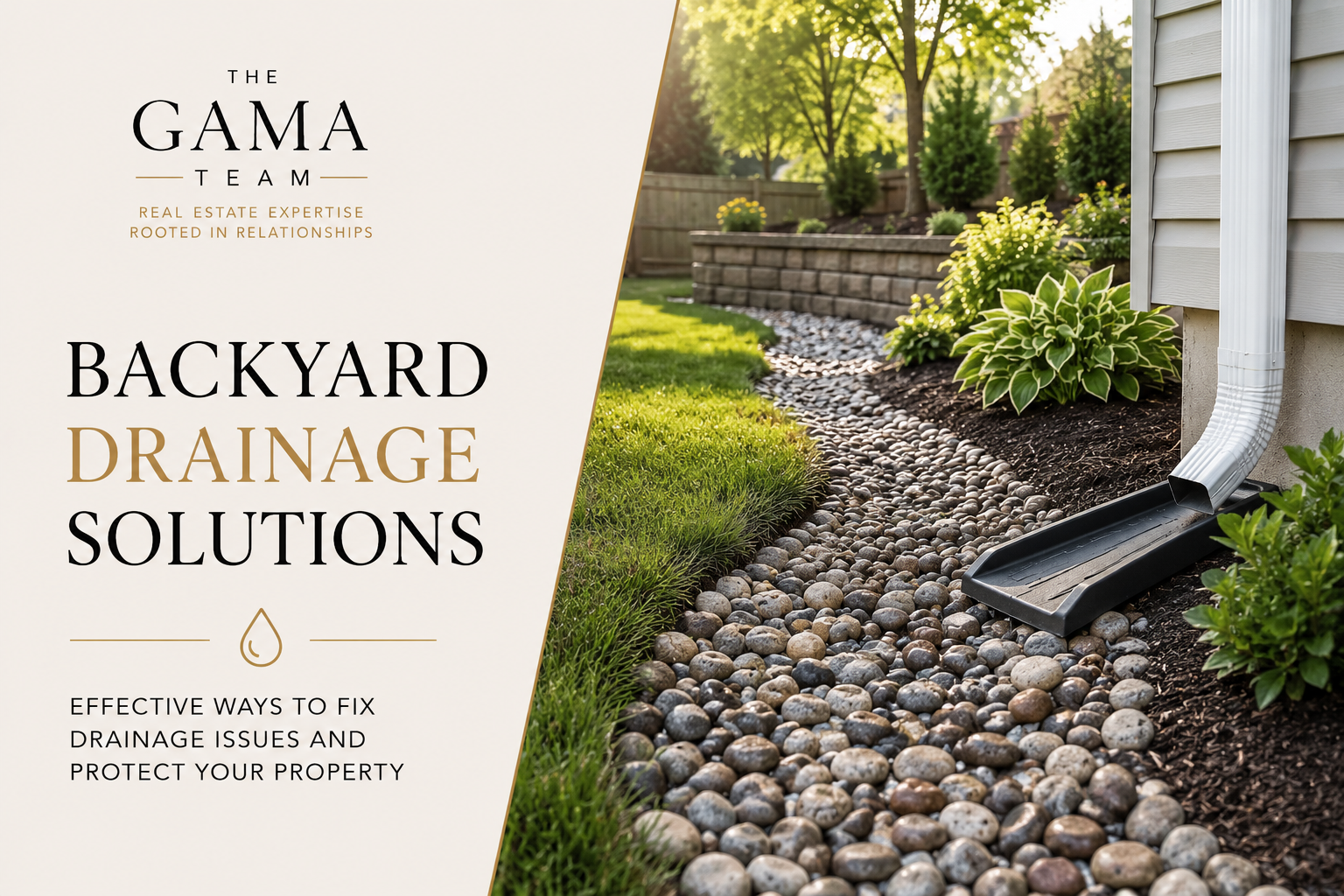
Why NJ backyards get wet, the real fixes (French drains, dry wells, grading, sump pumps), New Jersey's drainage laws and permits, and how it actually affects home value in Westfield, Cranford, Scotch Plains, Mountainside, Maplewood, Montclair, Basking Ridge, and New Providence.
Backyard Drainage Problems: Causes, Fixes, and How They Affect Home Value — The Complete Guide for Westfield, Cranford, Scotch Plains, Mountainside, Maplewood, Montclair, Basking Ridge, and New Providence
Why does my backyard stay wet after it rains, and how do I fix it? Most standing water comes down to one of a few fixable causes — poor grading, clogged or misdirected downspouts, compacted or clay-heavy soil, or a high water table — and the right fix depends entirely on correctly diagnosing which one you actually have, rather than guessing and digging.
"Water in the backyard scares people more than it should, but it's one of the most fixable things about a house if you catch it early and diagnose it correctly. The mistake is guessing at a solution instead of figuring out why it's actually happening," says Marina Fridman-Rybner of The GAMA Team. That's the idea this entire guide is built around. We see drainage come up constantly across Westfield, Cranford, Scotch Plains, Mountainside, Maplewood, Montclair, Basking Ridge, and New Providence — in pre-listing conversations with sellers who've lived with a wet corner of the yard for years and finally want to deal with it, and in buyer conversations about a low spot they noticed during a showing. It's rarely as scary as it looks, and it's almost never as simple as "just put in a French drain," which is the default answer a lot of homeowners reach for before actually figuring out what's causing the problem in the first place.
This guide walks through why yards in our specific part of New Jersey actually hold water, what each real fix does (and doesn't do), what a realistic project costs, the New Jersey legal rules that govern how your drainage work can affect your neighbor's property, the permits that can apply, and — the question underneath all of it — what a wet yard actually does to your home's value and what you're obligated to tell a buyer about it.
We're also going to cover the parts of this topic that tend to get skipped in a typical drainage company's blog post, because they're the parts that actually protect you as a homeowner rather than sell you a project: how to tell a simple fix from a genuinely complex one before you spend a dollar, what questions to ask any contractor before hiring them, how homeowners insurance actually treats this category of damage (less favorably than most people assume), and how this whole topic connects to the basement waterproofing conversation we've covered in a separate, dedicated guide. If you're dealing with a wet spot in your yard right now, or preparing to sell a home that has one, this is meant to be the single resource that answers the real question — not just "here's a French drain," but "here's how to figure out what you actually need, and what happens if you get it wrong."
Why Yards in Our Towns Actually Get Wet
Standing water after a rain almost always traces back to a small set of underlying causes, and it's worth understanding all of them, because the visible symptom — a puddle, a soggy lawn, a soggy basement corner — looks the same regardless of which one is actually responsible.
Clay-heavy and compacted soil. A lot of the older, established neighborhoods across our towns sit on soil with a meaningful clay component, and clay is dense, slow-draining material — water simply percolates through it far more slowly than it does through sandier or loamier soil. Compaction makes this worse: soil that's been driven over by construction equipment, walked on heavily over years, or compressed during a home's original construction loses the pore space that would otherwise let water soak in, effectively sealing the surface and forcing water to sit or run off rather than infiltrate.
Improper grading. The ground immediately around a foundation should slope away from the house — a commonly cited rule of thumb is a drop of roughly one to two inches for every ten feet moving away from the foundation. Where that slope is flat, reversed, or interrupted by a low spot, water has nowhere to go and simply collects, sometimes right up against the foundation itself, which is precisely the scenario that eventually leads to basement moisture and the kind of foundation issues we've covered in other guides.
Downspouts discharging too close to the house. This is, in our experience, the single most common and most fixable cause of what looks like a serious drainage problem. A roof sheds an enormous volume of water during even a moderate storm, and if that water is discharging directly at the foundation rather than being carried well away from it, it can saturate the surrounding soil and create exactly the kind of soggy, puddling conditions homeowners assume require a major excavation project to fix. The general guidance is to extend downspout discharge at least six to ten feet away from the foundation — a genuinely simple, low-cost intervention that resolves a surprising share of the "my yard is always wet near the house" complaints we hear.
Low spots and depressions. Sometimes a specific low point in the yard — from original construction grading, from years of settling, or simply from the property's natural topography — collects water with nowhere to drain, independent of any broader grading problem across the rest of the lot.
Missing drainage infrastructure entirely. Some lots, particularly larger or more irregularly shaped ones, simply don't have anywhere for water to go once it falls — no swale, no French drain, no catch basin, nothing to carry water off the property or into the ground in a controlled way. Water that has no built-in path just accumulates wherever gravity and the yard's natural shape happen to leave it.
A genuinely high water table. In some parts of our market — closer to the Rahway River corridor running through Cranford, for instance, an area we've covered in detail in our dedicated guide to Cranford's flood zones — groundwater sits naturally closer to the surface. When the water table itself is high, the soil has limited capacity to absorb additional rainfall regardless of how well it's graded or how far your downspouts extend, which is a meaningfully different (and generally more involved) problem than a grading or downspout issue on a lot with a normal water table.
Clogged or undersized gutters. Before a downspout even enters the picture, the gutters feeding it need to actually be functioning — a gutter packed with leaves and debris, particularly common under the mature tree canopy that characterizes a lot of our towns' older neighborhoods, can overflow along its entire length rather than channeling water to the downspout at all, effectively creating a curtain of water discharging directly along the foundation on the side of a clogged section. This is worth checking, and ruling out, before assuming a drainage problem requires anything more than a gutter cleaning and, if the gutters are older or consistently undersized for the roof's actual runoff volume, a possible upgrade.
Tree roots and landscaping changes. Mature trees can both help and hurt a drainage situation — root systems absorb meaningful volumes of water and can improve drainage in some conditions, but roots can also grow into and eventually crack or block existing drain lines, and a tree removed years after a French drain or other system was installed can change the local water table and soil absorption dynamics in ways that surface only gradually.
Changes on a neighboring property. Sometimes a drainage problem that didn't exist for years develops after a neighbor's landscaping project, addition, or regrading work changes how water moves across the shared property line — directly relevant to the New Jersey legal standard covered in detail later in this guide, and a useful thing to consider if a problem seems to have appeared suddenly rather than developed gradually.
A genuinely wetter New Jersey. This is a newer factor worth taking seriously rather than dismissing as an abstraction: New Jersey's own climate data shows a real, measurable shift in precipitation patterns. Annual precipitation has run roughly 3.7 inches above the long-term average over the 2005-through-2020 period, and the frequency of extreme, 2-inch-or-greater rainfall events ran about 50% above the long-term average during the 2010-through-2014 stretch specifically. Looking forward, state climate projections point to spring precipitation increasing by roughly 5 to 15 percent by mid-century, with northern New Jersey — where all eight of our towns sit — specifically projected toward the higher end of that range, at 10 to 15 percent. A drainage system that comfortably handled a normal storm a decade or two ago may simply be facing a meaningfully heavier volume of water today, independent of anything that's changed about the property itself, which is worth keeping in mind if a longstanding, previously adequate system has started falling behind in recent years.
Diagnose Before You Dig
Because several of these causes produce nearly identical symptoms — a wet lawn, a soggy low spot, water near the foundation after a storm — the single most important step in fixing a drainage problem is figuring out which one (or which combination) is actually responsible, before committing to a specific, often expensive fix. A homeowner who assumes the worst and installs a full French drain system to solve what was actually a simple downspout problem has spent thousands of dollars solving the wrong issue, while a homeowner who tries a cheap fix on a problem that's actually rooted in a high water table or serious grading failure will watch the water come right back.
A practical starting point costs nothing: watch what actually happens during and immediately after a real rainstorm. Where does the water pool first? Does it drain away within a few hours, or sit for a day or more? Is it concentrated near a specific downspout, or spread more generally across the yard? Does it track back to a single low point, or does the whole lot seem to hold water evenly? These direct observations, made over the course of one or two storms, often point clearly toward one of the causes above before you've spent a dollar on a contractor. For anything beyond an obvious downspout fix, a landscaper or drainage contractor who specifically diagnoses before proposing a solution — rather than one who shows up and immediately quotes a French drain system regardless of what's actually happening — is worth the extra step of finding.
A simple percolation test is another useful, low-cost diagnostic step worth knowing about: dig a hole roughly a foot deep in the problem area, fill it with water, and time how long it takes to drain. Soil that drains within a few hours has reasonable natural percolation capacity, which points toward solutions like a dry well or rain garden that rely on the soil actually absorbing redirected water. Soil that's still holding water after many hours, or overnight, signals genuinely poor percolation — dense clay, compaction, or a high water table — which points instead toward solutions that carry water away to a different discharge point entirely, rather than solutions that depend on the existing soil absorbing it. This one test, costing nothing but a shovel and some patience, can meaningfully narrow down which category of fix is actually likely to work on your specific property before you or a contractor commits to a specific approach.
The Fixes, One by One
Downspout Extensions
The simplest and often most effective first step: extending downspout discharge points well away from the foundation, either with a simple above-ground extension or, for a cleaner look, an underground burial system that routes the water through buried pipe to a discharge point elsewhere on the property. Simple extensions run roughly $5 to $25 each; an underground burial system, including trenching and a discharge basin, typically runs $150 to $350 per downspout. Given how often this single fix resolves what looked like a much bigger problem, it's the first thing worth trying before any larger excavation project.
Yard Regrading
When the underlying issue is the yard's actual slope — flat, reversed, or interrupted by a low spot — regrading physically reshapes the ground to restore a proper slope away from the foundation and toward an appropriate discharge point. A straightforward regrading project typically runs $500 to $3,000, scaling with the size of the area and how much soil actually needs to be moved. This is often paired with reseeding or new sod once the grading work is complete, since regrading necessarily disturbs the existing lawn surface.
Drainage Swales
A swale is a shallow, gently sloped channel — sometimes grass-covered, sometimes lined with stone — designed to guide surface water across a property toward an appropriate discharge point, working with the land's natural contours rather than burying pipe underground. Swales are a comparatively low-cost, low-maintenance option, typically running $5 to $15 per linear foot, or roughly $250 to $1,000 for a standard residential application, and they're often a good fit for a lot with a genuine, sustained flow of surface water across it (from a slope above the property, for instance) rather than a single isolated wet spot.
French Drains
A French drain is a trench filled with gravel surrounding a perforated pipe, buried beneath the surface, designed to intercept water moving through the soil and carry it to a controlled discharge point rather than letting it collect. This is the fix most homeowners think of first, and it's genuinely the right tool for a specific kind of problem — persistent subsurface water movement, often along a foundation wall or across a sloped section of yard — but it's also frequently proposed as a default solution even when a simpler fix would do. Exterior, shallow French drains typically run $10 to $35 per linear foot, or roughly $1,000 to $4,000 for a standard residential installation; interior perimeter drain systems (installed inside a basement, tied to a sump pump, addressing water that's already found its way into the foundation) run considerably more, typically $40 to $85 per linear foot or $4,000 to $15,000 total, reflecting the more invasive nature of that work.
Dry Wells
A dry well is an underground reservoir — anything from a simple gravel-filled pit to a prefabricated plastic chamber to a poured concrete structure — that collects water (often from a downspout or a French drain's discharge point) and allows it to slowly percolate into the surrounding soil rather than pooling on the surface or running off elsewhere. Costs vary widely by construction type: a basic gravel or loose-stone dry well runs roughly $50 to $250, a prefabricated plastic tank runs $200 to $700, and a poured concrete structure can run $500 to $3,000 or more, depending on size and site conditions. Dry wells work best in soil that has at least some natural percolation capacity; in genuinely dense clay soil or an area with a high water table, a dry well may struggle to actually absorb the volume of water directed into it.
Catch Basins and Storm Drains
A catch basin is a grated inlet, set at grade in a low spot or a hardscaped area, that collects surface water and routes it through underground piping to a discharge point, a dry well, or a municipal storm system where connection is permitted. Installation typically runs $8 to $15 per square foot of coverage area, with individual basin units themselves running $20 to $130 depending on size and material. Catch basins are particularly useful in hardscaped areas — patios, walkways, driveway aprons — where a swale or surface grading solution isn't practical because the surface itself is impervious.
Sump Pumps
For water that's already made it into a basement or crawl space rather than staying in the yard, a sump pump — installed in a basin at the lowest point of the foundation — actively pumps accumulated water out and away from the home rather than relying on gravity and grading alone. A standalone sump pump installation typically runs $500 to $1,200; combined with a full interior French drain perimeter system (the more comprehensive approach for a basement with a genuine, ongoing water intrusion problem), total project costs commonly run $4,000 to $15,000.
Rain Gardens
A rain garden is a shallow, planted depression — filled with soil amended for better absorption and native or water-tolerant plants — specifically designed to capture and slowly absorb runoff from a roof, driveway, or other hard surface, functioning as both a genuine drainage solution and a landscaping feature rather than a purely utilitarian buried system. DIY installation runs roughly $3 to $5 per square foot; professional installation, which typically includes proper percolation testing, soil amendment, and plant selection suited to your specific site conditions, runs $10 to $20 per square foot, with a typical 150-square-foot residential rain garden totaling $1,500 to $3,000 or more. Beyond the drainage function itself, a well-designed rain garden is one of the few fixes on this list that adds genuine landscaping value rather than being purely functional buried infrastructure — worth considering for a highly visible area of the yard where a purely utilitarian fix might otherwise detract from curb appeal.
Permeable Pavers and Porous Paving
For a driveway, patio, or walkway project specifically, choosing a permeable paving material over standard concrete or asphalt can meaningfully reduce how much runoff the hardscaped area generates in the first place, rather than requiring a separate system to manage water after the fact. Options range from plastic grid pavers ($5–$10 per square foot) and porous asphalt ($7–$15 per square foot) through concrete grid pavers ($6–$18 per square foot), pervious concrete ($8–$16 per square foot), and permeable interlocking pavers or natural stone with open joints (commonly $10 to $40 or more per square foot), with most residential permeable paving projects landing somewhere in the $10 to $30 per square foot range overall. This is also directly relevant to the impervious coverage and stormwater permit thresholds discussed later in this guide — a permeable surface, depending on your specific municipality's rules, may not count toward impervious coverage limits the same way standard paving does, which can be a meaningful consideration for a property already close to its allowable coverage.
Getting the Discharge Right Is Half the Job
"We see it constantly — someone installs a sump pump and runs the discharge line five feet from their own foundation, so the water just cycles right back to where it started. Where the water actually goes matters as much as getting it out of the basement," Marina notes, and this applies just as directly to every other fix described above, not just sump pumps specifically. A French drain, a downspout extension, or a dry well that discharges water too close to the foundation, or onto a neighbor's property, or somewhere it simply pools right back into the same problem area, hasn't actually solved anything — it's just relocated the water a few feet, often at real expense.
New Jersey sump pump discharge rules illustrate this well, and they're worth understanding specifically since sump pumps are one of the more common fixes homeowners install themselves or through a general contractor without necessarily knowing the applicable rules. Connecting a sump pump to a sanitary sewer line is generally prohibited across New Jersey municipalities — sanitary systems aren't designed to handle the volume of groundwater a sump pump can discharge, and overloading them creates real problems both for your own property and for the broader municipal system. The same generally holds for septic systems, which can be overwhelmed and damaged by sump pump discharge they weren't designed to handle. Discharge onto a street or sidewalk is commonly restricted as well, largely because of the winter icing hazard that pooled or flowing water creates on pavement, though the specific rule varies by municipality and by the type of road involved. The generally accepted approach: discharge onto your own lawn, mulch bed, or gravel area, positioned at least twenty feet from your foundation, never directly onto concrete or asphalt.
Because these rules are set and enforced at the municipal level rather than uniformly across the state, the specific requirements in Westfield, Cranford, Scotch Plains, Mountainside, Maplewood, Montclair, Basking Ridge, and New Providence can differ in their details, and it's worth confirming your specific town's rules — many maintain their own dedicated sump pump or stormwater ordinances — before finalizing where a new discharge line will run, rather than assuming a general rule of thumb from a different town applies uniformly here.
Yard Drainage vs. Basement Waterproofing: Related, But Different Problems
We've written a separate, dedicated guide to basement waterproofing in New Jersey, and it's worth being clear about how that topic relates to — and differs from — everything covered in this guide, since the two get conflated constantly and the right fix depends on understanding which problem you're actually facing.
Yard drainage, the focus of this guide, is fundamentally about managing water at and above the surface — keeping it from accumulating in the yard, redirecting it away from the foundation, and controlling where it ultimately goes once it falls on your property. Basement waterproofing addresses what happens once water has already reached, or penetrated, the foundation itself — sealing foundation walls, managing hydrostatic pressure against below-grade walls, and, for water that's already made it inside, managing it with interior systems like a sump pump and interior perimeter drain.
The two are deeply connected in practice: a functioning exterior yard drainage system is often the single best form of basement waterproofing available, since keeping water away from the foundation in the first place reduces or eliminates the pressure and moisture that would otherwise force its way through basement walls. A homeowner dealing with a genuinely wet basement should generally start by asking whether the underlying yard drainage is doing its job — poor grading, discharging downspouts, or a missing swale are common root causes of basement moisture that a purely interior fix (a sump pump alone, for instance) manages the symptom of without addressing the cause. That said, some basement water issues stem from below-grade conditions (a high water table pressing against foundation walls, or a foundation crack) that no amount of surface-level yard drainage work can fully resolve on its own, which is exactly the more involved territory our basement waterproofing guide covers in detail.
New Jersey's Legal Rule for Drainage Between Neighbors
This is a genuinely important piece of this topic that most drainage guides skip entirely, and it matters directly to anyone doing meaningful grading or drainage work on their own property: New Jersey follows what's known as the "reasonable use rule" for surface water disputes between neighboring landowners, established by the New Jersey Supreme Court in the 1956 case Armstrong v. Francis Corp. and reaffirmed as recently as the Appellate Division's 2013 decision in Gourley v. Township of Monroe.
Under this rule, a property owner is generally permitted to make reasonable use of their own land — including work that alters how surface water flows across it — even if that work causes some incidental harm to a neighbor's property. The key legal question isn't whether your project changed water flow at all (almost any grading or landscaping work does, to some degree), but whether the interference it caused crosses the line into "unreasonable." Courts weigh factors like the necessity and reasonableness of the work performed, the amount and character of harm caused, and whether less harmful alternatives were reasonably available.
A distinction worth understanding clearly: New Jersey's approach generally does not hold a homeowner responsible simply for the property's natural, pre-existing drainage pattern — if water has always flowed from your yard toward a neighbor's lower-lying property due to natural topography, that's generally not something you're liable for. The legal exposure arises specifically from affirmative changes you make — adding impervious surface like a patio or driveway that increases runoff volume, installing a drainage pipe or French drain that concentrates and redirects water toward a specific discharge point, or regrading in a way that measurably worsens conditions on a neighboring property. In those situations, if the change is found to unreasonably increase the burden on a neighbor, real liability can attach, including responsibility for resulting property damage.
The practical takeaway for anyone planning a meaningful drainage or grading project: think through, and ideally discuss with a professional (and sometimes directly with an affected neighbor) where the water you're redirecting is actually going to end up, not just whether it's successfully leaving your own property. A project that solves your wet yard by reliably flooding the yard next door isn't just a bad-neighbor move — it's a real legal exposure under New Jersey's own established case law.
If You're the One Being Flooded
The reasonable use rule cuts both directions, and it's worth understanding your own position if you're the one dealing with water arriving from a neighbor's property rather than the one doing the redirecting. The same Armstrong standard applies: you'd generally need to show that your neighbor's specific changes to their property — not the natural, pre-existing topography — caused an unreasonable increase in the water reaching yours, and that the harm you've experienced is a real, demonstrable consequence of those changes rather than a general, hard-to-attribute increase in yard wetness.
In practice, this means documentation matters enormously if you ever find yourself in this position: photos and notes on when a problem started relative to any known changes on the neighboring property (a new patio, a regrading project, a downspout redirected toward the property line), and, ideally, a professional assessment connecting the specific change to the specific harm you're experiencing. As the Lieberman Blecher firm's guidance on this exact topic notes, the recommended path is to attempt an amicable resolution first — a direct conversation, sometimes with photos and a clear explanation of the impact, resolves more of these situations than most homeowners expect — and to involve a land use attorney when that informal approach doesn't produce results, rather than escalating immediately to litigation over what may, after a conversation, turn out to be a solvable problem.
Permits: When Your Project Needs Sign-Off
A meaningful share of drainage fixes — a downspout extension, a modest regrading project, a small dry well — don't trigger any permit requirement at all in most of our towns. But it's worth understanding where the lines actually are, because larger projects, or projects that add impervious surface as part of a broader renovation, can trigger real regulatory requirements under both state and local rules.
The NJDEP Stormwater Threshold
New Jersey's statewide stormwater management rules, administered by the Department of Environmental Protection, define a "major development" trigger that pulls a project into a much more involved regulatory process. As adopted through municipal ordinances across our region (Westfield's own Chapter 38 stormwater ordinance is a representative example), major development generally includes projects disturbing one acre or more of land, or creating a quarter-acre (roughly 10,890 square feet) or more of new impervious surface. For context, that's a genuinely large addition — well beyond the scope of a typical patio, driveway extension, or pool deck project for most residential lots in our towns, which means the great majority of homeowner-scale drainage and hardscaping projects fall comfortably under this threshold and outside the full stormwater management review process.
There's also a specific, narrower exemption worth knowing about: construction of a single individual single-family dwelling is generally exempt from certain stormwater runoff quality standards, provided any associated motor vehicle surface (a driveway, for instance) uses permeable materials like gravel, dirt, or shells, and the project isn't part of a larger, already-approved development.
If a project does cross the major development threshold — a substantial addition with significant new impervious coverage, for instance — it triggers a considerably more involved process: a formal stormwater management plan demonstrating compliance with groundwater recharge standards (generally maintaining pre-construction recharge volume or infiltrating the runoff increase from a 2-year storm), water quality standards (removing 80% of total suspended solids from a defined design storm), and quantity control standards (managing peak runoff rates across 2-year, 10-year, and 100-year storm events), typically incorporating green infrastructure like permeable pavement, bioretention basins, rain gardens, or infiltration basins designed to the state's official Stormwater Best Management Practices Manual.
Local Grading and Soils Permits
Separate from the state stormwater threshold, many of our towns maintain their own local permit requirements specifically for soil disturbance and grading work, independent of whether a project triggers the state's major-development threshold. Westfield, for instance, maintains a dedicated soils and grading permit application process through its engineering department — a useful, concrete example of the kind of town-specific requirement that can apply to a drainage project well below the scale that would trigger NJDEP's own major-development review. Because these local requirements vary by municipality and can be triggered by factors as specific as the volume of soil moved or the project's proximity to a property line, it's worth checking directly with your specific town's construction or engineering office before starting any grading work beyond routine landscaping — a call that costs nothing and can prevent a genuinely costly problem if unpermitted grading work later needs to be explained during a home sale.
Impervious Coverage Limits
Separate from stormwater and grading permits specifically, most of our towns also maintain zoning-based impervious coverage limits — a maximum percentage of your lot that can be covered by driveways, patios, walkways, pools, and the building itself combined, tracked through a coverage calculation worksheet at the time of any permitted addition. This is a genuinely easy thing to lose track of on an older property that's accumulated a patio here, a shed there, and a driveway expansion at some point over the decades — worth confirming your current calculated coverage against your specific town's limit before planning a new hardscaping or drainage project that would add to it, since exceeding your allowable coverage can require a zoning variance, an entirely separate and more involved approval process from anything covered above.
Westfield's own approach illustrates this well: the town maintains a specific Building Coverage and Improvement Coverage Calculation Worksheet, used to track a property's cumulative coverage against its zoning limit at the time of any new permitted addition. This kind of documented, worksheet-based tracking is exactly why a buyer evaluating a property with a history of additions — a deck added in one decade, a patio in another, a pool more recently — should ask directly whether the current cumulative coverage is properly documented and within the town's allowable limit, since an undocumented or over-limit condition can complicate a future homeowner's own plans for further improvements, even if it caused no issue for the seller who never attempted an additional project after reaching that limit.
For anyone planning a project that adds meaningful impervious surface specifically to address a drainage problem — a new patio incorporating a catch basin, for instance — it's worth having this coverage conversation with your town's zoning office at the same time as the drainage-specific permit questions, since the two considerations are often relevant to the exact same project and are more efficiently resolved together than in separate, sequential conversations.
DIY vs. Professional: What's Reasonable to Take On Yourself
Not every fix on this list requires a licensed contractor, and it's worth knowing where the reasonable line actually sits, since overhiring for a simple problem wastes money just as reliably as undertaking a project beyond your actual skill level creates new ones.
Reasonable for most homeowners to tackle directly: downspout extensions (both simple above-ground versions and, with basic tools and some patience, an underground burial run), gutter cleaning and minor gutter repairs, and small-scale regrading of an isolated low spot using topsoil and basic hand tools. These are low-risk, low-cost interventions where a mistake is easy to correct and the potential downside of getting it slightly wrong is minimal.
Worth strongly considering a professional for: any French drain installation (getting the slope, depth, and fabric wrapping correct matters enormously to whether the system actually functions long-term, and it's genuinely difficult to verify your own work is correct without experience), any project affecting a significant portion of your yard's overall grading (getting this wrong can worsen the problem or create a new one, including the neighbor-liability exposure discussed above), dry wells and catch basins (both require an accurate understanding of your soil's actual percolation rate, which isn't something most homeowners can assess reliably on their own), and anything involving connection to or work near an existing sump pump system or foundation drain.
Always a licensed professional, no exceptions: any project that might trigger a local grading or stormwater permit, as covered in detail below — not because a homeowner couldn't physically do the work, but because unpermitted work creates the exact resale and liability problems discussed throughout this guide, and a licensed contractor is generally the one pulling and closing out the permit as a standard part of the job.
A useful middle-ground approach for a homeowner comfortable with basic yard work but uncertain about a more involved project: hire a professional for the diagnostic assessment and design of the fix, then handle the actual physical installation yourself if it's within your skill level, rather than treating "hire a professional" as an all-or-nothing decision. Many landscape and drainage contractors are willing to provide a paid consultation and a clear plan without requiring you to also hire them for the installation itself — worth asking about directly if budget is a genuine constraint but you still want a properly diagnosed, correctly designed solution before you start digging.
Choosing a Contractor: What to Actually Ask
Given how often a drainage contractor's first instinct is to propose the most involved (and most expensive) fix available, it's worth arming yourself with a specific set of questions before hiring anyone for a project beyond the simple, DIY-appropriate fixes described above.
Ask them to explain the actual cause before proposing a solution. A contractor who walks your property, asks about when and where water appears, and explains their specific theory of what's causing it — before quoting a fix — is giving you the diagnostic process this guide has emphasized throughout. A contractor who arrives, glances at the yard, and immediately quotes a full French drain system without much discussion of the underlying cause is a reasonable signal to get a second opinion.
Ask specifically where the water will discharge to. As covered above, this is the detail that separates a genuine fix from one that simply relocates the problem — get a specific, concrete answer, not a vague assurance that the water will be "directed away."
Ask whether the project requires a permit, and who's responsible for pulling it. A contractor experienced in your specific municipality should know this immediately; hesitation or uncertainty on this question is worth taking seriously, especially given how directly it affects your resale position down the line.
Ask about warranty and expected lifespan. French drains, dry wells, and similar systems can clog or fail over time, particularly if not properly maintained (French drain fabric can become clogged with fine sediment over years, for instance) — a contractor should be able to speak to expected system lifespan and what maintenance, if any, is recommended.
Get more than one estimate for anything beyond a simple downspout fix. Given how much proposed solutions can vary — and how much cost varies with them — a second opinion is genuinely worth the modest time investment for any project in the thousand-dollar-plus range.
Ask for references from similar projects, not just general residential work. A contractor with a strong general landscaping or excavation reputation isn't automatically the right choice for a drainage-specific diagnosis and fix — ask specifically about comparable drainage projects they've completed, ideally on a similar soil type or in a similar older-home context to your own property, rather than assuming general experience translates directly.
Is This a Simple Fix or a Real Problem?
"Most of what we see is solvable with a downspout extension or some regrading, not a full French drain system. Get an actual diagnosis before anyone starts digging up the yard," says Galina Kaplan of The GAMA Team — a genuinely useful filter for thinking through your own situation before committing to a specific project or contractor's proposal.
Signs that point toward a simpler fix: the wet area is concentrated near a specific downspout; the water drains away within several hours rather than sitting for a day or more; the problem is limited to a specific, identifiable low spot rather than spread across the whole property; and there's no visible sign of water intrusion into the basement or foundation itself.
Signs that point toward a more involved problem, warranting a fuller professional assessment: water that sits for a day or longer after a storm across a broad area; visible water intrusion into a basement or crawl space; a consistently wet area even during dry stretches (a signal of a genuinely high water table rather than surface runoff); or a problem that's worsened noticeably over time despite no obvious change to the property, which can sometimes indicate a shifting grading issue, a failing existing drainage component, or a change in a neighboring property that's redirecting more water onto yours than it used to.
Planning Drainage Into a Pool, Patio, or Addition From the Start
A meaningful share of the drainage problems we see aren't longstanding issues at all — they're new problems created by a recent addition, pool installation, or hardscaping project that didn't account for where the water displaced by the new impervious surface or structure would actually go. This is worth addressing directly, because it's one of the more preventable categories of drainage problem covered in this entire guide.
Any project that adds a meaningful amount of impervious surface — a pool deck, a patio, an addition's footprint, a widened driveway — necessarily changes how water moves across your property, even if the project falls well under the state stormwater thresholds discussed below. Water that used to soak into that specific patch of lawn now runs off instead, and it has to go somewhere. A well-planned project accounts for this from the design stage: incorporating a catch basin into a new patio's low corner, directing a pool's backwash and deck runoff to an appropriate discharge point rather than letting it sheet toward a neighboring property, or choosing a permeable paving material specifically to minimize the added runoff in the first place, as discussed above.
The mistake we see most often here isn't a lack of awareness that drainage matters — it's treating it as an afterthought, addressed (if at all) only after the new patio or pool is already generating a problem that wasn't there before. If you're planning any project that will meaningfully increase your property's impervious coverage, raising the drainage question directly with your contractor or landscape designer at the planning stage, rather than after installation, is one of the most cost-effective things you can do in this entire category — solving the problem in the design phase costs a fraction of what it costs to retrofit a fix after the fact, and avoids the neighbor-relations and liability exposure discussed in detail above.
What a Home Inspector Actually Looks For
If you're selling a home with any history of drainage concerns, it's worth understanding what a buyer's home inspector is specifically trained to look for, since this shapes what you should proactively address or be ready to discuss before that inspection happens. A qualified inspector will typically check for grading sloping toward rather than away from the foundation, visible efflorescence or staining on foundation walls (a sign of past water intrusion even if the area is currently dry), gutters and downspouts in poor condition or discharging too close to the foundation, visible erosion or standing water anywhere on the property at the time of inspection, and a musty odor or elevated moisture readings in a basement or crawl space.
An inspector flagging any of these isn't necessarily a transaction-ending finding — as this guide has emphasized throughout, most of what gets flagged in this category has a straightforward, moderately priced fix. But a flagged item does typically become a negotiating point, whether that's a request for a credit, a request that the seller complete a specific repair before closing, or, in some cases, a request for a more specialized inspection (from a structural engineer or waterproofing specialist) if the initial inspector's findings suggest something more involved than a simple grading or downspout issue. Sellers who've already diagnosed and either fixed or clearly documented a known issue tend to navigate this stage of a transaction considerably more smoothly than sellers encountering the question for the first time during a buyer's inspection.
Timing Drainage Work Around the Seasons
As we've covered in detail in our broader guide to timing a home sale, seasonality affects far more than just when to list a house — it affects when drainage work itself is practical and most effective to schedule. Late summer and early fall, after the heaviest storm season has typically passed but while the ground is still workable and warm enough for new grass seed or sod to establish before winter, tends to be an ideal window for regrading, French drain installation, or dry well projects. Spring, while tempting given how visibly wet problem areas often are right after snowmelt and spring rains, can actually be a more difficult season for excavation-heavy projects, since saturated soil is harder to work with and regrading work performed on oversaturated ground doesn't always compact and settle as reliably as work done on drier soil. If you're planning a project specifically to have it completed and settled before listing your home, working backward from your target listing date with your contractor's own seasonal scheduling constraints in mind is worth factoring into your timeline planning well in advance.
Does a Wet Yard Actually Affect Home Value?
This is the question underneath everything else in this guide, and the honest answer requires separating two related but distinct issues: what a drainage problem does to a buyer's perception during a sale, and what New Jersey law requires you to tell them about it.
On perception, the evidence is more anecdotal than statistically precise — we're not aware of a rigorous, published study quantifying an exact price impact the way some other home features have been studied, and we'd rather tell you that honestly than invent a number to make this section feel more authoritative. What we can say with confidence, based on what we see in actual transactions: visible signs of drainage trouble — standing water, moss or algae growth in a chronically damp area, erosion channels cut into a slope, a musty basement smell during a showing — register immediately and negatively with buyers, often out of proportion to the actual cost of fixing the underlying issue. A problem that might cost $800 to resolve with a downspout extension can, left unaddressed and visible during a showing, generate buyer anxiety (and negotiating leverage) far beyond that actual repair cost, simply because an unexplained wet spot invites a buyer's imagination to assume the worst-case, most expensive explanation rather than the most likely, simplest one.
This asymmetry — a modest actual repair cost versus a much larger perceived risk — is really the central economic dynamic of this entire topic, and it's worth internalizing as the practical lesson underneath all the technical detail in this guide. The dollar value at stake in most backyard drainage situations isn't really about the cost of the fix itself, which, as covered throughout this guide, is usually modest. It's about whether that cost gets resolved calmly and transparently before or during a transaction, or whether it gets discovered late, unexplained, and filtered through a buyer's understandable but often exaggerated worst-case assumptions.
"If you know about a drainage issue, you need to disclose it. We'd rather a seller fix it or be upfront about it than have it surface during a buyer's inspection and become a much bigger conversation," Galina Kaplan notes, and this reflects the same broader New Jersey disclosure principle we've covered in detail in our guide to death-in-home and other material-fact disclosures: New Jersey doesn't operate on a pure "buyer beware" standard when a seller has actual knowledge of a material defect. A known, chronic drainage problem — one you've dealt with for years, patched informally, or simply learned to work around — is exactly the kind of fact a seller's silence about can create real legal exposure over, independent of whether New Jersey's standard disclosure form specifically asks about it in those exact words.
What Buyers Actually Notice
"If you're touring a home and you see moss, erosion, or a low spot that's clearly held water recently, ask directly. It doesn't mean walk away — it means find out if it's a downspout problem or something bigger before you fall in love with the house," Marina advises, and it's worth buyers in our market taking this seriously as a practical showing checklist rather than a source of anxiety.
Specific things worth a direct question during a showing or a formal inspection: visible erosion channels or bare, washed-out soil, particularly on a slope; moss, algae, or unusually lush, dark green grass growth concentrated in one area (often a sign of chronically wet soil); efflorescence (a white, chalky mineral deposit) on foundation walls, a classic sign of water having moved through the concrete or masonry at some point; a musty or damp smell in a basement, even without visible standing water; and downspouts that discharge directly at the foundation with no visible extension. None of these, on their own, are automatic disqualifiers — as this guide has covered in detail, most drainage issues are genuinely fixable, often inexpensively — but they're worth a direct, specific question to the listing agent or seller rather than a silent assumption in either direction.
Does Homeowners Insurance Cover Drainage-Related Water Damage?
This is a genuinely important question worth understanding before you're relying on insurance to cover a drainage-related problem, because the answer is less reassuring than most homeowners assume. Standard homeowners insurance policies generally distinguish between sudden, accidental water damage (a burst pipe, for instance) and damage resulting from gradual seepage, ongoing maintenance neglect, or surface water and flooding — and drainage-related water intrusion frequently falls into the categories a standard policy excludes rather than covers.
Surface water and flooding are, in most standard homeowners policies, specifically excluded, which is why a separate flood insurance policy exists as its own distinct product for homeowners in flood-prone areas (a topic we've covered in detail in our dedicated guide to Cranford's flood zones). Water that backs up through a sewer or drain line, or that enters through a foundation due to hydrostatic pressure from saturated soil, is also commonly excluded from a standard policy unless you've specifically added a water backup or sump pump failure endorsement — a genuinely worthwhile, relatively inexpensive addition for any homeowner relying on a sump pump as part of their overall water management system. And damage attributed to a gradual, longstanding condition — the kind of chronic, known drainage issue this guide has discussed throughout — is generally treated by insurers as a maintenance issue the homeowner was responsible for addressing, not a covered loss, which is one more reason diagnosing and fixing a known problem promptly matters beyond the resale considerations covered elsewhere in this guide.
The practical takeaway: don't assume your standard homeowners policy will cover damage from a drainage problem you already know about, and call your insurer directly to understand your specific coverage — including whether a water backup endorsement makes sense for your situation — rather than discovering the gap in coverage only after a claim has already been denied.
Should You Fix It Before You List?
"If you know you have a drainage issue and you're planning to sell, fix it before you list if you can. A credit at closing works, but a buyer's imagination about how bad it might be is almost always worse than the actual fix," Galina Kaplan says, and the reasoning behind this advice is worth spelling out.
A seller who fixes a known drainage issue before listing controls the narrative entirely: the problem is resolved, there's nothing to disclose beyond the fact that a fix was made (which, handled well, can actually read as a positive — evidence of a well-maintained home rather than a red flag), and there's no negotiation to have over it during the transaction. A seller who instead offers a closing credit in lieu of fixing the issue is, in effect, asking every prospective buyer to individually estimate the cost and hassle of a fix they haven't personally researched — and buyers, working from limited information and a healthy dose of caution, tend to estimate on the high side, particularly for anything involving water and a foundation. The gap between what a fix might actually cost (often, as covered throughout this guide, a few hundred to a few thousand dollars for the most common causes) and what an anxious buyer imagines it might cost is real, and it's a gap that tends to work against the seller in negotiation.
This isn't a universal rule — a seller without the cash or time to complete a fix before listing may reasonably choose the credit route, and a buyer with their own contractor relationships may genuinely prefer to handle the work themselves rather than trust a seller's chosen contractor. But when the choice is genuinely available, fixing a known, well-understood issue before listing tends to produce a smoother, more confident transaction than leaving it as an open question for a buyer to price in on their own.
A Worked Example: What a Realistic Project Actually Costs
Numbers spread across a dozen different fixes are useful individually, but it's worth putting together a realistic composite example, since most actual drainage projects combine more than one element rather than relying on a single isolated fix.
Consider a fairly typical scenario: a homeowner has a chronically soggy back corner of the yard, traced through the diagnostic process described earlier in this guide to two contributing causes — a downspout discharging too close to the house, and a broader grading issue across roughly 400 square feet of lawn that's flattened out over decades of settling. The fix combines an underground downspout extension ($250), regrading the affected area ($1,400), and a small dry well at the new discharge point to help the redirected water actually absorb into the soil rather than simply relocating the puddle ($400 for a prefabricated plastic unit plus installation labor), landing at a total project cost of roughly $2,050 to $2,500 depending on labor rates and site access. Compare that to what the same homeowner might have spent defaulting straight to a full French drain system without first diagnosing the actual cause — potentially $3,000 to $4,000 or more for a fix that, in this specific case, wasn't actually necessary to solve the underlying problem.
This is the exact dynamic this guide has emphasized from the start: the diagnostic step isn't a formality, it's frequently the difference between a two-thousand-dollar project and a much larger one, solving the same actual problem either way.
Common Mistakes We See
Guessing at the cause instead of diagnosing it. As covered throughout this guide, the most expensive mistake in this entire category is installing an expensive fix (a full French drain system, most commonly) for a problem that was actually a simple downspout or grading issue, or vice versa — attempting a cheap fix on a problem rooted in a genuinely high water table or serious grading failure that needed a more comprehensive solution.
Discharging water somewhere that just brings it right back. As Marina's quote above illustrates directly, a fix that moves water a few feet without actually routing it away from the problem area — or, worse, onto a neighbor's property — hasn't solved anything and can create new legal and relationship problems on top of the original drainage issue.
Skipping a permit check on a project that actually needed one. While most homeowner-scale drainage projects fall well under New Jersey's state stormwater threshold, local grading permit requirements vary and can apply to smaller projects than homeowners assume, particularly work involving a meaningful volume of soil movement or work near a property line.
Losing track of accumulated impervious coverage over the years. A patio added a decade ago, a driveway widened five years ago, and a new shed last year can, combined, push a property over its zoning coverage limit without any single project having felt like a major undertaking at the time — worth checking your total calculated coverage before planning the next addition.
Treating a wet yard as a reason to panic rather than a reason to diagnose. As this guide has tried to make clear throughout, the overwhelming majority of backyard drainage issues in our market are genuinely fixable, often for a modest cost — the anxiety a wet spot generates is frequently disproportionate to the actual scope of the underlying problem.
Adding impervious surface without planning where the displaced water will go. As covered in detail above, a new patio, pool deck, or driveway expansion that doesn't account for its own added runoff is one of the most common ways homeowners create a brand-new drainage problem that didn't exist before the project, rather than solving an existing one.
Hiring based on price alone for anything beyond a simple fix. Given how much proposed solutions and their underlying diagnoses can vary between contractors, as covered above, the cheapest quote for a poorly diagnosed problem is rarely actually the cheapest path to an effective, lasting fix.
Common Misconceptions Worth Correcting
A handful of assumptions come up often enough in our conversations with clients that they're worth addressing directly, in plain terms.
The belief that a wet backyard automatically means a serious foundation problem is generally incorrect. As this guide has emphasized throughout, the overwhelming majority of yard drainage issues trace back to a simple, moderately priced cause — a downspout, a grading issue, a clogged gutter — and jumping to the worst-case assumption before an actual diagnosis often leads to overspending on an unnecessary fix.
The belief that any drainage work you do on your own property is automatically your own business, with no legal exposure to a neighbor, is also incorrect, as covered in detail above — New Jersey's reasonable use rule creates real liability for drainage changes that unreasonably harm a neighboring property, independent of whether the work happens entirely within your own property lines.
The belief that a French drain is the universal, default fix for any yard drainage complaint is incorrect as well. It's the right tool for a specific kind of problem — persistent subsurface water movement — and a genuinely poor, expensive fit for problems actually rooted in a simple downspout or grading issue that a much cheaper intervention would resolve just as effectively.
And the belief that installing a sump pump solves a wet yard is a common but mistaken conflation of two different problems: a sump pump manages water that's already made it inside a foundation, which is a genuinely different (and generally later-stage) problem than surface water sitting in a backyard that hasn't reached the house at all. Installing a sump pump doesn't address an outdoor drainage problem, and outdoor drainage work doesn't require or automatically include a sump pump — they're separate interventions for separate stages of the same broader water-management picture, as covered in the basement waterproofing comparison earlier in this guide.
Town-by-Town: A Few Local Notes
Cranford, given its position along the Rahway River corridor and the flood zone considerations we've covered in detail in a dedicated guide, is a town where distinguishing an ordinary yard drainage issue from a genuine flood-zone-related water concern matters more than in most of our other towns — the fixes and the disclosure obligations can differ meaningfully depending on which one you're actually dealing with.
Westfield, Scotch Plains, Mountainside, and New Providence, all sharing generally similar Union County soil and topography conditions, tend to see the same core set of causes described throughout this guide — clay-heavy soil, older housing stock with original grading that's settled or shifted over decades, and downspout-related issues in particular given how many homes in these towns feature mature landscaping that's grown up around original downspout placements never updated since construction.
Basking Ridge, with its generally larger lots, is a market where more involved drainage projects — a longer French drain run, a larger swale system managing water across a bigger property — are more common than in our denser, smaller-lot towns, simply because there's more land and more distance for water to travel before reaching a home.
Maplewood and Montclair, both featuring a meaningful share of older, pre-war housing stock, are towns where original construction-era grading is more likely to have settled or shifted significantly over the decades since the home was built, making a professional grading assessment a genuinely useful step for any buyer evaluating an older home in either town, independent of whether any visible drainage problem is apparent during a showing. Both towns' more established tree canopies also make the gutter-maintenance cause described earlier in this guide worth checking first before assuming a more involved problem.
Across all eight of our towns, it's worth remembering that municipal rules genuinely differ — a soils permit threshold, a sump pump discharge rule, or an impervious coverage limit that applies in Westfield won't necessarily match the specific numbers in Cranford or Basking Ridge, even though the underlying causes and fixes described throughout this guide are broadly consistent across our entire market. Confirming your specific town's current rules directly, rather than assuming a neighboring town's requirements apply uniformly, is a small step that avoids real complications later.
Worked Scenarios From Our Market
A Westfield Seller Who Fixed a Downspout Before Listing
A Westfield seller notices a chronically soggy patch near one corner of the house and initially assumes it signals a serious foundation problem. A quick diagnostic conversation with a landscaper reveals the cause: a downspout discharging directly at the foundation with no extension. A $200 underground downspout extension resolves the issue entirely within one season, and the seller lists with nothing to disclose beyond routine, well-documented maintenance.
A Cranford Buyer Who Asked the Right Questions
A buyer touring a Cranford home near the Rahway River corridor notices erosion along a side yard slope and asks directly whether it's related to river flooding or a separate, ordinary drainage issue. The seller's agent clarifies it's a longstanding surface-water erosion problem unrelated to the river's flood zone, provides documentation of a prior regrading estimate, and the buyer proceeds with the purchase, factoring a modest regrading cost into their own post-closing plans rather than treating it as a deal-breaking unknown.
A Basking Ridge Homeowner Who Needed the Real Fix
A Basking Ridge homeowner on a large, sloped lot tries a simple downspout extension to address water pooling near a detached garage, but the problem persists because the underlying cause is actually surface water traveling across the property from a higher elevation elsewhere on the lot. A professional assessment recommends a swale system to intercept and redirect that broader flow, resolving a problem the initial, simpler fix was never actually capable of solving.
A Montclair Seller Navigating a Neighbor Dispute
A Montclair homeowner planning a patio addition discusses the project with a neighbor concerned about water runoff, given the neighbor's own history of yard flooding. Rather than proceeding without addressing the concern, the homeowner's contractor incorporates a dry well into the design specifically to manage the patio's added runoff on-site, avoiding both a strained neighbor relationship and the kind of reasonable-use liability exposure described earlier in this guide.
A Scotch Plains Buyer Who Priced In a Known Issue
A Scotch Plains buyer evaluating a home with a disclosed, longstanding wet spot in the backyard requests a contractor estimate before finalizing their offer, learns the fix is a straightforward $1,500 regrading project, and negotiates a modest credit at closing to cover it — a clean resolution that worked specifically because the issue was disclosed clearly and priced accurately, rather than left as an ambiguous concern.
A Mountainside Homeowner Who Solved It With a Gutter Cleaning
A Mountainside homeowner, alarmed by water discharging along an entire section of their foundation during storms, initially requests a quote for a full French drain system. Before proceeding, their contractor checks the gutters first and finds them packed with debris from the property's mature tree cover, causing exactly the kind of overflow-along-the-length problem described earlier in this guide. A single gutter cleaning and minor repair resolves the issue entirely, at a fraction of the French drain quote's cost.
A New Providence Family Planning a Pool With Drainage in Mind
A New Providence family planning a new in-ground pool works with their contractor from the design stage to route the pool deck's runoff and backwash discharge to a dedicated dry well positioned well away from both their own foundation and the property line shared with their neighbor. The upfront planning adds a modest cost to the overall pool project, but avoids the far more expensive and contentious retrofit — and the neighbor dispute — that a reactive fix after the fact might have required.
A Basking Ridge Seller Who Documented a Known Issue Clearly
A Basking Ridge seller with a known, longstanding wet area on a sloped part of their large lot obtains a professional contractor estimate for a swale system before listing, and includes that documentation directly in their disclosure materials rather than waiting for a buyer to raise the issue independently. Buyers touring the home see a clearly diagnosed problem with a specific, reasonable price tag attached, rather than an ambiguous concern left to their own imagination — and the home sells without the issue becoming a significant point of renegotiation.
A Glossary of Terms Used in This Guide
French drain — A gravel-filled trench containing a perforated pipe, buried to intercept and redirect subsurface water flow to a controlled discharge point.
Dry well — An underground reservoir that collects water and allows it to gradually percolate into surrounding soil, ranging from a simple gravel pit to a prefabricated or poured structure.
Swale — A shallow, sloped channel that guides surface water across a property toward an appropriate discharge point, working with the land's natural contours.
Catch basin — A grated surface inlet that collects water and routes it through underground piping to a discharge point or drainage system.
Reasonable use rule — New Jersey's legal standard, established in Armstrong v. Francis Corp. (1956), governing liability for surface water drainage disputes between neighboring landowners.
Major development — The New Jersey stormwater management threshold (generally one acre of land disturbance or a quarter-acre of new impervious surface) that triggers full state stormwater management plan requirements.
Impervious coverage — The percentage of a lot covered by buildings, driveways, patios, and other surfaces that prevent water from soaking into the ground, typically subject to a maximum limit under local zoning.
Soils/grading permit — A local municipal permit, separate from state stormwater requirements, that can apply to projects involving soil disturbance or grading changes.
Water table — The upper level of groundwater saturation beneath a property's surface; a naturally high water table limits how much additional rainfall the soil can absorb regardless of surface grading.
Efflorescence — A white, chalky mineral deposit on foundation walls, often a visible sign of water having moved through concrete or masonry.
Percolation (perc) rate — The speed at which soil absorbs water, a key factor in determining whether a dry well, rain garden, or similar infiltration-based fix will function effectively on a given property.
Hydrostatic pressure — The pressure exerted by water saturated in the soil against a foundation wall, a common cause of basement water intrusion distinct from surface drainage issues.
Green infrastructure — Drainage approaches that use natural or semi-natural processes (permeable pavement, rain gardens, bioretention basins) to manage stormwater, as opposed to conventional buried pipe and concrete systems.
Water backup endorsement — An optional addition to a standard homeowners insurance policy covering damage from water backing up through a sewer or drain line, or from sump pump failure, not covered by a standard policy.
Reasonable use standard — The specific legal test New Jersey courts apply under the reasonable use rule, weighing the necessity and reasonableness of a landowner's actions against the harm caused to a neighboring property.
Bioretention basin — A landscaped, engineered depression designed to collect and filter stormwater runoff before it infiltrates into the ground or is released to a controlled discharge point, commonly used to satisfy NJDEP green infrastructure requirements on larger projects.
Work With a Team That Diagnoses Before It Reacts
Water in a backyard is one of the most common things we help clients think through, on both sides of a transaction, across Westfield, Cranford, Scotch Plains, Mountainside, Maplewood, Montclair, Basking Ridge, and New Providence — and it's also one of the areas where we see the most unnecessary anxiety, and occasionally the most unnecessary money spent solving the wrong problem. Whether you're a seller trying to figure out if a longstanding wet spot needs a professional fix or a quick downspout adjustment, or a buyer trying to understand whether what you noticed during a showing is a minor detail or a real concern, we'd rather help you get an accurate diagnosis than either dismiss it or panic about it.
We also think this topic is a good example of something worth saying plainly: a lot of what feels overwhelming about owning or buying a home in our market isn't actually complicated once someone walks you through it clearly. A wet patch of lawn, a downspout in the wrong place, a permit question — these are solvable, well-understood problems with well-understood answers, not mysteries. Our job, as much as anything else we do, is making sure you have that clarity before you spend money, sign a contract, or lose sleep over something that turns out to have a straightforward fix.
Reach out to The GAMA Team at Corcoran Sawyer Smith, 52a Elm Street, Westfield, NJ, or call or text 908-379-0525, or connect through thegamateam.com, and let's talk through what you're actually seeing in your yard, and what it does and doesn't mean for your specific situation.
Marina Fridman-Rybner & Galina Kaplan The GAMA Team | Corcoran New Jersey Real Estate | Home Sellers | Home Buyers | NYC to NJ Relocation
This article is intended for general informational purposes and reflects our understanding of New Jersey's reasonable use rule under Armstrong v. Francis Corp. and Gourley v. Township of Monroe, NJDEP stormwater management regulations, representative municipal ordinances including Westfield's Chapter 38, and general drainage industry cost and practice information, as of September 2026. It is not legal, engineering, or contracting advice. Municipal permit requirements, coverage limits, and applicable ordinances vary by town and change over time; confirm current requirements directly with your municipal construction and engineering offices, and consult a licensed drainage contractor, landscape engineer, or attorney for guidance specific to your property before making decisions based on this guide.
Sources
- Why Does My Yard Hold Water After It Rains? — Muthler Landscaping
- How Much Does a Drainage System Cost? — HomeGuide
- New Jersey Court Reaffirms "Reasonable Use Rule" — National Law Review
- Stormwater Drainage in New Jersey Causes Increasing Issues Between Neighbors — Lieberman Blecher & Sinkevich
- Chapter 38: Stormwater Management — Town of Westfield, NJ
- Application for Soils/Grading Permit — Town of Westfield, NJ
- Sump Pump Discharge Laws & Regulations in NJ — Blue Umbrella Waterproofing
- How Drainage Impacts Property Value and Home Inspections — Drainage Masters
Check out this article next