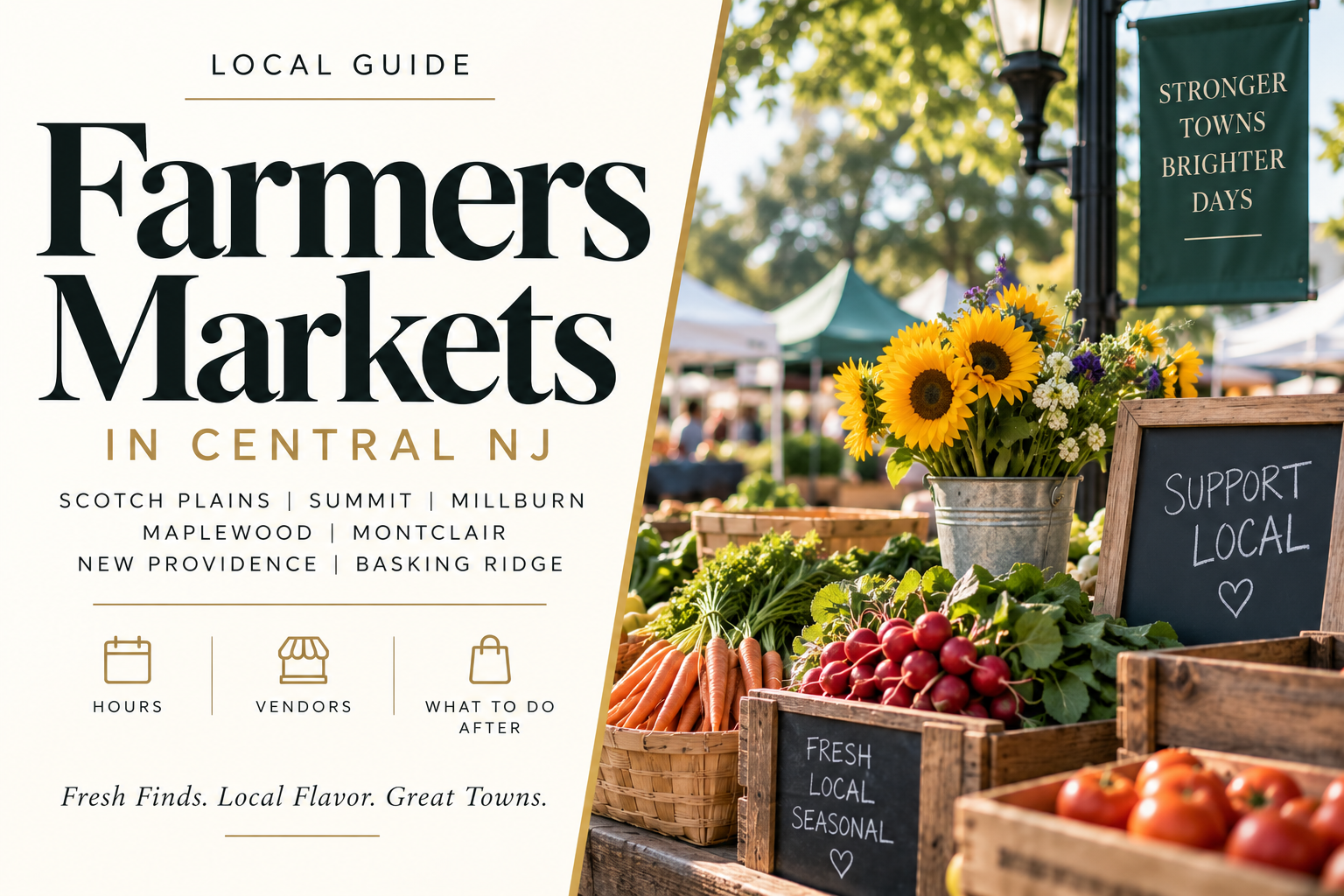
A complete guide to farmers markets in Scotch Plains, Summit, Millburn, Maplewood, Montclair, New Providence, and Basking Ridge — hours, vendors, and what to do after.
The Complete Guide to Farmers Markets Near Westfield and Cranford: Scotch Plains, Summit, Millburn, Maplewood, Montclair, New Providence, and Basking Ridge
Does Westfield or Cranford have its own farmers market? No — despite what a few outdated online directories still claim, neither town currently runs one. What both towns do have is genuinely excellent options minutes away: Scotch Plains runs one of the most established markets in the area on Saturdays, Summit runs a genuinely massive Sunday market with more than 70 vendors, and Millburn, Maplewood, Montclair, New Providence, and Basking Ridge (by way of neighboring Bernardsville) round out a real weekly circuit that a Westfield or Cranford household can realistically build a routine around without much of a drive at all.
We put this guide together because we get some version of "is there a farmers market near us" constantly from clients — both from families already living in Westfield, Cranford, Scotch Plains, Mountainside, Maplewood, Montclair, Basking Ridge, and New Providence, and from buyers relocating in who are trying to picture what a normal Saturday actually looks like here. The honest answer turned out to be more specific than a lot of general online guides suggest: Westfield and Cranford, our own home base towns, don't run their own weekly markets, but a genuinely strong cluster of markets in the towns immediately around them means the actual answer to "is there a good farmers market nearby" is an easy yes, just not inside either town's own borders. This guide walks through every market actually worth knowing about within a short drive of our core coverage towns — exact location, hours, season, who's actually selling there, and, because a farmers market trip rarely needs to be the whole outing, what's worth doing in that town's downtown once you've got your tomatoes and your flowers in the trunk.
Why Shop at a Farmers Market in the First Place?
Before getting into the town-by-town detail, it's worth being specific about what you're actually getting for the extra ten or fifteen minutes a farmers market trip takes compared to a supermarket run, because the benefits are more concrete than "it's nice to support local."
The Produce Is Genuinely Fresher
Produce sold at a farmers market has typically traveled a few miles to tens of miles from the field to the folding table in front of you, picked at or near peak ripeness within the last day or two — compared to supermarket produce, which is frequently picked before full ripeness specifically so it survives a multi-day-to-multi-week supply chain, then artificially ripened after the fact. This isn't just a taste difference, though the taste difference is real and immediately noticeable in something like a July tomato or August peach; produce also loses measurable nutritional value with every day that passes after harvest, meaning a shorter farm-to-table window generally means more of the vitamins and nutrients actually made it to your plate.
You're Genuinely Supporting New Jersey's Working Farms
New Jersey earns the nickname "the Garden State" honestly — the state's Jersey Fresh program, run through the New Jersey Department of Agriculture, exists specifically to promote and support the state's roughly 9,000-plus farms, and buying directly from a farmer at a market like the ones covered in this guide sends essentially all of your dollar to that farm, compared to a supermarket supply chain where a farmer typically captures a meaningfully smaller share of what you actually pay at the register. For a lot of the small and mid-size farms supplying markets in Scotch Plains, Summit, and Montclair specifically — many of them family operations in Hunterdon, Somerset, Warren, and Burlington counties that have been farming the same land for generations — that direct-to-consumer revenue is a genuinely meaningful part of what keeps working farmland in New Jersey actually working, rather than getting sold off for development.
Lower Food Miles, a Real Environmental Benefit
Because farmers market produce travels such a short distance compared to supermarket produce sourced from California, Mexico, Chile, or further, the actual transportation footprint — fuel burned, refrigeration required in transit — is meaningfully smaller. This is a real, if modest, environmental benefit that scales with how much of your household's produce shopping happens locally rather than through a long national or international supply chain.
Better Value During Peak Season
This one surprises people who assume "local and fresh" automatically means "expensive." During true peak season for a given crop — Jersey corn and tomatoes in mid-to-late summer are the classic example — a farmer selling directly at a market is often pricing genuinely competitively with, or below, supermarket pricing for the same item, because peak-season local abundance is exactly when a crop is cheapest to grow and harvest. The value proposition flips for anything out of season, which is exactly why the seasonal produce calendar later in this guide is worth keeping in mind — buying what's actually in season, rather than trying to find January tomatoes at a farmers market, is where both the flavor and the price genuinely work in your favor.
Your Purchase Genuinely Helps Keep Working Farmland From Becoming the Next Subdivision
New Jersey runs one of the oldest and most active farmland preservation programs in the country, and it exists specifically because the state's dense population and high land values put constant, real development pressure on the working farms that still supply markets like the ones in this guide. A farm that can't turn a reliable profit selling its crops is a farm considerably more likely to eventually sell to a developer instead — meaning every dollar spent directly with a farmer at a Saturday or Sunday morning market is, in a very real sense, a small vote for that specific parcel of New Jersey farmland staying farmland for another season, rather than becoming the next subdivision or shopping center. This is part of why state and county farmland preservation officials, and the farms themselves, consistently point to direct-market sales like these as a meaningful piece of what keeps New Jersey's remaining agricultural land economically viable.
A Genuine Direct Relationship With the Person Who Grew Your Food
There's a real, if less quantifiable, benefit to being able to ask the actual grower how something was raised, when it was picked, or how to cook an unfamiliar vegetable — a conversation a supermarket produce aisle simply can't offer. For families teaching kids where food actually comes from, this is one of the more genuinely educational, low-effort outings available on a weekend morning, and several of the markets covered in this guide run kid-specific programming for exactly this reason.
Access Programs Make Markets More Affordable Than Many Families Expect
A number of New Jersey farmers markets, including several covered in this guide, participate in nutrition assistance programs — SNAP benefits, and the New Jersey WIC and Senior Farmers Market Nutrition Programs, which provide vouchers redeemable specifically for fresh, New Jersey–grown produce at participating markets. New Providence's market, for instance, explicitly accepts SNAP, WIC, and senior nutrition program payments. This is a genuinely underused benefit worth knowing about if you or someone in your household qualifies, and it's part of why several of the markets in this guide describe themselves explicitly as community food-access initiatives, not simply a weekly shopping event for households who'd be shopping well regardless.
A Real, Low-Key Community Gathering
Practically every market covered in this guide doubles as a genuine social event — neighbors running into each other, a local Scout troop or school group with a table, live music at several markets, a dog or two tied up outside the coffee stand. It's a fundamentally different weekly rhythm than a supermarket trip, and for a lot of the families we work with, that's a real, if intangible, part of why they build their weekend morning around it.
A Genuine Hedge Against Grocery Price Swings
Supermarket produce pricing is exposed to national and international supply chain disruption — a poor growing season in California, a shipping delay, a fuel price spike — in a way that a farmer selling their own crop, grown a short drive from the market table, generally isn't. This doesn't mean farmers market prices never move, but the specific volatility drivers are different, and a household that shifts a meaningful share of its produce spending to what's actually in season locally often finds its own grocery bill somewhat more stable and predictable across a full year than one relying entirely on a supermarket's year-round, globally sourced produce section.
You'll Find Varieties a Supermarket Will Never Carry
Supermarket produce is bred and selected, in large part, for how well it ships and how long it sits on a shelf — which is exactly why a supermarket tomato so often tastes like very little at all. A small farm selling directly at a market has no such constraint, and it shows: heirloom tomato varieties in a dozen colors and shapes, unusual heirloom apple varieties that never make it into a grocery chain's standardized supply contract, specialty peppers, and regionally specific produce that simply isn't grown at the scale a national supermarket chain requires. For anyone who cooks seriously, or who simply wants to actually taste the difference between a "tomato" and a specific, well-grown variety of one, this is one of the most immediate, tangible benefits a farmers market offers over a standard grocery run.
A Legitimately Pleasant Reason to Get Outside and Walk
This is a modest point, but a real one: every market in this guide is an outdoor, walkable event, set in a parking lot or a town center rather than under fluorescent supermarket lighting. Stringing a market visit together with a walk through a downtown, as the "things to do after" sections throughout this guide cover in detail, turns a routine errand into a genuine, if small, piece of weekly outdoor activity — easy to underrate, and easy to actually stick with specifically because it doesn't feel like exercise for its own sake.
A Short History of Why New Jersey Takes Its Farmers Markets Seriously
It's worth understanding why this specific corner of the country supports the density and quality of markets covered in this guide, rather than treating it as a coincidence. New Jersey has carried the nickname "the Garden State" since the nineteenth century, when the state's proximity to the enormous populations of New York City and Philadelphia made it genuinely profitable for farmers here to grow perishable fruits and vegetables specifically for those nearby urban markets — a geographic advantage that, in a real sense, still defines the state's agricultural identity today. Even as suburban development consumed a substantial share of New Jersey's historic farmland over the twentieth century, the state retains a genuinely significant working agricultural base, particularly in Hunterdon, Warren, Burlington, Salem, Gloucester, and Cumberland counties, alongside smaller-scale operations much closer to the towns covered in this guide.
The Jersey Fresh program itself launched in 1984, making it one of the earliest and most successful state-level agricultural branding efforts in the country — a model several other states have since copied — specifically to help New Jersey farms compete against larger-scale, lower-cost agricultural regions by building consumer recognition and loyalty around the freshness and quality advantage a nearby farm genuinely offers a nearby customer. The farmers markets covered throughout this guide are, in a very direct sense, the retail expression of that same idea: a farm within a reasonable drive of Scotch Plains, Summit, or Montclair selling directly to the people who live in and around these towns, cutting out the multi-step distribution chain that separates most Americans from the actual source of their produce.
Montclair's market, having launched in 1993, was part of a genuine early wave of New Jersey municipalities establishing dedicated weekly markets, well ahead of the broader national farmers market boom of the 2000s and 2010s — and most of the other markets covered in this guide followed in the years after, as the model proved itself both economically viable for participating farms and genuinely popular with residents. Today, New Jersey supports several hundred farmers markets statewide during peak season, and the markets covered in this guide represent a genuinely dense, high-quality cluster within a relatively small geographic footprint — a real amenity worth factoring into how you think about daily life in this area, not simply a pleasant weekend option, even in the two towns that don't happen to run one of their own.
It's also worth understanding that most of these markets are run by a nonprofit, a downtown business association, or a volunteer community organization rather than a for-profit operator — Summit's market, organized through Summit Downtown, and Maplewood's township-run market are both direct examples. That structure matters practically: it means these markets tend to reinvest vendor fees back into the market's own operation and local programming rather than extracting profit, and it means the specific mix of vendors, hours, and even the market's continued existence depends genuinely on local volunteer effort and municipal or business-district support, not a corporate franchise model that would run the exact same way regardless of which town it's in. Every one of the markets covered in this guide is, in that sense, a genuinely homegrown institution specific to its own town, not an interchangeable franchise of a single regional brand.
At a Glance: Every Market's Day, Hours, and Season
| Town | Day | Hours | Season | Location |
|---|---|---|---|---|
| Scotch Plains | Saturday | 8:00 a.m.–1:00 p.m. | Early May–November | 430 Park Avenue municipal lot |
| Summit | Sunday | 8:00 a.m.–1:00 p.m. | April 19–December 20 | Park & Shop Lot #1, DeForest & Woodland Ave. |
| Millburn | Friday | 8:00 a.m.–3:00 p.m. | June–October | Essex Street at Town Hall |
| Maplewood | Monday | 2:00 p.m.–7:00 p.m. | June 1–November 23 | 1662 Springfield Avenue, at Vermont St. |
| Montclair | Saturday | 8:00 a.m.–1:00 p.m. (summer) / 9:00 a.m.–1:00 p.m. (winter) | Year-round | 86 Walnut Street, Walnut Street train station |
| New Providence | Wednesday | 12:00 p.m.–6:00 p.m. | June–October | 360 Elkwood Avenue |
| Basking Ridge / Bernardsville | Saturday | 9:00 a.m.–1:00 p.m. | June–November | Olcott Square area, Bernardsville (closest option to Basking Ridge) |
| Mountainside | Daily (farm stand, not a weekly market) | Mon–Sat 9 a.m.–6 p.m., Sun 9 a.m.–5 p.m. | April–December | Prince's Farm Stand, 1123 Mountain Avenue |
| Westfield | — | Westfield does not currently run its own market | — | Nearest options: Scotch Plains (Sat.) or Summit (Sun.), both a short drive away |
| Cranford | — | Cranford does not currently run its own market | — | Nearest options: Scotch Plains (Sat.) or Summit (Sun.), both a short drive away |
Days, hours, and season dates are set independently by each market's organizers and can shift year to year — confirm current details directly with the market before planning a trip, especially early or late in the season. Several general online directories still list markets in Westfield and Cranford that are no longer active; we've relied on direct, current sources for every market in this guide.
Scotch Plains: Saturdays With the Area's Widest Vendor Roster
Scotch Plains' farmers market runs every Saturday, 8:00 a.m. to 1:00 p.m., opening in early May and running through November — genuinely one of the longest seasons in this guide — set up in the municipal parking lot at 430 Park Avenue, and it's the closest, most convenient regular market for most Westfield and Cranford households, a short, easy drive from either downtown.
What's There
Scotch Plains publishes one of the more detailed vendor rosters of any market in our coverage area, and it's worth naming specifically because it shows just how much variety a single Saturday morning here can offer: Asprocolas Acres for fresh fruits, vegetables, and flowers from a family-owned farm; Backiel's Lithuanian Bakery, a three-generation family bakery out of Elizabeth turning out artisan breads and cakes; Bang Cookies, hand-rolled small-batch cookies; Cherry Grove Organic Farm, certified organic since 2002; Corner-Copia, New Jersey farm-fresh produce out of East Windsor; Ester's Treats, an organic, all-natural, mostly vegan bakery out of Springfield; a dedicated Gourmet Nuts & Dried Fruits vendor with custom trays; Happy Bite, French macarons; Stefan's Pure Blends, handmade pierogi and naturally smoked kielbasa; Mia's Lemonade Stand, run by a young local entrepreneur; Ort Farms, seasonal produce and plants out of Long Valley; Patricia & Paul Artisans, extra virgin olive oil and balsamics; Pickle Licious, pickles, olives, and hummus; Stella's Empanadas, Argentine empanadas and grilled meats; and Tassot Apiaries, raw, chemical-free honey and bee products. That's a genuinely wide spread — Eastern European bakery alongside Argentine street food alongside a kid-run lemonade stand — and it's part of why Scotch Plains' market has developed a real reputation as a destination beyond its own residents, Westfield and Cranford households very much included.
Things to Do in Scotch Plains After
Scotch Plains' downtown along Park Avenue is a short walk from the municipal lot, with a solid concentration of restaurants and shops worth exploring once you're done at the market. If you're looking to extend the morning further, Scotch Plains is also home to Shady Rest Golf and Country Club — the historic nine-hole public course we've covered in detail elsewhere as the first Black-owned country club in America, with an adjacent mini golf course, priced at just $4 a person, that's a genuinely easy, low-cost add-on for a family with kids, particularly once the weather warms into late spring and summer. A Saturday that starts with the farmers market and ends with nine holes or a round of mini golf at Shady Rest is about as full and as affordable a family morning as this entire coverage area offers.
Golf-minded visitors might also simply drive past Shackamaxon Country Club, the private Tillinghast-designed club we've profiled separately — its resort-style pool complex and its famous island-green eighteenth hole are worth a look even without a membership, as a nice bookend to a market morning. And because Scotch Plains' season is one of the longest in this guide, running from early May all the way through November, it's genuinely one of the more reliable options for a Westfield or Cranford household trying to build a consistent Saturday routine around a single nearby market.
Summit: A Sunday Market With Over 70 Vendors
Summit's farmers market is, by vendor count alone, the largest market covered in this guide — it runs every Sunday, 8:00 a.m. to 1:00 p.m., from April 19 through December 20, rain or shine, in Park & Shop Lot #1, at the corner of DeForest Avenue and Woodland Avenue in downtown Summit, with vehicle entrance off DeForest Avenue. Organized through Summit Downtown, the town's downtown business association, the market's roughly eight-month season is genuinely one of the longest of any market in this guide, meaningfully outlasting the June-through-October window most nearby towns run on.
What's There
Summit's market features more than 70 New Jersey-based vendors, a scale that puts it in a genuinely different category from most of the other markets in this guide. On the produce and farm side: Vacchiano Farm, WoodsEdge Farm, Zell's Farm, Cherry Grove Organic Farm, and Phillips Farms. For beverages: Ahrre's Coffee Roastery, Jersey Spirits, 3br Distillery, and Beach Bee Meadery. Prepared foods run from Paolo's Kitchen and Pizza Vita to Crepes Chantal, Oldwick Soup Company, and Pesto Joe's. Baked goods come from Anita's Baked Wonders, Brownie Points Bakery, and Chana's Challah Haven. Specialty vendors include Luxx Chocolat, Holly Jolly Jams, Pickle Licious, Karma Krackers, and Love 4 Nuts, alongside artisan and craft vendors like Made with Clay and Cecilia Hill Floral Design. The market also runs a genuinely notable community program, G.I.F.T., which collects donated food for local families in need — reportedly more than 13,000 pounds annually — directly through market vendors and shoppers, making a Summit market trip a genuinely easy way to contribute to a real local food-access effort without any extra errand required.
Things to Do in Summit After
Because the market sits in a downtown parking lot right off DeForest Avenue, it's an easy walk into the rest of Summit's genuinely substantial downtown — one of the larger, more restaurant- and retail-dense downtowns of any town covered in this guide, reflecting Summit's own scale relative to some of its smaller neighbors. Summit's downtown sits close to its NJ Transit Midtown Direct train station, making it realistic to combine a Sunday market visit with a broader downtown morning of coffee, breakfast, and browsing without needing to move the car at all. Given the market's long season, running from mid-April through late December, it's also one of the few markets in this guide realistically visitable across three full seasons — a spring visit for the first asparagus and strawberries, a summer visit at peak tomato and corn season, and a December visit for holiday baking ingredients and gifts from the market's artisan vendors, all without needing to switch to a different town's market as the calendar turns.
Millburn: A Friday Market in a Classic Downtown
Millburn's Jersey Fresh Farmers Market runs Fridays, 8:00 a.m. to 3:00 p.m., from June through October, set up on Essex Street at Town Hall — a genuinely convenient, central downtown location that puts the market a short walk from the rest of Millburn's own compact business district.
What's There
As a Jersey Fresh–affiliated market, Millburn's lineup draws on the same statewide network of certified New Jersey growers and producers that supplies several of the other markets in this guide, with a core focus on fresh, locally sourced produce alongside a rotating selection of specialty and prepared-food vendors. Millburn's Friday timing — spanning the morning into mid-afternoon — makes it a genuinely useful option for anyone with a flexible weekday schedule, retirees, or a household planning a Friday-evening dinner around whatever's freshest that day.
Things to Do in Millburn After
Millburn's downtown is a classic, walkable small-town business district, and a Friday market visit pairs naturally with lunch or an early dinner at one of the town's restaurants once you're finished browsing. Millburn is also home to Short Hills, and the broader Millburn Township area offers easy access to the South Mountain Reservation for anyone looking to extend the outing with a walk or a hike after finishing at the market — a genuinely pleasant way to spend a Friday for anyone with a flexible schedule that day. We've also written separately about the Short Hills Fairy Trail, a genuinely charming nearby day-trip destination worth combining with a Millburn market visit if you're making a fuller outing of it.
Maplewood: A Monday Evening Market in the Village
Maplewood's market is the one genuine scheduling outlier in this guide — it runs Monday afternoons and evenings, 2:00 p.m. to 7:00 p.m., from June 1 through November 23, at 1662 Springfield Avenue, at the corner of Springfield Avenue and Vermont Street near the Springfield Gazebo, rain or shine.
What's There
Maplewood's market has run in some form since the mid-1990s, originally established by the Springfield Avenue Partnership and now operated as a township initiative, and its primary produce supplier is Stony Hill Farms, supplemented by a genuinely broad rotating cast of specialty vendors — grab-and-go dinners (a real advantage of the market's after-work Monday timing, letting commuters pick up a ready meal on the way home rather than needing to cook), craft beer, candles, locally made breads, soaps, and pickles among them.
Things to Do in Maplewood Village After
Because the market sits directly in Maplewood Village — the same walkable downtown core we've written about in the context of ongoing redevelopment near the "movie theater block" — a Monday-evening market trip pairs naturally with an early dinner out, rather than the brunch-and-browse pattern that fits a weekend-morning market better. Maplewood Village's restaurant scene is genuinely strong for a town this size, and because the market runs into the early evening, it's easy to time a stroll through the shops and a sit-down dinner around your market stop rather than treating it as a separate errand entirely.
This is also one of the more genuinely useful markets in this guide for a two-income household: because it runs after the typical workday ends, it's realistic to actually stop on the way home rather than needing to carve out a separate weekend morning the way Scotch Plains' or Summit's markets require. Pick up one of the market's grab-and-go dinners directly, or gather ingredients from Stony Hill Farms' produce table and a bakery stand for a meal you'll actually cook that same night — either way, Maplewood's scheduling is genuinely built around a working household's realistic week rather than assuming a free weekend morning the way most of the other markets in this guide do. If you have a bit more time, Maplewood Memorial Park is a short distance from the Village and worth a stop for anyone looking to stretch their legs before or after dinner.
Montclair: The Area's Longest-Running, Nearly Year-Round Market
Montclair's farmers market is the elder statesman of this guide by a wide margin — it launched in 1993, making it one of the earliest farmers markets established anywhere in New Jersey, and it's the only market in this guide that runs essentially year-round: every Saturday, with summer hours (roughly June through November) of 8:00 a.m. to 1:00 p.m. shifting to winter hours (December through May) of 9:00 a.m. to 1:00 p.m. The market sets up at 86 Walnut Street, at Montclair's Walnut Street NJ Transit station.
What's There
More than three decades of operation have made Montclair's market a genuinely significant regional draw, described by organizers as pulling thousands of visitors annually — a scale meaningfully larger than most of the other markets in this guide, rivaled only by Summit's. The lineup covers fresh fruits and vegetables, meats, poultry, fish, cheeses, prepared foods, baked goods, condiments, honey, flowers, wine, and pickles, essentially a full weekly grocery run rather than a produce-only supplement, and the market runs its own nutrition assistance programming supporting New Jersey families and farmers alike — consistent with the access-program benefits covered earlier in this guide.
Things to Do in Montclair After
The Walnut Street station sits in Montclair's northern end, near the Watchung Plaza shopping and restaurant district — a smaller, more residential commercial strip than Montclair's larger Bloomfield Avenue and Church Street core downtown, and a genuinely pleasant, low-key place to grab a coffee or browse a few shops right near the market itself. If you've got more time, it's a short drive south to Montclair's larger downtown entertainment district, home to the Wellmont Theater and the Montclair Art Museum, both worth combining with a market morning if you're making a fuller day of it — particularly given that Montclair's market, unlike most others in this guide, is genuinely available as a year-round anchor for a weekend routine rather than a summer-only outing.
Because Montclair's market runs every single Saturday of the year, it's worth thinking about differently than the seasonal markets covered elsewhere in this guide — rather than a summer ritual, it can genuinely function as a household's regular weekly produce stop, supplemented rather than replaced by supermarket shopping the rest of the week. Winter visitors should specifically note the later 9:00 a.m. start time compared to the 8:00 a.m. summer opening, and should expect a smaller, more limited vendor lineup during the colder months, leaning more heavily on root vegetables, storage crops, and prepared and baked goods than the height-of-summer produce table.
New Providence: A Wednesday Afternoon Market
New Providence's Central Farmers Market runs Wednesdays, 12:00 p.m. to 6:00 p.m., from June through October, at 360 Elkwood Avenue, organized through the New Providence Business & Professional Association — the only weekday-afternoon market in this guide besides Millburn's, making it a genuinely useful option for a household whose weekends are already spoken for.
What's There
As a smaller borough market, New Providence's lineup skews toward core farm-fresh produce and a handful of specialty vendors rather than the seventy-plus roster Summit can support — but that smaller scale also makes it one of the easier, lower-friction markets in this guide to pop into for twenty minutes without it becoming a full outing, which for a lot of working households is exactly the point. The market explicitly accepts SNAP, WIC, and Senior Farmers Market Nutrition Program payments, consistent with the access-program benefits covered earlier in this guide.
Things to Do in New Providence After
New Providence's downtown, centered around South Street and Springfield Avenue, is a compact, easy walk from most points in the borough, with a solid, if modest, cluster of restaurants and everyday shops worth a stop on a Wednesday evening. Given the market's afternoon-into-evening hours, it pairs naturally with picking up dinner downtown rather than needing a separate errand for the meal — a genuinely practical, weekday version of the market-to-downtown pairing that defines most of the other towns in this guide on weekends instead.
New Providence sits directly on the Gladstone Branch of NJ Transit's Morris & Essex Lines, a detail we've covered in depth in our companion commuting guide to the Basking Ridge and New Providence area — meaning a household using this market is very often also the kind of household commuting into the city on that same line, and a Wednesday market stop genuinely fits into a working commuter's realistic week in a way a weekend-only market can't.
Basking Ridge: No Market of Its Own, But Bernardsville's Is Minutes Away
This is worth being direct about, because it's exactly the kind of specific, honest detail a generic regional guide won't tell you: Basking Ridge (Bernards Township) does not currently run its own dedicated weekly farmers market. The closest genuine option is the Bernardsville Farmers Market, in the adjacent downtown just a few minutes' drive away, running Saturdays, 9:00 a.m. to 1:00 p.m., from roughly early June through November, generally set up in the Olcott Square area of Bernardsville's compact, historic downtown.
What's There
Bernardsville's market runs a solid, representative regional lineup — produce, cheeses, baked goods, and specialty vendors typical of a well-established Somerset Hills-area market — in a genuinely charming, historic downtown setting that's worth the short drive on its own merits, independent of the market itself. Basking Ridge households have a couple of other reasonably close options too, including markets in Bridgewater (Sundays, June through October) and Bedminster (starting in late May), both a bit further afield but well within a reasonable weekend drive for anyone willing to make a small loop of it.
Things to Do in Basking Ridge and Bernardsville
Even without its own market, Basking Ridge's own historic village green — anchored by Oak Street's cluster of shops and restaurants, and the Ross-era history we've touched on in other guides to the area — is a genuinely pleasant destination in its own right, worth combining with a Bernardsville market run as a two-town loop rather than a single stop. Bernardsville's own downtown, compact and walkable around Olcott Square, has a solid concentration of restaurants and shops worth exploring once you've finished at the market, making the short drive feel like part of the outing rather than simply a commute to get groceries.
Mountainside: A Daily Farm Stand Instead of a Weekly Market
Mountainside is the other genuine exception in this guide, and again, worth being straightforward about: the borough doesn't host its own weekly farmers market either, but it does have something arguably even more convenient for a household that wants fresh, local produce on a flexible schedule — Prince's Farm Stand, at 1123 Mountain Avenue, open essentially every day from April through December (Monday through Saturday, 9:00 a.m. to 6:00 p.m.; Sunday, 9:00 a.m. to 5:00 p.m.), directly across from Echo Lake Park.
What's There
Prince's runs as a genuine farm stand rather than a rotating multi-vendor market, offering Jersey-fresh fruits and vegetables, local honey, jams and preserves, fruit pies and quiches, high-quality milk, eggs, and cheeses, freshly baked breads, and, seasonally, hanging baskets, potted plants, and flowers — everything a household would want from a weekly farmers market trip, just available on a daily rather than once-a-week schedule, which is a genuine practical advantage if your schedule doesn't reliably line up with a single fixed market morning.
Things to Do in Mountainside After
Because Prince's sits directly across from Echo Lake Park, this is one of the easiest, most natural market-to-outing pairings in this entire guide: grab your produce, then walk the park's trails, let the kids loose on the playground, or simply find a bench and enjoy the setting before heading home. Mountainside itself is a more purely residential town without a dense downtown retail strip of its own, so for a fuller morning or afternoon out, it's a short drive into either Westfield's Elm Street downtown or over toward Echo Lake Country Club's neighborhood, both covered in more detail elsewhere in our local guides.
What About Westfield and Cranford Themselves?
Since these are the two towns where we spend the most time, and where a lot of our own clients live, it's worth addressing this directly rather than simply listing them as having "no market" and moving on.
Neither Westfield nor Cranford currently runs its own weekly farmers market, despite a handful of older online directories, aggregator sites, and outdated social media pages still listing one for each town — exactly the kind of stale information this guide is meant to correct. For Westfield and Cranford households, the realistic, honest answer is that the best market experience is a short drive away rather than a walk from downtown: Scotch Plains' Saturday market, covered in detail above, is the closest full-scale option for most of both towns, and Summit's Sunday market, with its genuinely exceptional 70-plus vendor roster, is worth the slightly longer drive for anyone willing to make a morning of it.
This isn't a knock on either town — Westfield's and Cranford's own downtowns remain genuinely excellent destinations in their own right, covered in detail in our other local guides, and there's no reason a Saturday can't include a market stop in Scotch Plains followed by a full morning back in Westfield's own downtown, or a Sunday that starts in Summit and ends with lunch back in Cranford. It's simply worth knowing, clearly and accurately, that the market itself happens in a neighboring town, not your own, so you're not searching your own town's website or social media looking for a market that isn't actually there.
The Off-Season: What to Do Once Most of These Markets Close for the Year
Most of the markets covered in this guide run on a defined seasonal calendar, generally winding down somewhere between late October and late December — which raises the obvious question for anyone who's built a genuine weekly habit around one: what happens once the weather turns and the tables come down for the year?
Montclair's market is the direct answer for anyone unwilling to give up the routine entirely — its winter hours, running 9:00 a.m. to 1:00 p.m. every Saturday from December through May, mean it's genuinely possible to keep a version of this habit going year-round simply by shifting which market in this guide you're visiting, rather than abandoning the habit for four or five months.
Summit's market runs the longest season of any in this guide, from mid-April through December 20 — meaning it's realistically available well into the holiday season, long after Scotch Plains, Millburn, Maplewood, and New Providence have all closed for the year, making it a genuinely good option for holiday-week shopping and gifts from its artisan vendors.
Indoor and year-round specialty grocers fill part of the gap in towns without a winter market option. Prince's Farm Stand in Mountainside, for instance, stays open through December before its own seasonal closure, giving Mountainside households a genuinely late-season local option even without a winter market equivalent.
For produce specifically, the honest off-season answer is that New Jersey's own growing season simply doesn't support fresh, local produce through the winter months the way it does April through November — this is less a market-scheduling gap than a basic seasonal reality, and it's exactly why the seasonal calendar later in this guide is worth internalizing: winter is genuinely the season to lean on stored root vegetables, winter squash from a late-fall market haul, and a supermarket for anything requiring a growing season New Jersey simply isn't in during January and February.
What's Actually in Season: A Practical New Jersey Produce Calendar
Because getting the timing right is where a lot of the real value of farmers market shopping comes from, here's a general sense of when to expect New Jersey's classic crops to actually be at their best — worth keeping in mind as you plan which market visit to prioritize across the season, since actual timing can shift by up to a couple of weeks depending on weather in a given year, and it's always worth asking a specific vendor directly what's freshest that week.
Late spring (April into May) brings the first genuine local crops of the year: asparagus and strawberries typically arrive late in the season, alongside early peas, lettuce, spinach, and broccoli — a good stretch to catch at Scotch Plains or Summit, since both markets are already running by early-to-mid spring.
Early summer (June into July) is when the season really opens up: blueberries, peaches, watermelon, cantaloupe, sweet corn, cucumbers, zucchini, green beans, and the first tomatoes all hit their stride, alongside continuing broccoli and cabbage — this is roughly when Millburn's, Maplewood's, Montclair's summer-hours, and New Providence's markets are all in full swing alongside Scotch Plains and Summit.
Late summer into early fall (August into September) is peak Jersey tomato and corn season, with nectarines, apples, blackberries, eggplant, and peppers joining the lineup — genuinely the best stretch of the entire year to hit any of the markets in this guide, since every one of them is running simultaneously during this window.
Fall (October into November) shifts toward apples, pears, pumpkins, and winter squash, along with the last of the season's tomatoes, peppers, and leafy greens — a good window for the classic autumn farm-stand staples, and the stretch when several of these markets, including Millburn's and New Providence's, wind down for the season, while Scotch Plains and Maplewood run a few weeks longer into late November, Summit continues into December, and Montclair, of course, simply continues into its winter hours.
One honest caveat worth stating plainly: a genuine farmers market, by definition, isn't selling you a January strawberry or a February tomato — those items, even when a specific vendor happens to carry them in the off months, are almost certainly sourced from a warmer growing region rather than grown locally, and buying them defeats much of the freshness and food-miles benefit covered earlier in this guide. Part of getting real value out of any of these markets is simply adjusting your own expectations to New Jersey's actual growing calendar, rather than expecting a farmers market to replicate a supermarket's year-round, everything-available-always selection.
Visiting With Kids: What Each Market Actually Offers Young Families
Every market in this guide is genuinely stroller- and kid-friendly by nature — outdoor, low-pressure, no aisles to navigate — but a few offer something more specific worth knowing about if you're planning a trip around your children rather than fitting them in around your own errand.
Scotch Plains is arguably the strongest kids' pairing in this entire guide, given Shady Rest's adjacent mini golf course — a genuinely inexpensive, easy add-on that turns a produce errand into a full family outing, and one that specifically rewards a family willing to make the short drive from the Park Avenue lot over to Jerusalem Road.
Summit's downtown scale means there's genuinely more to do within a short walk of the market than in most of the smaller towns in this guide — plenty of casual restaurants and shops to wander into if the market itself has run its course with a young child's attention span.
Montclair's long-running market has, over more than three decades, developed a genuinely broad, multi-generational visitor base, and its year-round schedule means it's realistic to build an ongoing kids' routine around it rather than a summer-only novelty — worth knowing if you're the kind of family that likes consistency in a weekly schedule.
Maplewood's after-school timing (2:00 to 7:00 p.m.) is worth noting specifically for families with kids in after-school activities — it's one of the only markets in this guide realistically visitable on the way home from a Monday sports practice or music lesson, rather than requiring a dedicated weekend morning.
Mountainside's farm stand, right across from Echo Lake Park, is genuinely the easiest kid pairing of all, precisely because it's available every single day rather than requiring you to plan around a single weekly window.
Across every market in this guide, it's worth asking directly at the information table whether any kid-specific programming — a produce voucher program for young shoppers, a scavenger hunt, a craft table — is running that particular week, since several New Jersey markets rotate this kind of programming seasonally rather than running it every single week.
CSAs: A Deeper Commitment Than a Weekly Market Trip
For households who love the idea of eating seasonally and locally but don't love the unpredictability of a weekly market run, a Community Supported Agriculture (CSA) share is worth knowing about as a genuine complement, or alternative, to the markets covered throughout this guide.
A CSA works, at its core, as a subscription to a specific farm's harvest: you pay up front, typically at the start of a growing season, for a share of that farm's production, then pick up a weekly box of whatever's actually ready that week — sometimes at the farm itself, sometimes at a designated local pickup point, occasionally at the very same farmers markets covered in this guide. Several of the farms supplying markets in this guide, including some of the larger regional operations like Ort Farms out of Long Valley or Phillips Farms, run their own CSA programs alongside their market-stand presence, meaning a household that falls in love with a specific farm's produce at, say, Scotch Plains' or Summit's Saturday and Sunday markets has a real path to a deeper, season-long relationship with that same farm rather than hoping they show up again the following week.
The trade-off is real: a CSA share means committing to whatever a farm's season actually produces — a heavy zucchini week you didn't ask for, alongside the peak-tomato week you did — rather than the pick-and-choose flexibility of a weekly market visit. For a household that already cooks seasonally and doesn't mind a genuine surprise box each week, a CSA can be a meaningfully better value than paying per-item at a market stand; for a household that wants to choose exactly what it's buying each week, the markets covered throughout this guide remain the more flexible option. Several are worth running side by side for a season before committing to a full CSA share, simply to get a feel for which model actually fits how your household cooks.
Cooking With the Season: A Few Ideas Tied to What's Actually Fresh
Because a lot of the value in farmers market shopping comes from actually using what you buy while it's at its best, here are a few simple, seasonally grounded ideas worth keeping in mind as you move through the markets and months covered in this guide, rather than defaulting to the same shopping list you'd bring to a supermarket regardless of season.
In late spring, when asparagus, strawberries, peas, and the first lettuces are arriving, a simple roasted-asparagus side or a strawberry-and-greens salad lets the ingredients themselves do essentially all the work — this is not a season that calls for elaborate preparation, since the produce itself is the entire point.
In early summer, once corn, cucumbers, zucchini, and the first tomatoes hit the tables at Millburn, Maplewood, Montclair, and New Providence, a simple corn-and-tomato salad, or grilled zucchini alongside whatever's coming off a grill that week, makes for one of the easiest, most genuinely satisfying dinners of the entire year — again, minimal cooking required, maximum payoff from ingredient quality alone.
In peak late summer, when every market in this guide is running simultaneously and tomatoes, corn, peaches, and the first eggplant and peppers are all at their best together, this is the single best stretch of the year to build an entire meal — appetizer through dessert — from a single market trip: a simple tomato salad to start, corn and a grilled protein for the main course, and a peach dessert needing nothing more than a bit of sugar and maybe some vanilla ice cream to finish.
In fall, as apples, pears, pumpkin, and winter squash take over, this is the season for actual cooking rather than simple assembly — a roasted squash soup, an apple crisp, or a simple braised dish built around whatever root vegetables and hearty greens are still coming in as the markets in this guide wind down for the year.
Which Market Actually Fits Your Household?
Pulling everything in this guide into a practical framework, rather than simply listing every market as equally worth visiting:
If your top priority is the single most reliable, longest-season option, Summit's mid-April-through-December run, Scotch Plains' early-May-through-November run, or Montclair's genuine year-round schedule, are the three strongest anchors in this guide for a household that wants one consistent market to build a routine around.
If your top priority is the widest possible vendor variety in one visit, Summit's more-than-70-vendor roster and Montclair's full-grocery-run lineup — meats, fish, cheeses, and prepared foods alongside produce — both outpace the smaller, produce-forward markets in Millburn, Basking Ridge's Bernardsville option, or New Providence.
If your schedule genuinely doesn't allow for a weekend morning, Maplewood's Monday-afternoon-into-evening market, New Providence's Wednesday-afternoon market, and Millburn's Friday market are the three realistic options in this guide built around a working household's actual week rather than assuming free Saturday or Sunday hours.
If you're a Westfield or Cranford household specifically, Scotch Plains is the closest, easiest option for a Saturday routine, with Summit worth the slightly longer Sunday drive for its sheer scale and season length.
If you're specifically drawn to a market with real depth of history, Montclair's more-than-three-decade run gives it a genuinely different character and scale than the newer markets covered elsewhere in this guide.
If your town doesn't have its own market at all, as covered above for Westfield, Cranford, Basking Ridge, and Mountainside, the honest answer is a short drive to a genuinely strong neighboring option — or, in Mountainside's case, a daily stop at Prince's Farm Stand if a fixed weekly schedule isn't actually necessary for your household.
Getting There Without a Car: A Genuinely Useful Detail for Transit-Oriented Households
This is a detail worth calling out specifically, because it isn't true of every suburban farmers market and it matters a lot for the households we work with who are specifically choosing a town in part for its train access into the city: two of the markets in this guide sit directly at, or immediately next to, a train station.
Montclair's market runs at the Walnut Street station itself, meaning Montclair-Boonton Line riders have direct, no-car-needed access, every single Saturday of the year given the market's year-round schedule.
Summit's market sits close to Summit's own downtown and its NJ Transit Midtown Direct station, making a car-free Sunday morning trip realistic for anyone already in walking distance of the town center, even if the market lot itself is a short walk rather than directly adjacent to the platform the way Montclair's is.
For a household weighing whether to keep two cars after a move from the city, or for a teenager or young adult in the household who isn't driving yet, this is a genuinely practical, easy-to-overlook advantage specific to these two markets — a weekend morning routine that doesn't actually require anyone to get behind the wheel at all.
Practical Tips for Getting the Most Out of a Market Morning
Bring cash, but don't assume you'll need only cash. Most vendors at these markets now accept cards or mobile payment, but a smaller, family-run stand — particularly a kid-run one like Scotch Plains' lemonade stand — may still be genuinely easier to pay with a few small bills.
Arrive early for the best selection, or arrive late for the best deals. The classic farmers market trade-off holds true at every market in this guide: the widest selection and the first pick of a popular item (a specific bakery's most sought-after bread, for instance) goes to early arrivals, while some vendors will discount perishable remaining inventory in the final half hour rather than pack it back up.
Bring your own bags, and consider a wagon or a rolling cart for a bigger haul. None of these markets are set up like a supermarket with carts available, and a market trip that turns into six or eight separate purchases across different vendors adds up in both weight and number of bags faster than a single grocery run does — this matters especially at a market the scale of Summit's, where seventy-plus vendors make it genuinely easy to end up with far more than you planned to carry.
Check weather and rain policies before you go, particularly for markets like Maplewood's and Summit's that explicitly operate "rain or shine" — most of these markets do run in light rain, but it's worth a quick check of the market's social media (most maintain an active Instagram or Facebook presence) before heading out in genuinely bad weather. A market can also occasionally cancel for reasons that have nothing to do with weather — a scheduling conflict with another town event, a holiday, or a one-off logistical issue with the parking lot or venue itself — so a quick social media check before you leave the house is worth the thirty seconds regardless of how clear the forecast looks.
If you or someone in your household qualifies for SNAP or the WIC or Senior Farmers Market Nutrition Programs, ask directly at the market's information table whether vouchers are accepted that day — several of the markets in this guide, Montclair and New Providence among them, run active nutrition-assistance programming, and it's a genuinely underused benefit worth confirming rather than assuming isn't available.
Talk to the vendors. This is less a practical tip than a genuine recommendation: the farmers and specialty producers at these markets are almost always happy to talk about how something was grown or made, and it's consistently the single best way to find out what's actually at its peak that specific week, rather than guessing from the seasonal calendar above alone.
Don't assume the earliest and latest weeks of a market's season will look like the height of summer. The opening and closing weeks at markets like Scotch Plains' and Summit's often feature a leaner produce table and a smaller vendor turnout than the peak-summer weeks in between, simply because the growing season itself hasn't fully ramped up or has already started to wind down — worth knowing so a light early-season or late-season visit doesn't leave you with an unfairly low impression of what the market offers at its best.
Get to Know a Few of the Farms Behind These Markets
Part of the appeal covered throughout this guide is the direct relationship a market allows with an actual, named farm rather than an anonymous supply chain — so it's worth putting a bit more detail behind a handful of the specific growers and producers who show up repeatedly across these markets.
Ort Farms, out of Long Valley in Morris County, is one of the larger and more established regional growers supplying markets in this guide, appearing at Scotch Plains' Saturday market with seasonal produce and plants. Long Valley sits in the Musconetcong River valley, a genuinely productive stretch of Morris County farmland, and a farm operating at Ort's scale is generally able to offer a broader, more consistent range of produce across a full season than a smaller single-family operation can.
Cherry Grove Organic Farm, out of Princeton, has held organic certification since 2002 — meaning, for shoppers specifically prioritizing certified-organic produce, this is one of the more established, longest-certified options showing up at multiple markets in this guide, including both Scotch Plains and Summit.
Tassot Apiaries, out of Milford in Hunterdon County, along the Delaware River, specializes specifically in raw, chemical-free honey and other bee products — worth calling out specifically because a genuinely local, small-scale beekeeping operation like this offers a meaningfully different product than the blended, mass-market honey most supermarkets carry, both in flavor (raw honey varies noticeably by season and by what the bees were foraging on) and in how directly your purchase supports a single, specific beekeeping operation.
Stony Hill Farms, the primary produce supplier behind Maplewood's Monday market, is one of the larger diversified farm operations supplying markets across northern New Jersey, and its scale is part of why Maplewood's market — despite running on the area's least conventional schedule — is able to maintain a genuinely full, reliable produce table across its full June-through-November season.
Asprocolas Acres, a family-owned farm supplying Scotch Plains with fresh fruits, vegetables, and flowers, is representative of the smaller, family-run operations that make up a meaningful share of the vendor base across every market in this guide — the kind of farm where the person selling you produce on a Saturday morning is very often the same person who planted, tended, and picked it.
Phillips Farms and Vacchiano Farm, both part of Summit's roster, illustrate the same pattern at the scale Summit's market operates on — established regional growers whose presence across multiple weekly markets is part of what gives a shopper confidence in a specific farm's consistency and quality over a full season.
Getting to know even a few of these names, and asking the vendors themselves which markets in this guide they show up at, is a genuinely good way to follow a specific farm's produce across the season rather than treating each market as an entirely separate, disconnected shopping trip.
A Few Notes on Market Etiquette and Easy-to-Miss Practical Details
Bring your own container for honey, eggs, or anything sold in bulk if a specific vendor allows it — many honey and bulk-goods vendors, Tassot Apiaries among the kind of operation that often does this, will refill a jar you bring rather than requiring a new one every visit, though it's always worth asking rather than assuming.
Don't assume every vendor takes returns or exchanges the way a supermarket does — produce sold at a market stand is generally final sale, and any issue with quality is best raised directly and politely with the vendor at the time, since most farmers genuinely want to know if something wasn't right and will make it right on the spot.
Leashed pets are welcome at most of the outdoor markets in this guide, but it's worth checking a specific market's own posted rules, particularly around food vendor areas, and being mindful of both crowds and other shoppers' comfort level around your dog in a tightly packed market aisle.
Holiday weekends can shift a market's hours or cancel it entirely — a market falling on a major holiday weekend is worth a quick check of that market's social media before you head out, since scheduling around a holiday isn't consistent from market to market in this guide.
If you're buying in bulk for canning, freezing, or a specific event, most farm vendors are happy to take a standing order or a larger advance request — well worth asking directly, particularly for something like a full bushel of tomatoes at peak season, rather than assuming you need to buy only what's sitting on the table that morning.
Ask before you photograph a specific vendor's table or products for social media, particularly for a smaller family operation — most are genuinely happy for the exposure and will say yes readily, but it's a small, easy courtesy that's appreciated rather than assumed.
Keep in mind that a rained-out or unusually slow morning affects a small farm's actual livelihood in a way a supermarket's daily sales never notice — vendors at every market in this guide are, in a very direct sense, dependent on that specific day's foot traffic in a way a large retailer simply isn't, which is part of why showing up consistently, even on a so-so weather morning, genuinely matters to the farms and small producers who depend on these markets as real income, not just a side project.
Building a Week Around It: A Sample Multi-Town Market Routine
Because these markets run on genuinely different days, a household willing to drive fifteen to twenty minutes between towns can realistically build a rotating routine that hits fresh, local shopping several times a week during peak season, rather than treating a farmers market as a once-in-a-while weekend novelty.
A family based in Westfield, Cranford, or Mountainside, for instance, might catch New Providence's Wednesday-afternoon market on the way home from work, Maplewood's Monday-evening market as a dinner-and-shopping combination another night, and Scotch Plains' Saturday market as the main weekend anchor — with Summit's Sunday market as a genuine option too, if Saturday's outing didn't cover everything on the list, or simply because Summit's scale makes it worth a dedicated trip on its own.
A family based in Basking Ridge, without a market of its own, has a natural excuse for a Saturday-morning loop into Bernardsville, potentially combined with a Sunday trip out to Summit or a weekday stop wherever the drive makes sense given other errands already planned in that direction.
A family based in Montclair or Maplewood, on the northern end of our coverage area, might treat Montclair's Saturday market as their primary weekly anchor given its size and year-round availability, with Maplewood's Monday market as a genuinely useful midweek supplement rather than a redundant second stop, given how differently the two markets' schedules and vendor mixes actually work.
None of this requires rigid planning — the point is simply that, across this cluster of towns, "is there a farmers market open today" has a genuine answer on nearly every day of the week during peak season, which is a real, practical amenity worth factoring into how you think about a household's weekly rhythm here, not just a nice-to-have. Very few regions this size, even within greater New York's broader suburban ring, offer this level of genuine day-to-day choice in local, direct-from-farm shopping — it's a real point of distinction for this specific cluster of towns, not something every comparably sized suburban area can claim, even if it means a Westfield or Cranford household needs to drive a few minutes rather than walk downtown to reach it.
What a Town's Farmers Market Actually Signals About Its Character
We spend a lot of time in our own work helping buyers understand what a specific town actually feels like day to day, beyond school rankings and commute times — and a town's farmers market, or lack of one, is in our experience a genuinely reliable, if slightly unconventional, signal worth paying attention to during a home search.
A market's longevity says something real. Montclair's market has run continuously since 1993 — more than three decades of sustained community support is a genuine indicator of a town with deep, stable civic infrastructure and a population that consistently shows up for local institutions, not just a market that happened to survive one good season.
A market's vendor variety often tracks a town's broader demographic and culinary diversity, and its scale often tracks the town's own downtown scale. Summit's more-than-70-vendor roster reflects a genuinely large, well-resourced downtown business district capable of organizing and sustaining a market at that scale, while Scotch Plains' roster spanning Lithuanian baking, Argentine empanadas, and Polish pierogi alongside classic Jersey produce reflects a genuinely diverse population with real culinary range.
A market's scheduling flexibility can say something about a town's working population. Maplewood's, New Providence's, and Millburn's weekday markets, running specifically at hours that fit a commuter's realistic week, reflect towns with a significant share of residents commuting into New York — exactly the demographic pattern we see driving so much of the relocation interest in these towns to begin with.
Whether a town has a market at all is its own small data point, but not a particularly meaningful one on its own. Westfield and Cranford not running their own weekly markets doesn't reflect a lack of interest in fresh, local food in either town — both have real, active, genuinely excellent options a short drive away, as covered throughout this guide — but it's a genuine, if minor, difference in day-to-day convenience worth knowing about specifically if a walkable Saturday-morning market routine, right from your own downtown, is something you're actively looking for in your next home.
None of this is a reason to choose one town over another on its own — but for the buyers we work with who genuinely care about this kind of granular, lived-in texture of daily life, rather than just the numbers on a listing sheet, it's exactly the kind of detail worth walking through directly with an agent who actually knows these towns at this level.
"I'd rather tell a buyer the honest version — that Westfield's own market isn't there anymore, but Scotch Plains and Summit both are, and neither is more than fifteen minutes away — than let them find out for themselves after they've already moved in," says Marina Fridman-Rybner of The GAMA Team at Corcoran Sawyer Smith. "Little things like this are exactly what people don't think to ask about during a home search, and exactly what ends up mattering to how much they actually enjoy living somewhere."
A Worked Scenario: A Family Relocating From the City and Discovering the Circuit
A family relocating to Westfield from Manhattan, accustomed to a single large weekend farmers market as their primary point of comparison, initially assumes the area's offering will be a smaller, single-town version of what they left behind — and, after a quick search, are surprised and a little disappointed to find Westfield doesn't seem to have its own. Once their agent points them toward Scotch Plains' Saturday market, a short drive away, and Summit's considerably larger Sunday market, the disappointment turns into something closer to delight: within a season, their actual routine includes a Saturday morning in Scotch Plains, an occasional Wednesday stop in New Providence on the way back from an errand, and — once they realize Montclair's market runs essentially year-round — a winter outing there specifically because most of the other markets in this guide have already closed for the season by December. What started as "does Westfield have a farmers market" became, within a season, a genuine multi-town routine considerably richer than the single market they'd left behind in the city.
"Families moving from the city almost always underestimate how much of a real weekly rhythm they'll find out here," says Galina Kaplan, Marina's partner at The GAMA Team. "They picture giving something up when they hear Westfield doesn't have its own market. What actually happens is they end up with seven or eight different markets to choose from within a short drive, most of them bigger and better than what they had in the city, and they figure that out by accident their first summer here, not because anyone told them going in."
A Worked Scenario: A Basking Ridge Buyer Weighing the Town's Trade-offs
A buyer specifically drawn to Basking Ridge for its schools and its proximity to the Gladstone Branch line asks directly, during a tour, about the town's own farmers market — and is surprised to learn there isn't one. Rather than treating this as a genuine drawback, once the short drive to Bernardsville's Saturday market and Basking Ridge's own historic village green are laid out clearly, the buyer recognizes this is a genuinely minor trade-off relative to everything else the town offers, and one that's easily absorbed into an already-existing Saturday routine rather than a real gap in day-to-day life.
"The towns that don't have their own market are never a red flag to me, and I make sure buyers hear that directly," Marina says. "Basking Ridge, Westfield, Cranford, and Mountainside are all towns I'd move to happily, market or no market — it's a five- or ten-minute drive to a genuinely good one either way, and honestly, half our own clients end up market-hopping between towns anyway once they've lived here a season or two."
A Worked Scenario: A Two-Income Maplewood Household Building a Realistic Routine
A two-income household in Maplewood, both commuting into the city most weekdays, had assumed a regular farmers market habit simply wasn't realistic given how little unstructured weekend time they actually had once errands, kids' activities, and basic household maintenance were accounted for. Discovering that Maplewood's own market runs Monday afternoons into the early evening — squarely inside a normal commute-home window rather than requiring a dedicated weekend block — changed the calculation entirely. What had seemed like a nice-but-unrealistic Saturday ritual became a genuinely sustainable Monday habit: a stop at the market on the walk from the train station, dinner ingredients or a grab-and-go meal in hand, home before the evening got away from them. The lesson generalizes well beyond this one family: several of the markets covered in this guide are built around exactly this kind of working household's actual week, not the leisurely weekend-morning image a "farmers market" name might otherwise suggest.
A Worked Scenario: A Retiree in Basking Ridge Building a New Weekly Rhythm
A recently retired homeowner in Basking Ridge, newly free of a weekday work schedule and looking for ways to build structure into an open calendar, initially assumed the absence of a market in town meant this wouldn't be part of their new routine. Once the short drive to Bernardsville's Saturday market was reframed not as a workaround but as a genuine weekly outing in its own right — paired with a coffee in Bernardsville's own compact downtown, and occasionally extended into a loop through Basking Ridge's own historic village green on the way home — it became one of the more consistent fixtures of their new schedule. The broader point holds for anyone in a similar position: a town's own borders don't need to define your actual weekly routine, particularly in a region as densely packed with genuinely good, easy-to-reach options as the towns covered in this guide.
"The clients who get the most out of this area's markets are the ones who stop thinking of it as 'my town's market' and start thinking of it as 'this week's market,'" Marina adds. "Once you make that shift, Westfield or Cranford not having its own stops feeling like a gap at all — it just becomes one more reason to get in the car for fifteen minutes and see a different downtown."
A Glossary of Terms Used in This Guide
Jersey Fresh — The New Jersey Department of Agriculture's branding and promotional program supporting the state's farms and agricultural producers, launched in 1984 and commonly seen on signage and packaging at markets throughout this guide.
CSA (Community Supported Agriculture) — A subscription-style arrangement, offered by some of the farms supplying these markets, where a household pays a farm in advance for a regular share of the season's harvest, picked up weekly.
Food miles — The distance food travels from where it's grown to where it's ultimately sold or consumed, commonly used as a rough proxy for a food item's transportation-related environmental footprint.
SNAP / WIC / Senior Farmers Market Nutrition Program — Federal and state nutrition assistance programs that, at participating markets, provide vouchers redeemable specifically for fresh, locally grown produce.
Peak season — The specific window during which a given crop is at its most abundant, freshest, and typically least expensive, varying by crop across the New Jersey growing calendar covered in this guide.
Heirloom variety — An older, open-pollinated crop variety, typically bred and selected long before modern commercial agriculture prioritized shipping durability and shelf life over flavor — commonly found at farmers markets and rarely carried by conventional supermarkets.
Farm-to-table — A broad term describing food that moves directly, or with minimal intermediary steps, from the farm where it was grown to the consumer or restaurant using it — the underlying principle behind every market covered in this guide.
Certified organic — A formal USDA certification requiring a farm to meet specific standards around pesticide and fertilizer use, soil management, and other practices, verified through a certification process — Cherry Grove Organic Farm, covered above, is one certified example among the vendors at these markets.
Market manager — The individual or organization responsible for organizing a specific farmers market, recruiting and coordinating vendors, and handling logistics — a role filled by a downtown business association like Summit Downtown, a township government department in towns like Maplewood, or a dedicated market organization in towns like Montclair.
EBT / SNAP matching program — A benefit some farmers markets offer in which Electronic Benefit Transfer (SNAP) dollars spent at the market are matched, in whole or in part, with additional produce-specific vouchers — worth asking about directly at a specific market's information table.
We Know These Towns Down to the Saturday Morning Routine
Knowing which town's farmers market runs on which day, what a specific vendor sells, and what's worth doing afterward isn't trivia to us — it's part of genuinely understanding what daily life actually feels like in Westfield, Cranford, Scotch Plains, Mountainside, Maplewood, Montclair, Basking Ridge, and New Providence, which is exactly the kind of detail we build into every buyer consultation and every listing conversation we have. A house is a set of rooms; a town is everything around it, and for a lot of the families we work with, a genuinely good farmers market — the right day, the right walk afterward, the right feel on a weekend morning — turns out to matter more to how much they actually love living somewhere than they expected going in, even when the market itself happens to sit one town over.
Whether you're weighing Westfield against Scotch Plains, trying to decide whether Basking Ridge's short drive to Bernardsville is a dealbreaker or a non-issue, or simply curious what a normal week actually looks like in any of these towns, we're glad to walk through it with you — market schedules included.
Reach out to The GAMA Team at Corcoran Sawyer Smith, 52a Elm Street, Westfield, NJ, or call or text 908-379-0525, or connect through thegamateam.com to learn more about life in any of these towns, farmers markets included.
Marina Fridman-Rybner & Galina Kaplan The GAMA Team | Corcoran New Jersey Real Estate | Home Sellers | Home Buyers | NYC to NJ Relocation
This article is intended for general informational purposes. Farmers market days, hours, seasons, and vendor lineups are set independently by each market's organizers and are subject to change year to year, including early closures due to weather. Neither Westfield nor Cranford currently operates its own farmers market as of this writing; confirm current details directly with each market's official website or social media page before planning a visit, since availability changes from year to year in every town covered in this guide.
Sources
- Scotch Plains Farmers Market — Vendor List
- Scotch Plains Farmers Market Opens for 2026 Season — TAPinto
- Summit Farmers Market — Summit Downtown
- Summit Farmers Market — National Farmers Market Directory
- Millburn Jersey Fresh Farmers Market — National Farmers Market Directory
- Millburn Jersey Fresh Farmers Market — VendorsMap
- Maplewood Farmers Market — Township of Maplewood
- The Montclair Farmers' Market — Official Site
- New Providence Farmers Market — National Farmers Market Directory
- Basking Ridge Area Farmers Markets — Patch
- Prince's Farm Stand, Mountainside NJ — Official Site
- New Jersey Crop Harvest Calendar — PickYourOwn.org
Check out this article next