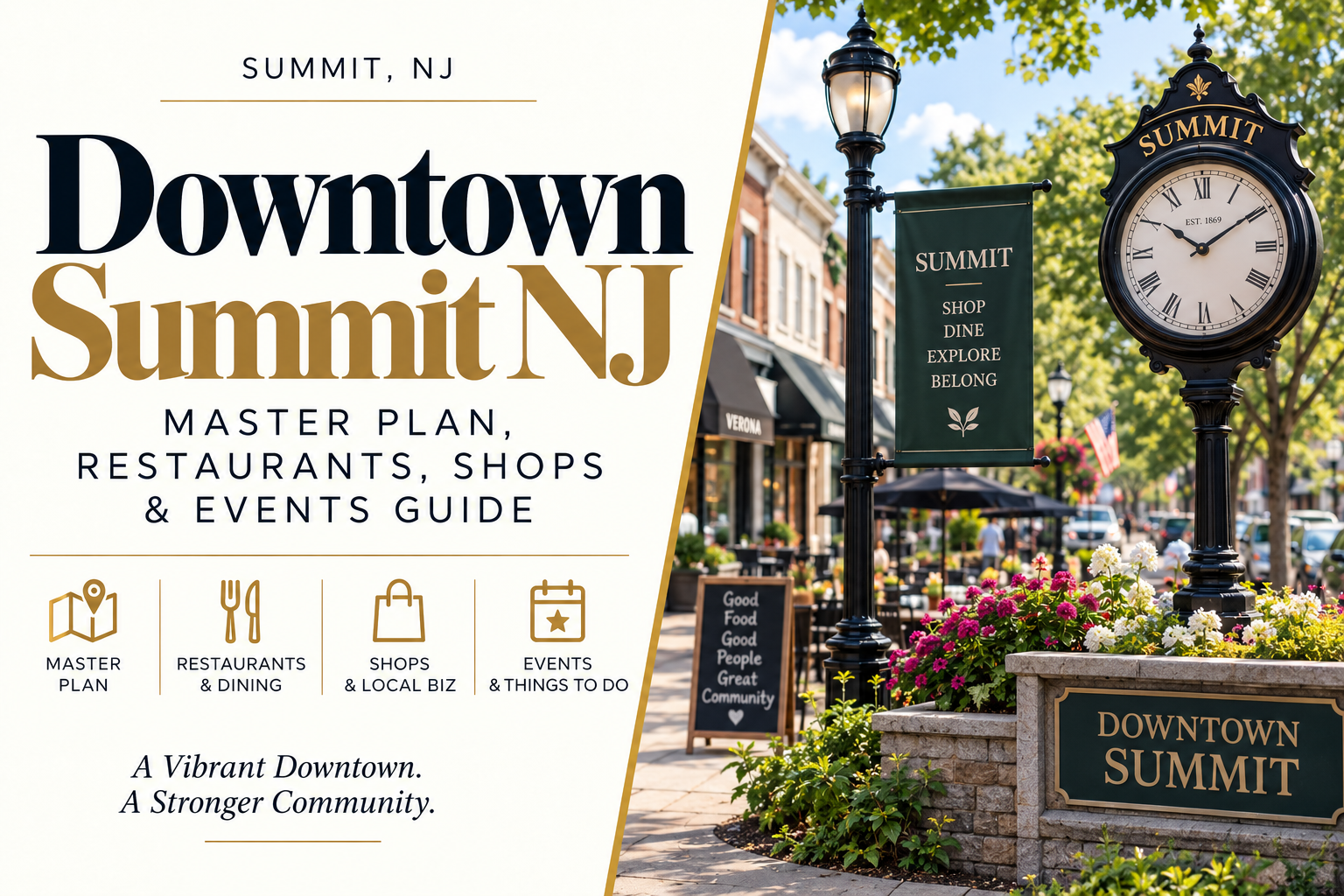
Everything happening in downtown Summit, NJ — the Broad Street West redevelopment and master plan, all 60-plus restaurants, the full shopping directory, and the year-round events calendar.
The Complete Guide to Downtown Summit, NJ: The Master Plan, Every Restaurant and Shop, and the Events That Fill the Calendar All Year
Downtown Summit is one of the more genuinely walkable, transit-connected, and architecturally intact downtowns anywhere in our part of New Jersey — a compact commercial core built around a train line that literally cuts through the middle of it, ringed by a federally recognized historic district, home to more than sixty restaurants and roughly eighty independent shops, and busy with organized public events almost every week from April through December. It's also, right now, in the middle of the most significant planning and redevelopment period it's seen in years, with a major mixed-use, mixed-income housing project moving through city approvals just west of the core downtown blocks, a separate rezoning already approved for the old firehouse site, and a long-term affordable housing settlement quietly reshaping how and where new housing gets built across the entire city.
We're covering all of it in one place — the planning and politics as well as the practical, "what's actually downtown" guide — because anyone seriously considering Summit, whether as a buyer weighing it against Westfield, Millburn, or Chatham, or as a longtime resident trying to understand what's actually being built two blocks from their office, deserves the full picture rather than a scattered set of headlines. Too much of what circulates about downtown Summit locally is secondhand — a rumor about a redevelopment site repeated at a block party, a "best restaurants" list built off a single visit years ago, an events calendar nobody's actually cross-checked against what's currently scheduled. This guide is built the opposite way: pulled directly from city planning documents, council meeting reporting, the downtown management organization's own current directory, and on-the-record local reporting, then organized the way an actual resident or prospective buyer would want to use it. Here's everything: the master plan and the Broad Street West redevelopment, the historic district that shapes what can and can't be built downtown, the complete restaurant lineup organized by what you're actually in the mood for, the full shopping directory, and the calendar of public events that runs nearly the entire year.
Why Downtown Summit Looks and Functions the Way It Does
A few basic facts explain a lot about why downtown Summit feels the way it does to anyone who's spent time there. Summit had a population of 22,719 residents at the 2020 census, with a 2023 estimate of roughly 22,344 — a genuinely small city, geographically, packed with a downtown commercial district disproportionately large and active for a town its size. The reason for that goes back to the town's origins: Summit developed in the 19th century as a retreat for wealthy New Yorkers seeking fresh air on high ground outside the city (the name itself comes from either the old Summit Lodge or "the summit of the Short Hills"), transitioning from farmland to grand estates in the late 1800s and then to its current, denser suburban character after World War II.
The single most defining physical feature of downtown Summit is its train station and the rail line it sits on, because unlike many New Jersey downtowns where the train station sits at the edge of the commercial district, Summit's train tracks run directly through the center of downtown, in a sunken cut that one writer memorably compared to "a Dutch canal" bisecting the handsome commercial blocks on either side. NJ Transit's Morristown Line and Gladstone Branch both serve Summit station, offering direct service to New York Penn Station with travel times of roughly 50 minutes on local trains and as fast as 35 minutes on express Midtown Direct service during peak commuting hours — a genuinely serious commuting advantage that's shaped the kind of downtown that's grown up immediately around the station: dense enough to support real retail and restaurant activity, walkable enough that residents genuinely leave their cars at home for an evening out, and valuable enough that redevelopment pressure on the remaining underutilized parcels near the station has become one of the defining local political issues of the last several years.
Downtown Summit's architectural core is also protected in a way a lot of comparable downtowns aren't: the Summit Downtown Historic District, roughly bounded by Springfield Avenue, the Village Green, Summit Avenue, and Waldron Avenue, received New Jersey state historic register recognition on November 17, 2010, and was added to the federal National Register of Historic Places on June 30, 2011. That designation doesn't freeze downtown Summit in amber — the Broad Street West redevelopment discussed at length below sits adjacent to, not inside, the protected core — but it does mean the town's own commercial heart, the blocks most residents actually picture when they think "downtown Summit," carries a formal, federally recognized preservation status that shapes how the city and its planning board approach change at the literal center of town, even as it actively redevelops parcels around the edges.
"Summit is one of the only downtowns in our whole coverage area where you genuinely don't need a car once you're there," says Marina Fridman-Rybner of The GAMA Team at Corcoran Sawyer Smith. "You get off an express train from Penn Station in well under 40 minutes, and you're already standing in the middle of sixty restaurants and a real historic downtown. That combination — the commute and the walkability together — is exactly what a lot of our clients coming out of the city are specifically looking for, and there just aren't that many towns in Union or Essex County that deliver both at this level."
The Master Plan, the Broad Street West Redevelopment, and Where Downtown Summit Is Actually Headed
Every New Jersey municipality is required under state law (the Municipal Land Use Law) to periodically re-examine its master plan, generally on a roughly ten-year cycle, and Summit's current planning framework traces back to a comprehensive master plan adopted in 2000, refined and re-examined multiple times since, with the City maintaining an ongoing Master Plan Re-examination process and a running library of Planning Studies and Reports that guide how the Planning Board evaluates new development. Rather than treating that as a dry procedural footnote, it's worth understanding the actual, concrete pieces of that planning framework currently reshaping downtown Summit block by block, because several of them are active right now, not theoretical someday proposals.
The 2013 Transit Village Designation and Downtown Planning Study
Summit was designated the 27th New Jersey Transit Village by the state Department of Transportation in September 2013, a designation specifically recognizing the town's "traditional town center and its easy access to New York City" through the Morris & Essex rail line's Midtown Direct service. The Transit Village program made Summit eligible for priority state funding and technical planning assistance — the state allocated $1 million in 2014 to be shared among that year's group of designated Transit Village communities — and the designation coincided with a comprehensive downtown planning study launched that same fall, aimed at guiding future land use, transportation, marketing, and economic development specifically around the train station while preserving the historic character described above. Concrete outputs from that planning push that residents can actually see and use today include streetscape improvements around downtown — added bicycle racks and lockers, enhanced on-street parking management, pedestrian wayfinding signage, and traffic-calming features like curb bump-outs at key intersections — along with several specific development projects that grew directly out of the plan, including an office building with ground-floor retail at 466 Springfield Avenue and the Village Courtyard at Franklin Place, a residential development built on what had been a former car dealership site.
The Fourth Round Affordable Housing Settlement — the Backdrop Behind Nearly Every Downtown Housing Project
To understand why downtown Summit has multiple active housing redevelopment sites moving through approvals right now, you have to understand the city's affordable housing obligation, because it's the single biggest driver behind where and how new housing gets sited citywide. Summit entered a Settlement Agreement with Fair Share Housing Center in October 2016 establishing a long-term mandate to rehabilitate 131 units of existing substandard housing (with a minimum $10,000 investment required per unit) and construct 663 new affordable housing units — reduced from an original 738-unit obligation after the city received credit for prior affordable projects already completed. Within that longer-term obligation sits a nearer-term requirement: the city was required to take "all reasonable steps" to build 50 new affordable units by July 2025, and as of recent reporting had completed 18 of those units, leaving roughly 32 still needed to satisfy that shorter-term benchmark.
The reason this connects so directly to downtown, specifically, is straightforward according to the city's own planning director: Summit simply doesn't have enough vacant land anywhere in the city to build one large affordable housing complex that could satisfy the obligation on its own, so the city has pursued a strategy of smaller, scattered redevelopment sites instead — and several of the parcels that best fit that description happen to sit at or near the edge of downtown, adjacent to the train station and existing commercial blocks, which is exactly why Broad Street West and the old firehouse site (both covered in detail below) have become the two most talked-about downtown-adjacent development sites in recent years. Separately, the city has also discussed a mandatory set-aside ordinance that would require future multi-family developments of five or more units to set aside 15% of units as affordable if built for rental, or 20% if built for ownership — a citywide policy tool aimed at spreading the affordable housing obligation across future private development more broadly, rather than concentrating it entirely on city-led redevelopment sites.
Broad Street West: The Largest Active Redevelopment Site Near Downtown
The single largest and most closely watched project currently moving through the city's approval process is the Broad Street West redevelopment, a mixed-income housing development planned for city-owned and adjacent property just west of the core downtown commercial blocks, being advanced in partnership with developers Toll Brothers and L&M Development Partners. The city's financial advisor, Robert Powell Jr., presented a detailed financial breakdown of the project to Summit's Common Council built around a 30-year PILOT (Payments in Lieu of Taxes) agreement, under which the city would receive approximately $600,000 per year initially from the developer in lieu of standard property taxes, rising by roughly 2% annually, for an average of about $619,000 a year in net revenue to the city over the full 30-year term — a striking increase over what Powell described as the property's current yield of only about $30,000 a year in its underutilized state. Over the full 30 years, Powell's presentation projected PILOT payments generating more than $18 million for the city, on top of a separate $8 million upfront payment Toll Brothers and L&M have agreed to pay the city directly for the site itself. A Redevelopment Area Bond of roughly $1.75 million is also planned to help fund public-purpose improvements tied to the project, with about $100,000 of the annual $600,000 PILOT revenue earmarked specifically for debt service on that bond.
The project has not moved forward without real, organized resident pushback. More than 1,100 residents signed a petition specifically demanding that the relevant subdistrict of the redevelopment plan (referred to in city planning documents as Subdistrict 3) be downsized from its originally proposed scale, and residents raised a range of additional concerns at public meetings: that an initial vote occurred during the summer when many residents are away and less able to engage in the public process; that the sequence of decisions seemed backward, with one resident asking pointedly, "so we can develop a building and then change the plans to meet the building?"; and that the city was prioritizing debt reduction and revenue generation over what some felt was an already-satisfied affordable housing obligation. In direct response to that feedback, the city presented a revised version of the plan reducing the total number of residential units from the original proposal, increasing the amount of on-site parking, and adjusting the building's overall scale and design — changes Council President Marjorie Fox described as addressing "concerns about the scale and design" directly. Questions about the underlying revenue projections have also been raised publicly, including whether the PILOT figures assume an optimistic 95% occupancy rate that could prove too high if parking constraints end up suppressing resident demand for the units.
Mayor Radest has been a visible public advocate for the redevelopment as part of the city's broader downtown revitalization and affordable housing strategy, framing it as an opportunity to convert an underutilized parcel adjacent to downtown into a meaningful, ongoing revenue source for the city while helping meet Summit's court-enforceable affordable housing obligations under the Fair Share settlement described above.
The Old Firehouse Site and the Morris Broad Crossroads Overlay
A second, smaller but still significant downtown-adjacent rezoning has already been formally approved: the Morris Broad Crossroads Overlay, covering roughly 1.5 acres near the intersection of Morris Avenue, Ashwood Avenue, and Broad Street, encompassing the city's old, now-vacant firehouse site, the adjacent Chestnut parking area, an existing office building, and a privately owned parking lot. Summit's Planning Board unanimously approved rezoning this combined parcel to allow for 48 residential units across roughly 80,000 square feet, blending market-rate and affordable housing, along with more flexible parking requirements and adjusted height limits designed to accommodate office space with 14-foot ceilings on part of the site. According to city planner Tom Behrens, part of the rationale for converting what had been a more limited "overlay" zoning designation into a full, standalone zoning district was to consolidate the entire combined lot under a single, coherent set of development rules — described as the only realistic zoning framework capable of supporting redevelopment of the full, oddly-shaped combined parcel — while also achieving what city officials described as a meaningful aesthetic improvement to a site that's sat as an underused municipal property for years. The rezoning's second reading and public comment period was scheduled for September 16, 2025.
What All of This Actually Means if You're Buying or Selling Near Downtown Summit
Pulling all of the above together, here's the practical takeaway for anyone weighing a purchase near downtown Summit right now, or a longtime owner wondering how the neighborhood around them might change: downtown Summit is not a static, finished downtown coasting on its historic character alone. It's actively adding new housing supply on multiple specific, identifiable parcels — Broad Street West and the old firehouse site chief among them — under a long-term, court-enforceable affordable housing framework that's going to keep generating similar projects on other underutilized parcels for years to come, precisely because the city has explicitly chosen a scattered-site strategy over one large complex. For a buyer, that generally means more housing supply and more density immediately adjacent to (though not inside) the protected historic core over the coming years, which can be a genuine amenity — more rooftops within walking distance supporting the same sixty-plus restaurants and eighty shops described below — or a genuine source of added traffic and parking competition, depending on which specific block a given property sits on relative to these sites. For a seller with a home near one of these active redevelopment parcels, it's worth understanding exactly what's approved, what's still contested, and what the realistic construction timeline looks like before setting a price or fielding buyer questions, since half-informed rumors about "that big building going up on Broad Street" circulate constantly in a town this actively engaged in its own local politics.
"I tell clients looking at anything near Broad Street West or the old firehouse site the same thing: don't rely on neighborhood gossip about what's being built there, because the actual plan has already changed once in response to resident pushback and could keep evolving," says Galina Kaplan, Marina's partner at The GAMA Team. "We pull the actual planning board filings and the latest council presentations before a client makes a decision based on a rumor. In an active redevelopment environment like downtown Summit's right now, that diligence genuinely matters."
Every Restaurant in Downtown Summit, Organized by What You're Actually Craving
Downtown Summit's dining scene is genuinely large for a downtown this size — more than sixty distinct restaurants, cafes, and food shops packed into a walkable core — and it's varied enough that grouping everything by cuisine and category is far more useful than an alphabetical list. Here's the full lineup, organized the way you'd actually search for it.
Coffee, Juice, and Morning Fuel
Downtown Summit supports a genuinely deep bench of coffee options, from national names to committed local roasters. Ahrre's Coffee Roastery is a dedicated local roaster with the kind of serious, specialty-coffee focus that's become a genuine destination category of its own over the past decade, while Boxwood Coffee and Gregory's Coffee offer their own distinct specialty-coffee takes within a few blocks of each other. Starbucks and Dunkin Donuts round out the reliable, high-volume national options for anyone who just needs a fast, familiar order on the way to the train. Batavia Café, Marigolds Cafe, and Cafe Mavi Express Coffee Shop each offer their own sit-down or grab-and-go café experience, and Serra Doce brings a Portuguese and Brazilian coffee-shop sensibility, pairing espresso drinks with a dessert case worth lingering over. For fresh juice and smoothies, Fresh Press Juice Co., The Juice Caboose, and Playa Bowls (acai bowls and smoothie-bowl breakfasts) give downtown Summit a genuinely serious lineup of healthy, grab-and-go morning options — a category that's expanded noticeably in Summit and comparable downtowns over the last several years as demand for quick, health-forward breakfast options has grown.
Bakeries, Sweets, and Ice Cream
For baked goods specifically, BAKE Bakery specializes in traditional Italian pastries, Anita's Baked Wonders brings an Argentinean bakery tradition to downtown, and Brownie Points Bakery rounds out the category with its own dedicated baked-goods focus. On the sweets side, Tea Time Chocolates makes handcrafted, gluten-free chocolates, Sweet Nothings combines confections with gift items, and McCool's Ice Cream & Frozen Yogurt and Zrolls (Thai-style rolled ice cream, hand-rolled to order) give downtown two genuinely different takes on frozen treats for warm-weather evenings after dinner.
Italian and Pizza
Italian cuisine is one of the single deepest categories downtown, reflecting both a broadly Italian-American dining tradition across central and northern New Jersey and Summit's own specific concentration of Italian restaurants within a few blocks of each other. Farinolio and Fiorino Ristorante both lean into Tuscan-specific Italian cooking, La Pastaria and Village Trattoria of Summit offer their own distinct takes on classic Italian trattoria dining, and DÚE 360 blends Argentinian and Italian influences into a tapas-style small-plates format. For pizza specifically, Doria's Pizzeria Restaurant, Pizza Vita, SQR Artisan Pizza, and Zappia's Brick Oven give downtown Summit a genuinely wide range of pizza styles, from classic pizzeria slices to artisan, wood-fired approaches.
Asian Cuisine: Ramen, Sushi, Thai, and More
Downtown Summit's Asian food scene is broad enough to split into several distinct sub-categories. Ani Ramen anchors the ramen category with a dedicated, from-scratch ramen-shop concept. For sushi and Japanese cuisine specifically, Sushi Palace and Taka Sushi give downtown two established options. Thai cuisine has a particularly strong presence for a downtown this size, with Nakorn Thai Restaurant and Times Thai Streatery both offering distinct takes on Thai cooking. Blossom, which participated in a recent Summit Restaurant Week with a dedicated Asian-inspired prix fixe menu, and Bowls & Noodles and Sofun Kitchen (noodles and dim sum) round out the broader Asian category with their own noodle- and rice-bowl-centered concepts.
Mexican and Latin American
Barbacoa and Tacoria Mexican Street Kitchen both bring a modern, fast-casual approach to Mexican street food to downtown Summit, giving residents two genuinely distinct takes on tacos, burritos, and Mexican street-food staples within walking distance of each other.
Mediterranean, Middle Eastern, and Persian
Summit Greek Grill covers Greek and broader Mediterranean cuisine, Pita Grill & Creperie blends Middle Eastern pita-based dishes with French-style crepes in a single concept, and Negeen Persian Grill brings a dedicated Persian restaurant to downtown — a genuinely specific, less commonly found cuisine category that adds real diversity to Summit's overall dining mix.
American, Bistro, and Comfort Food
For classic American and bistro-style dining, The Office Tavern Grill (which ran a "Taste of Maine" special menu during a recent Restaurant Week) leans into hearty American comfort food, while Winberie's Restaurant & Bar offers a broader Euro-American bistro menu with a full bar. Piattino: A Neighborhood Bistro, which introduced a new Sardinian-inspired menu during that same Restaurant Week, and Four Monkeys Bistro, which blends Indian and American fusion cooking into a single concept, both push past a standard American bistro format into more distinctive, chef-driven territory. Summit House, which debuted a new menu from Chef AJ Capella, anchors the higher end of downtown's contemporary American dining scene.
Steakhouse and Seafood
Roots Steakhouse is downtown Summit's dedicated steakhouse, the natural choice for a special-occasion dinner or a serious business meal. On the seafood side, FIN Raw Bar & Kitchen focuses specifically on raw bar and seafood-forward dishes, while Jack's Surf & Turf combines a seafood-and-burgers format into one broadly appealing menu.
Delis, Specialty Foods, and Catering
Downtown Summit has a genuinely deep bench of delis and specialty food purveyors well beyond standard sit-down dining. Sam's Delicatessen Summit and Zappia's Delicatessen & Caterers both offer classic deli sandwiches, specialty meats, and full-service catering, while Hill City Deli rounds out the deli category with its own sandwich-and-salad-focused menu. What A Dish operates as a dedicated catering and prepared-foods business rather than a sit-down restaurant, and The Committed Pig brings a specialty-foods focus (built around, as the name suggests, pork-centric products) to the category. Summit Cheese Shoppe rounds things out for anyone assembling a serious cheese board or gift basket rather than sitting down for a full meal.
Bagels and Diners
For classic diner fare, Summit Diner and Peppercorn Diner both serve the reliable, all-day, every-day comfort-food role a genuine diner is supposed to play in a downtown — the place open early, serving breakfast all day, that a town's residents end up visiting more consistently over the years than almost any trendier restaurant nearby. Manhattan Bagel covers the bagel-and-quick-breakfast category as the area's dedicated bagel shop.
Breweries, Bars, and Historic Dining
Bull 'n Bear Brewery gives downtown Summit its own dedicated brewery and taproom concept. And The Albion Summit Hotel & Restaurant occupies a genuinely unique place on this list: operating out of Summit's own historic hotel property, it combines a full-service American restaurant with the hospitality and event-space role a historic downtown hotel restaurant has traditionally played in towns like Summit for well over a century.
"What strikes me most about Summit's restaurant scene isn't any single standout — it's the sheer range within a genuinely small, walkable footprint," says Marina. "You can do Persian one night, Sardinian-inspired Italian the next, and a classic diner breakfast the morning after, all without moving your car. That's a real amenity for buyers who are used to a much more spread-out suburban dining scene."
The Full Downtown Summit Shopping Directory
Downtown Summit's retail mix runs from fine jewelry and interior design showrooms to a genuinely serious independent bookstore-adjacent stationery scene, children's boutiques, and specialty food shops — roughly eighty distinct businesses in total, organized here by category the same way Summit Downtown, the organization that promotes and manages the district, organizes its own directory.
Jewelry and Watches
Downtown Summit supports a genuinely deep jewelry and watch category for a town this size. Henry's Fine Jewelry offers fine jewelry, watches, gifts, and repairs alongside custom design work; Nando's Jewelers focuses on high-quality jewelry sales and repair; Schroth & Lorenson Jewelers specializes in Pandora alongside broader jewelry sales and repair; 1MoreTime Watches deals specifically in luxury watch sales and sourcing for collectors; and The Silver Lining rounds out the category with sterling silver and semi-precious stone jewelry at a different price point than the fine-jewelry houses nearby.
Clothing and Accessories
On the clothing side, downtown Summit blends national specialty retailers with genuinely independent boutiques. J. McLaughlin brings its classic American clothing and accessories line to downtown, lululemon athletica covers technical athletic apparel, and Jacadi offers French-tradition children's fashion. Independent options include No. 18 Boutique, a high-end women's boutique carrying emerging designers; Willow St. and Tea & Oranges, both women's fashion and accessories shops; Dor L'Dor, offering European-inspired fashion; Carrie Dunham, combining clothing, jewelry, and handbags in one shop; John Hyatt Clothing, a dedicated men's haberdashery; and The Cashmere Sale, focused specifically on in-season cashmere at accessible prices.
Home Goods, Furnishings, and Interior Design
This is one of downtown Summit's genuinely largest and most specialized retail categories, reflecting both the town's affluent household base and its position as a real destination for interior design services, not just off-the-shelf furniture. National names West Elm, Serena & Lily, and DUXIANA (premium bed systems) anchor the category, while The Shade Store specializes in custom window treatments, blinds, and drapery. On the more bespoke, design-services side, Calico offers custom home furnishings and design work, Donna Donaldson Home & Interiors and Maison 53 both provide dedicated interior design services, Cabri, Inc. and Kitchen Expressions focus specifically on custom cabinetry and kitchen renovation, and Bedrosian Industries specializes in hand-woven rugs and carpets along with cleaning and restoration services. Ernesta offers designer-quality custom rugs, GreatHouse Bonny Neiman and Loblolly Curated Home & Gift both bring an eclectic, curated approach to home décor and gifts, MK Linens & Home covers bedding and bath linens with custom monogramming, Cove Carpet One is a locally owned flooring and home décor shop, and Windows and Doors by The Men with Tools rounds out the category with dedicated home-improvement installation services.
Health, Beauty, and Wellness
Downtown Summit's wellness category has grown noticeably in recent years to include both retail and service-based businesses. bluemercury offers personal care and beauty products, Madison Reed provides hair color services, and My Love Story is a dedicated beauty products and accessories boutique. On the medical-aesthetics and treatment side, LaserAway offers laser hair removal and The Brightwood Skin focuses on medical aesthetics and skincare treatments. For movement and fitness specifically, The Daily Pilates offers Pilates classes, Stretch Lab provides assisted stretching and flexibility training, and The R3finery focuses on movement and mindfulness training — a genuinely broad wellness ecosystem within a few downtown blocks. Summit Health Shoppe rounds out the category with vitamins, supplements, and antioxidant products.
Children, Toys, and Family
Families in and around Summit have a genuinely strong set of dedicated children's retail options downtown. The Red Balloon is an elevated children's boutique covering ages 0 to 14, Murray & Finn covers children's clothing, maternity wear, and toys for ages 0 to 7, and Jacadi (also listed under clothing above) brings its French children's fashion tradition to the category as well. A to Zooom combines toys, clothing, and an actual party space for kids, tweens, and teens into one destination, Cam Jam Kids offers handpicked toys and gifts, and Toy Division rounds out the category with a more traditional toy-and-game-and-book shop format.
Specialty Food and Beverage Retail
Beyond the sit-down restaurants covered above, downtown Summit has a genuinely serious specialty food and beverage retail scene. The Wine List & Marketplace offers a full range of wine, beer, spirits, and specialty marketplace goods, while Beechwood Wine & Liquors, Cambridge Wines (which offers same-day delivery), and Wine & Whiskey Town round out the beverage retail category with their own distinct selections. Beechwood Cigars & Newspapers and Florez Tobacconist cover cigars and tobacco specifically. On the specialty grocery side, Summit Cheese Shoppe focuses on specialty cheeses, Patricia & Paul Artisans specializes in fine oils and balsamics, Love 4 Nuts offers specialty nuts, and Sweet nothings blends confections with gift items.
Arts, Framing, and Creative Services
Downtown Summit supports a genuine arts and creative-services cluster. The RAM Art Gallery and Healing Arts Gallery (which combines art exhibitions with a holistic wellness angle) both host contemporary art exhibitions, Peanut Gallery LLC focuses specifically on mid-century modern and contemporary art, and Badawang Art offers fair-trade, handcrafted gifts alongside its own gallery space. For custom framing, FRAMEBRIDGE and Frames For You give downtown two dedicated framing options. Color Me Mine offers paint-your-own-pottery experiences and parties, and Viburnum Designs provides floral arrangements specifically for events.
Stationery, Gifts, and Specialty Shops
The stationery and gift category downtown is genuinely deep for a town this size. Paper Source, Paperfolio, and The Papery (a family-owned stationery business) all compete directly in artisanal papers, stationery, invitations, and gift items. Beyond stationery specifically, Kanibal & Co. combines gifts, apparel, and home goods with DIY workshops, Lavender and Sage Boutique offers jewelry, accessories, and ethical gift items, DG Dubon Florist provides floral arrangements and gifts, Party Line covers balloons and party favors, and Soiree NJ offers party planning and event space alongside paint-and-sip events. Horizon Rare Coin Gallery rounds out the category for coin collectors and appraisals — a genuinely specific niche retailer not every downtown can support.
Pets, Sports, and Recreation
Pet owners downtown have two dedicated options: L&B Healthy Pet Markets for pet nutrition and supplies, and Wonder Dog, which combines a pet boutique with an on-site dog spa. For sports and recreation, Fleet Feet Summit specializes in running shoes and apparel, Hilltop Bicycles and Trek Bicycle Summit give downtown two dedicated bike shops (carrying Giant, Focus, Scott, and Haro at Hilltop, and Trek/Bontrager products with service and events at the Trek-branded shop), Universal Lacrosse covers lacrosse equipment specifically, and WalkWell Shoes focuses on health-oriented footwear for both children and adults.
Technology, Home Improvement, and Everyday Services
Rounding out the directory, Audio Nexus handles audio and video equipment and installation, eRepair Plus offers electronics repair for phones, tablets, and laptops, Summit Technology Center covers phones and accessories, and Guitars 'n Jazz is a genuinely specific niche retailer focused on archtop guitars. For home improvement, KOHLER and General Plumbing Supply covers plumbing fixtures and design, Kryston's Paint & Hardware and Ricciardi Brothers Paint (in business since 1929) both serve the paint and hardware category, and Summit Fireplace Centre specializes in fireplace accessories and custom mantels. Everyday pharmacy and essentials are covered by CVS Pharmacy and Walgreens, both with locations downtown, and The Junior League of Summit Thrift Shop and The RealReal (authenticated luxury consignment) give downtown two very different takes on secondhand and resale retail.
"The thing I point out to clients touring Summit is how much of this is genuinely independent, owner-operated retail rather than a mall directory copied and pasted into a downtown," says Galina. "A rare coin gallery, an archtop guitar shop, a shop that's sold paint since 1929 — that's not a downtown that's been hollowed out and refilled with chains. It's still a real Main Street, even with national names mixed in."
Downtown Summit's Year-Round Events Calendar
One of the most underrated things about downtown Summit, especially for anyone comparing it against other central New Jersey downtowns, is how consistently active its public events calendar is — not one or two headline festivals a year, but a steady rhythm of organized programming from early spring through the end of December, almost all of it run or coordinated by Summit Downtown, Inc. (SDI), the town's official downtown management organization, headquartered at 18 Bank Street. Here's the full calendar, organized by season.
Spring and Summer: The Farmers Market and Street Sounds
The backbone of downtown Summit's warm-weather calendar is the Summit Farmers Market, held rain or shine every Sunday from mid-April through late December (the 2026 season runs April 19 through December 20) from 8 a.m. to 1 p.m. at Park & Shop Lot #1, at the corner of DeForest Avenue and Woodland Avenue, with vehicle entry and exit on DeForest Avenue — an eight-month run that's genuinely longer than most comparable farmers markets in our coverage area, many of which wrap up by mid-fall. The 2026 season marks the market's 33rd year in continuous operation, and it now draws more than 70 vendors each week, spanning produce farms (Vacchiano Farm, Race Farm, and Roaming Acres among them), artisanal prepared foods (Oldwick Soup Company, Paolo's Kitchen, and Pesto Joe's), baked goods from downtown's own Anita's Baked Wonders and Brownie Points Bakery, and specialty purveyors covering distilleries, meaderies, coffee roasters, and cheesemakers, alongside non-food vendors like florists and ceramics artists — a market widely regarded as one of the strongest in the entire state, not just within our own coverage area. Running a market that far into December, well past the typical harvest-season cutoff, and sustaining it across 33 consecutive seasons, reflects both strong sustained demand from Summit shoppers and vendors willing to show up through genuinely cold weather to sell to a market that's proven it draws a crowd nearly year-round.
Come late summer and fall, Summit Street Sounds takes over Friday evenings downtown, running from early September through late October (the 2026 fall edition runs September 4 through October 30, 5 to 8 p.m.). The concept is straightforward and effective: live music performances up and down the downtown blocks, outdoor café dining strung with market lights, and extended shopping hours at participating downtown businesses, turning an ordinary Friday evening into a genuine destination event for months at a stretch rather than a single one-off concert night. For a downtown built around walkability the way Summit's is, a recurring Friday-night music series is exactly the kind of low-cost, high-return programming that keeps foot traffic strong through the shoulder season between summer vacations and the holiday rush.
Early Fall: Arts & Cars
Mid-September brings one of downtown Summit's genuine signature annual events: Arts & Cars, combining Peotter's Car Show with the Visual Arts Center of New Jersey's own Arts Festival into a single downtown-wide celebration (the 2026 edition runs Sunday, September 20, from 10 a.m. to 4 p.m.). Pairing a classic and specialty car show with a juried visual arts festival in the same downtown footprint, on the same day, is a smart piece of event programming — it draws two genuinely different audiences (car enthusiasts and gallery-going arts patrons) into the same downtown blocks at the same time, each group discovering the other event, and both groups discovering the restaurants and shops in between.
Restaurant Week
Downtown Summit also runs its own dedicated Restaurant Week, a roughly ten-day stretch (a recent edition ran July 20 through 30) built around participating restaurants offering special promotions, prix fixe menus, and limited-time dishes, promoted heavily through Summit Downtown's own social media channels. Recent participation has included DÚE 360 offering 50% off desserts with an entrée purchase, Blossom running a special Asian-inspired prix fixe menu, The Office Tavern & Grill debuting a "Taste of Maine" menu, Piattino Neighborhood Bistro introducing a new Sardinian-inspired menu, and Summit House launching a new menu from Chef AJ Capella — a genuine cross-section of the depth of downtown's dining scene described in full above, all using Restaurant Week as an occasion to show off something new rather than simply discounting existing menus.
Halloween: Downtown Trick-or-Treat
Downtown Summit hosts its own dedicated Downtown Trick-or-Treat event each October (the 2026 edition runs Friday, October 30, from 2:30 to 4 p.m.), with participating downtown businesses handing out candy directly to trick-or-treaters in a controlled, walkable, daylight setting — a genuinely popular format for parents of younger children who'd rather not navigate an entire neighborhood door to door after dark, and a smart piece of downtown programming that gets families walking past every participating storefront in the middle of a weekday afternoon.
The Holiday Season: Summit's Busiest Stretch of Public Events
Downtown Summit's calendar reaches its peak density during the holiday season, with a genuinely packed run of events from late November through late December.
The centerpiece is Miracle on Elm Street, the town's main holiday kickoff celebration, typically held the Friday after Thanksgiving (the most recent edition was scheduled for November 27 and postponed a couple of days to November 29 due to rain) from 1 to 6 p.m. in the Elm Street parking lot. The event includes ice skating, cookie decorating, bonfires, and complimentary hot beverages, building toward a tree lighting ceremony around 5 p.m. with the mayor in attendance, and the Summit Fire Department assisting with Santa's arrival for photos with children — a genuinely full afternoon-into-evening program rather than a brief, five-minute tree-lighting-and-done ceremony.
The following weeks bring a steady rhythm of additional programming. Small Business Saturday, the Saturday after Thanksgiving, runs from 1 to 4 p.m. with special retail offers specifically at downtown's independent businesses — a direct, practical complement to the national Small Business Saturday campaign, translated into actual in-store promotions at the specific shops covered in the directory above. An Elf Scavenger Hunt runs for roughly three weeks, from the day after Thanksgiving through mid-December, with a $500 gift card prize for children who complete the hunt — a genuinely effective piece of programming for keeping families returning downtown multiple times across several weekends rather than making a single holiday-shopping trip. On select Saturdays through December (recent editions ran November 26 and December 3, 10, and 17), Carriage and Carolers brings free horse-drawn carriage rides departing from Lyric Park (at the corner of Beechwood Road and Bank Street) alongside strolling carolers and musicians playing holiday standards, including performances from groups like St. Peter's Brass.
The season closes with Celebrate in Summit, typically held in mid-to-late December (recent editions have run from 1 to 4 p.m.), which layers live music, more horse-drawn carriage rides (with Santa aboard in some years), live ice carving in the Promenade, DJ entertainment at Lyric Park, and interactive winter-themed craft activities into one final, all-ages holiday celebration before the calendar year ends — with the Summit Downtown gift card program, accepted at more than 150 local businesses, promoted heavily throughout as a way to keep holiday gift-giving dollars inside the downtown district. Separately, Temple Sinai of Summit hosts a public Menorah Lighting ceremony at the Village Green in mid-December (recent editions ran December 18, from 5 to 6 p.m.), open to the general public regardless of congregation membership — a meaningful piece of interfaith holiday programming held in the same civic green space that anchors so much of downtown Summit's public life throughout the rest of the year.
Virtually all of this holiday programming is free to attend, funded and organized through Summit Downtown, Inc. and the district's participating businesses rather than charging admission — a deliberate choice that keeps the events genuinely accessible to every family in town regardless of budget, and one that reliably brings foot traffic back to downtown's restaurants and shops on the very same afternoons.
"I always tell out-of-town buyers touring Summit around the holidays that what they're seeing isn't a one-off — it's an actual annual calendar the town has built and refined over years," says Marina. "A downtown that can run a real tree lighting, weeks of carriage rides, an elf scavenger hunt, and a full ice-carving-and-DJ closing event, all free, all funded by the local business community — that tells you something concrete about how strong that downtown's businesses actually are. You don't get that kind of sustained community investment in a struggling commercial district."
The Historic Landmarks Anchoring Downtown Summit
Beyond the restaurants, shops, and events, downtown Summit is built around a small handful of genuine civic and historic landmarks that give the district its actual sense of place, and it's worth knowing what they are and where they came from.
The Summit Playhouse is the single best example. The building itself dates to 1891, originally constructed as Summit's very first library, designed in the Romanesque style by architect Arthur Bates Jennings. In 1918, in the aftermath of World War I, a group organized the Playhouse Association as a wartime relief organization and began renting the by-then-vacant library building for a symbolic $1 per year over a fifty-year term, on the condition that the Association maintain the building itself. A 120-seat auditorium was added in 1960, converting the original 1891 library structure into an actual working stage, and the Summit Library Association formally transferred full ownership of the building to the theater group in 1968. Today, the Summit Playhouse operates as one of the oldest continuously operating amateur community theaters anywhere in the United States, staging multiple productions a year and giving downtown Summit a genuine, working piece of 19th-century civic architecture still actively used for its intended public purpose rather than converted into private retail space, as has happened to so many comparable buildings in other towns.
The Village Green functions as downtown Summit's central civic gathering space — the site of the annual public Menorah Lighting described above, and generally the kind of open, central green space that anchors public life in a historic New England-style town center, even this far into central New Jersey. Lyric Park, at the corner of Beechwood Road and Bank Street, plays a similar civic role specifically for the holiday season programming described above, serving as the departure point for the horse-drawn carriage rides that run across multiple weekends every December.
Layered around these specific landmarks is the broader Summit Downtown Historic District itself, covered earlier in this guide's master plan section — the federally recognized historic district, added to the National Register of Historic Places in 2011, that encompasses the core commercial blocks roughly bounded by Springfield Avenue, the Village Green, Summit Avenue, and Waldron Avenue. Together, these landmarks are why downtown Summit reads, to anyone walking it for the first time, as an actual historic town center that's simply kept adding modern restaurants and shops over the decades, rather than a newer commercial development dressed up to look old.
Parking and Getting Around Downtown
For anyone actually planning a visit — or weighing how practical daily downtown access would be from a specific home — it's worth understanding how parking works in downtown Summit, because it's a genuinely active, evolving piece of city infrastructure right now, not a settled, static system. The city maintains a mix of commuter parking (for residents and permit holders using the train station), employee parking specifically for people working at downtown businesses, and general visitor and resident parking spread across several municipal lots and structures, along with on-street metered spaces throughout the core commercial blocks.
The Tier Garage on Springfield Avenue, one of downtown's key parking structures, is currently undergoing reconstruction after structural engineers identified water damage and surface deterioration — as of the most recent public reporting, a full restoration timeline had not yet been announced, though the garage's lower levels have remained available for continued use throughout the reconstruction of the upper levels. In a related move, the Summit Common Council unanimously approved an ordinance converting 84 spaces on the top level of the separate Broad Street Garage from non-resident commuter designation to reserved parking specifically for residents and downtown employees, alongside converting eight additional employee permit spaces along Deforest Avenue that had previously been paid visitor spots. Together, these changes reflect an active, ongoing effort by the city to rebalance parking supply between commuters, downtown employees, and shoppers and diners as one of downtown's aging parking structures goes through a multi-year reconstruction process.
For residents, the city requires an annual parking permit renewal (recent deadlines have fallen around October 31) covering both parking and municipal transfer station access, and separate permit categories exist for residents, commuters, and downtown employees, each with its own designated zones and structures. For visitors and anyone simply coming downtown for a meal or an afternoon of shopping, Summit Downtown, Inc. maintains its own parking guidance and a published downtown parking map through its website, geared toward first-time visitors who aren't yet familiar with which specific lot or garage sits closest to a given block.
"Parking is genuinely the one recurring practical question I get from clients considering a move to downtown Summit specifically," says Galina. "My honest answer is that it's a real, active issue the city is actively working through right now, not a solved problem — but it's also not remotely a dealbreaker. It's the kind of thing every dense, walkable, transit-oriented downtown in our area deals with to some degree, and Summit's working through it with actual structural investment, not just talk."
How the Railroad Actually Built Downtown Summit
It's worth going back further than the 2000 master plan or the 2013 Transit Village designation to understand why downtown Summit sits exactly where it does, because the answer is almost entirely about the railroad. Rail service first reached Summit on September 28, 1837, when the Morris and Essex Railroad extended its line out from Orange to Madison, running directly through what would become the center of town — meaning the railroad didn't arrive at an already-established downtown Summit, it essentially created the conditions for one, the same way rail lines built the commercial core of nearly every classic New Jersey and New York commuter suburb in the 19th century. That original at-grade rail line ran directly through the surface streets of what became downtown, creating the kind of street-level crossing conflicts between trains and horse-and-carriage (and eventually automobile) traffic that became an increasingly serious safety and congestion problem as both rail traffic and the town itself grew through the second half of the 1800s.
The solution — and the reason downtown Summit's train tracks sit in the distinctive sunken cut described earlier in this guide — came between 1902 and 1905, when the Delaware, Lackawanna and Western Railroad funded a full grade-elimination project, physically lowering the rail line below street level through the downtown core and building the current station structure as part of that same project. That single infrastructure decision, made more than 120 years ago, is the direct reason downtown Summit today has cross streets passing safely over the rail line via bridges rather than at-grade crossings, and it's the reason the station itself functions as a genuine junction point rather than a simple stop — Summit station is where NJ Transit's Gladstone Branch and Morristown Line converge and diverge, sharing track eastbound toward Hoboken Terminal and New York Penn Station, then splitting again westbound toward their separate endpoints in Hackettstown and Gladstone. In the station's earlier era, it hosted a number of named, flagship passenger trains, including the Delaware, Lackawanna and Western's famous Phoebe Snow, and the station itself received a cosmetic renovation in 2005 timed to the PGA Championship held at nearby Baltusrol Golf Club, when Summit briefly found itself a arrival point for a genuinely national sporting event's visiting crowds.
Understanding this history matters for more than trivia purposes: it explains why downtown Summit's commercial core, historic district, and train station are all essentially the same few blocks rather than three separate parts of town loosely connected by roads. The 1902–1905 grade-separation project locked in the physical layout that every master plan, downtown planning study, and redevelopment proposal since has had to work within and around — including, directly, the Broad Street West and old firehouse redevelopment sites discussed earlier in this guide, both of which sit close enough to that same rail infrastructure to benefit from (and, in the resident pushback described earlier, generate real anxiety about) the parking and traffic patterns the 1905 station design never had to anticipate.
Beyond Downtown's Blocks: The Civic Amenities Within Walking Distance
Downtown Summit's restaurants, shops, and events don't exist in isolation — part of what makes the immediate area around downtown so consistently in demand is the civic and cultural infrastructure within an easy walk of the same core blocks. The Reeves-Reed Arboretum, at 165 Hobart Avenue, is the single best example: a 13.5-acre public arboretum, the only one in all of Union County, built on what was originally a private country estate called "The Clearing," developed beginning in 1889 by merchant John Hornor Wisner with landscape architect Calvert Vaux (the same Calvert Vaux who co-designed New York's Central Park), and later expanded between 1916 and 1925 by the Reeves family with designers Ellen Biddle Shipman and Carl F. Pilat. The City of Summit converted the property into a public arboretum in 1974, and today the grounds — including an azalea garden with roughly 850 shrubs, a rose garden with more than 150 varieties, herb and lilac gardens, woodland trails, and a vernal pool — are open to the public daily from dawn until dusk, free of charge. The arboretum runs its own annual public programming as well, including a Daffodil Day featuring more than 30,000 blooms each spring, seasonal Celebrate Fall activities, and holiday tours, alongside school field trips, scout programs, adult gardening workshops, and summer nature camps for children — a genuinely serious piece of horticultural and civic infrastructure sitting a short walk or drive from the same downtown blocks covered throughout this guide.
For anyone weighing how a move to downtown Summit would actually feel day to day, this is worth factoring in directly: a downtown this dense and walkable, sitting this close to a free, 13.5-acre public arboretum with its own annual events calendar, on top of the Village Green, Lyric Park, and the historic Summit Playhouse covered earlier, gives residents a genuinely wide range of both built and green public space within a short walk of home — not something every dense, transit-oriented downtown in our coverage area can claim to the same degree.
What Downtown Summit's Strength Means for the Housing Market Around It
Downtown Summit's density, restaurant and retail depth, and active event calendar aren't just quality-of-life amenities in the abstract — they show up directly in what buyers are willing to pay to live near it. As of the most recent data available, the average Summit home value stood at $1,433,872, up 12.3% over the past year — a genuinely significant year-over-year increase that reflects sustained, strong demand for a town combining Midtown Direct rail access with the kind of dense, walkable, restaurant-and-retail-rich downtown described throughout this guide.
It's worth being direct about how Summit compares to the other central New Jersey towns we cover most closely for clients. Westfield, Cranford, Mountainside, Scotch Plains, Maplewood, Montclair, Basking Ridge, and New Providence each offer their own version of a walkable downtown and a serious Midtown Direct or comparable NYC rail commute, but Summit's downtown genuinely stands out even within that group for the sheer density of what's packed into its specific commercial core — more than sixty restaurants and roughly eighty shops within a footprint that a healthy adult can walk end to end in well under fifteen minutes, anchored by a train station sitting literally in the geographic middle of downtown rather than at its edge. That density is a direct product of the decades of planning history covered earlier in this guide: the 2000 master plan and its subsequent re-examinations, the 2013 Transit Village designation and downtown planning study, and the current wave of Broad Street West and old-firehouse-site redevelopment, all specifically aimed at concentrating more housing and activity as close to the train station and existing commercial core as the city's zoning and historic preservation constraints will allow.
For buyers specifically prioritizing walkability and downtown vibrancy over the largest possible lot size, that concentration is a genuine, tangible asset — the actual reason a Summit listing within a few blocks of downtown commands the premium it does relative to a comparably sized home further from the train station and commercial core within the same town. For buyers whose priorities run the other direction — more land, more privacy, a longer but still manageable walk or short drive to downtown amenities — Summit's outer neighborhoods and comparable nearby towns can offer a different, still strong, version of the same overall commuting and lifestyle package at a different price point and density level.
"Downtown proximity in Summit isn't a nice-to-have line in a listing description — it's one of the single biggest price drivers in the entire town," says Marina. "When a client tells me walkability to downtown restaurants and the train matters more to them than square footage, Summit is one of the very first towns I bring up, precisely because of everything in this guide — the restaurant count, the shop count, the events calendar, all of it. That's not marketing language. It's the actual reason the demand, and the pricing, looks the way it does."
How Downtown Summit Actually Compares to Downtown Westfield
Because so many of our clients are actively cross-shopping Summit against Westfield — the two towns get compared constantly by buyers working with us, and for good reason, since both offer a genuinely strong Midtown Direct commute anchored by a real, walkable downtown — it's worth a direct, honest comparison rather than leaving readers to guess.
Both downtowns share the fundamentals: a train station within walking distance of the commercial core, a historic downtown business district, and a restaurant and retail scene deep enough to genuinely fill an entire weekend without leaving town. Where they diverge is in the specifics. Downtown Summit's single defining physical feature is its train tracks running directly through the geographic center of downtown in that sunken, 1902–1905 grade-separated cut — meaning the station and the commercial core are, quite literally, the same few blocks, with retail and restaurants wrapping the station on both sides. Downtown Westfield's train station sits more at the edge of its own commercial core, with the shopping and dining district extending outward from there along South and East Broad Streets. Neither layout is objectively better — Summit's puts you closer to the platform from literally any downtown storefront, while Westfield's creates a more traditional Main-Street-radiating-outward feel — but they produce a genuinely different walking experience day to day.
On sheer scale, downtown Summit's restaurant count (more than sixty, as detailed above) runs somewhat ahead of downtown Westfield's, while Westfield has built a particularly strong, well-documented niche competitive scene in specific categories — bagel shops chief among them, where four genuinely distinct shops now compete within a few blocks of each other, a level of hyper-local competition downtown Summit doesn't have in quite the same concentrated form. Both towns run genuinely serious, well-organized downtown events calendars through their respective downtown management organizations, though Summit's holiday programming in particular — Miracle on Elm Street, weeks of Carriage and Carolers, an Elf Scavenger Hunt, and the Celebrate in Summit closing event — runs unusually deep even by the standards of comparably strong downtowns in our coverage area.
On the master plan and redevelopment front, both towns are navigating real, active tension between historic preservation and new housing development driven by New Jersey's statewide affordable housing framework, though the specifics differ: Summit's current flashpoint is the Broad Street West redevelopment and the old firehouse site rezoning described at length above, while Westfield's own redevelopment conversations have centered on different specific parcels and a different mix of stakeholders. Home values in both towns sit at a premium relative to most of our broader coverage area, reflecting the same underlying combination of rail access, school quality, and downtown vibrancy in both cases, though the specific price points, inventory levels, and competitive dynamics between the two towns shift often enough that we'd always recommend pulling current, town-specific numbers before drawing a firm conclusion about which offers better relative value in a given month.
"I never tell a client Summit is simply 'better' or 'worse' than Westfield, because that's not a real answer — they're both excellent, and they're genuinely different in ways that matter more to some buyers than others," says Galina. "Summit's downtown wraps around its train station in a way that's hard to replicate anywhere else in our coverage area. Westfield's downtown has that same walkability but a slightly different, more Main-Street feel, plus that incredible bagel-shop competition we've written about separately. The right answer depends entirely on what a specific buyer actually prioritizes day to day."
A Perfect Day in Downtown Summit
For anyone visiting downtown Summit for the first time — whether house-hunting or simply exploring a town under serious consideration — here's how all of the above actually fits together into a single, realistic day.
Start the morning with coffee at one of the specialty roasters covered above — Ahrre's Coffee Roastery, Boxwood Coffee, or Gregory's Coffee all make a strong case — paired with a pastry from BAKE Bakery or Anita's Baked Wonders. If it's a Sunday between April and December, time the visit around the Summit Farmers Market, running 8 a.m. to 1 p.m., for a genuine sense of the town's food culture beyond the restaurant scene, then walk the handful of blocks separating the market from downtown's retail core.
Spend the late morning working through the shopping directory covered above based on what actually interests you — the stationery cluster around Paper Source and The Papery for anyone who appreciates a genuinely deep specialty-paper selection, the home-goods and design cluster (Serena & Lily, West Elm, Calico, and the custom design studios nearby) for anyone furnishing a new home, or the children's boutique cluster (The Red Balloon, Murray & Finn, A to Zooom) for anyone shopping for kids. If the visit falls during Summit Street Sounds season (Friday evenings, September through October), plan to extend the afternoon into early evening specifically to catch the live music and extended shopping hours described earlier.
For lunch, the sheer range covered in the restaurant guide above means the choice really comes down to mood: Tacoria or Barbacoa for a quick, casual Mexican lunch; Hill City Deli or Sam's Delicatessen for a classic deli sandwich; or Ani Ramen or one of the Thai options (Nakorn Thai, Times Thai Streatery) for something warmer and more filling. Round out the afternoon with a walk to Reeves-Reed Arboretum, a short distance from the core downtown blocks, for a genuine change of pace from retail and restaurants — free, open daily from dawn to dusk, and a legitimately different side of what living near downtown Summit actually offers beyond the commercial district itself.
For dinner, decide whether the occasion calls for something more casual (Winberie's, The Office Tavern Grill, or Piattino all handle an easy weeknight-out dinner well) or something more special (Roots Steakhouse for a serious steak dinner, or Summit House for Chef AJ Capella's contemporary American menu). If the visit happens to land during Restaurant Week, treat that as a genuine opportunity rather than a scheduling coincidence — it's specifically designed to showcase new menus and dishes the participating restaurants are proudest of that season. Close the evening with dessert at McCool's Ice Cream, Zrolls, or Tea Time Chocolates, all a short walk from wherever dinner ended.
If the visit happens to fall during the holiday season, none of the above changes — it simply layers on top of whatever public event is running that particular week, whether that's the full Miracle on Elm Street celebration, a Carriage and Carolers Saturday, or the Celebrate in Summit closing event described in detail earlier in this guide.
Following the Master Plan: How to Track What's Actually Being Built
Given how much of this guide has focused on active, evolving planning decisions — the Broad Street West redevelopment, the old firehouse rezoning, the broader affordable housing settlement driving both — it's worth closing the master plan discussion with practical guidance on how to actually follow these decisions as they continue to evolve, rather than relying on secondhand neighborhood conversation, which, as covered earlier, has already proven to lag or misstate the specifics of these projects at least once.
Summit's Planning Board meets on a regular public schedule, with meeting notices, agendas, and application materials posted through the City of Summit's own website, and major redevelopment proposals like Broad Street West typically go through multiple rounds of public hearings — including the kind of public meeting referenced earlier in this guide, where the city's initial recommendations were first presented and residents had a direct opportunity to weigh in before the plan was revised. The city also maintains an ongoing library of Planning Studies and Reports, including the original Downtown Planning Study and subsequent Master Plan Re-examination documents, for anyone who wants to read the underlying planning rationale directly rather than relying on summaries. For financially-minded readers specifically, presentations like financial advisor Robert Powell Jr.'s breakdown of the Broad Street West PILOT structure, covered in detail earlier in this guide, are generally part of the public Common Council meeting record as well.
For residents and prospective buyers who want to stay current without digging through raw meeting minutes, local outlets TAPinto Summit and Summit, NJ Patch both cover city government and redevelopment proceedings on an ongoing basis, and have been the direct source for much of the Broad Street West and old firehouse reporting referenced throughout this guide. Given how much these specific plans have already changed once in response to organized resident feedback, and given that the city has signaled an intention to keep pursuing scattered-site affordable housing development on other underutilized parcels to satisfy its longer-term Fair Share obligation, this is genuinely a story worth continuing to follow rather than treating this guide's snapshot as a permanent, final picture of downtown Summit's future footprint.
"Anyone seriously considering a purchase near one of these active sites should be looking at the actual planning board record, not just what a neighbor mentioned at a block party," says Marina. "We do exactly that kind of diligence for our own clients before they make an offer near an active redevelopment parcel anywhere in our coverage area, Summit included, and it's made a real difference more than once in how a client thought about a specific property."
Who Runs Downtown Summit's Day-to-Day Operations
The organization behind nearly every event, promotion, and piece of downtown marketing described throughout this guide is Summit Downtown, Inc. (SDI), headquartered at 18 Bank Street, Suite 101. SDI operates in the model common to downtown management organizations across New Jersey and the country: a dedicated nonprofit or quasi-public entity, typically funded at least in part through a special assessment on downtown property and business owners specifically (a structure generally referred to statewide as a Special Improvement District, or SID), tasked with marketing the district, coordinating the kind of recurring public events covered in detail earlier in this guide, maintaining the searchable business directory this guide draws from directly, and generally serving as the day-to-day promotional and organizational engine for the commercial district — distinct from, though coordinated with, the City of Summit's own planning and zoning functions covered in the master plan section above. In practical terms, SDI is who a prospective new business calls when considering opening downtown, who organizes the annual Restaurant Week and holiday programming, and who maintains the parking guidance, historical walking tour materials, and gift card program mentioned throughout this guide. It's a genuinely important, if often invisible, piece of why downtown Summit functions as cohesively as it does — the events calendar, the unified downtown branding, and the shared promotional push behind local businesses don't happen automatically just because a lot of good, independent businesses happen to be clustered in the same few blocks; they happen because an organization is actively coordinating it.
It's worth appreciating how much coordination that actually represents once you tally it up across this guide: a farmers market now in its 33rd consecutive season drawing more than 70 vendors a week for eight months straight, a Friday-night concert series running two full months every fall, a combined car-and-arts festival, a dedicated Restaurant Week, a Halloween event, and a multi-week holiday season with at least six distinct named programs layered across December alone. Very few downtown management organizations anywhere in our broader coverage area sustain a calendar this dense year over year, and it's a direct, tangible reflection of how much the downtown business community itself has invested in Summit functioning as a genuine destination, not simply a collection of individually successful storefronts.
Schools and the Broader Case for Summit
No discussion of what draws buyers to a town this consistently is complete without addressing schools directly, since for a large share of the families we work with, school quality sits alongside downtown walkability and commute time as one of the three or four factors that actually decide where they end up buying. The Summit Public School District currently carries an overall A+ grade from Niche, ranking as the #1 school district in Union County and #7 out of 243 ranked districts statewide in New Jersey. The district reports a student-teacher ratio of roughly 12:1 (well below the national average of 16:1), a 96% graduation rate, and an average SAT score around 1330 out of 1600 alongside an average ACT score around 31 out of 36 — genuinely strong college-readiness numbers that place Summit's schools firmly among the state's top tier, alongside the other high-performing districts we cover regularly for clients, including Westfield, Millburn, and Chatham.
Combined with everything else covered in this guide — the downtown density, the restaurant and retail depth, the active events calendar, the historic preservation framework, and the ongoing, carefully managed redevelopment adding new housing near the train station — Summit's school performance is the final piece of why the town commands the kind of sustained buyer demand reflected in its home values. It's genuinely rare to find a town that scores this highly on rail commute, downtown vibrancy, and school quality simultaneously, and it's exactly that combination, rather than any single factor alone, that keeps Summit near the top of the list for buyers relocating from New York City who want all three at once.
Who Downtown Summit Actually Suits Best
Pulling everything in this guide together, it's worth being specific about the kind of buyer or resident downtown Summit genuinely suits best, rather than presenting it as a universally perfect fit for every kind of household.
Downtown Summit is an especially strong match for a household prioritizing a serious Midtown Direct commute — the 35-to-50-minute ride to Penn Station described earlier — combined with genuine day-to-day walkability once home, someone who wants to be able to leave the car in the driveway for an evening out at any of the sixty-plus restaurants covered above, or to walk to the farmers market on a Sunday morning rather than drive to one. It's an especially strong fit for a family prioritizing top-tier public schools without sacrificing that downtown walkability, given the school district numbers just covered. And it's a strong fit for anyone who values a downtown with a genuinely active civic and cultural life — the historic Summit Playhouse, the Village Green, the year-round events calendar, and the nearby Reeves-Reed Arboretum — over a purely retail-and-restaurant-focused commercial strip with little else layered on top.
It's a less natural fit for a buyer whose top priority is maximizing lot size, privacy, or new-construction square footage on a fixed budget, since Summit's downtown-adjacent premium, reflected in the home value data covered above, generally buys density and walkability rather than acreage — a buyer prioritizing space over walkability may find better value in Summit's outer neighborhoods or in a comparable nearby town with a different density profile. It's also worth real, honest awareness for anyone specifically considering a home near one of the two active downtown-adjacent redevelopment sites covered in detail earlier — Broad Street West and the old firehouse parcel — since both are still moving through a genuinely live public process that's already changed once and could continue to evolve before either project breaks ground.
"The households who end up happiest in downtown Summit are the ones who go in with their eyes open about exactly what they're buying — genuine walkability, a top school district, and a real, still-evolving downtown, not a finished, frozen-in-time postcard," says Galina. "That's true of literally every town we cover, but it's especially true right now in Summit specifically, given how much is actively in motion around Broad Street West and the old firehouse site. We'd rather walk a client through all of it upfront than have them surprised by a construction crane eighteen months after closing."
What's New Downtown Right Now
Downtown Summit's restaurant scene isn't standing still even beyond the master-plan-level redevelopment covered earlier — new restaurants have continued opening on Springfield Avenue even as this guide was being written. Felina, an Italian fine-dining concept from the same restaurant group behind existing locations in Ridgewood and Jersey City, opened at 570 Springfield Avenue, bringing what its own team describes as "elevated Italian comfort food" to downtown in a genuinely striking, architecturally ambitious space — an open-kitchen design with terrazzo and mosaic marble detailing, a floating kitchen hood over the open kitchen, a working fireplace in the dining room, and a 60-seat bar pouring five signature negronis on tap. Felina serves lunch Monday through Friday from noon to 3 p.m., weekend brunch Saturday and Sunday from 11 a.m. to 3 p.m., and dinner nightly (5 to 10 p.m. Monday through Saturday, 4 to 9 p.m. Sunday) — a serious, full-service addition to downtown's already deep Italian dining category covered earlier in this guide.
Separately, Tacoria Mexican Street Kitchen, the fast-casual Mexican concept covered in the restaurant guide above, opened its Summit location at 353 Springfield Avenue on January 16, 2026. Tacoria was founded a decade earlier in New Brunswick by four Rutgers alumni and has since expanded to more than a dozen New Jersey towns, with additional locations already planned for Freehold and Somerville at the time of its Summit opening — meaning the Summit location joined an already well-established, multi-town New Jersey chain rather than launching as an unproven concept. The opening included a buy-one-get-one-free burrito promotion through its first week and a formal ribbon-cutting on January 30 that included donations to local first responders and complimentary food and merchandise for its first 100 guests, a genuinely community-oriented launch for a new downtown business.
Both openings are worth flagging for the same reason: downtown Summit's retail and restaurant vacancy churns constantly, the same way any healthy, in-demand downtown's does, and the specific business list in this guide reflects the most current, verified information available as of publication — but anyone using this guide as an ongoing reference, rather than a one-time snapshot, should expect the specific roster of restaurants and shops to keep evolving even as the broader master plan and redevelopment story described earlier plays out over a much longer, multi-year timeline.
Getting To and From Downtown Summit, Beyond the Train
While the Midtown Direct rail connection covered earlier is downtown Summit's single biggest draw for commuters, it's worth rounding out the full picture of how the town connects outward, since not every trip is a commute into Manhattan. Summit sits within reasonably direct reach of several major regional highways — Routes 24 and 78 run close by, with Route 287 and the Garden State Parkway also within a manageable drive — giving downtown Summit residents genuine flexibility for trips that don't run toward New York City: south toward the Jersey Shore, west toward more rural Somerset and Morris County towns, or north toward Route 80 and beyond. NJ Transit bus service also connects Summit to surrounding towns and to New York, giving residents without a car, or those simply looking for an alternative to driving or the train on a given day, a genuine second transit option.
For anyone weighing whether a car is even necessary living in or near downtown Summit, the honest answer is nuanced: the downtown itself, as this entire guide has demonstrated, is genuinely walkable enough that a household could realistically go a full week without needing a car at all — groceries, dining, shopping, the farmers market, and the train station are all within an easy walk of most of the core downtown blocks. But Summit's surrounding neighborhoods, like most New Jersey suburbs, are built at a lower density that generally assumes car ownership for anything beyond the immediate downtown core — school drop-off, weekend errands further afield, and visits to the arboretum or other town amenities not directly downtown all become considerably easier with a car available, even for a household that primarily walks to and from the train station itself.
How Summit Stacks Up Against Millburn–Short Hills and Chatham
Beyond the direct Westfield comparison covered earlier, the other towns clients most frequently cross-shop against Summit are Millburn–Short Hills and Chatham, both of which offer their own version of the same core value proposition: a genuinely strong Midtown Direct commute paired with a walkable downtown and a top-tier school district. It's worth being equally direct about how these compare.
Millburn–Short Hills offers its own distinct downtown character split across two separate commercial nodes (downtown Millburn and the Short Hills train station area), plus, notably, the Mall at Short Hills, a genuinely upscale regional shopping destination that neither Summit nor Chatham can match in sheer retail scale — though, as this guide has demonstrated at length, downtown Summit's own independent retail and restaurant density holds up well against Millburn's smaller, more boutique-focused downtown core specifically. Chatham, meanwhile, offers a more intimate, small-town downtown scale than either Summit or Millburn, with a correspondingly tighter restaurant and retail footprint, appealing specifically to buyers who want the Midtown Direct commute and strong schools without quite the same level of downtown density and bustle that Summit and Millburn both offer.
Home values across all three towns sit in a broadly comparable premium tier, though the specific numbers shift often enough between towns and between months that we'd always recommend pulling current, town-specific data rather than relying on a general reputation alone — a town's overall reputation for being "expensive" or "a great commuter town" can mask meaningful month-to-month or even block-to-block variation in what's actually available and at what price at any given moment.
"Millburn, Chatham, and Summit end up in the same conversation with clients constantly, and for good reason — they really are peers in terms of commute and school quality," says Marina. "What I try to get clients to focus on is the specific downtown experience each one actually offers day to day, because that's where the real differences show up. Summit's downtown wrapping around the train station the way it does, with this much restaurant and retail density, is genuinely distinct even within that peer group."
For Sellers: What Downtown Proximity Is Actually Worth in a Listing
Everything covered in this guide isn't just useful for buyers evaluating Summit from the outside — it's directly useful for sellers marketing a home near downtown Summit, because the specific details matter far more than a generic "walk to town!" line in a listing description. A listing genuinely close to downtown should say so specifically: which restaurants and shops are actually within a five-minute walk, whether the home sits within the federally recognized historic district covered earlier (a genuine selling point for the right buyer, and a fact some buyers will specifically screen for), and how the home's location relates to the Midtown Direct commute time described throughout this guide — the difference between a seven-minute walk to the platform and a fifteen-minute walk is a genuinely meaningful distinction to the exact buyer this guide has been describing, the one prioritizing walkability above nearly everything else.
For a home sitting near either of the two active redevelopment sites covered at length earlier — Broad Street West or the old firehouse parcel — proactive, accurate information is a genuine asset rather than something to downplay or avoid mentioning. A well-informed seller (or a seller's agent who's done the diligence described in the master plan section above) can address likely buyer questions about construction timelines, parking impact, and the actual approved scope of a nearby project directly and accurately, rather than leaving a buyer to discover a half-true version of the story from a neighbor during a walk-through — which, given how much public attention and organized resident feedback these specific projects have already generated, is a genuinely realistic risk for any home near either site.
"I tell sellers near downtown Summit the same thing I tell buyers: specificity sells," says Galina. "A vague 'close to downtown' line does nothing for the exact buyer who's going to pay a premium for this town. Naming the actual walk time to the train, mentioning that the home sits inside the historic district, being upfront about what's actually happening at Broad Street West if it's nearby — that level of detail is what turns a generic listing into one that speaks directly to the buyer who's already decided Summit is exactly the kind of downtown they want."
A Quick Glossary
Master plan: The comprehensive, state-law-required planning document (re-examined roughly every ten years under New Jersey's Municipal Land Use Law) that guides a municipality's zoning, land use, and development decisions — Summit's current framework traces back to a 2000 master plan, refined through multiple subsequent re-examinations.
Transit Village: A New Jersey Department of Transportation designation recognizing a municipality's traditional, walkable town center built around rail access, making the designated town eligible for priority state funding and technical planning assistance; Summit received the designation in September 2013 as the state's 27th Transit Village.
PILOT (Payments in Lieu of Taxes): A negotiated agreement, common in redevelopment projects, under which a developer pays the municipality a set, often escalating annual payment instead of standard property taxes — the financial structure underlying the Broad Street West redevelopment's projected revenue to the city.
Redevelopment Area Bond (RAB): A municipal bond specifically tied to a designated redevelopment area, used to fund public-purpose infrastructure improvements tied to a specific project, repaid using a portion of that project's PILOT revenue.
Overlay zone: A zoning designation layered on top of an existing base zoning district to allow specific additional uses or development standards within a defined area, without fully replacing the underlying zoning — the Morris Broad Crossroads Overlay covering the old firehouse site is a direct example.
Fourth Round (affordable housing): The current statewide cycle of New Jersey's constitutional affordable housing obligation, following the state Supreme Court's Mount Laurel doctrine, under which municipalities including Summit must plan for and facilitate a calculated number of new affordable housing units — Summit's obligation, set through a 2016 settlement with Fair Share Housing Center, requires 663 new units long-term.
Special Improvement District (SID): A New Jersey mechanism allowing a municipality to designate a commercial district (like downtown Summit) for a special property assessment on district businesses and property owners, funding a dedicated management organization — Summit Downtown, Inc., in Summit's case — responsible for marketing, events, and general downtown promotion.
Historic district (National Register): A formally designated area recognized by the National Park Service for its historic architectural or cultural significance, subject to certain preservation considerations for federally funded projects; downtown Summit's historic district was added to the National Register in 2011.
The Best Time of Year to Actually Visit Downtown Summit
Given how much of downtown Summit's character is tied to its recurring events calendar, it's worth closing with direct guidance on when to actually go, depending on what a visitor — or a prospective buyer trying to get the fullest possible sense of the town — is hoping to see.
Late spring through early summer (May and June) is the best window to see downtown Summit at its most relaxed: the Farmers Market is running, outdoor café seating is out in force, and the calendar hasn't yet filled with the bigger organized festivals, making it the easiest time to simply walk the downtown blocks, eat a leisurely lunch, and browse the shopping directory without the added foot traffic a major event brings. September is the single best month for anyone who wants to see downtown Summit at its most programmed without the holiday crowds — Street Sounds kicks off, Arts & Cars brings its combined car show and arts festival to the same Sunday, and the Farmers Market is still running at full strength, all within the same few weeks. Late October adds Restaurant Week's autumn energy and Downtown Trick-or-Treat into that same active stretch. And the run from late November through late December is, as covered at length above, downtown Summit's single busiest and most distinctive period — Miracle on Elm Street, weeks of Carriage and Carolers, the Elf Scavenger Hunt, the Menorah Lighting at the Village Green, and Celebrate in Summit closing out the year — genuinely worth experiencing at least once for anyone seriously considering the town, since it's the clearest possible demonstration of how much organized community investment actually goes into downtown Summit's public life.
For a buyer specifically trying to get an accurate, representative feel for the town rather than a single best-case snapshot, we'd actually recommend visiting during a quieter, non-event week as well — a random Tuesday afternoon or an ordinary Saturday with nothing special on the calendar — precisely because that's the version of downtown Summit a resident actually experiences on most days of the year. The festivals and holiday programming are genuinely wonderful, but the ordinary, uneventful version of downtown Summit — busy but not chaotic, walkable, full of the same sixty-plus restaurants and eighty shops covered throughout this guide — is the version that matters most to daily quality of life after the excitement of a first visit wears off.
"When I bring a client to see Summit for the first time, I try to time it around something on the calendar if I can, because it genuinely shows the town at its best," says Marina. "But I always tell them to come back on an ordinary day too, before making a final decision. A town has to work for you on a boring Tuesday, not just during Arts & Cars weekend. Summit genuinely does — that's the real test, and it's the one that actually matters once you've moved in."
Downtown Summit, Taken as a Whole
Downtown Summit is, at the same time, one of the more historically intact downtowns in our entire coverage area, a genuinely dense and evolving redevelopment zone actively adding new housing near its train station, and one of the most consistently active event calendars of any town we cover — Farmers Market Sundays for eight months of the year, Friday-night Street Sounds through the fall, Arts & Cars in September, a real Restaurant Week, Trick-or-Treat in October, and a genuinely deep holiday season running from Miracle on Elm Street through Celebrate in Summit in December. Layer on top of that more than sixty restaurants spanning nearly every cuisine we could catalog, roughly eighty independent and specialty shops, a top-tier, A+-rated public school district, a 35-to-50-minute Midtown Direct commute, and a free, 13.5-acre public arboretum within walking distance of downtown, and it's genuinely easy to see why Summit's home values have climbed the way they have even in a broader market that's been anything but uniformly hot.
None of that means downtown Summit is finished changing. Broad Street West and the old firehouse rezoning are both still moving through a genuinely live public process, the city's longer-term affordable housing obligation guarantees more scattered-site development is coming to other underutilized parcels in the years ahead, and the Tier Garage reconstruction is an open, unresolved piece of downtown infrastructure right now. Even the restaurant and retail roster itself keeps moving, as the recent arrivals of Felina and Tacoria demonstrate — a healthy downtown is, almost by definition, never a finished, static thing. That ongoing evolution isn't a reason for caution so much as a reason to go in informed — which is exactly what this guide has tried to provide, from the 1837 arrival of the railroad and the 1902–1905 grade-separation project that physically shaped the downtown we see today, through the master plan and the redevelopment financials, every restaurant, every shop, and every event that actually fills downtown Summit's calendar across a genuinely packed twelve-month year.
Whether you're a longtime Summit resident trying to make sense of what's actually being proposed two blocks from your house, a buyer cross-shopping Summit against Westfield, Millburn, or Chatham, or a seller trying to put an accurate, specific price on exactly what downtown proximity is worth, the goal of this guide has been the same throughout: replace secondhand impressions and stale online listings with the actual, current, sourced picture of what downtown Summit is, where it's headed, and why it commands the demand — and the home values — that it does.
Reach out to The GAMA Team at Corcoran Sawyer Smith, 52a Elm Street, Westfield, NJ, or call or text 908-379-0525, or connect through thegamateam.com to talk through what a move to downtown Summit — or a comparison against Westfield, Cranford, Maplewood, Montclair, Basking Ridge, New Providence, or any of the other towns we cover — would actually look like for your specific situation. We're happy to walk through current inventory near any of the specific downtown blocks, redevelopment sites, or school zones discussed in this guide, and to pull the latest planning board filings on Broad Street West or the old firehouse site before you make any decision that depends on them — whether you're comparing Summit to the other towns we cover, timing a sale around a nearby redevelopment milestone, or simply trying to figure out which side of the train tracks puts you closest to your favorite restaurant on this list.
Marina Fridman-Rybner & Galina Kaplan The GAMA Team | Corcoran New Jersey Real Estate | Home Sellers | Home Buyers | NYC to NJ Relocation | Westfield, Cranford, Mountainside, Scotch Plains, Maplewood, Montclair, Basking Ridge, New Providence, and Summit
This is a living downtown, and this guide reflects a snapshot of it: restaurants and shops open and close, events shift dates from year to year, and the redevelopment sites discussed above will keep moving through public review long after this guide is published. Treat everything here as an accurate, well-sourced starting point rather than a permanent, unchanging record, and confirm anything time-sensitive directly before making plans or decisions around it.
This article is intended for general informational purposes and reflects publicly available information about downtown Summit, NJ, its planning and redevelopment process, and its business community as of the date of publication. Redevelopment plans, zoning, business listings, events, hours, and pricing are all subject to change and are controlled independently by the City of Summit, Summit Downtown, Inc., and the individual businesses named; confirm current details directly before making plans or decisions based on this guide. Housing market figures reflect a specific data provider's methodology and a specific point in time, and can move meaningfully in either direction; they are not an appraisal of any individual property. This article does not constitute legal, financial, or real estate investment advice — consult a licensed New Jersey real estate professional, attorney, and financial advisor regarding any specific purchase, sale, or investment decision.
Sources
- Downtown Planning Study Report — City of Summit, NJ
- Master Plan Re-examination — City of Summit, NJ
- Planning Board — City of Summit, NJ
- Planning Studies & Reports — City of Summit, NJ
- 2000 City of Summit Master Plan — City of Summit, NJ
- Summit Designated 27th NJ Transit Village — The Transit Friendly Planning Newsletter
- City Leaders Advance Zoning Reform For Site Of Old Firehouse In Summit — Summit, NJ Patch
- What Will Summit's Broad St. West Cost? Financial Expert Explains — Summit, NJ Patch
- Summit Present Revised Broad St. West Plans Amid Resident Concerns — Summit, NJ Patch
- What Is Summit's Affordable Housing Obligation? Legal Team Explains — Summit, NJ Patch
- City of Summit Fourth Round Affordable Housing Plan Summary — City of Summit, NJ
- Summit Approves Additional Parking During Garage Reconstruction — Summit, NJ Patch
- Parking Services — City of Summit, NJ
- Summit Downtown — Directory, Events, and Business Guide
- Summit Downtown — Eat Directory
- Summit Downtown — Shop Directory
- Summit Downtown — Events
- Summit Downtown — Farmers Market
- Felina Summit — By Landmark
- Tacoria Opening Summit, New Jersey Location — NJBIZ
- Summit Downtown — Restaurant Week
- Summit Downtown — Celebrate in Summit
- Tree Lighting, Ice Skating, Menorah Lighting to Be Held in Summit — Summit, NJ Patch
- Summit Downtown Historic District — Wikipedia
- Summit, New Jersey — Wikipedia
- Summit station (NJ Transit) — Wikipedia
- Summit Playhouse — Wikipedia
- Reeves-Reed Arboretum — Wikipedia
- Summit, NJ Housing Market — Zillow
- Summit Public School District — Niche
Check out this article next