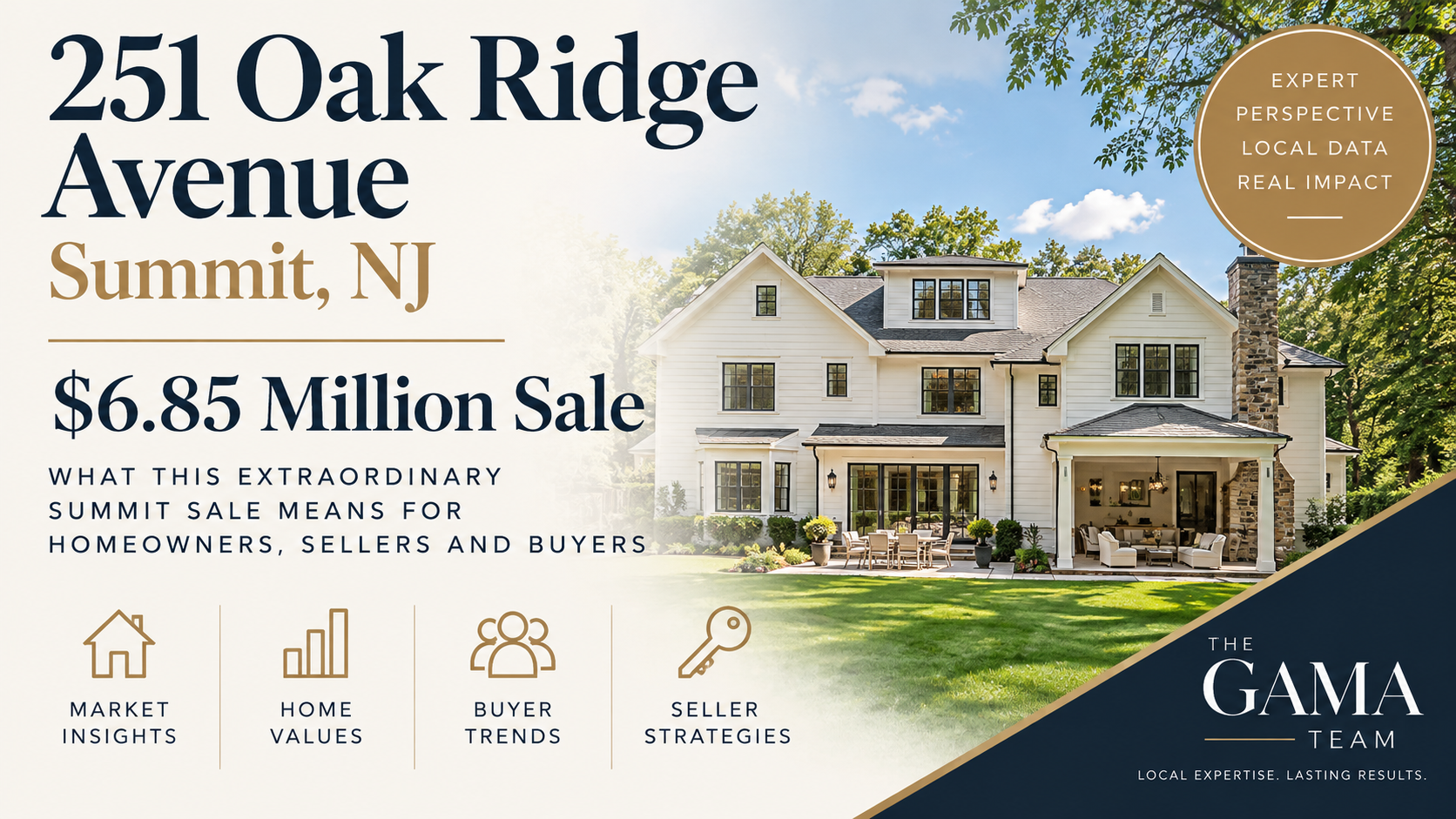
251 Oak Ridge Avenue Sells for $6.85 Million: What This Extraordinary Summit NJ Sale Means for Homeowners, Sellers and Buyers
Every once in a while, a home sale happens that makes even people who follow the local real estate market every day stop and look at the number twice. This summer, that happened at 251 Oak Ridge Avenue in Summit, New Jersey, where an exceptional five-bedroom luxury residence sold for $6,850,000 on July 15, 2026. The number alone is impressive, but what makes the transaction particularly interesting is how the entire deal came together. According to the Garden State Multiple Listing Service report, the property was listed for $6,850,000 and sold for exactly $6,850,000. The transaction was reported as cash, and the MLS shows zero days on market. For a residential sale approaching $7 million in suburban New Jersey, those are remarkable numbers.
The property itself helps explain why this was anything but an ordinary Summit sale. The home was described as a 2021-era Colonial situated on approximately 0.63 acres, with five bedrooms, five full bathrooms, two half bathrooms and an oversized three-car attached garage. The amenities go far beyond what we typically see even in beautifully renovated Summit homes. The property includes a heated gunite pool, cabana, outdoor kitchen, elevator, four fireplaces, golf simulator, fitness studio, lounge, mudroom, pet spa, additional laundry facilities and in-law accommodations. The MLS credits Valerie Grant Interiors with the interior design and John James Architecture with the architecture, and the listing description emphasizes the relationship between the interior spaces and the pool, terraces, cabana and landscaped grounds outside.
It would be easy to look at a transaction like this and simply write a story about a nearly $7 million house selling in Summit. The much more useful question, especially for anyone who already owns a home in Summit or is thinking about moving here, is what this sale actually tells us about the Summit NJ real estate market. Does it change Summit home values? Does it tell us anything about what today's luxury buyers are willing to pay for? Does it affect homeowners with properties worth $2 million, $3 million or $4 million? What does it tell us about renovation, land value, new construction and the premium buyers may place on a truly turnkey home?
A single extraordinary sale does not suddenly make every house in Summit more valuable, and homeowners should be very careful about drawing that conclusion. What 251 Oak Ridge Avenue does provide, however, is a significant new data point at the very top of the market. It shows us that when location, land, architecture, design, condition, amenities, scarcity and the right buyer all come together, the upper end of the Summit luxury market can reach a level dramatically above where the typical home trades. For certain Summit homeowners, that is important information.
What Exactly Sold at 251 Oak Ridge Avenue in Summit NJ?
Before trying to understand what the $6.85 million transaction means for other properties, it is important to understand what actually sold. According to the MLS, 251 Oak Ridge Avenue is a five-bedroom Colonial built or substantially completed around 2021 on approximately 0.63 acres. The reported lot dimensions are approximately 120 by 200 feet, and the home includes five full bathrooms, two half bathrooms and an oversized three-car attached garage. The original list price, final list price and reported sale price were all $6,850,000.
The architecture and interior design are a significant part of the property's story. The listing credits Valerie Grant Interiors with the interiors and John James Architecture with the architecture. The MLS description highlights herringbone floors, tailored millwork, high ceilings and significant natural light, along with a floor plan that moves from the more formal living spaces into the kitchen, breakfast area and family room. Rather than treating those rooms as separate destinations, the design appears to have been centered around the way a family actually lives, with the kitchen and family room functioning as the heart of the house.
The connection to the exterior is equally important. Walls of glass open toward a covered outdoor room with a vaulted wood ceiling and fireplace, and that space continues toward the heated pool, cabana, terraces and landscaped grounds. Upstairs, the primary suite includes a private bathroom, sitting room and two dressing rooms, while the lower level contains a golf simulator, fitness studio, lounge, mudroom, pet spa and additional laundry. There is also an elevator, an in-law suite with a bedroom and full bathroom, wet and dry bars, multiple fireplaces, a generator and an outdoor kitchen.
When all of those characteristics are considered together, it becomes clear why simply comparing this house with another five-bedroom Summit Colonial would not tell us very much. At this level of the market, the buyer is not purchasing a bedroom count or even square footage alone. The buyer is purchasing the entire experience of the property, including the land, architecture, design, amenities, functionality and the fact that everything has already been completed.
Is 251 Oak Ridge Avenue the Most Expensive Home Ever Sold in Summit?
This is naturally one of the first questions people ask when they hear about a residential sale approaching $7 million. The $6.85 million Oak Ridge transaction is unquestionably an extraordinary Summit luxury sale and one of the most significant recent publicly visible residential transactions in the city. However, I would be careful about definitively calling it the highest residential sale in Summit history without reviewing the complete historical Garden State MLS record along with private and off-market transactions.
That distinction matters because luxury real estate does not always appear neatly in public databases. Some high-end properties trade privately, older transactions may be recorded differently, and consumer-facing real estate websites do not necessarily capture every transaction with complete accuracy. For that reason, the responsible way to describe 251 Oak Ridge Avenue is as an extraordinary recent Summit luxury benchmark and one of the city's most notable high-end residential transactions.
Frankly, the sale does not need a record-breaking label to be remarkable. A Summit home selling for $6.85 million at its full asking price, with cash terms and zero reported days on market, already gives us plenty to analyze. The much more interesting question is why a buyer was willing to pay that amount and what characteristics made this particular property valuable enough to command it.
Why Would a Buyer Pay $6.85 Million for a Home in Summit?
Luxury real estate behaves differently from the middle of the housing market. At more conventional price points, much of a property's value can often be explained through familiar measurements such as square footage, bedrooms, bathrooms, lot size, location, condition and comparable sales. Those things still matter enormously at the luxury level, but as properties become more expensive and more unique, scarcity begins to play a much larger role.
A buyer considering a property like 251 Oak Ridge Avenue is not simply asking how many square feet they are receiving for $6.85 million. They are evaluating how difficult it would be to find another house offering the same combination of location, lot size, privacy, architecture, design, condition, amenities and functionality. That distinction becomes incredibly important in a mature community such as Summit, where desirable land is finite and truly exceptional newer homes do not become available every day.
Consider two houses that are roughly the same size and have the same number of bedrooms. One might have an older floor plan, smaller windows, a dated primary suite, a two-car garage, a relatively basic finished basement and limited backyard privacy. The other might offer professionally designed architecture, abundant natural light, a kitchen and family room opening directly to sophisticated outdoor living, a pool and cabana, mature landscaping, an elevator, a three-car garage, a fitness studio, a golf simulator and flexible accommodations for extended family or guests. On a spreadsheet, those properties may appear surprisingly similar. To a buyer walking through them, they are entirely different products.
This is one reason price per square foot becomes less reliable as properties become more unique. Buyers are not purchasing raw square footage. They are purchasing what that square footage allows them to experience. A beautifully planned 5,000-square-foot house can feel more valuable and more livable than a poorly planned home that is significantly larger. At the luxury level, execution matters tremendously.
The Real Luxury May Be Not Having to Build It Yourself
One of the most overlooked reasons a completed luxury residence can command such a substantial premium is time. Imagine that you have the financial ability to spend $6 million or $7 million on a home and want something similar to 251 Oak Ridge Avenue. One option would be to find an older property on an appropriate Summit lot and create the house yourself. That may sound straightforward until you begin considering everything involved.
First, you need to find the right property and successfully purchase it. Then you need an architect, plans, engineering and municipal approvals. You need a builder and an enormous number of decisions involving the kitchen, bathrooms, flooring, windows, doors, millwork, mechanical systems, lighting, technology and exterior materials. If the vision includes a pool, cabana, outdoor kitchen and professionally designed landscaping, those become substantial projects of their own. After construction comes furnishing the home, installing window treatments and completing all of the smaller details that turn a newly built structure into a finished residence.
A sophisticated custom build or extensive luxury renovation can take years from the initial property search until the house is truly complete. During that period, the homeowner is absorbing not only construction costs but also time, uncertainty, decision fatigue, delays and the risk that the final product may cost considerably more than originally expected. A buyer purchasing a completed property avoids most of that uncertainty. The landscaping is established, the pool is finished, the architecture can be experienced rather than imagined, and the buyer knows exactly what they are getting.
That convenience has real economic value. The buyer is not merely paying for lumber, stone, cabinetry and appliances. They are also paying for certainty and time. For busy executives, entrepreneurs and families relocating from Manhattan, Brooklyn, Hoboken, Jersey City or elsewhere, the ability to purchase a fully realized home rather than spend several years creating one can be extremely valuable.
The 2020 Sale Makes the Story Even More Interesting
Public property history adds another fascinating layer to the Oak Ridge story. The property reportedly sold for approximately $1.6 million in September 2020, while the current residence is identified as approximately 2021 construction. Six years later, the property sold for $6.85 million, representing a difference of approximately $5.25 million.
It would be completely misleading to look at those two numbers and conclude that Summit homes appreciated by more than 300 percent in six years. The asset itself changed dramatically. The buyer in 2020 did not simply purchase the same finished residence and wait for the market to increase its value. The property was subsequently rebuilt or substantially transformed into something very different.
This is a perfect example of the difference between market appreciation and value creation. Market appreciation is what happens when the overall housing market rises. Value creation occurs when an owner changes the property through construction, architecture, design, layout, landscaping or other substantial improvements. The enormous difference between the 2020 and 2026 transactions appears to reflect both the strength of the Summit real estate market and the value of what was subsequently created on the property.
That distinction is extremely important for Summit homeowners considering whether to renovate, expand, rebuild or sell their existing home as-is. A spectacular finished-home sale does not prove that every expensive renovation will produce an equally impressive return. It does show that buyers can place enormous value on the right finished product when the execution, location and underlying property all support it.
What the $6.85 Million Sale Tells Us About the Summit NJ Housing Market
The most important thing to understand is that 251 Oak Ridge Avenue is not representative of the typical Summit transaction. Summit is an expensive and highly desirable suburban market, but most buyers are not spending nearly $7 million on a home. The city contains a broad spectrum of housing, including condos, townhomes, smaller older houses, Colonials and Tudors, extensively renovated properties, newer construction and large estate-style residences.
Rather than thinking of Summit as one single housing market, it is more useful to think of several overlapping markets operating simultaneously. A buyer searching around $1.2 million is making very different compromises from someone shopping at $2 million. A $3 million buyer has different expectations again, and by the time a purchaser reaches the $5 million or $6 million range, the number of both available properties and qualified buyers becomes dramatically smaller.
That is exactly why the Oak Ridge transaction matters. It does not tell us where the center of Summit's market is. It tells us something about the upper boundary of buyer demand. The middle of a market helps us understand what a typical buyer is paying, while an exceptional transaction helps us understand what a buyer may be willing to pay when a property offers something unusually difficult to reproduce.
For the owner of a typical Summit home, that distinction is interesting but may not directly change value. For someone who owns a particularly large lot, significant newer construction, an architecturally important residence or a comprehensively renovated luxury property, however, an upper-end transaction can become much more relevant.
Does This Sale Make Other Summit Homes More Valuable?
One of the first questions Summit homeowners may have after seeing a $6.85 million transaction is whether it increases the value of their own house. The answer is more nuanced than simply saying yes or no. A single luxury sale does not automatically reprice every home in town, and 251 Oak Ridge Avenue would not be an appropriate direct comparable for the overwhelming majority of Summit properties.
What the sale can do is provide additional evidence about the depth of demand at the upper end of the market. It demonstrates that a buyer was willing to commit $6.85 million to the right Summit property, which can become relevant when evaluating other homes that share some of the same difficult-to-reproduce characteristics. The closer another property is to Oak Ridge in terms of lot quality, construction, condition, architecture, privacy and amenities, the more useful the transaction may become as part of a broader valuation analysis.
For the owner of a modest three-bedroom home, the direct effect is probably minimal. For the owner of a newer or comprehensively renovated property on a substantial lot with a pool, three-car garage, exceptional primary suite, sophisticated outdoor environment or other luxury characteristics, the transaction may be far more meaningful. The important concept is similarity rather than simple geographic proximity. A house does not become a comparable merely because it happens to sit a few streets away.
Why This Sale Matters More to Summit's $3 Million, $4 Million and $5 Million Homeowners
The higher you move in the Summit market, the thinner the comparable-sales data becomes. At more common price points, there may be many transactions available for analysis over a relatively short period. At $4 million or $5 million, the number of truly relevant properties can become extremely small, and certain houses are so unusual that there may not be a perfect comparable anywhere nearby.
That is where an upper-end benchmark such as 251 Oak Ridge Avenue becomes particularly useful. It does not mean another large Summit residence should automatically be valued near $6.85 million, but it gives homeowners, buyers and real estate professionals another example of what the market has actually supported. When comparable data is scarce, each relevant high-end transaction becomes more meaningful.
There is also a psychological component. If buyers perceive that the absolute top of a market is somewhere around $3.5 million, then a $3 million house can feel extremely close to the ceiling. When buyers see successful transactions occurring well above that level, the $3 million and $4 million segments occupy a different place within the broader luxury spectrum. Buyers still care about value, but their frame of reference changes.
Why Two Summit Homes With Similar Square Footage Can Sell Millions Apart
One of the most common questions homeowners ask is why two houses that appear similar online can produce dramatically different sale prices. The answer is that buyers do not purchase bedroom counts or square-foot measurements in isolation. They buy the combination of the house, land, location and lifestyle.
Lot dimensions can create an enormous difference in value, as can topography. A flat, private backyard with room for a pool is fundamentally different from the same acreage on a steep slope. Street traffic matters, privacy matters and the way a house sits on the property matters. Natural light, ceiling height, room proportions, the location and quality of the primary suite, the garage, outdoor space and the relationship between the kitchen and backyard all influence the way a buyer experiences a home.
Renovation quality can create an equally dramatic difference. One property described as “renovated” may have received new kitchen cabinets and updated bathrooms, while another may have undergone a complete architectural reworking in which windows, ceiling heights, millwork, sight lines and room relationships were carefully reconsidered. Both may appear under the same online search filters, but buyers can usually recognize the difference immediately when they walk inside.
This is why relying too heavily on price per square foot can be particularly dangerous when evaluating Summit luxury real estate. The number can provide context, but it cannot explain why one home feels exceptional while another feels ordinary.
Why the Lot at 251 Oak Ridge Avenue Matters
One of the characteristics that stands out at 251 Oak Ridge Avenue is the approximately 0.63-acre lot with reported dimensions around 120 by 200 feet. In an established community like Summit, land can become increasingly valuable because the supply of desirable building sites is fixed.
A homeowner can replace a kitchen, remodel a bathroom, refinish floors or redesign a primary suite. It is much harder to make a narrow lot wider, create additional backyard depth or manufacture privacy where none exists. Once an established neighborhood is largely built out, high-quality land becomes genuinely scarce.
That does not mean every large lot is equally valuable. Two properties containing the same acreage may have very different usability. One may be flat, rectangular and private, while another may have substantial slope, unusual dimensions, easements or other limitations. Frontage, setbacks, topography, drainage, orientation and zoning can all influence what a buyer or builder can actually do with the property.
This is particularly important for owners of older Summit homes who receive unsolicited offers from builders. Sometimes the house itself is not the only source of value. The underlying land may have significant redevelopment potential, and homeowners should understand that potential before accepting an off-market offer.
How High-End Summit Sales Can Affect Builder Offers
Builders generally evaluate redevelopment opportunities by working backward from the potential value of the finished product. They estimate what a completed new home might sell for and then subtract demolition, architecture, engineering, approvals, financing, construction, landscaping, taxes, carrying costs, selling expenses, contingency and profit. What remains influences the amount they can afford to pay for the underlying property.
When the market demonstrates that exceptional finished homes can sell at increasingly high numbers, the economics of certain redevelopment properties can change. That does not mean every Summit teardown becomes more valuable because 251 Oak Ridge Avenue sold for $6.85 million. Construction costs, zoning, lot width, setbacks, neighborhood characteristics and the potential finished product still control the calculation.
What it does mean is that owners of desirable lots should understand the property from more than one perspective. The best buyer may be a family that wants to live in the existing house, someone who wants to renovate it or a builder who sees an entirely different opportunity. The highest-value use is not always obvious until those possibilities are compared.
Builder Offer Versus Selling a Summit Home on the Open Market
An off-market builder offer can be incredibly appealing because it may come with cash terms, no staging requirements, no repair requests, fewer showings and a flexible closing schedule. For a homeowner who has lived in the property for decades and wants a simple transition, that convenience can have genuine value. The important question is whether the convenience outweighs the potential difference in net proceeds if the property were exposed to the open market.
Imagine a builder offers $1.8 million for a property. The homeowner may be thrilled with the ability to sell without preparing the house. However, if an end user would potentially pay $2.1 million, the seller should understand that difference before making a decision. Preparation costs, commissions, carrying expenses, inspection exposure and timing all need to be considered, but those numbers can be estimated.
Sometimes the builder offer will still be the best choice. Sometimes an open-market sale may produce a dramatically stronger outcome. There is no universal answer, but sellers should make the decision with information rather than assuming the easiest offer is automatically the most profitable one.
What the Oak Ridge Sale Tells Us About Renovation Quality
One conclusion homeowners should not draw from this transaction is that everyone needs to renovate before selling. The more useful lesson is that the market can reward exceptional execution, which is very different from simply spending money.
A homeowner can spend hundreds of thousands of dollars on improvements that buyers do not particularly value. Another homeowner can spend far less and substantially improve marketability by correcting the right issues. High-end buyers tend to be particularly sensitive to cohesion. They notice when the kitchen belongs to one design era while the bathrooms belong to another, when flooring changes awkwardly between rooms, when additions do not flow naturally or when the scale of windows and ceiling heights feels inconsistent.
Buyers also increasingly care about how a house functions in everyday life. The Oak Ridge amenity list is interesting because it includes not only impressive entertaining spaces but also a mudroom, additional laundry, fitness studio, in-law accommodations and a pet spa. Those features are not merely decorative. They solve everyday problems.
Modern luxury is increasingly about making daily life easier. A spectacular dining room may impress someone during a showing, but a beautifully designed mudroom may improve the owner's life every single day. The strongest luxury properties tend to do both.
Should You Renovate Your Summit Home Before Selling?
There is no universal answer because the right decision depends on the property, the likely buyer and the seller's timeline. If you are two or three years away from selling and there are improvements you will personally enjoy while also improving resale, the calculation may make sense. If you plan to sell within six months, the strategy can be completely different.
The first question should not be, “What should we renovate?” It should be, “Who is most likely to buy this house, and what will matter to that buyer?” For some properties, updating a kitchen can dramatically expand the buyer pool. For others, the likely buyer is going to renovate regardless of what the seller does, making an expensive new kitchen immediately before selling a poor investment.
The same logic applies to bathrooms, finished basements, pools and other substantial projects. This is why homeowners should ideally speak with an experienced local real estate professional before beginning major pre-sale improvements. Sometimes one of the most valuable things we can tell a seller is that a project they were about to spend $100,000 on probably will not meaningfully change their sale price.
Why Sellers Often Fix the Wrong Things Before Listing
After living in a house for many years, homeowners naturally stop seeing certain things the way a buyer sees them. They may no longer notice that the foyer feels dark, that landscaping has grown over the front windows, that oversized furniture makes the family room feel smaller or that closets appear cramped because they are completely full.
At the same time, a seller may become focused on replacing a bathroom vanity or installing an expensive new countertop that buyers would not have objected to in the first place. This is why pre-listing preparation should begin by identifying buyer objections rather than creating an endless list of potential upgrades.
A strong pre-sale evaluation looks at what buyers are likely to notice first, what makes the property feel dated, what photographs poorly, which rooms feel smaller than they actually are, what issues may surface during inspection and which improvements could meaningfully change the buyer's perception. The objective is not to make every part of the house new. The objective is to spend money where it has the greatest chance of affecting the outcome.
Indoor-Outdoor Living Has Become a Major Luxury Feature
One of the strongest aspects of the Oak Ridge property is the relationship between the interior and exterior. The MLS describes walls of glass opening to a covered outdoor room with a vaulted wood ceiling and fireplace, which then connects to the pool, cabana, terraces and landscaped grounds.
That is significantly different from simply having a backyard or even simply having a pool. At the upper end of today's real estate market, outdoor spaces are increasingly treated as extensions of the interior living environment. Buyers respond differently to a pool placed in the middle of a lawn than they do to a property where the architecture, covered patio, outdoor kitchen, pool, landscaping and hardscaping all feel like parts of one cohesive design.
This is another example of why features should not always be valued individually. The pool has value, the cabana has value and the outdoor kitchen has value, but the greater premium may come from the way all of those elements work together. Buyers are often paying for the experience of the complete property rather than adding up the cost of each individual improvement.
Does a Pool Add Value to a Summit NJ Home?
A pool can absolutely add value to certain Summit properties, particularly at the luxury level, but there is no universal dollar amount that applies to every house. The value depends heavily on placement, privacy, condition, landscaping, hardscaping and how much usable yard remains after the pool is installed.
A dated pool requiring substantial repairs can create a completely different buyer reaction from a sophisticated heated pool surrounded by attractive terraces and connected to an outdoor kitchen or cabana. Similarly, a pool that consumes nearly the entire backyard may appeal to a different buyer than one that leaves substantial lawn and entertaining space.
The Oak Ridge property is a good example of the pool functioning as one part of a much larger lifestyle package. That is very different from simply checking a box on an MLS sheet indicating that the property has an in-ground pool.
Why a Three-Car Garage Can Be More Valuable Than Sellers Expect
The three-car garage at 251 Oak Ridge Avenue is not the most glamorous feature in the listing, but it is more important than it may initially appear. In established communities like Summit, garages can be surprisingly difficult to expand because adding another bay may involve setbacks, lot coverage, architecture and significant construction.
For households with multiple vehicles, teenage drivers, bicycles, sports equipment or substantial storage needs, additional garage capacity can be extremely useful. As the price of a property rises, buyers also tend to expect the supporting infrastructure of the house to match the lifestyle. A buyer spending several million dollars may be much less willing to compromise on garage capacity than someone shopping at a lower price point.
This is another example of scarcity creating value. If most comparable properties have two-car garages and one exceptional house has three, that difference may matter more than the raw construction cost of the additional bay.
Why the Elevator Is About More Than Luxury
An elevator may initially sound like an extravagant amenity, but in a substantial multi-level residence it can be highly practical. It makes it easier to move groceries, luggage and household items between floors, supports multigenerational living and can allow owners to remain comfortably in the property as they age.
This reflects a broader change in what buyers consider luxury. Some of the most valuable high-end amenities are increasingly features that combine convenience with sophistication. Buyers may appreciate the visual impact of a beautiful room, but they also appreciate a house that makes everyday life easier.
An elevator, mudroom, second laundry area, fitness studio and flexible guest accommodations all contribute to that kind of functionality. None of those features alone explains a $6.85 million price, but together they help create a property that feels unusually complete.
The In-Law Suite Reflects the Way Families Actually Live
The MLS identifies an in-law suite with a bedroom and full bathroom, and that kind of flexibility has become increasingly important to buyers. Families may want accommodations for parents, adult children, a nanny, caregiver or long-term guests. Even buyers who do not need the arrangement immediately may value having the option in the future.
A thoughtfully incorporated secondary living arrangement also feels very different from a makeshift basement bedroom added simply to increase the bedroom count. Location within the house, access to a full bathroom, privacy and the quality of the surrounding space all influence whether buyers see it as genuinely useful.
As households become more multigenerational and buyers think more about how a house will serve them over a longer period, flexible spaces can become meaningful contributors to value.
Even the Golf Simulator and Pet Spa Tell Us Something About Today's Luxury Buyer
The lower level at 251 Oak Ridge includes a golf simulator, fitness studio, lounge, mudroom, pet spa and additional laundry. While a pet spa may sound like a small or even amusing detail, it actually illustrates something interesting about the evolution of luxury housing.
Luxury was once defined heavily by formal spaces such as grand dining rooms, elaborate living rooms and impressive foyers. Those spaces still matter, but today's buyers increasingly value convenience and functionality. A well-designed mudroom may improve daily family life more than a formal room used a few times a year. A home gym removes a commute, additional laundry simplifies household routines and a dedicated pet-washing area prevents muddy paws from traveling through the rest of the house.
These features may not be the first thing someone notices in a photograph, but they are the kinds of details owners use constantly. The modern luxury buyer increasingly wants a home that is both beautiful and exceptionally easy to live in.
The Lower Level Shows Why “Finished Basement” Does Not Tell Us Enough
Sellers often describe a property as having a finished basement as though every finished basement should contribute similar value. In reality, there can be an enormous difference between a lower level containing basic flooring, drywall and a television and one that functions as a true extension of the home.
Ceiling height, natural light, climate control, bathroom quality, access and layout all matter. The intended use of the space matters as well. A lower level containing a thoughtfully designed gym, lounge, golf simulator, laundry and mudroom provides a very different experience from generic overflow square footage.
This is true at every price point, although expectations rise substantially as the price rises. Buyers paying several million dollars generally expect lower-level spaces to feel consistent with the quality and functionality of the rest of the home.
What Does the Oak Ridge Sale Mean for a $1.5 Million or $2 Million Summit Home?
For a homeowner in this price range, the direct impact is probably smaller than some sellers may hope. Oak Ridge is not an appropriate direct comparable for a typical $1.5 million or $2 million Summit property because the houses are simply too different in terms of construction, land, amenities and overall positioning.
The transaction can still contribute to the broader perception of Summit as a market capable of attracting significant purchasing power, but homeowners should focus primarily on what buyers are paying for properties that actually compete with theirs. A strong luxury sale does not automatically pull every price tier upward by the same percentage.
The useful question for a $2 million homeowner is not how much Oak Ridge adds to their value. It is what buyers are currently willing to pay for the best homes in their actual competitive category and what separates their property from the alternatives those buyers can purchase.
What Does the Sale Mean for a $3 Million or $4 Million Summit Home?
This is where the transaction begins to become more relevant. When buyers see the upper end of a market expand, a $3 million or $4 million residence occupies a different position within the luxury spectrum. That can influence perception, particularly when the property itself offers characteristics associated with Summit's stronger high-end sales.
Quality still matters enormously. A beautifully renovated $3 million home can perform very differently from a dated property at the same asking price even when their square footage and bedroom counts appear similar. Buyers at these levels become increasingly selective, and they often have the financial ability to consider several towns rather than compromise on a property they do not love.
For homeowners with exceptional properties, the Oak Ridge transaction provides another important piece of evidence that Summit can support substantial luxury pricing when the property justifies it.
The Very High-End Summit Market Is Real, but It Is Still Thin
A $6.85 million transaction demonstrates genuine purchasing power at the top of Summit's market, but sellers should not interpret that as evidence that every home priced above $5 million will sell easily. Luxury markets are thin by definition. There are fewer competing properties, but there are also fewer qualified buyers.
That makes positioning particularly important. A $1.5 million property may appeal to a broad group of buyers already searching in Summit, while a $6 million property may have a much smaller number of realistic purchasers during any given period. Identifying those buyers, reaching the agents who represent them and presenting the property in a way that clearly communicates why it is worth its price become increasingly important as the price rises.
Luxury sellers have less room for mediocre marketing because the pool of potential buyers is already limited. Every qualified buyer matters.
What Zero Days on Market Really Tells Us
The Garden State MLS report shows zero days on market for 251 Oak Ridge Avenue. That does not necessarily mean the house appeared online one morning and somebody purchased it that afternoon. At the upper end of real estate, substantial networking can happen before broad public exposure. Agents know buyers, buyers tell agents what they are waiting for and properties may be discussed privately before the general market becomes aware of them.
What the reported zero days does tell us is that this was not a property that spent months publicly searching for a buyer while undergoing repeated price reductions. A buyer and seller aligned extremely quickly at a reported $6.85 million sale price.
At this price level, that is significant. It is also a reminder that the public launch of a listing is only one part of the selling process. Much of the most important work should happen before the property officially appears on the market.
Marketing a Summit Home Starts Before It Hits the MLS
One of the biggest misconceptions about selling a home is that the marketing process begins when the listing becomes active. By that point, a substantial amount of work should already be finished. The property should have been evaluated room by room, necessary repairs should be addressed, staging decisions should be made, photography and video should be planned, the likely buyer should be identified and the pricing strategy should already be established.
For distinctive properties, agents who may represent the likely buyer should also know that something is coming. Marketing materials should be ready before launch rather than created after the listing is already active. This becomes particularly important for luxury properties because the buyer pool is smaller and the value story is often more complicated.
The MLS is an extremely important distribution system, but it is not the entire marketing strategy. Putting a home into the MLS does not automatically explain why a buyer should choose it over everything else available.
A Summit Home Should Be Positioned, Not Simply Listed
There is a meaningful difference between listing a house and positioning it. Listing means entering the property details, photographs and description into the MLS. Positioning means understanding exactly why a buyer should care about this particular house.
For one Summit property, the story may be its proximity to downtown. For another, it may be a large level lot, extraordinary architecture, a recent renovation, a pool, privacy, a first-floor suite or redevelopment potential. The strongest listings identify that competitive advantage and make it easy for buyers to understand.
Oak Ridge had a very clear value story. It offered exceptional design, a significant lot, turnkey condition, sophisticated indoor-outdoor living and an unusually complete collection of luxury amenities. The property did not need to appeal to every buyer. It needed to resonate strongly with the right one.
What a $6.85 Million Cash Sale Tells Us About the Buyer Pool
The MLS reports the Oak Ridge transaction as cash. A cash purchase at this level demonstrates the financial capacity that exists among at least some buyers targeting Summit's upper-end market, although it certainly does not mean every luxury buyer is purchasing without financing.
For sellers, the more useful lesson is that an offer should always be evaluated as a complete package rather than simply by looking at the purchase price. Financing, appraisal exposure, inspection terms, closing dates and contingencies can all influence the strength of an offer.
There are circumstances where a slightly lower cash offer may be more attractive than a higher financed offer because it reduces certain transaction risks. In another situation, the higher financed offer may clearly be the better choice. The important thing is to understand what each term means rather than automatically assuming that the highest number on the page is the strongest offer.
What This Sale Means for Buyers Moving to Summit NJ
If you found this article because you are researching moving to Summit NJ, homes for sale in Summit NJ or simply trying to understand how much it costs to live here, the $6.85 million Oak Ridge transaction should not be viewed as representative of the entire housing market. This is an extraordinary upper-end property, not the typical Summit home.
Summit contains a wide variety of housing, including older Colonials and Tudors, expanded homes, renovated historic properties, condos, townhouses, newer construction and large luxury residences. The useful question is not simply how much a Summit house costs. It is what a particular budget buys in the parts of Summit that best fit the buyer's priorities.
A household that values proximity to downtown may make different compromises from someone whose priority is a large private lot. Another buyer may care most about newer turnkey construction, while someone else may specifically want an older house with architectural character and renovation potential. Understanding those differences is much more useful than looking at one townwide number.
Why Buyers Continue to Consider Summit NJ
Summit's appeal comes from a combination of characteristics rather than one single feature. The city has an established downtown with restaurants, shops and everyday conveniences, residential neighborhoods containing a wide range of architecture and transportation connections serving the broader New York metropolitan area. Summit's public-school system includes primary centers, elementary schools, Lawton C. Johnson Summit Middle School and Summit High School.
For many relocating buyers, particularly those coming from Manhattan, Brooklyn, Hoboken or Jersey City, the attraction is the ability to live in an established suburban environment while remaining connected to a traditional downtown and the broader New York region. Some areas offer significant walkability, while other parts of Summit provide larger properties and more privacy.
The housing stock itself also creates variety. Buyers can choose among older homes with architectural character, renovated properties and highly sophisticated newer construction. That diversity allows Summit to appeal to different types of households and different budgets, including the very high-end buyer represented by the Oak Ridge transaction.
Summit Luxury Sellers Are Not Only Competing With Other Summit Homes
One of the most important things luxury sellers need to understand is that buyers do not always shop within municipal boundaries. A household with $3 million or $4 million to spend may be considering Summit while simultaneously looking at Short Hills, Chatham, Madison, Westfield and other nearby communities.
That means a seller's real competition may not be the house around the corner. It may be whatever else the buyer can purchase within the broader geographic area they are considering. If an exceptional Summit property, a beautiful Short Hills home and an impressive Chatham new construction residence are available at the same time, all three may be competing for the same household.
This is why pricing luxury real estate sometimes requires a wider lens than simply looking at nearby sales. Buyers are comparing lifestyles and opportunities, not municipal boundaries.
How Should a Summit Seller Think About Pricing After a Sale Like This?
The wrong response would be to take the previous estimate of a home's value and simply increase it because Oak Ridge sold for $6.85 million. Pricing should begin by identifying the property's actual competitive category.
That means examining the most relevant recent sales and understanding which characteristics drove their values. It also means looking at active competition because sellers are not competing only with houses that sold six months ago. They are competing with whatever buyers can purchase right now.
Imagine historical comparable sales suggest a Summit property is worth approximately $2.5 million. If there are five excellent renovated homes currently available between $2.4 million and $2.7 million, that competition matters. If there is not one comparable property available, the historical sales have not changed, but the seller's competitive environment has. Scarcity can influence buyer behavior and may affect how aggressively a property can be positioned.
This is why pricing is not simply averaging several sold properties. It requires understanding both historical evidence and current market conditions.
Why Overpricing Can Still Hurt in a Strong Summit Market
Strong demand does not mean buyers have stopped caring about value. In fact, buyers searching in towns like Summit can become extremely knowledgeable because many of them spend months watching the market before purchasing. They know which homes sold quickly, which properties sat, which listings were reduced and how renovated homes compare with unrenovated ones.
When a property comes to market significantly above where buyers perceive its value, many buyers do not immediately make a lower offer. They simply wait. That can be dangerous because the first part of a listing's life is often when the largest group of active buyers is paying attention.
Once those buyers decide that a property is overpriced, it can be difficult to completely recreate the initial excitement later, even after a price reduction. A strong market rewards good pricing, but it does not eliminate the consequences of poor positioning.
The Oak Ridge transaction presents a very different story. The reported asking price and sale price were both $6.85 million, with zero reported days on market. Whatever occurred behind the scenes, the property, pricing and buyer aligned quickly.
Why Underpricing Is Not Automatically the Answer Either
Another overly simplistic piece of real estate advice is that every seller should intentionally price low and create a bidding war. That strategy can work extremely well for certain properties and price points, but it is not universally appropriate.
At a price range where dozens of qualified buyers may compete for the same house, strategic pricing can create tremendous urgency. At $6 million, the buyer pool is naturally much smaller. Pricing a luxury property artificially low does not magically create twenty additional households capable of purchasing it.
The right strategy depends on the property, available competition, depth of the buyer pool, current market conditions and the seller's goals. Pricing should not be treated as a gimmick. It should be designed to generate the strongest possible response from the actual buyers who exist.
Why Some Buyers Pay More Than Comparable Sales Suggest
Residential real estate is data-driven, but it is not purely mathematical. Some homes perform almost exactly as comparable sales suggest they should, while others create an emotional response that changes buyer behavior.
A buyer walks into a house and the kitchen opens perfectly to the family room. The natural light is exceptional. The backyard feels private. The primary suite feels peaceful. The home office is exactly where it needs to be, and the mudroom solves a daily problem the buyer has been dealing with for years. Suddenly the buyer can imagine Thanksgiving dinner, summer evenings outside and children coming home after school.
At that point, the buyer is no longer evaluating only a spreadsheet. They are thinking about what happens if someone else buys the house.
That is where urgency comes from, and urgency can create value. This does not mean emotion replaces market data, but it helps explain why certain properties outperform what a purely mathematical analysis might predict.
Why Natural Light and Layout Can Have Such a Large Impact
Natural light is difficult to quantify on an appraisal adjustment sheet, but buyers experience it immediately. Bright rooms photograph better, often feel larger and make materials look richer. The relationship between interior and exterior becomes more visible, and the entire house can feel more inviting.
Layout works similarly. A poorly planned 6,000-square-foot home can feel less usable than a beautifully designed property that is significantly smaller. Buyers respond to circulation, sight lines, room proportions and the relationship between spaces even when they cannot explain exactly what they are reacting to.
When someone walks into a house and says it “just feels right,” they are often responding to dozens of architectural decisions simultaneously. At the luxury level, those qualitative differences can represent significant value.
Why Staging Still Matters in an Expensive Home
Some homeowners assume that a beautiful luxury property does not need staging, but staging is not about disguising a bad house. Good staging helps buyers understand architecture, scale and lifestyle. It establishes appropriate circulation, directs attention toward the property's strongest characteristics and reduces distractions.
Sometimes the most effective staging decision is removing furniture rather than adding it. An oversized sectional can make a substantial family room appear small. Heavy window treatments can hide natural light. A dark rug can cover beautiful flooring, while too many personal objects can make buyers focus on the current owner's life rather than imagining their own.
The goal is not to remove every trace of personality and make the house feel like a hotel. The goal is to make the architecture and lifestyle easy for the buyer to understand.
Your First Showing Usually Happens Online
Long before a buyer walks through the front door, they have already formed opinions about the property. They have seen the lead photograph, kitchen, family room, primary suite, backyard and pool. They may have looked at taxes, maps, nearby sales and school information. They may already have forwarded the listing to a spouse, friend or parent.
By the time the buyer arrives for the physical showing, expectations have already been created. This is why professional photography is not simply a cosmetic marketing expense. A beautiful property can look remarkably ordinary when photographed poorly, and buyers make decisions quickly when scrolling through listings online.
High-quality marketing cannot manufacture value that does not exist, but it can make sure buyers recognize the value that is already there.
Why Video Can Matter for a Summit Luxury Listing
Photography captures individual rooms beautifully, but video can communicate something photographs often cannot: movement through the property. It allows a buyer to see how the foyer connects to the living spaces, how the kitchen relates to the family room and how the family room opens toward the backyard.
For a luxury residence, those relationships can be an important part of the property's value. The home is not simply a collection of attractive rooms. It is the experience of moving through those rooms and understanding how the entire property functions.
This can be particularly important for relocation buyers who may be evaluating Summit homes while still living in New York City or elsewhere. The more completely they can understand the property before arriving, the more meaningful the eventual showing becomes.
What If Your Summit Home Is Completely Unrenovated?
An older Summit home does not need to resemble 251 Oak Ridge Avenue to have significant value. In some cases, the very things that make a property different from new construction are what buyers find appealing. The home may contain original architectural details, sit on an unusually desirable lot or offer renovation and expansion possibilities that are difficult to find elsewhere.
The likely buyer may also want complete control over the renovation. In that situation, spending heavily immediately before selling could actually be counterproductive. Another property may benefit enormously from a modest cosmetic refresh without requiring structural changes.
The correct strategy could involve $20,000 or $30,000 of preparation, a substantial renovation or selling completely as-is. The answer should be based on the economics of the individual property rather than fear that buyers only want new construction. They do not. Different buyers want very different things.
The Best Time to Think About Resale May Be Years Before You Sell
Homeowners often assume they should contact a real estate agent only when they are ready to put the house on the market. In reality, a conversation two or three years before selling can be extremely useful because it allows improvements to be considered strategically rather than under pressure.
With more time, homeowners can prioritize projects they will personally enjoy while also considering future resale. A roof that needs replacement can be addressed properly, landscaping can mature, lighting can be improved and a bathroom renovation can be enjoyed for several years before the property is sold.
What I hate seeing is a homeowner who lives with a dated kitchen for twenty years, spends an enormous amount remodeling it six months before selling and never gets to enjoy it. Sometimes the renovation is financially justified, but often the homeowner would have been better off either doing it years earlier or spending much less immediately before the sale.
If You Are Selling Within Six Months, the Strategy Changes
When a sale is approaching quickly, the objective is generally not to reinvent the house. It is to maximize impact while minimizing risk, expense and delay. That often means focusing on projects such as painting, floor refinishing, lighting, landscaping, repairs, decluttering, deep cleaning and staging.
Relatively modest improvements can dramatically change how a property photographs and how buyers experience it. The objective is not to create the seller's dream home immediately before they leave. It is to make buyers see the strongest possible version of the property that already exists.
This is also where timing matters. A project that theoretically adds value but delays the listing by six months may not make sense if market conditions change during that period. Every improvement has to be evaluated within the seller's broader strategy.
What the Oak Ridge Sale Ultimately Tells Summit Sellers
The most useful lesson from 251 Oak Ridge Avenue is not that every Summit homeowner should raise their asking price. It is that buyers can pay substantial premiums when several difficult-to-reproduce characteristics come together in one property.
At the upper end of the Summit market, value is usually created by multiple elements working together rather than one dramatic feature. Lot quality, architecture, privacy, condition, layout, amenities, outdoor living and scarcity all contribute to the buyer's perception of the property, and the strongest premiums tend to appear when those elements are unusually difficult to reproduce in one home.
That is why the goal of preparing a Summit property for sale should never be to copy whichever house just achieved the highest headline price. The goal is to understand what makes your particular property difficult to replace. For one seller, that may be proximity to downtown. For another, it may be a large level lot, historic architecture, an exceptional renovation, privacy, expansion potential or a combination of several characteristics.
Every home has a different value story. The work is identifying that story and making sure buyers understand it.
What Buyers Should Take Away From the $6.85 Million Sale
Buyers should look at the Oak Ridge transaction from a different perspective. A property should not automatically be considered overpriced simply because it trades dramatically above the town's typical sale price. The better question is what it would cost, how long it would take and whether it would even be possible to recreate the same property elsewhere.
A less expensive house may require years of construction to achieve a similar result. Another property may sit on a lot that can never provide the same privacy or outdoor environment. In those situations, the premium for the turnkey home may make sense. In other circumstances, purchasing the older property and renovating it could be the better opportunity.
The important thing is to compare the complete cost and experience rather than only the purchase price. Time, construction risk, financing, temporary housing, design fees and the value of years spent managing a project should all be part of the equation.
Frequently Asked Questions About 251 Oak Ridge Avenue and Summit NJ Real Estate
How much did 251 Oak Ridge Avenue in Summit NJ sell for?
251 Oak Ridge Avenue sold for $6,850,000 on July 15, 2026. According to the Garden State Multiple Listing Service report, the original list price and final list price were also $6,850,000, meaning the property sold at its full reported asking price.
Was the $6.85 million purchase a cash transaction?
Yes. The GSMLS report identifies the transaction terms as cash. That does not mean every Summit luxury buyer is purchasing without financing, but it is a significant detail in a transaction of this size.
How long was 251 Oak Ridge Avenue on the market?
The Garden State MLS report shows zero days on market. That figure should be understood as MLS-reported market time and does not necessarily tell us whether any private conversations, networking or pre-market exposure occurred before the transaction.
How many bedrooms and bathrooms does 251 Oak Ridge Avenue have?
The property was marketed with five bedrooms, five full bathrooms and two half bathrooms. It also includes an in-law suite with a bedroom and full bathroom, providing additional flexibility for extended family or guests.
How large is the property?
The MLS reports approximately 0.63 acres with lot dimensions of roughly 120 by 200 feet. The size and usability of the lot are important parts of the property's luxury positioning, particularly because high-quality land is limited in an established community such as Summit.
When was the current residence built?
The property is reported as approximately 2021 construction. Public property history indicates an earlier transaction in 2020, which is why the increase between the 2020 and 2026 sale prices should not be interpreted as ordinary appreciation of an unchanged house.
What amenities does 251 Oak Ridge Avenue have?
According to the MLS, notable amenities include a heated gunite pool, cabana, outdoor kitchen, elevator, oversized three-car attached garage, four fireplaces, golf simulator, fitness studio, lounge, mudroom, pet spa, additional laundry and in-law accommodations. The property also includes extensive interior design and landscaping elements that contribute to the overall experience of the home.
Who designed 251 Oak Ridge Avenue?
The MLS remarks credit Valerie Grant Interiors with the interior design and John James Architecture with the architecture. That professional design pedigree is part of what distinguishes the property from a more conventional luxury renovation.
Did the property previously sell for approximately $1.6 million?
Public property history indicates that the property sold for approximately $1.6 million in September 2020. Because the current residence is reported as approximately 2021 construction, the later $6.85 million transaction should not be interpreted as the same house simply appreciating by more than 300 percent.
Is $6.85 million the most expensive home ever sold in Summit NJ?
The $6.85 million transaction is an extraordinary upper-end Summit sale and one of the most significant recent publicly visible residential transactions in the city. A comprehensive historical MLS, deed and private-sale review would be necessary before definitively describing it as the highest residential sale in Summit history.
Does the Oak Ridge sale increase the value of my Summit home?
Not automatically. Its relevance depends on how similar your property is in terms of location, lot quality, architecture, age, condition, renovation quality, amenities and overall luxury positioning. For most Summit homes, more conventional comparable sales will remain much more important when determining value.
Does a pool add value to a Summit home?
A pool can add meaningful value, particularly at higher price points, but there is no fixed amount. Privacy, condition, placement, landscaping, hardscaping and the amount of usable yard remaining around the pool all influence how buyers perceive it.
Should I renovate my Summit home before selling?
Not necessarily. Some properties benefit substantially from renovation, while others are better served by targeted cosmetic preparation or an as-is sale. The right decision depends on the likely buyer, cost of the work, seller's timeline and potential return.
Should I accept an off-market builder offer for my Summit property?
An off-market builder offer can provide convenience, cash terms and flexible timing, but homeowners should understand what the property might bring on the open market before accepting it. The best comparison is generally expected net proceeds, convenience and transaction risk rather than simply comparing the gross purchase prices.
How do I determine what my Summit NJ home is worth?
A meaningful valuation should consider micro-location, lot size and usability, architecture, square footage, condition, renovations, outdoor space, garage capacity, taxes, active competition and truly relevant recent sales. Townwide averages and automated online estimates can provide broad context, but they are rarely sufficient for unusual or luxury Summit properties.
Final Thoughts: Why the $6.85 Million Sale at 251 Oak Ridge Avenue Matters
The easy headline is that a home in Summit sold for $6.85 million. The more interesting story is that a buyer paid the full reported asking price for a property that combined a substantial lot, newer construction, professional architecture and interior design, sophisticated outdoor living, extensive amenities and turnkey condition. That does not mean every Summit homeowner should suddenly add a large percentage to what they believe their house is worth, but it does tell us that the Summit market can support an extraordinary price when the property itself is extraordinary.
For someone who owns a highly unusual luxury residence, the transaction may expand the conversation around value. For an owner of an older home on an exceptional lot, it may make redevelopment economics worth examining. For someone considering a major renovation, the transaction demonstrates how much value buyers can place on cohesive design while also reminding us that the enormous difference between this property's earlier sale and its 2026 price was not simply ordinary market appreciation. For buyers, it illustrates why a completely finished residence can command a premium over a less expensive property that might require years of construction to create a similar lifestyle.
For every Summit homeowner, whether the property is worth $1 million, $2 million or considerably more, the broader lesson is that home value is not determined by one statistic. Bedroom count, square footage, the neighbor's sale and an automated online estimate can all provide pieces of information, but none tells the complete story. Value comes from the way location, land, architecture, condition, improvements, scarcity, buyer demand and current competition come together at the exact moment the property enters the market.
That is why two Summit homes can look surprisingly similar online and produce dramatically different results. The most useful question after a transaction like 251 Oak Ridge Avenue is not whether one extraordinary sale suddenly made every house in Summit worth more. The better question is what today's Summit buyer values most about your particular property, how difficult those characteristics are to reproduce and how effectively that value can be communicated when it is time to sell.
Thinking About Selling a Home in Summit NJ?
If you are considering selling a Summit home this year, next year or even several years from now, the best first step is not automatically renovating, accepting a builder offer or deciding on a list price. It is understanding the property you already own and how today's buyers are likely to view it.
At The GAMA Team, Marina Fridman-Rybner and Galina Kaplan help sellers evaluate the entire property before making those decisions. That means identifying the likely buyer, determining which improvements may actually matter, understanding which projects probably are not worth the expense, analyzing the property's competitive position and developing a strategy around preparation, presentation, marketing, pricing and negotiation.
Sometimes maximizing a home's value means renovating. Sometimes it means doing far less than the homeowner expected. Sometimes the greatest value is in the existing house, while in other situations it may be in the land or future potential of the property. The $6.85 million sale of 251 Oak Ridge Avenue is an excellent reminder that exceptional real estate value is rarely created by one feature alone. It comes from understanding what makes a property difficult to replace and making sure the right buyer recognizes it.
Sources & Data
Garden State Multiple Listing Service (GSMLS) — Residential Agent Complete Report for 251 Oak Ridge Avenue, Summit, NJ, MLS #4040998. Used for the reported list price, $6.85 million sale price, July 15, 2026 closing date, zero reported days on market, cash terms, lot dimensions and acreage, bedroom and bathroom count, property features, design credits and listing remarks.
Zillow — 251 Oak Ridge Avenue Property History — Public property history, prior transaction information and reported construction year.
Redfin — Summit NJ Housing Market — Summit housing-market trends and publicly available recent-sale data.
Realtor.com — Summit NJ Real Estate — Summit housing-market and consumer real-estate data.
Compass — Summit NJ Recently Sold Homes — Publicly available recent Summit sales used for additional luxury-market context.
City of Summit — About Summit — Local information regarding Summit, its downtown, transportation, community and municipal resources.
Public property and sales records — Used as supplemental context for historical transactions and Summit luxury-market comparisons.
Data Note: Real estate statistics and property information can vary among GSMLS, public records and consumer-facing real estate websites because of differences in reporting periods, update timing, property classifications and calculation methodology. Property-specific details for 251 Oak Ridge Avenue were taken primarily from the Garden State Multiple Listing Service report. The $6.85 million transaction is described here as an extraordinary Summit luxury benchmark rather than definitively as the highest residential sale in Summit history because a complete historical MLS and private-sale review would be required to verify an all-time record.
Check out this article next