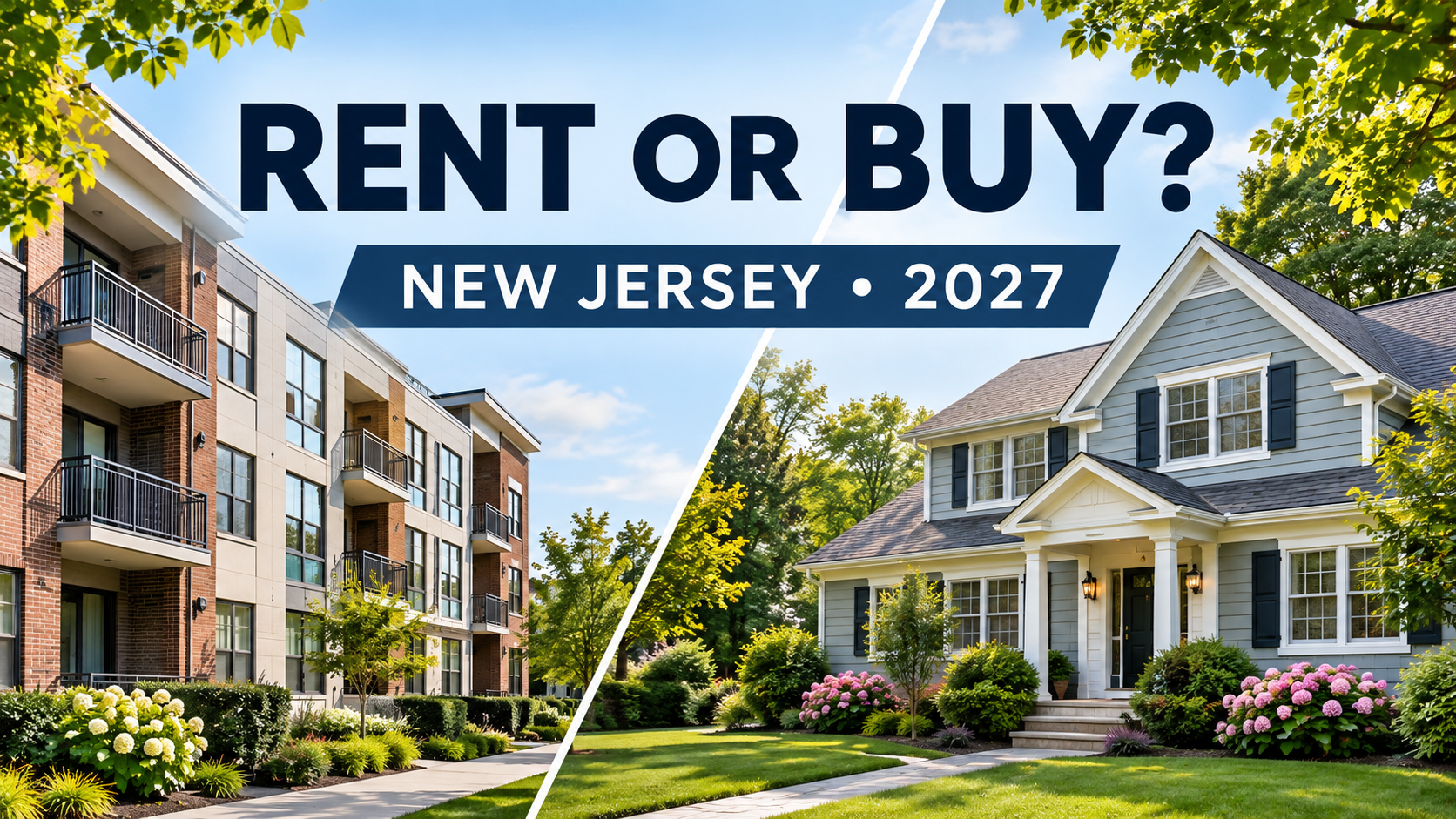
If you're thinking about moving to New Jersey in 2027, one of the biggest questions is whether it makes more sense to continue renting or buy a home. With home prices, property taxes, mortgage rates, and rents all affecting your monthly budget, the answer isn't as simple as "buying is always better."
For some people, renting in 2027 may be the smarter financial move. For others, buying a home could provide long-term stability, equity, and more control over where they live.
The right decision depends on your finances, how long you plan to stay, what you want from your home, and the cost of renting versus owning in the specific New Jersey town you're considering.
The quick answer: Should you rent or buy in New Jersey in 2027?
Rent if you need flexibility, aren't financially ready for the upfront costs of buying, or aren't sure you'll stay in New Jersey for several years.
Buy if you have a stable financial situation, enough savings for the purchase and ongoing expenses, and expect to stay long enough to make the costs of homeownership worthwhile.
Neither choice is inherently better. The goal is to make a decision that fits your life rather than trying to time the housing market perfectly.
What is the housing market likely to look like in New Jersey in 2027?
No one can predict exactly where mortgage rates, home prices, or rents will be in 2027. But current market conditions can help us understand what buyers and renters may need to consider.
As of November 2026, Freddie Mac reported an average 30-year fixed mortgage rate of 7.28%. Mortgage rates can change significantly, and the rate available to an individual buyer will depend on factors such as credit score, down payment, loan type, and lender.
In Union County, recent housing data also illustrates the difference between renting and buying.
Realtor.com reported a median rent of approximately $2,500 per month in Union County in October 2026. The same report showed a median sold home price of approximately $650,000.
These are countywide figures, and they don't represent the same type or size of property. A rental apartment and a single-family home aren't necessarily comparable. But they demonstrate why buyers need to look beyond the monthly mortgage payment when deciding whether to purchase.
Renting in New Jersey: When it makes sense
Renting can be a smart decision, especially when you're still figuring out where you want to live or what your long-term plans look like.
1. You need flexibility
If you're moving from New York City, Hoboken, or Jersey City, you may not know exactly which New Jersey town will feel right.
You might be deciding between Westfield, Cranford, Summit, Scotch Plains, or another community. Renting gives you time to experience an area before committing to a purchase.
It can also make sense if your job, family situation, or future plans could change in the next few years.
2. You want to preserve your savings
Buying a home requires more than a down payment.
You'll also need to budget for closing costs, inspections, moving expenses, and the possibility of repairs soon after moving in. Once you own a home, you should also maintain an emergency fund for unexpected expenses.
Renting may allow you to keep more money available for investments, retirement savings, business opportunities, or other financial priorities.
3. Your monthly rent is significantly lower than the cost of owning
In some New Jersey markets, renting a property may cost substantially less each month than purchasing a comparable home.
When you buy, your monthly expenses can include:
- Mortgage principal and interest
- Property taxes
- Homeowners insurance
- Mortgage insurance, if applicable
- Maintenance and repairs
- Utilities
- HOA or condominium fees, if applicable
A mortgage calculator that only shows principal and interest can make homeownership appear more affordable than it actually is.
4. You're not ready for the responsibility of homeownership
When you rent, your landlord is generally responsible for major property repairs and maintenance, subject to the terms of your lease and applicable law.
When you own a home, you are responsible for the roof, heating system, plumbing, appliances, landscaping, and the many unexpected expenses that come with maintaining a property.
That responsibility can be rewarding, but it requires time, money, and planning.
Buying a home in New Jersey: When it makes sense
Buying can be a good long-term decision when your finances and lifestyle are aligned with homeownership.
1. You plan to stay for several years
Buying and selling a home involves transaction costs. If you purchase a property and sell it shortly afterward, those costs can make it difficult to build meaningful equity.
If you expect to stay in the same home for several years, you have more time to benefit from paying down your mortgage and potentially from changes in the home's value.
There is no universal rule that you must stay five or seven years for buying to make sense. The right timeline depends on the purchase price, financing, property taxes, appreciation, selling costs, and what you would otherwise pay in rent.
2. You want to build equity
When you rent, your monthly payment provides housing but does not build ownership in the property.
When you own a home with a mortgage, part of each payment goes toward reducing your loan balance. Over time, that creates equity, assuming the property's value and your loan balance remain favorable.
Equity can also increase if the home's market value rises, although appreciation is never guaranteed.
3. You want more control over your home
Homeownership gives you greater control over how you use and improve your property.
You may be able to renovate a kitchen, change flooring, create a home office, improve outdoor space, or make other changes that fit your needs, subject to local regulations, permits, HOA rules, and other restrictions.
For many buyers, this flexibility is one of the biggest benefits of owning.
4. You want stability in your housing costs
With a fixed-rate mortgage, the principal and interest portion of your payment generally remains the same throughout the loan term.
Rent can increase when a lease renews, and the amount of the increase may depend on the rental market and applicable local laws.
However, owning does not mean every housing expense is fixed. Property taxes, insurance, maintenance, utilities, and HOA fees can increase over time.
What does renting versus buying actually cost in North Jersey?
Let's look at a simplified example using recent Union County market figures.
Recent market data showed a median sold home price of approximately $650,000 in Union County. Meanwhile, the median rent was approximately $2,500 per month.
These figures are not a direct comparison of equivalent homes, but they provide a useful starting point.
Imagine purchasing a $675,000 home with a 20% down payment.
- Purchase price: $675,000
- Down payment: $135,000
- Mortgage amount: $540,000
- Interest rate assumption: 7.28%
- Loan term: 30 years
At that rate, the estimated principal and interest payment would be approximately $3,690 per month.
That is before property taxes, homeowners insurance, maintenance, and any HOA fees.
For comparison, New Jersey's statewide average residential property tax bill was $10,570 in 2025, according to the New Jersey Department of Community Affairs data. That works out to approximately $881 per month, although actual property taxes vary dramatically by municipality and property.
Using that statewide average as an illustration, the mortgage and property tax alone would be approximately $4,570 per month.
You would still need to account for homeowners insurance, maintenance, and other expenses.
This is why comparing rent to mortgage principal and interest alone can be misleading.
The actual numbers for a home in Westfield, Cranford, Summit, Mountainside, Scotch Plains, or another town may be very different. Property taxes, purchase prices, rents, and available housing types vary considerably from one community to another.
Don't forget the hidden costs of buying
Before deciding that buying is the better option, make sure you understand the full cost of ownership.
Property taxes
Property taxes are one of the biggest ongoing expenses for New Jersey homeowners.
The amount depends on the municipality, assessed value, tax rate, and applicable local charges. Two homes with similar purchase prices in different towns can have very different property tax bills.
Always review the actual tax bill for the specific property you're considering.
Maintenance and repairs
A homeowner should plan for ongoing maintenance, even when the home appears to be in excellent condition.
Some expenses are predictable, such as landscaping, cleaning gutters, servicing HVAC systems, and maintaining appliances.
Others are unexpected. A roof, heating system, water heater, or plumbing problem can create a substantial expense.
Closing costs
Buying a home involves additional expenses beyond the down payment.
Depending on the transaction, these may include attorney fees, title costs, lender fees, inspections, appraisal fees, prepaid taxes and insurance, and other closing expenses.
Moving costs
Whether you're moving from New York City, another part of New Jersey, or elsewhere, moving costs should be included in your budget.
If you're buying and selling at the same time, the financial and logistical planning becomes even more complicated.
What about renting while waiting for mortgage rates to come down?
This is one of the most common questions buyers ask.
Some people choose to rent while waiting for mortgage rates to decline. Others prefer to buy when they find a home that meets their needs and their budget, rather than trying to predict where rates will go.
The challenge is that waiting can have several outcomes.
- Mortgage rates could decrease, potentially improving affordability.
- Home prices could also increase, which may offset some of the benefit of a lower mortgage rate.
- Alternatively, prices could remain stable or decrease in certain markets.
There is no guaranteed way to know which scenario will happen.
If you are financially prepared to buy and find a home that works for you, the decision should be based on the total cost of ownership and your long-term plans, not solely on a prediction about interest rates.
Should you rent first when moving to New Jersey?
For some people relocating to New Jersey, renting first is a very practical strategy.
If you're unfamiliar with the area, you may want time to explore different communities, commuting options, housing styles, and local amenities.
Renting can allow you to experience a town before purchasing a home.
For example, someone moving from Manhattan might initially focus on Westfield because of its downtown and commuter rail access. After spending time in New Jersey, they may discover that Cranford, Scotch Plains, Summit, or another community better fits their budget, preferred housing style, or daily routine.
Renting first can help you make a more informed decision.
But it isn't the only approach. If you have already researched the towns, understand your budget, and have a clear idea of what you want, buying directly may make more sense.
A real example: Renting can be the right decision before buying
One of our published client stories illustrates why the rent-versus-buy decision doesn't need to be rushed.
A client initially explored purchasing a home in 2024 but ultimately decided to continue renting. When the timing was right, the client restarted the search in 2026 and purchased a home in Scotch Plains.
The decision to rent first wasn't a failure or a missed opportunity. It allowed the client to move forward when the timing and circumstances were right.
You can read the story in our client success stories.
The important takeaway is that buying a home should fit your financial readiness and personal timeline. Renting while you prepare can be a perfectly reasonable decision.
Five questions to ask yourself before deciding to rent or buy in 2027
Before making a decision, consider these questions.
1. How long do I expect to stay in New Jersey?
If you may relocate again in a year or two, renting could offer more flexibility.
If you expect to stay for several years, buying may be worth exploring.
2. How much money will I have left after buying?
A down payment is only one part of the purchase.
You should also consider closing costs, moving expenses, emergency savings, and the money you'll need to maintain the home.
3. Can I comfortably afford the full monthly payment?
Don't evaluate affordability based only on the mortgage payment.
Include property taxes, insurance, maintenance, utilities, and HOA fees.
4. Am I buying because I want to, or because I feel pressured?
The decision to buy should be based on your goals and finances, not fear that you'll miss out on the market.
5. Does the home fit my lifestyle?
A home is more than an investment.
Think about your commute, space requirements, maintenance responsibilities, outdoor space, accessibility, and the features that matter most to you.
So, is it better to rent or buy in New Jersey in 2027?
There isn't one answer that applies to everyone.
Renting may be the better choice if you need flexibility, want to preserve savings, or aren't certain where you want to live.
Buying may be the better choice if you're financially prepared, expect to stay for several years, and find a property that makes sense based on its total cost.
The most important thing is to compare the actual numbers for your situation rather than relying on a general rule about renting or buying.
If you're considering a move to Westfield, Cranford, Summit, Mountainside, Scotch Plains, Fanwood, Berkeley Heights, New Providence, or another North Jersey community, we can help you explore the local housing options and understand what buying could look like in your budget.
Frequently asked questions
Is renting cheaper than buying in New Jersey in 2027?
In many situations, renting may have a lower monthly cost than buying a comparable property. However, the comparison depends on the home price, rent, mortgage rate, property taxes, insurance, maintenance, and how long you plan to stay.
Will home prices go down in New Jersey in 2027?
No one can reliably predict exactly what home prices will do in 2027. Prices can vary by town, property type, and local supply and demand. Buyers should evaluate current market conditions and their own financial situation rather than relying on a prediction.
Is it better to buy a house before mortgage rates fall?
Waiting for lower rates is not guaranteed to produce a better outcome. If rates fall, home prices or competition may increase. If you find a home you can comfortably afford and plan to own for the long term, the decision may make sense based on today's numbers.
Should I rent before buying in North Jersey?
Renting first can be helpful if you're unfamiliar with North Jersey or aren't sure which town fits your needs. It gives you time to explore different communities and understand local housing options. Buyers who already know the area and are financially ready may prefer to purchase directly.
How long should I plan to stay in a home before buying makes sense?
There is no universal timeline. The longer you stay, the more time you generally have to spread out transaction costs and build equity. But the right timeline depends on the home's price, financing, property taxes, maintenance, appreciation, and your alternative rental costs.
Thinking about buying or renting in North Jersey?
Whether you're planning to rent for another year, buy your first home, or relocate from New York City, the best next step is to understand your options in the communities you're considering.
The GAMA Team can help you explore the local market, compare towns, and evaluate available homes based on your budget, timeline, and goals.
Contact The GAMA Team to start the conversation.
Check out this article next