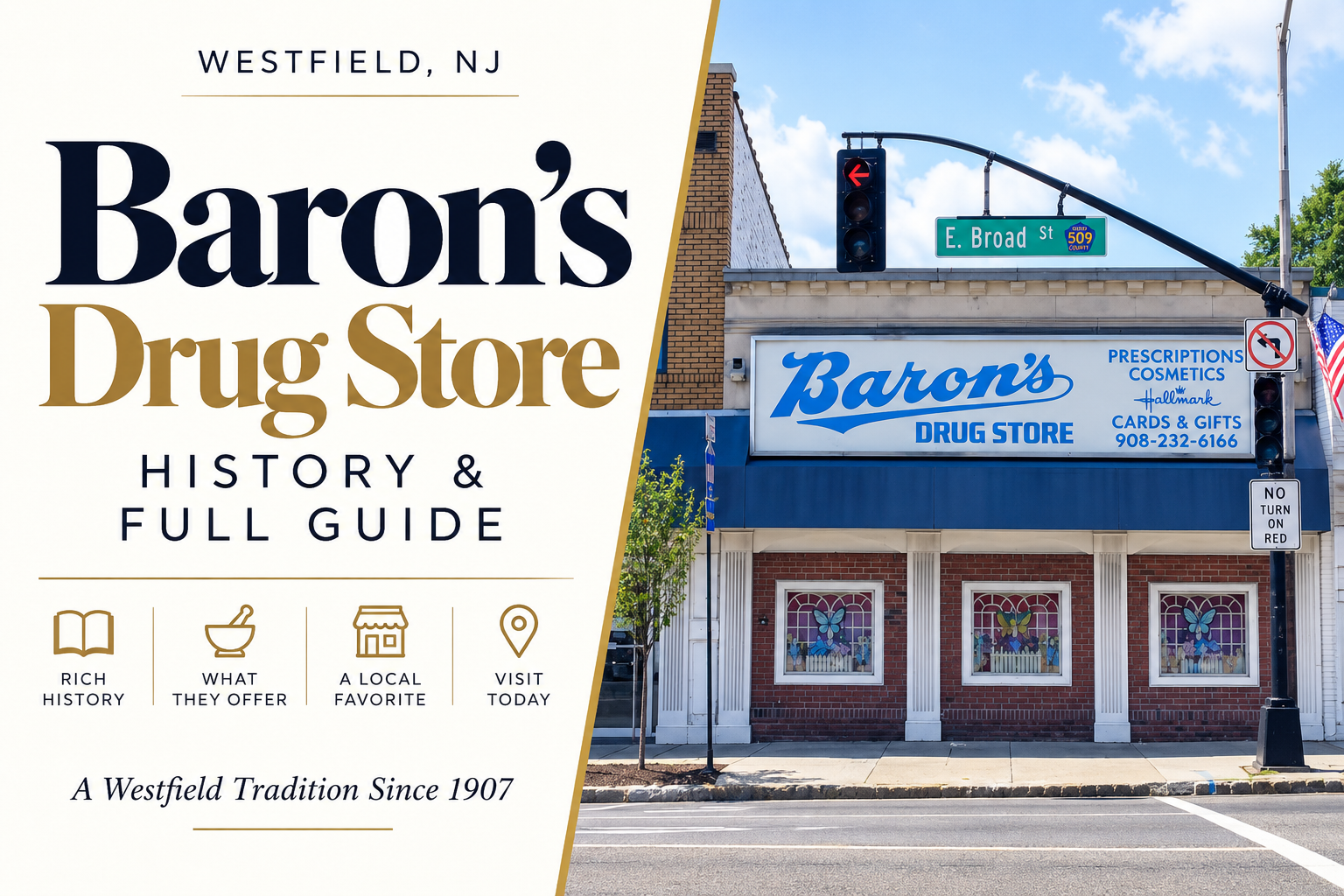
Baron's Drug Store has filled prescriptions on East Broad Street since 1936. Here's the full history, every service it offers today, and why Westfield's last independent pharmacy has outlasted nearly every chain that's tried to compete with it.
Baron's Drug Store: The Independent Pharmacy That's Outlasted Nearly Every Chain That's Tried to Compete With It
Baron's Drug Store has been filling prescriptions at 243 East Broad Street since August 1936 — which means the pharmacy predates the interstate highway system, television, the modern shopping mall, and every single chain drugstore currently operating in Westfield, and has simply kept going, in the same downtown, through all of it. Over close to nine decades in business, Baron's has filled more than 6,000,000 prescriptions and, by its own account, has "employed literally thousands of people, many of them being first-time jobs" for Westfield residents. It is one of a genuinely small number of businesses left in town that a person who grew up here in the 1960s and a person who moved in last year could both walk into and recognize as the same place, doing business the same fundamental way.
We're writing about Baron's at length because it's the kind of institution that tells you something real about a downtown's staying power. An independent pharmacy going up against CVS and Walgreens — both of which now operate their own locations within a few blocks of Baron's own front door — plus mail-order pharmacy benefit managers, plus nearly a decade of well-documented, industry-wide financial pressure on small pharmacies, and not just surviving but apparently continuing to serve the town at the same address it opened at in 1936, is not the norm nationally. It's genuinely the exception. This guide covers the full history of Baron's, exactly what it offers today, how it compares to the chain pharmacy options in town, why independent pharmacies like it have become increasingly rare across the country, and why a business like this matters more to a town's character than most residents stop to think about.
How Baron's Started
Baron's Drug Store was founded in August 1936 by Gerson Barondess, a Westfield resident, and the store's name is a shortened, easier-to-say version of the founder's own surname. 1936 places the store's opening squarely in the middle of the Great Depression, at a moment when the U.S. unemployment rate was still sitting above 15 percent and bank failures earlier in the decade had wiped out a huge share of Americans' personal savings. It was not, by any conventional measure, an obvious moment to open a small independent business in a small New Jersey town — which makes the fact that Baron's not only survived the years that followed, but is still operating on the same stretch of East Broad Street nearly ninety years later, all the more notable.
Independent, family-style drugstores of that era typically functioned as genuine neighborhood hubs in a way that's easy to lose sight of today. The pharmacy counter sat toward the back, filling the prescriptions that were, in that decade, still frequently compounded by hand rather than dispensed as manufactured tablets straight from a bottle. Up front, a broader general-goods and sundries counter carried everything from cosmetics and film to greeting cards and tobacco, and in many towns of that period, an actual soda fountain or lunch counter made the local drugstore as much a gathering spot and social hub as a place to fill a prescription — the coffee-shop-on-every-corner role that a Starbucks or a diner plays in a downtown today was, in the 1930s through the 1950s, very often filled by the corner drugstore instead. Baron's built its identity in that same broader tradition: a full-service, walk-in pharmacy that was also simply a place in town, not a chain outpost with a name printed the same way in a thousand other towns.
To put nearly ninety years of continuous operation in perspective, it's worth sketching, in broad strokes, what independent pharmacies as a category have lived through since 1936 — not as claims about Baron's specific internal history, which isn't fully documented in public records, but as the backdrop against which its survival has to be understood. World War II brought rationing and manpower shortages that touched nearly every small retail business in the country, pharmacies included, as young pharmacists and clerks left for military service and certain goods became scarce or restricted. The postwar boom of the late 1940s and 1950s brought suburban growth, a rising middle class, and, eventually, a wave of new prescription medications entering the market as the pharmaceutical industry itself modernized and expanded. Chain drugstores began appearing in New Jersey and across the country in meaningful numbers starting in the 1960s and 1970s, introducing direct, in-town competition to independents like Baron's for the first time in a way earlier decades hadn't. Mail-order pharmacy benefits, which let large employers and insurers route routine prescriptions to centralized, high-volume mail-order facilities instead of a local storefront, expanded significantly starting in the 1990s and 2000s. And over roughly the last fifteen years, the consolidation of prescription benefit management into a small handful of pharmacy benefit managers — the companies that sit between insurers, drug manufacturers, and pharmacies to negotiate what a pharmacy actually gets reimbursed for a given prescription — has reshaped the economics of running an independent pharmacy more dramatically than any single development since the arrival of the chains themselves. (We cover that shift, and what it's done to independent pharmacies nationally, in detail further down in this guide.)
What's genuinely hard to pin down with full confidence, going back to a 1936 founding, is the complete chain of ownership between Gerson Barondess and the pharmacy's leadership today. What we can confirm directly from current public business records: Baron's remains an independent, family-owned pharmacy today, not part of a national or regional chain, and its current president of record is Rudi Trivigno. Businesses that have operated continuously for close to ninety years typically pass through more than one set of hands along the way — sometimes staying within a founding family across generations, sometimes passing to longtime employees who worked their way into ownership, sometimes passing to a new family entirely who took over an already-established name and location. Baron's own public materials lean on continuity of service — long-tenured pharmacists, a stable customer relationship, decades in the same storefront — rather than a detailed ownership timeline, as the story worth telling about itself. That's a common and entirely reasonable choice for a business this age: the version of its own history it emphasizes is about the pharmacists who've stayed for decades and the customers they've known that whole time, not a corporate ownership chart. We'd rather say plainly that the full ownership succession isn't publicly documented than invent a tidy multi-generation story that sounds good but isn't verified.
"There's something genuinely rare about a business that's been in the same spot since before your grandparents were dating," says Marina Fridman-Rybner of The GAMA Team at Corcoran Sawyer Smith. "When buyers ask me what makes Westfield's downtown different from a strip mall with the same ten chain stores as every other town, Baron's is one of the first places I mention. It's not manufactured character — it's just actually old, and it actually stayed independent through decades that put a lot of businesses like it out of business entirely."
A Brief History of the American Drugstore, and Where Baron's Fits
It's worth zooming out even further for a moment, because Baron's 1936 founding date only really lands once you understand what a "drugstore" actually was in America at that point, and how dramatically the category itself has changed since. The modern American drugstore traces back to the late 1800s and early 1900s, when pharmacists — then more commonly called druggists or apothecaries — compounded most medications by hand from raw ingredients, mixing powders, tinctures, and syrups to a physician's specific written formula rather than dispensing pre-manufactured pills from a factory-sealed bottle. That hands-on compounding role is part of why the corner drugstore held such a trusted, almost quasi-medical position in a community: the druggist wasn't simply handing over a product, they were often the one actually making it, on the spot, to order.
The soda fountain era that so many people associate with old-fashioned drugstores — marble counters, milkshakes, an actual "soda jerk" behind the counter — grew out of a practical historical accident: many early tonics and medicinal preparations were mixed with carbonated water to make them more palatable, and pharmacies were among the first retail businesses to install the carbonation equipment needed to make them. Once that equipment existed on-site, it was a short leap to start selling flavored sodas and ice cream treats to the general public, and by the 1920s through the 1950s, the drugstore soda fountain had become a genuine American cultural institution in its own right — the place teenagers met after school, where a first date might happen over a shared milkshake, completely independent of anyone actually filling a prescription that day. Drugstores of Baron's founding era existed at exactly this intersection: serious, licensed medical retail on one side of the counter, and an informal, everyday neighborhood gathering spot on the other.
That dual identity is genuinely part of why a business like Baron's, even stripped of the soda fountain many drugstores of that era eventually phased out, still occupies a different place in a town's affection than a typical retail business does. A hardware store or a clothing shop, however well-loved, doesn't carry the same layered, decades-deep social history that a drugstore founded in the 1930s does — the accumulated weight of thousands of small, ordinary interactions across nearly a century: a first prescription picked up as a new parent, a flu shot before a big trip, a familiar face behind the counter during a difficult health scare. That's the kind of institutional memory that simply can't be replicated by a business that opened five or ten years ago, no matter how well-run it is.
The Pharmacists Behind the Counter
One of the more unusual things about Baron's, by its own description, is how long its staff actually stays. The pharmacy states plainly that its "pharmacists do not rotate between other stores, and, like many of our employees, have been here for many years" — which is a genuine, structural point of differentiation from a chain pharmacy, where staffing is typically managed across a district or region and the pharmacist filling your prescription this month may not be the same person filling it in six months, or even next week.
Patrick Colicchio, RPh, is Baron's Pharmacist in Charge. He's been with Baron's since 1988, is a graduate of the Rutgers College of Pharmacy (also 1988), and is a New Jersey-certified immunizing pharmacist. That's 30-plus years at a single independent pharmacy, in an era when most working pharmacists have moved between multiple employers, often more than once, over the course of a career.
Michael Cleary, RPh, is a staff pharmacist who joined Baron's in 2009 and brings nearly 40 years of pharmacy experience overall, including a prior role as a District Manager at Drug Fair, a now-defunct regional pharmacy chain that once operated dozens of locations across New Jersey before being acquired and dissolved. He's also a Rutgers College of Pharmacy graduate (1981) and a New Jersey-certified immunizing pharmacist.
Between the two of them, Baron's pharmacy counter is staffed by people with a combined seven decades of pharmacy experience, and more than three of those decades have been spent specifically behind Baron's own counter. That's the kind of tenure that lets a pharmacist actually know a regular customer's full medication history, their allergies, and their preferences without needing to pull up a screen to remember — the exact experience an independent pharmacy is built to offer, and one a high-volume chain location structurally struggles to replicate given typical staffing turnover and rotation patterns across a multi-store district.
It's also worth understanding what "Pharmacist in Charge" actually means under New Jersey pharmacy regulation, since it's a specific, legally meaningful title rather than an honorary one. New Jersey, like every state, requires every licensed pharmacy to designate a single Pharmacist in Charge who holds direct, personal accountability to the New Jersey Board of Pharmacy for the pharmacy's overall compliance — proper drug storage and security, accurate recordkeeping, staff supervision, and adherence to state pharmacy law. When a customer's prescription runs into an insurance issue, a drug interaction flag, or any other complication that needs a judgment call, the Pharmacist in Charge is, by regulation, the person ultimately responsible for how that judgment call gets made at that specific pharmacy. Having held that role at Baron's for well over three decades means Colicchio isn't simply a long-tenured employee — he's the specific individual the state holds accountable for how the pharmacy runs, and he's held that accountability continuously since 1988.
Both pharmacists' New Jersey immunizing pharmacist certification is also worth unpacking briefly, because it reflects a real expansion of what pharmacists are legally permitted to do that's happened gradually over the past couple of decades. Under New Jersey's pharmacy regulations (N.J.A.C. 13:35-6.26), a licensed pharmacist authorized by the state Board of Pharmacy may administer vaccines directly to patients, either under a patient-specific prescription or under a standing order issued by a supervising physician, along with the specific emergency medications the regulation names for handling an adverse reaction on the spot — diphenhydramine (commonly known as Benadryl) and epinephrine. The regulation requires that vaccine administration follow current CDC guidelines and that a supervising physician remain reachable by phone or other direct communication for consultation if needed. In practical terms for a Baron's customer, this is exactly why the pharmacy can administer immunizations on-site rather than only ever referring patients elsewhere: both pharmacists have gone through the state's certification requirements to be legally authorized to give a vaccine, handle a rare adverse reaction safely on the spot, and do it without an appointment at a separate medical office.
"People don't always realize how much more a pharmacist is legally allowed to do now than even ten or fifteen years ago," says Galina Kaplan, Marina's partner at The GAMA Team. "A flu shot or a shingles vaccine used to almost always mean a trip to your doctor's office. Now it can happen at the same counter where you're already picking up a refill, from someone who's been filling your prescriptions for years. That's a genuinely bigger convenience than people give it credit for."
What Baron's Actually Offers Today
Baron's has stayed relevant across nearly nine decades by expanding well past "fill this prescription and hand it over the counter." Here's the full current picture of what the pharmacy offers, along with the broader context for why each of these services actually matters in practice, not just as a checklist item on a website.
Prescription Refills, Around the Clock
Baron's supports prescription refills around the clock through its mobile app (PocketRx, available on both Apple's App Store and Google Play), its website, or by phone — meaning a refill request doesn't have to wait for the pharmacy's actual open hours. For a household managing a Sunday-evening realization that a medication is about to run out, or a parent trying to get ahead of a refill before a Monday-morning school drop-off, the ability to submit that request at 11 p.m. rather than waiting for a phone line to open the next morning is a genuinely practical, quality-of-life difference, and it's the kind of digital convenience that independent pharmacies have had to build or license in order to keep pace with what chain pharmacy apps have offered for years.
Medication Therapy Management
Medication therapy management is a structured, pharmacist-led review of everything a patient is currently taking — prescription medications, over-the-counter drugs, and supplements alike — aimed specifically at catching interactions, duplications, or outdated prescriptions that a patient managing multiple medications from multiple prescribers might not catch on their own. This service matters most for patients managing several chronic conditions at once, where a specialist prescribing one medication may have no visibility into what a different specialist prescribed for an unrelated condition, and the pharmacy counter is often the one place in a patient's entire care picture where every single medication actually converges in one record. A pharmacist who's filled a patient's prescriptions for years, as is common at Baron's given its staff tenure, is often better positioned to notice a meaningful change or a new interaction risk than a rotating staff member seeing that patient's chart for the first time.
Medication Synchronization
Medication synchronization coordinates refill timing across multiple prescriptions so that everything a patient is taking is ready for pickup on the same day each month, instead of a patient making three or four separate trips to the pharmacy throughout the month as each individual prescription happens to run low on its own separate schedule. This is sometimes called an "appointment-based model," and it's been studied directly, with genuinely striking results. Research on appointment-based medication synchronization programs has found that patients newly starting a chronic medication showed between 3.4 and 6.1 times greater odds of staying adherent to that medication compared to patients not enrolled in a sync program, and patients already established on a medication for six months or more still showed between 2.3 and 3.6 times greater odds of adherence. Separate cost-benefit research has estimated that the medical cost savings generated by that improved adherence — fewer emergency visits and hospitalizations tied to skipped or inconsistent medication use — range from roughly $1.25 to nearly $37 in savings for every additional dollar spent on the medication itself, with the strongest returns showing up for common chronic-condition drugs like metformin (for diabetes) and statins (for cholesterol management). In plain terms: synchronizing refills isn't just a convenience feature, it's one of the more evidence-backed interventions in all of community pharmacy for actually keeping patients on the medications their doctors prescribed, and it's exactly the kind of hands-on program that requires a pharmacy team with enough continuity and attention to manage individually, rather than a fully automated, high-volume dispensing model.
Multi-Dose Packaging
Multi-dose packaging — sometimes called blister packaging or medication packaging by date and time — pre-sorts a patient's various pills into single, sealed, clearly labeled packets organized by day and time of day, rather than leaving a patient (or a caregiver) to sort multiple pill bottles into a weekly organizer by hand. This is a genuinely significant convenience and safety feature for anyone managing multiple daily medications, and it matters most for two groups in particular: older adults managing several prescriptions at once, where sorting pills manually becomes both tedious and a real source of dosing errors as the number of medications climbs, and family caregivers managing medications on behalf of a parent or another loved one, where a clearly labeled, pre-sorted packet removes a meaningful source of both error risk and daily mental load from an already demanding caregiving role.
Immunizations and Health Screenings
As covered above, both of Baron's staff pharmacists are New Jersey-certified immunizing pharmacists, and the store administers vaccinations on-site under the state's pharmacist immunization regulations, along with general health screenings. For many patients, particularly during flu season or ahead of travel requiring specific vaccinations, being able to walk into a familiar neighborhood pharmacy for a shot — administered by a pharmacist who may already know their medication history and allergy profile — is both faster and, for some patients, simply more comfortable than scheduling a separate visit to a doctor's office purely for an immunization.
The Diabetes Care Center
Baron's operates a dedicated diabetes care center, reflecting how much day-to-day pharmacy work for a chronic condition like diabetes goes well beyond simply filling an insulin or oral medication prescription. Diabetes management in practice typically involves ongoing testing supplies (glucose meters, test strips, and increasingly continuous glucose monitors), careful medication timing, and a genuine amount of hands-on patient education about how diet, activity, and medication interact day to day — education that a rushed chain pharmacy counter, filling dozens of prescriptions an hour, often has limited bandwidth to provide in real depth. A dedicated diabetes care center within an independent pharmacy signals a level of specialized attention and continuity that patients managing a lifelong chronic condition often specifically seek out, precisely because the same pharmacist can track how their needs change over months and years rather than starting from scratch with a new face at every visit.
Erectile Dysfunction Services
Baron's also offers dedicated erectile dysfunction services — an area many patients report being genuinely more comfortable discussing candidly with a longtime, familiar independent pharmacist in a quieter setting than in a crowded chain-store checkout line, where privacy at the pharmacy counter can be limited. This is a small line item on a services list, but it reflects the same underlying advantage that runs through nearly everything on this list: a stable, known pharmacy relationship makes patients more comfortable bringing up sensitive health topics in the first place.
Durable Medical Equipment and Supplies
Baron's stocks and sells durable medical equipment and supplies — ambulatory aids such as canes, walkers, and similar mobility equipment, along with bathroom safety equipment — and this matters more in practice than it might sound on a services list. For a family suddenly navigating a parent's mobility needs after a fall or a surgery, or managing a temporary injury requiring crutches or a raised toilet seat, being able to walk into a familiar local pharmacy and get properly fitted equipment the same day, with a pharmacist or trained staff member available to advise directly on fit and use, is a meaningfully different experience than ordering equipment blind through an online marketplace and waiting on shipping — particularly when the need arose suddenly and the patient can't easily wait several days. Medicare Part B does cover a range of durable medical equipment when it's medically necessary and prescribed by a physician, and a local pharmacy that stocks this equipment directly can often help a patient sort through what's actually covered far more efficiently than researching it alone online, on top of getting the physical item in hand immediately rather than waiting on a shipment.
Retail, Gifts, and Pet Care Products
Beyond the pharmacy counter, Baron's runs a genuine retail operation carrying its own LEADER-branded health and wellness products (a private-label line commonly sold by independent pharmacies through pharmacy buying cooperatives, generally positioned as a lower-cost alternative to national name-brand over-the-counter products), gift items, and pet care products, plus what the store describes as a newly added retail shop section — keeping the "browse the aisles" character of an old-school drugstore alive alongside the modern pharmacy services layered on top of it. This is, in a small way, a direct continuation of the original 1930s-era drugstore model described earlier in this guide: a pharmacy that's also simply a place to pick up a greeting card, a gift, or something for the family pet, not a purely transactional prescription-fulfillment counter.
Home Delivery and Package Drop-Off
Baron's offers home delivery within Westfield's city limits, a package drop-off service, and, as covered above, 24/7 refill capability through its app. For homebound patients, elderly residents living alone, or anyone managing a household with a new baby or recovering from a recent surgery, in-town delivery from a pharmacy that already knows the patient's medication history is a meaningfully different experience than a mail-order pharmacy benefit manager shipping a box from an out-of-state fulfillment center with no local relationship behind it at all — no familiar voice to call with a question, no pharmacist who already knows the rest of what's in the medicine cabinet.
Medicare Open Enrollment Assistance
Each fall, Baron's provides direct assistance to patients navigating Medicare open enrollment — a genuinely valuable, hands-on service for a process that a large share of seniors find confusing and stressful to handle entirely on their own. The Medicare Annual Enrollment Period runs from October 15 through December 7 each year (the 2026 window falls on those same dates), and it's the one period each year when Medicare beneficiaries can freely enroll in, switch, or drop a Medicare Part D prescription drug plan, with any changes taking effect the following January 1. The stakes of getting this right are genuinely significant: Part D plans change their drug formularies, tiers, and pricing every single year, meaning a plan that covered a patient's specific medications affordably last year can quietly become far more expensive for those same exact medications this year without the patient necessarily realizing it until a January refill comes back with a surprising price tag. A pharmacist who already knows exactly which medications a patient takes is in a uniquely strong position to actually compare what different available plans would charge for that specific patient's specific drug list — a far more useful, personalized comparison than a patient trying to interpret plan brochures alone, and one a corporate chain pharmacy, moving a much higher volume of customers through the counter with less individual continuity, is far less likely to offer with the same unhurried, one-on-one attention.
Current Hours and Contact
Baron's Drug Store is located at 243 East Broad Street, Westfield, NJ 07090, and can be reached at 908-232-6680. Current posted hours are Monday through Friday, 9 a.m. to 8 p.m.; Saturday, 9 a.m. to 6 p.m.; and Sunday, 9 a.m. to 4 p.m. — a genuinely generous seven-day schedule for an independent pharmacy, and one that covers evenings and weekends better than many people assume a small local drugstore will.
How Baron's Compares to Westfield's Chain Pharmacy Options
Westfield residents aren't short on pharmacy options today. CVS Pharmacy operates a location at 1144 South Avenue West, and Walgreens operates a location at 260 North Avenue East — meaning Baron's now competes directly, within the same small downtown, against two of the largest pharmacy chains in the country, each backed by national buying power, national marketing budgets, and, in CVS's case, ownership of one of the country's largest pharmacy benefit managers in its own corporate family.
| Baron's Drug Store | CVS Pharmacy (Westfield) | Walgreens (Westfield) | |
|---|---|---|---|
| Address | 243 East Broad St | 1144 South Ave W | 260 North Ave E |
| Ownership | Independent, family-owned | National chain (CVS Health) | National chain (Walgreens Boots Alliance) |
| In business since | 1936 | Corporate location, decades of chain history nationally | Corporate location, decades of chain history nationally |
| Pharmacist continuity | Staff pharmacists with 15-plus and 30-plus years at this specific store | Staffing typically rotates across a district | Staffing typically rotates across a district |
| Specialty programs | Diabetes care center, ED services, DME, in-house Medicare enrollment help | Broad national retail and photo/front-store offering | Broad national retail and photo/front-store offering |
| Local decision-making | Made on-site, by owners and pharmacists who work the counter | Set by corporate policy at a national level | Set by corporate policy at a national level |
The comparison isn't really about which pharmacy is "better" in some abstract sense — a national chain offers real advantages of its own, including broader nationwide network coverage for patients who travel or split time between multiple homes, and often deeper front-of-store retail selection. But the kind of experience is genuinely different, and it's worth being explicit about what that difference actually is rather than leaving it vague. A chain pharmacy's staffing, pricing, hours, and product mix are set by decisions made at a corporate or regional level, often states or even a continent away from the specific Westfield storefront a customer walks into. Baron's decisions — which services to add, how to staff the counter, whether to keep a specific product line — are made on-site, by people who live in or near this specific town and see the results of those decisions in the same customers who walk back through the door month after month.
"I've had clients tell me they specifically chose a house near downtown partly because they liked being in walking distance of a pharmacy where the pharmacist actually knows them," says Marina. "That's not something you can say about most CVS or Walgreens locations, through no fault of the people working there — it's just not how a corporate staffing model is built. Baron's is built differently, on purpose, and it shows."
It's also worth addressing pricing directly, since it's the single most common assumption people bring into a comparison like this: that an independent pharmacy must automatically cost more than a national chain. In reality, prescription pricing for insured patients is set almost entirely by the same pharmacy benefit managers described in the next section, applied identically across independent and chain pharmacies alike for a given insurance plan — meaning a patient's co-pay for a given covered medication is typically the same dollar amount whether it's filled at Baron's, at CVS, or at Walgreens, because the insurance plan itself, not the pharmacy, is what sets that co-pay. Where pricing differences most often show up is on the cash-pay side, for patients without insurance coverage for a specific drug or with a high-deductible plan, where independent pharmacies frequently have more flexibility to price-match a discount program like GoodRx or to work directly with a patient on the most affordable generic option available — a conversation that requires a pharmacist with time to actually have it, rather than one is simply too rushed to raise proactively.
What Aging in Place in Westfield Has to Do With a Neighborhood Pharmacy
This is a real estate blog, not a healthcare publication, so it's worth being direct about why a deep dive into a local pharmacy actually belongs here, beyond simple town-pride local color. A meaningful share of the conversations we have with clients — both longtime Westfield homeowners weighing whether to stay in their current house as they age, and adult children helping a parent think through the same decision — eventually touch on exactly the kind of infrastructure this guide has been describing: is there a pharmacy nearby that actually knows my medications, that delivers if a snowstorm or a recovery period makes leaving the house difficult, that can help sort through a genuinely confusing Medicare Part D decision every fall without charging for the time, that stocks a cane or a raised toilet seat the same day it's needed rather than three days later by mail?
Those aren't abstract, someday concerns for a lot of the households we work with. They're often the actual, practical variables behind a decision to stay in a longtime family home in downtown Westfield rather than relocate somewhere with, on paper, an easier single-floor layout but none of the accumulated local infrastructure — a known pharmacist, a known doctor, a known neighbor two doors down — that makes staying independent at home actually feel manageable day to day. A walkable downtown with an independent pharmacy that offers home delivery, in-person Medicare guidance, and durable medical equipment on the shelf is a genuine, tangible asset for exactly this kind of decision, in a way that's easy to overlook when touring a house on a Saturday afternoon but that matters enormously five or ten years into living there.
"I've sat at kitchen tables with adult children trying to talk a parent into moving somewhere 'easier,' and the parent's actual objection often isn't the house itself — it's everything around the house," says Marina. "The pharmacy that already knows them, the diner where the staff knows their order, the walk to the post office. Baron's is exactly the kind of thing that quietly makes 'aging in place in Westfield' a realistic plan instead of just a nice idea, and it's worth mentioning to clients who are wrestling with that decision."
Transferring a Prescription and What to Expect on Your First Visit
Switching a prescription from a chain pharmacy to an independent one like Baron's is, in practice, one of the simpler moves in all of healthcare administration, and it's worth walking through plainly since it's the actual first step for anyone reading this guide who's persuaded but unsure how to make the switch. A patient doesn't need to contact their current pharmacy directly or request records themselves — the new pharmacy handles the transfer on the patient's behalf. In practice, that means calling or visiting Baron's directly, providing the name and location of the current pharmacy along with the names of the medications being transferred, and letting Baron's own staff request the actual transfer from the prior pharmacy, a process that in most cases takes same-day to complete for routine, non-controlled medications. Controlled substances — certain pain medications, ADHD medications, and similar drug classes subject to additional federal recordkeeping requirements — sometimes require an extra verification step, but the process still runs through the pharmacy itself rather than requiring the patient to personally shuttle paperwork between two locations.
For a first visit, it's worth bringing a current insurance card, a list of every medication currently being taken (including over-the-counter drugs and supplements, which matters for the medication therapy management review described earlier in this guide), and, if applicable, the phone number of the pharmacy being transferred from. Because Baron's staff pharmacists have the kind of tenure detailed above, many longtime Westfield residents find that a first visit at Baron's ends up including a genuinely thorough conversation about their overall medication picture — the kind of conversation a first visit to a new chain pharmacy location, with staff meeting a new customer for the first time and managing a high daily volume, often doesn't have the built-in time to offer in the same depth.
Why Independent Pharmacies Like Baron's Are Increasingly Rare
It's worth stepping back and asking why any of this is genuinely worth writing about, beyond simple local trivia about an old storefront. Independent pharmacies have been under sustained, well-documented financial pressure across the entire country for years now, and the numbers behind that pressure are genuinely stark.
A National Community Pharmacists Association survey of independent pharmacy owners found that 30.3% were considering closing their pharmacy in 2025, and among those considering it, 53% said they'd plan to sell the pharmacy while 31% said they'd plan to close permanently. More broadly, 80.3% of independent pharmacy owners reported declining financial health in 2024, with nearly half — 48.6% — describing that decline as significant rather than modest.
The single biggest driver behind that distress, according to the same survey, is reimbursement from pharmacy benefit managers — the companies, often owned by or closely aligned with the same insurance conglomerates that also own competing pharmacy chains, that sit between insurers and pharmacies to set what a given pharmacy actually gets paid for a given prescription. Fully 96.5% of independent pharmacy owners surveyed said PBM and health plan reimbursement for Medicare Part D prescriptions specifically threatened the ongoing viability of their business. More concretely, 40.8% reported being reimbursed below the National Average Drug Acquisition Cost — meaning below what the pharmacy itself actually paid to acquire the drug in the first place — on more than 40% of the Medicare Part D prescriptions they filled, and 29.2% faced below-cost reimbursement on more than half of their prescriptions. Put plainly: a genuinely large share of independent pharmacies nationally are, on a meaningful share of the prescriptions they fill for Medicare patients, losing money on the transaction itself before any other operating cost — rent, staff, utilities — is even factored in.
Separately, the rollout of the federal Medicare Drug Price Negotiation Program has created its own new financial strain specifically for smaller pharmacies: independent pharmacies are required to pay for the newly negotiated-price drugs up front and then wait more than 30 days for manufacturers to send the corresponding refund, a cash-flow gap the same NCPA survey estimated requires an independent pharmacy to float roughly $27,000 a month while waiting on reimbursement — a genuinely significant amount of working capital for a small, independently owned business to tie up on an ongoing basis, in a way a large national chain's balance sheet is far better equipped to absorb.
This is the actual, well-documented backdrop against which every year Baron's has stayed open and independent needs to be understood — not simply nine decades of steady, uneventful operation, but nine decades that have included, particularly over roughly the last fifteen years, real, ongoing financial headwinds that have driven a meaningful share of comparable independent pharmacies elsewhere in the country to sell to a chain or close outright. A pharmacy surviving and continuing to expand its own service offerings against that backdrop is a genuinely different, more impressive story than a pharmacy simply existing in a quiet market with no real competitive or financial pressure at all.
"People assume the corner pharmacy sticking around is just inertia — that it's always been there, so it'll always be there," says Galina. "The actual numbers on what independent pharmacies nationally have been dealing with tell a very different story. Baron's being here isn't inertia. It's an actual, ongoing business succeeding against real pressure, year after year."
What Baron's Longevity Actually Signals About Downtown Westfield
For residents, what all of this means in practice is a pharmacy where the person behind the counter has likely filled your prescriptions before, knows your medication history without pulling it up cold, and can spend real, unhurried time walking you through a new prescription, a piece of medical equipment, or a genuinely confusing annual Medicare enrollment decision instead of processing you through a queue built around volume. That's a different relationship than most people have with a pharmacy today, and it's part of what makes a downtown feel like an actual town with its own institutions, rather than an interchangeable collection of the same national chains found in every neighboring municipality.
It also connects to something we think about constantly in our own work: what actually makes one downtown genuinely different from another, superficially similar one nearby. Westfield's downtown has plenty of the same national retail and restaurant names found in comparable towns across Union and Essex Counties — that's simply the reality of a strong, high-traffic commercial district today. What distinguishes a downtown with real, lasting character is what's layered on top of that national retail mix: a bagel shop where the owner named sandwiches after his own kids, a diner that's been in the same family for generations, and a pharmacy that opened during the Great Depression and is still independently owned nearly ninety years later, run by pharmacists who've spent thirty-plus years behind the same counter. None of that shows up on a standard market comparison of retail square footage or foot traffic counts, but it's exactly the texture that turns "a good downtown" into "our downtown" for the people who actually live here — and it's a genuine, if hard-to-quantify, factor in why certain towns hold their value and their appeal decade over decade in a way others don't.
A Quick Glossary
Pharmacist in Charge (PIC): The single pharmacist a licensed pharmacy must designate under state law as personally, legally accountable to the state Board of Pharmacy for the pharmacy's overall compliance, recordkeeping, and operations.
Immunizing pharmacist: A pharmacist who has completed the specific state certification requirements authorizing them to administer vaccines directly to patients, either under an individual prescription or a physician's standing order.
Medication therapy management (MTM): A structured, pharmacist-led review of a patient's full medication regimen — prescription, over-the-counter, and supplements — aimed at catching interactions, duplications, or outdated prescriptions.
Medication synchronization (appointment-based model): Coordinating a patient's refill dates so that all of their medications are ready for pickup on the same day each month, rather than on separate, staggered schedules.
Multi-dose packaging: Pre-sorted, sealed medication packets organized by day and time, as an alternative to a patient or caregiver manually sorting individual pill bottles into a weekly organizer.
Durable medical equipment (DME): Reusable medical equipment prescribed for home use, such as walkers, canes, and bathroom safety equipment, a portion of which is typically coverable under Medicare Part B when medically necessary.
Pharmacy benefit manager (PBM): A company that sits between insurers, drug manufacturers, and pharmacies to negotiate drug pricing and set pharmacy reimbursement rates — a small number of PBMs, several closely affiliated with major insurers and competing pharmacy chains, now manage the large majority of prescription drug benefits nationally.
National Average Drug Acquisition Cost (NADAC): A federal benchmark estimate of what pharmacies actually pay, on average, to acquire a given drug — used as a reference point for whether a given reimbursement rate covers a pharmacy's actual cost.
Medicare Annual Enrollment Period: The window each year, October 15 through December 7, during which Medicare beneficiaries can enroll in, switch, or drop a Medicare Part D prescription drug plan, with changes taking effect the following January 1.
Compounding: The practice of a pharmacist preparing a customized medication from raw ingredients to a specific patient's or physician's exact specification — the original, dominant model of pharmacy work in the era Baron's was founded, still practiced today on a smaller scale for patients who need a dosage, form, or ingredient combination not available in a standard manufactured product.
Formulary: The specific list of drugs a given insurance plan covers, and at what tier or cost-sharing level — the reason a Medicare Part D plan that covers a patient's medications affordably one year can become significantly more expensive for those same medications the next, if the plan's formulary changes.
Generic substitution: The practice, permitted and often required under state pharmacy law absent a specific physician instruction otherwise, of dispensing a lower-cost generic equivalent of a brand-name drug that contains the identical active ingredient — one of the more reliable, everyday ways any pharmacy, independent or chain, can lower a patient's out-of-pocket cost.
Why This Kind of Local History Belongs on a Real Estate Blog
We write about businesses like Baron's for the same reason we write about farmers markets, dog parks, and the towns' bagel shops: because the actual experience of living somewhere is built almost entirely out of details like these, not out of the square footage or the granite countertops that dominate a typical listing description. Anyone can look up a home's tax record, its lot size, or its school district rating in about thirty seconds online. What's genuinely harder to research from outside a town — and what tends to matter most once someone has actually moved in — is whether the place has the kind of everyday infrastructure that makes ordinary life feel supported: a pharmacy where the staff recognizes you, a downtown that's held onto its independent businesses instead of losing all of them to turnover, a community with enough institutional continuity that a new resident can feel, within a year or two, like they've actually joined something rather than simply purchased square footage in it.
Baron's Drug Store, at close to ninety years and counting on the same stretch of East Broad Street, is about as clear an example of that kind of continuity as downtown Westfield has to offer. It's the sort of detail a buyer touring homes on a Saturday afternoon will likely never think to ask about — and exactly the sort of detail that, five years into living here, quietly becomes one of the things they'd genuinely miss if they left.
A Small-Town Institution, Still Standing
Baron's Drug Store isn't the flashiest business in downtown Westfield, and it's not trying to be. It's a pharmacy that opened during the Great Depression, has been run as an independent, family-owned operation for close to ninety years, has filled more than six million prescriptions, and today offers a genuinely full slate of modern pharmacy services — immunizations, medication synchronization, a dedicated diabetes care center, durable medical equipment, home delivery, hands-on Medicare enrollment help, and more — alongside pharmacists who've often spent their entire careers behind the same counter, at a time when the national data on independent pharmacies shows a genuinely difficult financial environment driving a meaningful share of comparable businesses to sell out or close entirely. In a retail and healthcare landscape that's consolidated hard around a handful of national chains and the pharmacy benefit managers connected to them, a business like Baron's staying open, independent, and still adding services is not nothing. It's exactly the kind of long-running, independently owned local institution that gives a downtown its actual character, and it's worth supporting the next time a prescription needs filling.
Reach out to The GAMA Team at Corcoran Sawyer Smith, 52a Elm Street, Westfield, NJ, or call or text 908-379-0525, or connect through thegamateam.com to learn more about the local businesses and history that make Westfield worth calling home.
Marina Fridman-Rybner & Galina Kaplan The GAMA Team | Corcoran New Jersey Real Estate | Home Sellers | Home Buyers | NYC to NJ Relocation
This article is intended for general informational purposes and reflects publicly available information about Baron's Drug Store, New Jersey pharmacy regulation, and national independent pharmacy industry data as of the date of publication. Hours, services, staffing, and ownership at Baron's Drug Store are set independently by the business and are subject to change; confirm current details directly with the pharmacy before visiting. This article does not constitute medical, legal, or financial advice — consult your pharmacist or physician regarding any medication, health screening, or treatment decision, and consult a licensed Medicare counselor or the Medicare.gov plan finder regarding specific Part D plan decisions.
Sources
- Baron's Drug Store — Official Site
- Baron's Drug Store — About Us / Staff
- Baron's Drug Store — Contact
- Baron's Family Pharmacy Inc — Company Profile, Dun & Bradstreet
- Baron's Drug Store — Company Overview, ZoomInfo
- Baron's Drug Store — Healthgrades Pharmacy Listing
- Baron's Drug Store — Yelp
- Baron's Drug Store in Downtown Westfield Hit by Van — TAPinto Westfield
- N.J.A.C. 13:35-6.26 — Procedures for Physician-Ordered Immunizations Performed by Licensed Pharmacists, Cornell Legal Information Institute
- Local Pharmacies on the Brink, New Survey Reveals — National Community Pharmacists Association
- NCPA to CMS: A Third of Independent Pharmacies Won't Carry Drugs in the Negotiated Price Program — National Community Pharmacists Association
- January 2025 NCPA Member Survey Executive Summary — National Community Pharmacists Association
- Cost-Benefit of Appointment-Based Medication Synchronization in Community Pharmacies — American Journal of Managed Care
- 2026 Medicare Open Enrollment Period Dates — MedicareAdvantage.com
- CVS Pharmacy — 1144 South Avenue W., Westfield, NJ
- Walgreens Pharmacy — Westfield, NJ Store Locator
Check out this article next