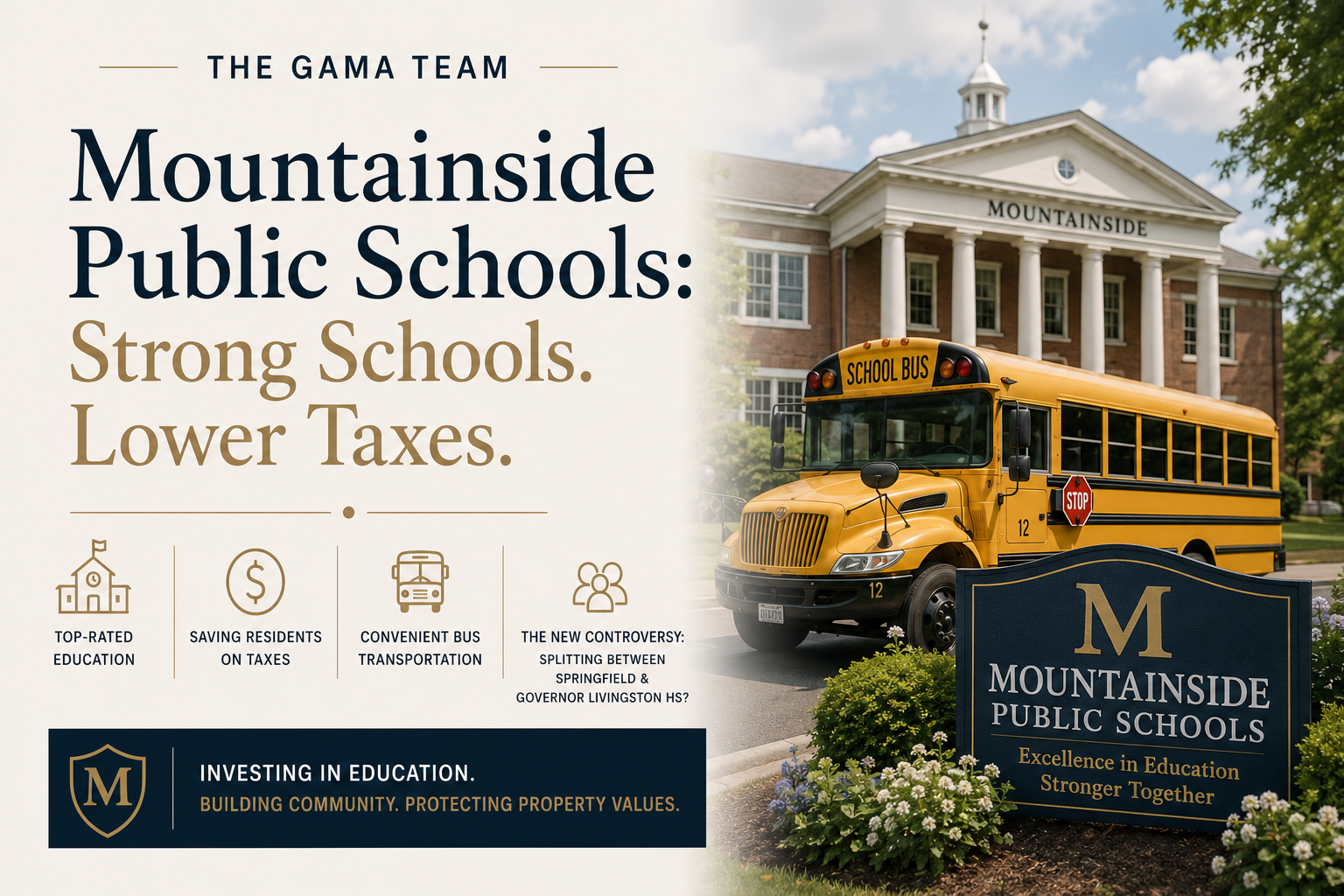
A complete guide to Mountainside, NJ's public schools — how the send/receive model to Governor Livingston High School saves homeowners on taxes, how busing actually works, and what's behind the new statewide consolidation debate touching Springfield and Berkeley Heights.
Mountainside NJ Public Schools: How the Town's Unique Structure Saves Homeowners on Taxes — and What the New Regionalization Debate Could Mean for Governor Livingston and Springfield
Mountainside, New Jersey operates its own highly regarded K-8 school district — Beechwood School and Deerfield School, the latter a 2024 National Blue Ribbon School — but does not operate its own high school. Instead, Mountainside's roughly 300 high schoolers attend Governor Livingston High School in neighboring Berkeley Heights under a formal send/receive contract, an arrangement that dates back to the 1997 dissolution of the old six-town Union County Regional High School District. Because Mountainside never has to build, staff, or maintain a full high school campus — athletic complexes, auditoriums, science wings, and all — its per-pupil spending runs meaningfully below the statewide K-8 average, and its overall effective property tax rate is among the lowest in Union County. Busing is guaranteed by New Jersey law for any high schooler living more than 2.5 miles from Governor Livingston and for any K-8 student living more than 2 miles from Beechwood or Deerfield. As of 2026, a real and active statewide push toward mandatory school district consolidation — championed in different forms by New Jersey's gubernatorial candidates and by a pending state Senate bill — has put small, non-operating K-8 districts like Mountainside's squarely in the conversation, reviving decades-old questions about whether Mountainside should fully merge into Berkeley Heights and reopening historical memories of the era when Mountainside, Berkeley Heights, and Springfield were all part of the very same regional high school district.
If you're considering a move to Mountainside, or you already live here and have started hearing chatter at borough council meetings, on local Facebook groups, or over coffee at the Route 22 diners about "regionalization," this guide is meant to walk you through exactly how Mountainside's school system works today, why it has produced real, measurable tax advantages for homeowners, how the busing actually functions day to day, and — as honestly and clearly as the available public record allows — what the current statewide consolidation debate actually is, where the historical Springfield connection comes from, and what it would realistically take for anything to change.
What Makes Mountainside's School System Different: The "Non-Operating High School" Model
Most New Jersey towns run a single K-12 public school system, or a system with its own dedicated middle school and high school buildings. Mountainside is structured differently, and understanding that structure is the foundation for everything else in this guide.
Mountainside operates its own independent school district for kindergarten through eighth grade only. The Mountainside School District runs two schools — Beechwood School and Deerfield School — serves roughly 750 to 800 students, and has its own locally elected Board of Education, its own superintendent, and its own annual budget and tax levy that residents vote on (or that gets set through the standard New Jersey school budget process) each year.
For grades nine through twelve, Mountainside has no school building of its own at all. Instead, the Mountainside School District contracts with the Berkeley Heights Public Schools district to educate Mountainside's teenagers at Governor Livingston High School, located in neighboring Berkeley Heights. This is what's known in New Jersey school law as a "send/receive" or "sending/receiving" relationship: Mountainside is the "sending district," Berkeley Heights is the "receiving district," and the entire arrangement is governed by a negotiated, periodically renewed contract between the two boards of education, with New Jersey's Commissioner of Education holding ultimate oversight authority if the two sides can't agree.
This is not a small or unusual footnote — it's the single most defining structural fact about Mountainside's public education system, and it shapes nearly everything else covered in this guide, from the town's tax rate to its busing obligations to the live policy debate currently playing out in Trenton and in school board meetings across Union County.
The Real Story: How Mountainside Ended Up Without Its Own High School
To understand why Mountainside operates this way, it helps to go back nearly ninety years, because the town's current arrangement is a direct descendant of a regional high school system that once covered six different Union County towns.
In 1937, the Union County Regional High School District was formed, originally uniting Berkeley Heights, Clark, Garwood, Kenilworth, Mountainside, and Springfield Township under a single regional high school umbrella. The district built and operated several campuses over the following decades: Jonathan Dayton Regional High School in Springfield opened first, in 1937 itself; Arthur L. Johnson Regional High School in Clark followed in 1956; Governor Livingston Regional High School in Berkeley Heights opened in 1960; and David Brearley Regional High School in Kenilworth opened in 1966 before eventually closing in 1993. Under this system, Mountainside teenagers — like teenagers from every other town in the six-municipality region — attended whichever regional campus they were assigned to, funded through a shared regional tax levy spread across all six towns.
That regional system came apart in the mid-1990s. In May 1996, voters across the six member towns went to the polls on a formal dissolution referendum, and the measure passed with about 55 percent support region-wide. The vote broke down unevenly by town: Berkeley Heights, Kenilworth, Mountainside, and Springfield all voted in favor of dissolving the regional district, while Clark and Garwood voted against it. Despite that split, the overall regional majority carried the day, and the Union County Regional High School District officially dissolved at the end of the 1996–97 school year.
What happened next is the direct origin of Mountainside's current structure. Springfield, which already hosted the Jonathan Dayton campus within its own borders, reorganized into a full K-12 district and simply took over Jonathan Dayton High School as its own town high school — a comparatively clean outcome for a town that already had a school building sitting inside its municipal boundaries. Berkeley Heights did the same thing with the Governor Livingston campus, becoming Berkeley Heights Public Schools, a full K-12 operating district with Governor Livingston High School as its capstone. Clark similarly took over Arthur L. Johnson as its own town high school, and Kenilworth reopened David Brearley as its town high school. Garwood, like Mountainside, had no high school campus of its own within its borders and needed to establish a sending relationship — in Garwood's case, to Arthur L. Johnson in Clark.
Mountainside was left in the same position as Garwood: a town with no high school building, needing to negotiate a formal sending arrangement with one of its former regional partners. Given Governor Livingston's physical proximity and Mountainside's existing ties to the Berkeley Heights community, the town entered into a send/receive agreement with the newly independent Berkeley Heights Public Schools district, and Mountainside teenagers have attended Governor Livingston High School ever since — an arrangement now approaching its thirtieth consecutive year.
This history matters enormously for understanding today's headlines, because it explains something that can otherwise seem confusing: any serious conversation about "regionalizing" or "consolidating" Mountainside's school system inevitably raises Springfield's name alongside Berkeley Heights and Governor Livingston's, simply because all three towns were literally part of the same six-town regional district for sixty years. The historical fork in the road — Mountainside and Berkeley Heights going one direction, Springfield going another — is precisely why any renewed regionalization push in Union County tends to reopen old questions about whether that 1996 split was the right long-term answer, and whether some version of the old regional model might eventually make a comeback in a different form.
Beechwood and Deerfield: Mountainside's Own K-8 Schools
Before getting further into the high school arrangement, it's worth spending time on the part of Mountainside's school system the town runs entirely on its own, because it's genuinely one of the district's strongest selling points for families considering a move here.
Beechwood School serves Mountainside's younger students, providing the early elementary foundation before students transition to Deerfield School for the upper elementary and middle school grades. Deerfield School serves the district's older elementary and middle school population, and it earned one of the most significant recognitions available to any American public school: in 2024, Deerfield was named a National Blue Ribbon School of Excellence by the U.S. Department of Education, a designation reserved for schools demonstrating either exceptionally high overall academic achievement or dramatic progress in closing achievement gaps. This is a genuinely meaningful credential — Blue Ribbon status is not handed out casually, and it places Deerfield among a relatively small, elite cohort of public schools nationwide.
Class sizes across the district run favorably small. Mountainside's overall student-teacher ratio sits at roughly 10.4 to 1, meaningfully lower than many larger suburban districts, giving Beechwood and Deerfield students access to more individualized attention than a bigger district's elementary and middle schools might realistically offer. Total district enrollment runs in the 750-to-800-student range across both schools combined — small by design, and part of what allows the close-knit, community-feel atmosphere that Mountainside families frequently cite as a reason they chose the town.
The district falls into New Jersey's "I" District Factor Group classification, the second-highest socioeconomic status category the state uses for comparing districts, reflecting Mountainside's generally affluent, well-resourced community base. Total per-pupil spending across the district runs notably below the statewide K-8 district average, a figure explored in more depth in the tax section below, alongside a median teacher salary that reflects the district's overall compact scale.
Families in Mountainside also have access to New Jersey's Union County Vocational-Technical Schools system, an option available to students seeking specialized career and technical education tracks alongside or instead of the traditional Governor Livingston pathway — worth knowing about for families with older students interested in trades, health sciences, engineering, or other specialized vocational programs not typically offered at a traditional comprehensive high school.
Governor Livingston High School: Where Mountainside's Teens Go
Once Mountainside students finish eighth grade at Deerfield, they transition to Governor Livingston High School in Berkeley Heights — a school with its own long, well-regarded history in Union County's education landscape.
Governor Livingston opened in September 1960, originally welcoming about 800 students from both Berkeley Heights and Mountainside under the old regional district structure, with Frederick Aho serving as the school's first principal. The school became fully part of Berkeley Heights Public Schools in 1997 following the regional district's dissolution, and it has operated as Berkeley Heights' town high school — with Mountainside continuing on as a sending district — ever since.
Enrollment as of the 2024–25 school year sat at roughly 849 students, with a student-to-teacher ratio of about 10.4 to 1 — nearly identical to Mountainside's own elementary ratio, meaning Mountainside students transition into a high school environment with class sizes and individual attention levels genuinely consistent with what they experienced at Beechwood and Deerfield, rather than facing a jarring jump into oversized classes the way students sometimes do moving from a small K-8 district into a much larger regional high school.
Governor Livingston has built a genuinely strong academic and athletic reputation over more than six decades. The school's rankings have moved around over the years depending on the ranking methodology and year in question — placements in the 30s among New Jersey high schools in some rankings cycles, alongside various national rankings — but it has consistently placed among the stronger public high schools in Union County. Athletically, the school has a deep trophy case, including state championships in boys' soccer across multiple eras (1977, 1979, 1984, and 1994), girls' soccer (1985 and 2018), and baseball (1999, 2011, 2015, and 2024), along with a well-regarded marching band program, a nationally recognized robotics team, and a full slate of AP coursework, including recognized instructors presenting at national subject-area conferences.
Because Mountainside students make up a meaningful minority of Governor Livingston's total enrollment — roughly 300 out of around 850 students, or a little over a third of the school — Mountainside families genuinely have a voice in the broader Governor Livingston community, even without their own seat on the Berkeley Heights Board of Education (a structural quirk of the send/receive model addressed later in this guide). Mountainside students participate fully in Governor Livingston's general education classes, honors and AP tracks, sports teams, clubs, and extracurricular activities, on the same basis as Berkeley Heights' own resident students.
Getting to Know Berkeley Heights: The Town That Educates Mountainside's Teenagers
Because Mountainside families are, in a very real sense, entrusting a meaningful chunk of their children's education to a neighboring town's school district, it's worth understanding a bit about Berkeley Heights itself, not just the mechanics of the contract that connects the two towns.
Berkeley Heights is a well-regarded Union County township in its own right, generally considered one of the stronger residential markets in the immediate area, with its own reputation for strong schools, a walkable downtown, and convenient commuter rail access. Berkeley Heights Public Schools operates as a full K-12 district serving roughly 2,300 students across six schools, with Governor Livingston sitting at the top of that system as the district's single comprehensive high school.
This scale differential is worth appreciating directly: Berkeley Heights' overall K-12 enrollment runs roughly three times the size of Mountainside's entire K-8 district, meaning Mountainside's roughly 300 high schoolers join a considerably larger overall educational community once they reach ninth grade, gaining access to the broader course catalog, activity roster, and extracurricular depth that a bigger combined student body can support, while still benefiting from Governor Livingston's specific 10.4-to-1 student-teacher ratio rather than the more diluted ratios sometimes found in larger regional high schools drawing from many more towns at once.
The relationship between the two communities extends well beyond the strict legal terms of the send/receive contract. Mountainside families with high schoolers at Governor Livingston routinely participate in Berkeley Heights' broader community life through school sports, theater and music programs, and parent organizations, and many Mountainside families report feeling genuinely well-integrated into the Governor Livingston community rather than treated as outside guests — a reasonable expectation given that, as noted earlier, Mountainside residents make up more than a third of the school's total population at any given time.
The Send/Receive Contract: How the Financial Relationship Actually Works
The mechanics of how Mountainside pays for its students' education at Governor Livingston are worth understanding in some detail, both because they explain a meaningful chunk of the town's annual school budget and because they're directly relevant to the consolidation debate covered later in this guide.
Mountainside pays Berkeley Heights a negotiated annual tuition rate for each Mountainside student attending Governor Livingston, set through a formal contract between the two boards of education. For the 2024–25 school year, the Mountainside Board of Education approved a tuition agreement with Berkeley Heights totaling $4,316,718 — a substantial sum that, by some public estimates, represents roughly 30 percent of Mountainside's total annual school district budget, reflecting just how central this single line item is to the town's overall education spending.
The per-student tuition rate under a send/receive contract is typically calculated using a state-regulated formula based on Berkeley Heights' actual per-pupil cost of educating a high school student at Governor Livingston, adjusted for the specific mix of general education, special education, and any additional services Mountainside's students require. This formula-driven approach is designed to ensure the sending district pays its fair share of the actual cost of education, without either subsidizing or free-riding on the receiving district's taxpayers.
Contract terms for send/receive relationships in New Jersey typically run in multi-year increments, frequently five-year terms with renewal options, giving both districts a reasonable planning horizon while still requiring periodic renegotiation. A previous renegotiated agreement between Mountainside and Berkeley Heights was approved in 2016, effective from July 1, 2017 through June 30, 2022, with the structure allowing for additional five-year renewal terms after that. Public reporting on the relationship has referenced a subsequent extension reportedly running through June 2028, alongside continued annual tuition-rate agreements like the 2024–25 contract referenced above, which get approved and adjusted yearly even within the framework of a longer multi-year base agreement.
This periodic renewal cycle is itself a genuinely important structural feature to understand, because it means Mountainside's entire high school arrangement is never something the town can simply take for granted indefinitely — every renewal period represents a formal negotiation between two separate boards of education, each answerable to its own taxpayers, and each with its own incentives. Berkeley Heights taxpayers, for instance, have sometimes raised questions over the years about capacity, facility usage, and whether the tuition formula adequately compensates the district for the marginal cost of educating out-of-district students — questions that surface periodically in Berkeley Heights Board of Education meetings and that, in theory, could complicate a future renewal if left unaddressed. To date, however, the relationship has proven durable and has been renewed and extended repeatedly across nearly three decades.
The Tax Savings Case: How This Structure Keeps Mountainside's School Costs Down
This is the section homebuyers and current residents alike tend to care about most directly, so it's worth laying out the actual numbers as clearly and honestly as the available data allows — including being upfront about which parts of Mountainside's tax advantage come from the school structure specifically, and which come from other factors entirely.
Mountainside's overall effective property tax rate is genuinely one of the lowest in Union County. Recent data puts the town's effective rate somewhere in the neighborhood of 1.57 to 1.99 percent depending on the specific year and data source, placing it behind only Summit among nearby Union County towns and comfortably below New Jersey's statewide median effective rate of roughly 2.88 percent. On a median-valued home in Mountainside, this translates to an average annual tax bill in the range of $11,000 to $13,300 — a genuinely competitive figure for a town offering this level of school quality, community amenities, and proximity to major employment centers.
It's important to be honest that Mountainside's overall low effective rate isn't attributable to any single factor, and the school structure is only part of the picture. Independent property-tax analysis of the town points to two additional, non-school-related drivers that meaningfully compress Mountainside's overall rate: the town's stretch of the Route 22 commercial corridor, where businesses contribute substantial ratable value to the municipal tax base and share a tax burden that in purely residential towns would otherwise fall entirely on homeowners; and Mountainside's generally high median home values, which spread the total municipal and school tax levy across a larger pool of assessed value, mechanically compressing the rate that each dollar of assessed value carries. Any complete, honest picture of "why Mountainside's taxes are relatively low" has to include both of these factors alongside the school structure — this guide isn't interested in overselling a single explanation when the real picture is genuinely a combination of several.
Where the school structure specifically and measurably helps is on the education side of the ledger. Mountainside's total per-pupil spending runs at roughly $15,200, a figure that sits about 19.5 percent below the statewide average for comparable K-8 districts — a meaningful gap that reflects genuine structural cost avoidance, not just efficient budgeting. The core reason is straightforward: Mountainside never has to fund the capital costs of building, maintaining, heating, insuring, or eventually renovating a full high school campus — no auditorium, no science wing, no full-size gymnasium and athletic complex, no dedicated administrative wing for a four-year secondary program, no district-owned athletic fields requiring irrigation, lighting, and turf replacement on a multi-decade capital cycle. Instead, Mountainside pays a single, formula-driven annual tuition line item that covers its proportional share of Berkeley Heights' actual cost of running Governor Livingston — without ever carrying the underlying capital debt, bonding costs, or long-term facility liability that come with owning a high school outright.
This distinction matters enormously when you consider how New Jersey school construction and renovation typically gets financed. Towns that operate their own full K-12 systems periodically go to voters (or use state-approved financing mechanisms) for large capital bond referendums to fund high school renovations, additions, turf field replacements, HVAC overhauls, and security upgrades — bonds that get repaid over 15, 20, or even 30 years through the local school tax levy. Mountainside taxpayers are structurally insulated from ever having to approve or repay a bond referendum specifically tied to high school capital improvements, because they don't own the building. When Governor Livingston needs a new roof, an athletic facility upgrade, or a major renovation, that capital cost falls on Berkeley Heights' own bonding capacity and tax base — factored into Mountainside's tuition rate only proportionally, through the negotiated per-pupil formula, rather than hitting Mountainside taxpayers directly and disproportionately the way a standalone capital project would.
None of this means Mountainside residents pay nothing toward Governor Livingston's ongoing costs — the roughly $4.3 million annual tuition payment is real money, funded by Mountainside's own school tax levy, and it represents close to a third of the town's total school budget. But it is a fundamentally different, generally more predictable and more cost-contained financial exposure than owning and operating a full four-year high school outright would be — and it's a genuine, defensible piece of the broader tax-advantage story that Mountainside residents and prospective buyers should understand clearly, distinct from (but complementary to) the Route 22 ratable and high-home-value factors covered above.
How Mountainside Compares to Neighboring Towns With Their Own High Schools
For buyers weighing Mountainside against other towns in GAMA's core coverage area, it's genuinely useful to see how the send/receive model stacks up against towns that operate their own comprehensive high schools from kindergarten through twelfth grade.
Westfield operates its own full K-12 system, including Westfield High School, a large comprehensive high school serving the entire town directly. Westfield's overall effective tax rate has run around 1.81 percent in recent data, with average tax bills near $18,900 — reflecting, among other factors, the ongoing capital costs of operating a large, single-town high school system serving a considerably bigger overall student population than Mountainside's entire K-8 enrollment.
Cranford similarly operates its own K-12 system with Cranford High School. Cranford's effective rate has run closer to 2.11 percent, with average bills in the neighborhood of $13,700 — a genuinely different profile than Mountainside's, shaped by Cranford's own mix of home values, commercial ratables, and the ongoing costs of running its own full-service high school.
Scotch Plains, together with Fanwood, jointly operates the Scotch Plains-Fanwood Regional School District, including Scotch Plains-Fanwood High School — itself a regional arrangement, though a considerably larger and more established one than Mountainside's smaller-scale send/receive contract with a single neighboring town. Scotch Plains' effective rate has run around 2.14 percent in recent data, among the higher rates in this specific peer comparison.
Summit operates its own full K-12 system and, notably, posts an even lower effective tax rate than Mountainside in some recent data sets — a reminder that Mountainside's tax advantage, while real, isn't unique in the immediate area, and that towns with their own comprehensive high schools can still post highly competitive rates when other factors (dense commercial ratables, very high home values, efficient budgeting) are strong enough to offset the capital costs of owning a high school.
New Providence and Basking Ridge (Bernards Township), two more towns in GAMA's core coverage area, both operate their own comprehensive high schools as well — New Providence High School and Ridge High School, respectively — giving families in those towns a fundamentally different structural relationship with their high school than Mountainside families have: direct local control over the high school's budget, curriculum decisions, and capital planning, but also full direct exposure to the capital costs of maintaining that building over time.
The honest takeaway for buyers comparing these towns side by side is this: there's no single "best" structure in the abstract. Owning your own comprehensive K-12 system, as Westfield, Cranford, Summit, New Providence, and Basking Ridge all do, means full local control and a single, unified educational identity from kindergarten through senior year — but it also means full exposure to the capital costs of a high school campus. Mountainside's send/receive model trades some of that local control (Mountainside doesn't get a direct seat on the Berkeley Heights Board of Education, and Governor Livingston's curriculum and facility decisions are made primarily by Berkeley Heights residents and their elected board) for a meaningfully lower, more predictable school-related capital cost exposure, layered on top of a town that already benefits from strong Route 22 commercial ratables and high home values. For many Mountainside families, particularly those drawn to the smaller K-8 environment at Beechwood and Deerfield in the first place, that trade-off has proven genuinely worthwhile for close to three decades running.
Beyond Governor Livingston: The Union County Vocational-Technical Option
While the overwhelming majority of Mountainside's high schoolers attend Governor Livingston, it's worth giving proper attention to an alternative pathway that gives families genuine additional flexibility within the broader system.
The Union County Vocational-Technical Schools district operates specialized, application-based programs open to eligible students across Union County, including Mountainside residents, covering fields ranging from engineering technologies and biotechnology to culinary arts, cosmetology, allied health, and a wide range of skilled trades. These programs typically operate on either a full-time "career academy" model, where students attend the vocational campus for their entire high school experience, or a shared-time model, where students split their school day or school year between their home sending high school (Governor Livingston, in Mountainside's case) and a vocational-technical campus.
Access to this system is a genuine, meaningful benefit of Mountainside's overall structural position within Union County, giving families interested in specialized career pathways an alternative or supplement to the traditional comprehensive high school track at Governor Livingston, without requiring Mountainside to build or fund any specialized vocational facilities of its own — another example of how being embedded within Union County's broader shared educational infrastructure, rather than operating a fully self-contained K-12 system in isolation, gives Mountainside families access to a wider menu of options than the town's small size might otherwise suggest.
Admission to Union County's vocational-technical programs is typically competitive and application-based, with specific eligibility, application windows, and program availability changing from year to year, so families interested in this pathway for a specific child should work directly with Mountainside's guidance counseling staff, who typically coordinate directly with the vocational-technical admissions office to guide interested students through the application process well in advance of the standard high school transition timeline.
Busing: How Mountainside Students Actually Get to School
Busing is one of the most practical, day-to-day concerns for any family evaluating a town's school system, and Mountainside's structure creates a genuinely two-tiered busing picture worth understanding clearly.
New Jersey state law sets clear minimum distance thresholds for mandatory school busing. Under state statute, elementary students in kindergarten through eighth grade are legally entitled to busing if they live more than two miles from their assigned school, while secondary students in grades nine through twelve are entitled to busing if they live more than two and a half miles from their school. Districts are permitted, but not required, to provide "courtesy busing" (sometimes called subscription busing) to students living closer than these legal thresholds, and when they do offer it, state law explicitly permits districts to charge parents or guardians a fee for that optional service.
For Mountainside's K-8 students attending Beechwood or Deerfield, busing eligibility follows the standard two-mile threshold — given Mountainside's genuinely compact geographic footprint as a small borough, many families likely fall within walking or short-drive distance of their assigned school rather than the legally mandated busing radius, though families living at the edges of town or along less walkable routes may qualify for required transportation, and courtesy busing options may be available for others depending on the district's specific policies and any hazardous-route designations along particular streets.
For Mountainside's high schoolers attending Governor Livingston in Berkeley Heights, the calculation is different because the school itself sits in a neighboring town, meaning essentially the entire Mountainside high school population lives well beyond the 2.5-mile secondary busing threshold from their assigned school by definition. This makes busing to Governor Livingston a functionally universal service for Mountainside's high school population, built directly into the overall send/receive financial relationship between the two districts, rather than a discretionary or hazardous-route-specific accommodation the way it might be for a family living just outside the mandatory radius from an in-town school.
Transportation costs for the Mountainside-to-Governor Livingston busing route are generally incorporated into the overall financial relationship between the sending and receiving districts, either as a distinct line item or folded into the broader tuition and service agreement, rather than being billed to Mountainside families directly the way a discretionary courtesy-busing fee might be for a family requesting optional transportation closer to home. Families with specific questions about current bus routes, stop locations, and pickup times for either the in-town K-8 schools or the Governor Livingston route are always best served by confirming details directly with the Mountainside School District's transportation office, since specific routes and schedules are set and adjusted annually and can shift based on enrollment, staffing, and road conditions.
It's worth noting, too, that New Jersey's busing framework includes hazardous-route provisions, under which a local Board of Education has the discretion — though not a strict legal obligation — to provide transportation for students living within the standard distance thresholds if a particular route is deemed unsafe for walking, due to factors like heavy traffic, lack of sidewalks, or dangerous intersections. Families concerned about a specific walking route to Beechwood or Deerfield can raise the issue directly with the district, which retains discretion over whether to designate that route as hazardous and extend courtesy transportation accordingly.
The New Controversy: Statewide Pressure to Consolidate Small Districts Like Mountainside's
Here's where Mountainside's decades-old, generally stable school structure runs into a genuinely live, current, and evolving statewide policy debate — one that has real implications for towns exactly like Mountainside, even though, as this section will make clear, no single finalized plan currently on the table proposes a literal, immediate split of Mountainside's students between Governor Livingston and Springfield's Jonathan Dayton High School.
The push toward consolidating New Jersey's smallest school districts is not new, but it has gained real, renewed momentum heading into 2026. Back in 2019, then-Senate President Steve Sweeney introduced a sweeping 32-point "Path to Progress" fiscal reform plan that included a proposal to merge roughly 274 of New Jersey's approximately 600 school districts into about 320 larger regional systems, specifically targeting the state's many small K-4, K-5, K-6, K-8, and K-9 districts — a category Mountainside's own K-8 district falls squarely into. Sweeney argued the plan could generate roughly $1 billion in statewide savings by eliminating redundant district-level administration, memorably framing the goal as wanting to "eliminate the administration, put a principal in the school." That specific 2019 proposal never became law, but it planted a policy seed that has continued to resurface in various forms ever since.
That seed resurfaced prominently during New Jersey's 2025 gubernatorial race. Both major-party candidates expressed support for encouraging school district mergers as a strategy for controlling New Jersey's notoriously high property taxes — schools consume roughly 52 percent of local property tax revenue statewide — but the two candidates differed meaningfully on whether consolidation should be voluntary or state-mandated. Democratic candidate Mikie Sherrill favored a two-step approach: offering financial incentives for voluntary mergers first, then pursuing compulsory consolidation specifically for underperforming districts if voluntary efforts proved insufficient. Republican candidate Jack Ciattarelli took a more locally-deferential position, stating that state government should not force consolidation and that such decisions belong with local communities, while still supporting incentives to encourage voluntary mergers. As of this writing, New Jersey operates 590 separate school districts, down only modestly from 599 just a few years earlier — a sign of just how slowly voluntary consolidation efforts have historically moved.
More concretely, a specific piece of state legislation has entered the conversation. In late 2025, State Senator Vin Gopal introduced Senate Bill S4861, which would require county executive superintendents to develop formal consolidation plans for small school districts — specifically, districts with fewer than 500 resident students. If a state-funded feasibility study determined that a proposed merger would reduce costs, improve the overall learning environment, and not increase segregation, the affected districts would be required to merge after a five-year transition period. As of December 2025, the bill had been introduced but not yet advanced through committee, with its sponsor indicating an intention to push it forward with likely modifications sometime in 2026. It's worth being precise here: Mountainside's own K-8 enrollment, at roughly 750 to 800 resident students, sits above the specific 500-student threshold named in this particular bill as drafted — meaning Mountainside would not automatically fall under this exact proposal's mandatory review trigger as currently written, though the broader political momentum behind the bill, and the likelihood of future amendments adjusting that threshold, means Mountainside families are reasonable to watch this legislation closely rather than assume the town is permanently exempt.
Beyond the legislative track, a more direct, Mountainside-specific proposal has circulated in local policy commentary. An analysis published on the education policy site nj21st, titled "Too Many Bosses, Not Enough Students," made a detailed case for fully consolidating Mountainside's roughly 800-student K-8 district directly into Berkeley Heights Public Schools' approximately 2,300-student K-12 system — effectively converting the current send/receive contractual relationship into full district unification, with Mountainside's Beechwood and Deerfield schools becoming part of a single, unified Berkeley Heights-Mountainside K-12 district rather than two separately governed districts connected by contract. The piece argued such a merger could reduce costs (citing research suggesting very small districts spend roughly 17 percent more on average than larger ones, driven primarily by administrative overhead), better align curriculum and specialized programming between the two towns (noting, for instance, that Mountainside currently lacks the same collaborative special-education classroom model Berkeley Heights offers), permanently secure Mountainside students' place at Governor Livingston without the periodic uncertainty of contract renewal negotiations, and allow greater teacher mobility between the two districts without loss of tenure. The analysis pointed to precedents including a 2014 Hunterdon County district merger and ongoing consolidation studies involving the Watchung Hills Regional High School District as evidence that this kind of unification is both achievable and, in the right circumstances, genuinely beneficial.
Separately, and worth watching closely, is a related but distinct regional consolidation study specifically involving Watchung Hills Regional High School District, examined in a February 2026 nj21st analysis titled "Smaller Districts, Bigger System," which looked at the broader benefits case for regional consolidation models across northern New Jersey more generally. While that particular study centers on a different regional high school district than Governor Livingston's, it reflects the same broader statewide policy current — a genuine, active reconsideration of whether New Jersey's historically fragmented, town-by-town school district map still makes fiscal sense in an era of tighter state aid formulas and mounting property tax pressure — a current that touches Mountainside's own arrangement directly, given the town's small-district, non-operating-high-school structure.
Where the "Springfield" Question Actually Comes From
Given how often Springfield's name comes up alongside Mountainside and Governor Livingston in any conversation about regionalization, it's worth addressing this directly and precisely, because the honest answer is more nuanced than a simple "Mountainside might switch to Jonathan Dayton" headline would suggest.
There is no current, formally proposed plan on the public record that would literally split Mountainside's high school population between Governor Livingston in Berkeley Heights and Jonathan Dayton in Springfield. No pending legislation, no active Mountainside or Berkeley Heights Board of Education resolution, and no formal feasibility study identified in current public reporting proposes sending some Mountainside students to one school and others to the other. The town's roughly 300 high schoolers currently attend, and are expected to continue attending, Governor Livingston as a single unified group under the existing send/receive contract.
What is real, and what almost certainly explains where this idea comes from, is the historical fact covered earlier in this guide: Mountainside, Berkeley Heights, and Springfield were literally part of the very same regional high school district for sixty years, from 1937 until the 1996 dissolution vote. Under that old system, all three towns' fates were directly tied together through a single regional governing board, a single regional tax levy, and a shared set of high school campuses that included both what's now Governor Livingston and what's now Jonathan Dayton. When that system dissolved, Mountainside and Springfield's paths diverged specifically because Springfield had a high school campus sitting inside its own municipal borders (making a clean transition to full local control straightforward) while Mountainside did not (requiring a sending arrangement instead). That historical fork — Mountainside toward Governor Livingston, Springfield toward its own Jonathan Dayton — is precisely the kind of detail that resurfaces naturally whenever regionalization gets discussed again, because any serious, comprehensive rethinking of "how should these formerly-regional Union County towns handle high school education" almost inevitably has to grapple with the fact that these towns' current arrangements all trace back to the same 1996–97 dissolution event.
It's also worth noting that Jonathan Dayton High School in Springfield participates in New Jersey's Interdistrict Public School Choice Program, a long-standing statewide initiative that allows designated "choice districts" to accept a limited number of out-of-district students, funded through state aid that follows the student rather than through a locally negotiated tuition contract like Mountainside's arrangement with Berkeley Heights. This is a meaningfully different mechanism than a formal send/receive relationship — Choice Program seats are limited, awarded through a competitive application and lottery process, and available to families from anywhere in the state, not specifically reserved for Mountainside residents — but it does mean that, in a narrow, technical sense, individual Mountainside families theoretically have the option to apply to Jonathan Dayton through the statewide Choice Program on the same basis as any other New Jersey family, entirely separate from Mountainside's official, town-wide sending relationship with Governor Livingston. This is a genuinely different thing from an official district-level "split," and families should not confuse an individual student's Choice Program eligibility with any kind of town-wide policy shift — but it's a real, accurate piece of the broader picture worth including for completeness.
Put plainly: the "Springfield and Governor Livingston" framing that circulates locally reflects genuine historical roots and a real, live statewide consolidation conversation that touches Mountainside directly — but it should not be mistaken for an active, specific proposal to divide Mountainside's current student population between the two schools. The more accurate, precise way to understand the current moment is that Mountainside's decades-old, single-partner arrangement with Governor Livingston faces a broader, statewide policy environment that is, for the first time in years, seriously questioning whether small non-operating districts like Mountainside's should exist in their current contractual form at all — with full unification into Berkeley Heights being the specific, concretely proposed alternative circulating in local policy discussion, not a Springfield-based alternative.
What Could Actually Change, and What It Would Mean for Mountainside Families and Homebuyers
Given everything covered above, it's worth walking through, as honestly and specifically as possible, what the realistic range of outcomes actually looks like — and what each would mean practically for current residents and prospective buyers.
Scenario one: the status quo continues, largely unchanged. This remains, by a meaningful margin, the most likely near-term outcome. New Jersey has a long, well-documented history of proposed school consolidation measures generating substantial public discussion without translating into mandatory, statewide action, largely due to the state's strong home-rule tradition and the genuine political difficulty of forcing local communities to merge school districts against local preference. Even the December 2025 Senate bill discussed above would, if it advances at all, likely apply first to districts with far fewer resident students than Mountainside's roughly 750 to 800, and would still require a feasibility study process and a five-year transition window even where it did apply. For a family evaluating Mountainside today, betting on continuity of the current Governor Livingston sending arrangement remains the most reasonable working assumption.
Scenario two: full voluntary unification with Berkeley Heights. This is the specific outcome the nj21st analysis argued for, and it remains a genuinely plausible longer-term path, particularly if both towns' boards of education and voting publics came to see clear, mutual benefit in converting the current contractual relationship into full district merger. Practically, for Mountainside families, this would likely mean Beechwood and Deerfield becoming part of a single, unified Berkeley Heights-Mountainside K-12 district governance structure, potentially with a combined Board of Education giving Mountainside residents direct representation over Governor Livingston's budget and policy decisions for the first time — a genuine governance upgrade from the current contract-renewal model, in which Mountainside has influence but not a formal board seat. Financially, proponents argue this could reduce administrative redundancy costs over time, though any such merger would require careful negotiation over tax-levy allocation between the two towns' differing home values and ratable bases, a genuinely complex process that has, historically, taken other New Jersey merger efforts years to work through even when both communities were broadly supportive.
Scenario three: a broader, mandated regional restructuring driven by state legislation. This remains the least immediately likely scenario for Mountainside specifically, given the 500-student threshold in the current draft Senate bill and the state's overall historical reluctance to force consolidation over local objection — but it's also the scenario most worth monitoring over a multi-year horizon, given the genuine political momentum building around property-tax relief as a statewide priority following the 2025 gubernatorial race. Should future legislation lower the mandatory-review threshold, or should broader political consensus shift meaningfully toward compulsory consolidation, Mountainside's small, non-operating K-8 structure would likely become a more directly relevant case study than it currently is.
For current homeowners, none of these scenarios suggest an imminent, dramatic tax increase is on the immediate horizon — the send/receive contract with Berkeley Heights was recently renewed and reportedly extends into 2028, giving families a reasonable multi-year window of continuity regardless of how the broader statewide conversation develops. For prospective buyers specifically drawn to Mountainside because of its current tax profile, it's genuinely worth having an informed, direct conversation with a local agent about how these dynamics might play out over a five-to-ten-year ownership horizon, particularly for buyers planning to raise children through the full K-12 educational cycle in town, since a genuine district merger — while not imminent — is a live enough possibility that informed buyers should understand the landscape rather than be caught off guard by a headline several years down the road.
The Real Estate Angle: Why This Matters for Buyers and Sellers Right Now
Because school systems are consistently one of the top two or three factors driving where families choose to buy in Central New Jersey, it's worth translating everything above into direct, practical real estate guidance.
For buyers, Mountainside currently offers a genuinely compelling combination: a small, high-performing, Blue Ribbon-caliber K-8 experience at Beechwood and Deerfield, a well-regarded and athletically successful high school experience at Governor Livingston, and one of the more competitive effective property tax rates in Union County — a combination that, taken together, explains a meaningful part of why Mountainside has remained a consistently desirable, tightly held market even as broader regional conditions have shifted over recent years. Buyers specifically prioritizing lower school-related capital tax exposure, smaller elementary and middle school class sizes, and a genuinely tight-knit small-town feel should weigh Mountainside seriously against larger, full K-12 towns like Westfield, Cranford, or Scotch Plains, understanding clearly that the trade-off is a degree of direct local control over the high school experience itself.
For sellers, understanding and being able to clearly, accurately explain Mountainside's school structure to prospective buyers — rather than assuming buyers already understand the send/receive model — is a genuinely valuable part of effective listing marketing. Out-of-town buyers relocating from areas where every town simply runs its own full K-12 system sometimes need this structure explained clearly and reassuringly, since an unfamiliar arrangement can otherwise read as a red flag rather than the genuine, longstanding, and financially favorable structure it actually is. A well-informed listing conversation should be able to walk a buyer through exactly what this guide has covered: the history, the tax mechanics, the busing guarantee, and an honest, current summary of the broader statewide consolidation conversation — precisely the kind of substantive, transparent guidance The GAMA Team aims to provide every client considering Mountainside.
For families already in Mountainside considering whether to stay through their children's full K-12 years, the current picture remains genuinely reassuring. The send/receive relationship with Governor Livingston has proven durable across nearly three decades and multiple renewal cycles, current legislation would not appear to directly and immediately capture Mountainside's district under its specific drafted thresholds, and even the most concretely proposed alternative — full unification with Berkeley Heights — would represent an enhancement of local governance influence over Governor Livingston rather than any kind of degradation of the educational experience Mountainside families currently receive.
A Case Study: A Family Choosing Between Mountainside and a Full K-12 Town
To make all of this genuinely practical, it's worth walking through how this actually plays out for a real category of buyer The GAMA Team works with regularly.
A family relocating to Central New Jersey from out of state, with a rising second-grader and a rising kindergartner, spent several months comparing Mountainside against Cranford and Westfield before making a final decision. Initially, the family was hesitant about Mountainside specifically because of the send/receive high school structure — having grown up in towns where a single district ran K-12 continuously, the idea of switching school systems and buildings between eighth and ninth grade felt unfamiliar and, at first pass, mildly concerning.
After a direct conversation walking through exactly the material covered in this guide — Governor Livingston's own strong athletic and academic track record, the genuinely favorable 10.4-to-1 student-teacher ratio carrying through from Beechwood and Deerfield into the high school level, the town's competitive effective tax rate, and the practical reality that roughly a third of Governor Livingston's total student body already comes from Mountainside, meaning Mountainside kids aren't some small minority group parachuting into an unfamiliar school as outsiders — the family's concerns shifted considerably. They ultimately chose Mountainside, specifically citing Deerfield's Blue Ribbon status and the town's lower overall tax burden as decisive factors relative to comparably priced homes they'd viewed in Cranford and Westfield.
Two years into ownership, the family reports genuine satisfaction with Beechwood's smaller class sizes and the close-knit community feel that drew them to the town in the first place, and they've begun paying closer attention to the broader regionalization conversation covered in this guide — not with alarm, but with the kind of informed, engaged interest that comes from genuinely understanding how their town's school system works, rather than simply hoping nothing changes.
A Second Case Study: A Longtime Resident Weighing a Move as Consolidation Talk Grows
A longtime Mountainside homeowner, whose children graduated from Governor Livingston several years ago, found herself fielding questions from a neighbor about whether the recent statewide consolidation headlines meant she should consider selling before any potential changes affected home values.
Working through the actual public record — the 500-student threshold in the pending state Senate bill that places Mountainside's roughly 750-to-800-student district above the current mandatory-review line, the genuinely multi-year renewal cycle already extending Mountainside's Governor Livingston relationship into 2028, and New Jersey's well-documented historical pattern of consolidation proposals generating extensive debate without swift mandatory action — gave her a considerably calmer, more grounded picture than the more alarmist framing she'd encountered secondhand. Rather than rushing to sell out of uncertainty, she came away with a clearer sense of what to actually watch for: any specific amendment to the state bill's enrollment threshold, any formal resolution introduced by either the Mountainside or Berkeley Heights Board of Education regarding unification, and the outcome of the 2028 contract renewal cycle when it arrives.
This case is worth including specifically because it illustrates something important about how to actually process a story like this one: genuine, informed understanding of the underlying mechanics — thresholds, contract timelines, and historical precedent — is a far more useful tool for homeowners and prospective buyers than reacting to a headline or secondhand neighborhood chatter, however well-intentioned that chatter might be.
Running the Numbers: What This Structure Could Mean Over a Typical Ownership Timeline
For buyers who think in terms of long-term cost of ownership rather than just a single year's tax bill, it's worth translating the structural advantages covered throughout this guide into a rough, illustrative long-horizon picture — with the clear caveat that this is a simplified illustration, not a financial projection, and actual results depend on countless variables no article can predict with precision.
Consider two otherwise-comparable Union County homes purchased at similar price points, one in Mountainside and one in a full K-12 town with a broadly similar overall effective tax rate. Over a typical 15-to-20-year ownership horizon — long enough to see a child through the full K-8-to-12 educational cycle and then some — the full K-12 town's school district will, in the ordinary course of maintaining any aging public high school facility, very likely go before voters or use approved state financing mechanisms for at least one and quite possibly several significant capital bond referendums: a roof replacement, an HVAC overhaul, an athletic facility renovation, a security infrastructure upgrade, or an academic wing addition to accommodate enrollment growth. Each of these, when approved, typically adds an incremental amount to that town's school tax levy for the duration of the bond's repayment period, on top of the town's baseline operating budget.
Mountainside homeowners are structurally insulated from ever voting on, or having their tax bill directly affected by, a Governor Livingston-specific capital bond referendum, because that decision and its associated tax impact rest with Berkeley Heights' own voters and tax base, not Mountainside's. Mountainside's exposure to Governor Livingston's capital costs is limited to whatever proportional share gets folded into the periodically renegotiated tuition rate — a meaningfully smoothed, predictable, formula-driven cost rather than a lump-sum capital assessment tied to a specific local bond vote.
This doesn't mean Mountainside taxpayers face zero exposure to Governor Livingston's long-term capital needs — a substantial future renovation at Governor Livingston would, over time, likely be reflected in higher negotiated tuition rates in subsequent contract renewals, since Berkeley Heights would reasonably expect Mountainside to continue paying its fair proportional share of the school's true operating and capital costs. But the mechanism is fundamentally smoother and more predictable: incremental adjustments folded into a periodic, negotiated tuition contract, rather than a single, potentially large one-time bond referendum landing entirely on Mountainside's own tax levy the way it would in a town that owned its high school outright.
The honest, complete picture, then, is this: Mountainside's overall tax advantage over the life of a long-term ownership horizon comes from a genuine combination of factors — the Route 22 commercial ratable base, high median home values compressing the effective rate, and the structural capital-cost insulation the send/receive model with Berkeley Heights provides. None of these factors alone fully explains Mountainside's competitive tax position, but together, sustained over a 15-to-20-year ownership horizon, they represent a genuinely meaningful, defensible cumulative advantage worth factoring into any serious long-term cost-of-ownership comparison between Mountainside and its full K-12 neighboring towns.
A Practical Glossary
Send/receive relationship (sending-receiving relationship): A formal contractual arrangement under New Jersey school law in which one district (the "sending district," here Mountainside) pays a negotiated tuition to another district (the "receiving district," here Berkeley Heights) to educate its students, typically because the sending district lacks its own school facility for those grade levels.
Regional school district: A school district formed by combining multiple municipalities under a single governing board and shared tax levy, historically used in New Jersey to build and operate high schools serving several smaller towns collectively — the structure that originally connected Mountainside, Berkeley Heights, Springfield, Clark, Garwood, and Kenilworth from 1937 to 1997.
District consolidation/regionalization: The process of merging two or more previously separate school districts into a single unified district with one governing board, one administration, and typically one combined tax levy — the subject of the current statewide policy debate covered in this guide.
Courtesy busing (subscription busing): Optional busing a district may choose to provide to students living closer than the state's mandatory distance thresholds, for which the district is legally permitted to charge parents a fee.
Interdistrict Public School Choice Program: A New Jersey statewide program allowing designated districts to accept a limited number of out-of-district students through a competitive application process, funded through state aid rather than a locally negotiated tuition contract.
District Factor Group (DFG): A now-largely-historical New Jersey classification system that grouped school districts by socioeconomic status, used for comparing similar districts on standardized test performance and other metrics; Mountainside was classified in the "I" group, the second-highest socioeconomic tier.
Effective tax rate: A property tax measure calculated as a home's total annual tax bill divided by its true (rather than assessed) market value, allowing more accurate comparison of tax burden across towns with different assessment practices.
Frequently Asked Questions
Does Mountainside have its own public high school? No. Mountainside operates its own K-8 district with two schools, Beechwood and Deerfield, but sends all of its high schoolers to Governor Livingston High School in neighboring Berkeley Heights under a formal send/receive contract.
Why doesn't Mountainside have its own high school? Mountainside was part of the six-town Union County Regional High School District from 1937 to 1997. When that regional district dissolved, towns with a high school building physically located within their borders (like Berkeley Heights and Springfield) took over those buildings as their own town high schools. Mountainside had no high school building within its own borders, so it entered into a sending relationship with Berkeley Heights instead.
How many Mountainside students attend Governor Livingston? Roughly 300 Mountainside students attend Governor Livingston, out of a total school enrollment of around 849 students as of the 2024-25 school year — meaning Mountainside students make up more than a third of the school's total population.
How much does Mountainside pay Berkeley Heights for this arrangement? For the 2024-25 school year, the Mountainside Board of Education approved a tuition contract with Berkeley Heights totaling $4,316,718, representing roughly 30 percent of Mountainside's total annual school district budget.
Does sending students to Governor Livingston actually save Mountainside residents money? It's a genuine contributing factor, though not the only explanation for Mountainside's low overall tax rate. By not owning or operating a high school building, Mountainside avoids the capital bonding costs of high school construction, renovation, and major facility maintenance, which is reflected in the district's per-pupil spending running about 19.5 percent below the statewide K-8 average. However, independent analysis attributes a significant share of Mountainside's overall low effective tax rate to other factors as well, particularly Route 22 commercial ratables and high median home values, which spread the total tax burden more broadly.
What is Mountainside's property tax rate compared to nearby towns? Recent data places Mountainside's effective tax rate somewhere between roughly 1.57 and 1.99 percent, among the lowest in Union County, behind only Summit in some comparisons and below full K-12 towns like Westfield (around 1.81 percent), Cranford (around 2.11 percent), and Scotch Plains (around 2.14 percent).
How does busing work for Mountainside's younger students? Beechwood and Deerfield students are legally entitled to busing if they live more than two miles from their assigned school, per New Jersey state law. Given Mountainside's compact size, many families may live within walking distance, though courtesy busing options and hazardous-route accommodations may be available depending on specific circumstances.
How does busing work for Mountainside's high schoolers? Because Governor Livingston is located in a different town, essentially all Mountainside high schoolers live beyond the state's 2.5-mile secondary busing threshold, making busing to Governor Livingston effectively universal for Mountainside's high school population, incorporated into the broader send/receive relationship between the two districts.
Is Deerfield School actually a nationally recognized school? Yes. Deerfield School was named a National Blue Ribbon School of Excellence by the U.S. Department of Education in 2024, a significant national recognition reserved for schools demonstrating exceptionally high academic achievement.
What is the current controversy about Mountainside's schools? There is an active, evolving statewide debate about mandating or incentivizing the consolidation of New Jersey's smallest school districts, driven by rising property tax pressure, a 2019 Sweeney-era proposal, positions taken by both 2025 gubernatorial candidates, and a pending state Senate bill (S4861) targeting districts with fewer than 500 resident students. Separately, a specific policy analysis has proposed fully merging Mountainside's district into Berkeley Heights Public Schools. Neither currently proposes splitting Mountainside students between Governor Livingston and Jonathan Dayton in Springfield.
Why does Springfield keep coming up in conversations about Mountainside's schools? Springfield, Mountainside, and Berkeley Heights were all part of the same six-town Union County Regional High School District from 1937 to 1997. When that district dissolved, Springfield took over its own Jonathan Dayton High School while Mountainside entered a sending relationship with Berkeley Heights' Governor Livingston. That shared history is why any broader regionalization conversation naturally brings Springfield's name back into the discussion.
Could Mountainside students end up splitting between Governor Livingston and Jonathan Dayton? There is no current, formally proposed plan on the public record that would split Mountainside's student population between the two schools. Individual Mountainside families could theoretically apply to Jonathan Dayton through New Jersey's statewide Interdistrict Public School Choice Program on the same competitive basis as any New Jersey family, but this is separate from any official town-wide policy change.
Would Mountainside's mandatory consolidation review under the pending state Senate bill apply to the town right now? As currently drafted, Senate Bill S4861 would apply mandatory consolidation review to districts with fewer than 500 resident students. Mountainside's roughly 750-to-800-student district sits above that threshold as written, meaning it would not automatically fall under this specific bill's trigger in its current form, though future amendments could change that threshold.
When does Mountainside's current contract with Berkeley Heights expire? Public reporting has referenced an agreement extending through June 2028, alongside annually approved tuition-rate contracts like the 2024-25 agreement, though families with specific questions should confirm current contract status directly with the Mountainside School District.
Does Mountainside have a seat on the Berkeley Heights Board of Education? Under the current send/receive contractual structure, Mountainside does not have a formal seat on the Berkeley Heights Board of Education, which governs Governor Livingston. A full district merger, as proposed in some policy analyses, could potentially change this by creating a unified governance structure with direct Mountainside representation.
Is Governor Livingston a good high school? Governor Livingston has a long-established academic and athletic reputation, including multiple state championships across several sports over the decades, competitive class sizes with a roughly 10.4-to-1 student-teacher ratio, and a full range of AP and honors coursework, alongside recognized robotics, band, and other extracurricular programs.
Should I be worried about buying a home in Mountainside because of the consolidation debate? Based on the current public record, the most likely near-term outcome is continuity of the existing arrangement, with any formal change — whether full unification with Berkeley Heights or a broader mandated restructuring — remaining a longer-term, multi-year possibility rather than an imminent shift. Buyers with specific concerns should discuss the current landscape directly with a knowledgeable local agent as part of their overall decision-making process.
Considering Mountainside — Or Any of Our Central New Jersey Towns?
Understanding a town's school structure — not just its test scores and rankings, but the actual governance, financial, and historical mechanics behind them — is exactly the kind of substantive, transparent guidance The GAMA Team believes every buyer and seller deserves. Whether you're drawn to Mountainside's unique send/receive model and competitive tax rate, or you're weighing it against full K-12 towns like Westfield, Cranford, Scotch Plains, Summit, New Providence, Basking Ridge, Maplewood, or Montclair, we're glad to walk through exactly how each town's school system works, what it costs, and what the current statewide policy landscape could mean for your family's specific timeline.
Reach out to The GAMA Team at Corcoran Sawyer Smith, 52a Elm Street, Westfield, NJ, or call or text 908-379-0525, or connect through thegamateam.com to start a conversation grounded in real, current information rather than secondhand assumptions.
The GAMA Team | Corcoran Sawyer Smith | 52a Elm Street, Westfield, NJ 07090 | 908-379-0525 | thegamateam.com
This article is for general informational purposes only and does not constitute legal, financial, or educational advice. School district policies, tax rates, contract terms, and pending legislation are subject to change. Always confirm current information directly with the Mountainside School District, Berkeley Heights Public Schools, Union County, and the New Jersey Department of Education before making decisions based on this content.
Sources
- Mountainside School District — Wikipedia
- Governor Livingston High School — Wikipedia
- Union County Regional High School District — Wikipedia
- Springfield Public Schools (New Jersey) — Wikipedia
- Schools — Borough of Mountainside
- Mountainside School District Could Be Eliminated Under Plan — Patch
- Too Many Bosses, Not Enough Students: A Case for School District Unification in Union County — nj21st
- Smaller Districts, Bigger System: Watchung Hills Study Examines Benefits of Regional Consolidation — nj21st
- NJ Governor Hopefuls Split on Compulsory School District Consolidation — New Jersey Monitor
- NJ Bill That Would Mandate School Mergers Gets Mixed Reception — New Jersey Monitor
- NJ Advances School Consolidation Plan: Here's What This Means — Patch
- Mountainside BOE Approves 2024-25 Tuition Agreement — Westfield Leader
- Mountainside, Union County, New Jersey Property Taxes — Ownwell
- New Jersey Department of Education — Transportation FAQ
Check out this article next