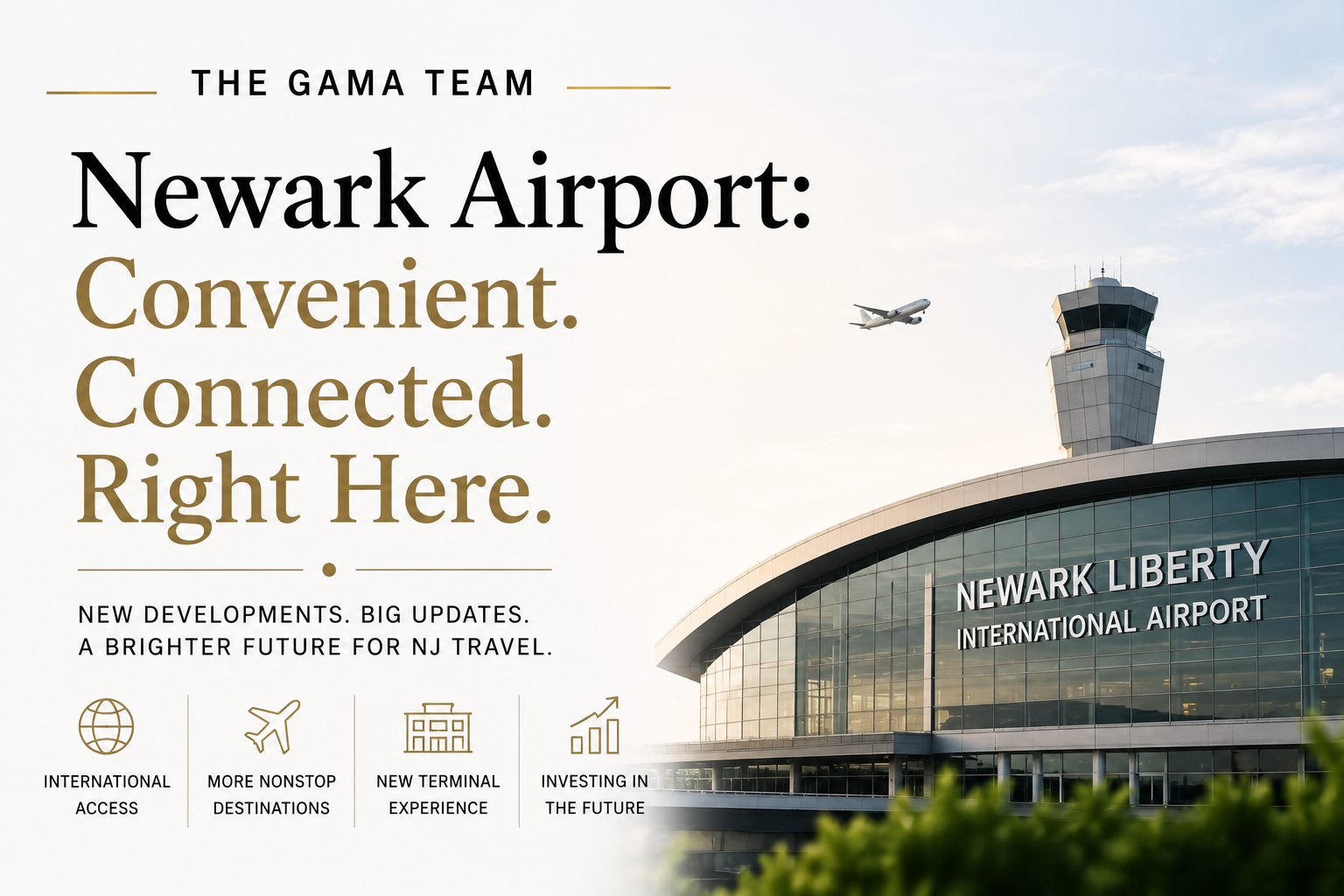
Everything Central New Jersey residents should know about Newark Liberty International Airport — why having a major international hub minutes away is a genuine advantage, plus the latest on Terminal B, the AirTrain replacement, and the airport's 2026 turnaround.
Newark Liberty International Airport: Why Having a World-Class Airport Minutes From Home Is a Genuine Advantage — Plus Every Major Development Underway in 2026
Newark Liberty International Airport (EWR), a 20-to-40-minute drive from every town in GAMA's core coverage area, handled nearly 49 million passengers in 2024, making it the 13th-busiest airport in the United States and a genuine global gateway offering nonstop flights to more than 50 international destinations — including the world's longest nonstop commercial flight, a 9,500-plus-mile route to Singapore. As United Airlines' fourth-largest hub nationally, operating roughly 63% of all Newark passenger traffic, the airport offers Central New Jersey residents a level of one-stop, nonstop global access that few other American suburban regions can match. After a genuinely difficult stretch in 2025 — air traffic control staffing shortages, aging telecommunications infrastructure, and runway construction combined to produce months of high-profile delays and flight cuts — Newark has staged a remarkable turnaround, emerging in 2026 as the leading on-time performer among major Northeast airports. That recovery comes alongside a historic wave of capital investment: the award-winning, $2.7 billion Terminal A that opened in 2023; a $200 million interim upgrade now underway at 1970s-era Terminal B ahead of its eventual full replacement; a $3.5 billion AirTrain Newark replacement project that broke ground on major construction in January 2026; and a broader $45 billion Port Authority capital plan for 2026 through 2035 that allocates $20.7 billion to aviation projects, with Newark positioned as one of the single largest beneficiaries. For families evaluating a move to Westfield, Cranford, Scotch Plains, Mountainside, Summit, New Providence, Basking Ridge, Maplewood, or Montclair, easy access to this level of global connectivity is a genuine, tangible lifestyle and real estate advantage — one that's only getting stronger as these projects come online over the next several years.
Ask almost anyone who has relocated to Central New Jersey from a region without convenient airport access what they miss least about their old commute to catch a flight, and "the drive to the airport" tends to come up fast. Having a major international hub genuinely close by — not a two-hour trek, not a connection through a smaller regional field, but direct, frequent, one-stop access to nearly every corner of the globe — is one of those quality-of-life advantages that's easy to take for granted until you've lived without it. This guide covers exactly why that convenience is real and significant, what's actually happening at Newark right now across a genuinely historic wave of construction and modernization, and what all of it means for anyone considering a move to our corner of New Jersey.
Why Having Newark Liberty International Right Here Is a Genuine Advantage
Before getting into the specific developments and updates, it's worth stating plainly just how meaningful proximity to a major international airport actually is, since it's easy to underestimate until you've experienced the alternative.
A short, predictable drive to the airport genuinely changes how people travel, and how often. For families in most of GAMA's coverage towns, EWR sits somewhere between 15 and 35 minutes away under normal traffic conditions — a fundamentally different experience than the 90-minute-plus drives, or multi-leg regional connections, that residents of many other parts of the country have to plan around for even a routine domestic trip. That shorter, more predictable drive translates directly into more flexibility: an earlier flight becomes realistic, a same-day business trip becomes practical, and the general friction of air travel — arguably the single most stressful part of any trip for many travelers — gets meaningfully reduced.
Beyond convenience alone, Newark's sheer scale and route network mean genuinely direct global access, not simply domestic connectivity with an occasional international option layered on top. With nonstop service to major hubs across Europe, Latin America, Asia, and beyond, Central New Jersey residents can reach an extraordinary share of the world's major cities without connecting through a larger, farther-away gateway airport first — a genuine practical and financial advantage for business travelers, families visiting relatives abroad, and leisure travelers alike.
For families specifically weighing a move to Central New Jersey against other Northeast or Mid-Atlantic suburban markets, this level of airport access is a genuinely underappreciated differentiator. Plenty of attractive suburban communities across the country offer strong schools, walkable downtowns, and reasonable commutes to a major city center — but comparatively few combine all of that with a 20-to-30-minute drive to one of the busiest, most globally connected airports in the world. It's the kind of advantage that doesn't always make it onto a standard relocation checklist, but that residents who've experienced both sides of the comparison consistently describe as genuinely significant to their overall quality of life.
By the Numbers: Just How Big and Busy Newark Airport Really Is
Understanding Newark's actual scale helps put both its convenience and its recent challenges into proper context.
Newark Liberty handled approximately 48.9 million passengers in 2024, following a record 49.1 million passengers in 2023 — figures that place it as the 13th-busiest airport in the entire United States and among the busiest airports on Earth by international standards. The airport spans 2,027 acres straddling Essex and Union counties, operates three runways (the longest stretching 11,000 feet), and serves roughly 50 different airlines across nearly 1,200 daily flight operations.
The airport's three terminals collectively offer 125 gates: the new Terminal A with 33 common-use gates; Terminal B, the original 1973 facility, with 24 gates primarily serving international and budget carriers; and Terminal C, United Airlines' dedicated 68-gate hub facility, originally completed in 1988 and substantially expanded in the early 2000s.
United Airlines dominates Newark's operations, handling roughly 63% of the airport's total passenger volume, making EWR United's fourth-largest hub nationally, behind only Denver, Chicago O'Hare, and Houston. United's Newark footprint spans roughly 2 million square feet across three separate buildings — a genuinely massive operational commitment that reflects just how central Newark is to United's overall domestic and international network. Beyond United, Spirit Airlines maintains a significant operating base at Newark (roughly 6% of passenger traffic), with JetBlue, Delta, and American Airlines each carrying meaningful shares of the remaining traffic as well.
This scale is precisely why Newark's operational challenges over the past several years drew such intense national attention — a disruption at an airport handling nearly 49 million annual passengers and nearly 1,200 daily operations ripples outward across the entire national air traffic system, not just the immediate New York-New Jersey region, which is part of why the recovery story covered later in this guide carries such real significance beyond Central New Jersey alone.
How Close Is EWR, Really? Drive Times From Our Coverage Towns
For readers specifically weighing airport convenience as part of a relocation decision, it's worth getting concrete about actual drive times from GAMA's core coverage towns.
Maplewood and Montclair sit closest to Newark among our coverage towns, generally running somewhere in the 15-to-25-minute range under normal traffic conditions via the Garden State Parkway or local arterial roads — a genuinely quick, easy trip that makes even an early-morning flight a manageable, low-stress proposition.
Westfield, Cranford, Scotch Plains, and Mountainside typically run somewhere in the 20-to-30-minute range, generally accessed via the Garden State Parkway, Route 22, or Route 78 depending on the specific starting point and time of day — still a genuinely convenient, predictable drive well within the range most travelers consider comfortable for airport access.
Summit and New Providence generally run a bit further, in the 25-to-35-minute range, while Basking Ridge (Bernards Township), the furthest of GAMA's core coverage towns from Newark, typically runs closer to 35 to 45 minutes depending on traffic and the specific route taken, generally via Route 78 or Route 287 connecting to the Parkway or Route 78 corridor toward Newark.
All of these figures assume normal, non-peak traffic conditions — rush hour, major holiday travel periods, or significant highway incidents can meaningfully extend any of these drive times, which is worth building into travel planning regardless of which specific town a family calls home. Even accounting for that variability, every one of GAMA's core coverage towns sits within what most frequent travelers would consider a genuinely convenient, same-morning drive to a major international airport — a real, practical advantage worth factoring into any relocation decision.
A Quick History: From 1928 Marshland to Modern Global Hub
Newark's remarkable current scale traces back to a genuinely historic aviation origin story, worth understanding as context for everything that's happening at the airport today.
Newark Liberty opened on October 2, 1928, as Newark Metropolitan Airport, built on 68 acres of reclaimed marshland at a construction cost of roughly $6 million (equivalent to well over $100 million in today's dollars) — and it holds a genuinely remarkable distinction as the first major airport to serve the New York metropolitan area and the first commercial airport in the entire United States, featuring the nation's first paved airstrip.
The airport continued setting aviation firsts throughout its early decades. In 1930, it became home to the nation's first air traffic control tower and airport weather station. In 1935, aviation pioneer Amelia Earhart dedicated the airport's Art Deco administration building, which doubled as the first purpose-built passenger terminal in the United States. In 1952, Newark became the first airport in the country to allow nighttime operations following the installation of runway lighting.
The Port Authority of New York and New Jersey assumed operational control in 1948, adding new runway and terminal infrastructure over the following decades. Terminals A and B both opened in 1973 under the airport's rebranded name, Newark International Airport, and Terminal C followed in 1988, later undergoing a substantial $1.2 billion expansion between 1998 and 2003 as United's predecessor, Continental Airlines, built out its Newark hub operation. The airport took its current name, Newark Liberty International Airport, in 2002, in the aftermath of September 11th.
This nearly century-long history of continuous growth and reinvestment is directly relevant to understanding the current wave of development covered throughout the rest of this guide — Newark has never been a static facility, and the current Terminal A, Terminal B, and AirTrain projects represent simply the latest chapter in a pattern of near-continuous modernization stretching back to the airport's earliest days.
United's Newark Hub: What It Means for Nonstop Access
Understanding United Airlines' outsized presence at Newark is essential to understanding exactly why the airport offers Central New Jersey residents such extensive nonstop access.
As Newark's dominant carrier, operating roughly 63% of the airport's total passenger volume, United has built out an extraordinarily broad domestic and international route network from its Terminal C hub — meaning travelers based in Central New Jersey benefit from route density and flight frequency that a smaller, less hub-dominant airport simply couldn't offer. Rather than relying on a single daily flight to a given destination, many of Newark's most popular routes operate multiple times per day, giving travelers genuine schedule flexibility rather than being locked into a single, potentially inconvenient departure time.
United has continued actively investing in and expanding its Newark operation even through the airport's 2025 operational challenges, a signal of the carrier's long-term commitment to the hub rather than a retreat in the face of difficulty. United CEO Scott Kirby has spoken directly and publicly about Newark's operational recovery, crediting coordinated federal, Port Authority, and airline action for the airport's genuinely dramatic 2026 turnaround, covered in detail later in this guide.
This hub concentration also means that when Newark operates well — as it has increasingly through 2026 — the benefits compound for United's Central New Jersey-based customer base specifically, since United's own operational priorities and on-time performance are directly, structurally tied to Newark's overall functioning in a way that isn't true for an airline operating only a handful of flights out of a given airport.
Where You Can Fly Nonstop From Newark
Newark's route map offers a genuinely comprehensive picture of just how far Central New Jersey residents can travel without ever connecting through another airport first.
On the domestic side, Newark's busiest routes connect travelers to essentially every major American market, with Los Angeles, Orlando, San Francisco, Chicago O'Hare, and Atlanta ranking among the airport's highest-volume domestic destinations as of 2024 data — meaning both major leisure destinations and essential business travel markets are covered with genuine frequency and schedule depth.
Internationally, Newark's route network is genuinely extensive, with London Heathrow, Toronto Pearson, Cancún, Santiago de los Caballeros (Dominican Republic), and Paris Charles de Gaulle ranking among the airport's top international routes by passenger volume in recent data. Beyond these top routes, Newark offers regular nonstop service to destinations including Frankfurt, Lisbon, Santo Domingo, Tel Aviv, and Punta Cana, among dozens of others — a route map that genuinely spans Western and Central Europe, Latin America and the Caribbean, and select destinations across Asia and the Middle East.
For Central New Jersey families with international ties — whether visiting relatives abroad, managing international business relationships, or simply planning a European vacation — this breadth of direct international access from a genuinely nearby airport is a significant, tangible convenience that residents of many other American suburban regions, even wealthy ones, simply don't have available to them without a considerably longer drive to a larger gateway city first.
The World's Longest Nonstop Flight Leaves From Newark
Among Newark's many notable route distinctions, one stands out as a genuinely remarkable aviation superlative worth knowing about.
Singapore Airlines operates the world's longest nonstop commercial flight route between Newark and Singapore, a journey covering more than 9,500 miles and typically running somewhere around 18 hours in the air, depending on prevailing winds and specific routing. The route is flown using the Airbus A350-900ULR, an ultra-long-range variant of the A350 specifically configured to handle this kind of extreme-distance, nonstop operation.
The route has a genuinely interesting operational history: Singapore Airlines originally launched Newark-Singapore nonstop service years earlier, discontinued it for a period due to aircraft economics, and then resumed the route in October 2018 once ultra-long-range aircraft technology had advanced enough to make the route commercially viable again on a sustained basis.
For Central New Jersey residents, having access to literally the longest nonstop commercial flight route on Earth, departing from an airport a short drive from home, is a genuinely remarkable, if somewhat under-appreciated, local distinction — a tangible illustration of just how significant Newark's global route network actually is, well beyond the more commonly cited European and Latin American destinations covered above.
The 2025 Crisis: What Actually Went Wrong
No honest, complete picture of Newark's current situation can skip over the genuinely difficult stretch the airport endured throughout 2025 — a period worth understanding clearly, both because it was real and disruptive, and because understanding it makes the subsequent recovery, covered later in this guide, all the more meaningful.
Newark's 2025 operational crisis stemmed from three converging problems, according to the FAA's own public accounting of events. First, Philadelphia TRACON's Area C — the specific air traffic control facility responsible for managing Newark's surrounding airspace — operated with a persistent staffing shortfall, part of a broader, well-documented nationwide air traffic controller staffing shortage that has affected numerous major American airports in recent years. Second, aging telecommunications infrastructure connecting New York-based radar data systems to the Philadelphia TRACON facility experienced repeated outages, creating dangerous single points of failure in a system that fundamentally depends on continuous, reliable data connectivity. Third, ongoing construction on one of Newark's major runways, 4-Left/22-Right, reduced the airport's overall operational capacity through mid-June 2025, compounding the other two issues at precisely the wrong moment.
The combined effect was a period of genuinely severe, high-profile flight delays, cancellations, and even temporary equipment blackouts affecting air traffic controllers' ability to safely track aircraft — problems serious enough to draw sustained national media attention and direct intervention from the U.S. Department of Transportation and FAA leadership. At the peak of the crisis, in May and June 2025, the FAA imposed direct hourly flight limitations at Newark, capping arrivals and departures at just 28 operations per hour during the height of construction-related capacity constraints, later easing slightly to 34 operations per hour outside the most acute construction periods.
It's worth being direct and honest about this period rather than glossing over it: 2025 was, by nearly every account, a genuinely difficult year for Newark's operational reliability, and travelers who experienced significant delays or cancellations during that stretch had entirely legitimate grievances with the system's performance at the time. Understanding this baseline is essential context for properly appreciating the scale of the recovery covered in the sections that follow.
How the FAA and Port Authority Responded
Facing a crisis serious enough to draw sustained national attention, federal and regional authorities moved on multiple fronts simultaneously to address Newark's underlying problems — a response worth understanding in some detail, since it directly explains the airport's subsequent turnaround.
On the technology side, the FAA installed three new, high-bandwidth telecommunications connections between the New York-based radar data system (STARS) and the Philadelphia TRACON facility, specifically eliminating the single-point-of-failure vulnerability that had contributed to the earlier outages. The agency also deployed temporary backup systems and expanded fiber optic infrastructure, and established a redundant STARS data hub directly at the Philadelphia TRACON facility itself, completing these telecommunications improvements by early July 2025.
On the staffing side, the FAA worked to accelerate controller training and hiring specifically for the Philadelphia TRACON's Area C team, which had been operating with just 22 certified controllers and 21 additional trainees at the height of the crisis — filling training classes through July 2026 as part of a sustained, multi-year effort to rebuild adequate staffing levels for this specific, critical facility.
On the infrastructure side, the runway 4-Left/22-Right construction project that had been compounding capacity constraints reopened in early June 2025, removing one of the three converging pressures that had driven the crisis in the first place. The FAA subsequently extended its flight limitation program through October 2026 as a precautionary, capacity-management measure even as conditions improved, while simultaneously raising the hourly operations cap from 68 to 72 — a sign of growing confidence in the system's underlying stability even as officials chose to maintain a structured, conservative capacity ceiling rather than immediately returning to pre-crisis scheduling levels.
This multi-pronged response — new redundant telecommunications infrastructure, accelerated controller staffing, completed runway construction, and a carefully calibrated, gradually loosening capacity cap — represents exactly the kind of coordinated, sustained intervention that a crisis of this scale required, and it's precisely this combination of fixes that set the stage for the genuinely remarkable turnaround covered in the next section.
Newark's Remarkable Turnaround: Leading the Northeast in 2026
Perhaps the most genuinely newsworthy Newark development of the past year isn't a construction project at all — it's the airport's dramatic operational recovery, worth covering in real detail given how directly relevant it is to anyone currently evaluating the airport's convenience and reliability.
Newark Liberty has emerged in 2026 as the leading on-time performer among major Northeast airports — a genuinely remarkable turnaround from the depths of the 2025 crisis covered above, and one that has drawn direct public commentary from both federal transportation officials and the airport's dominant carrier. U.S. Transportation Secretary Sean Duffy publicly credited the Department of Transportation's intervention with "making EWR #1 for on-time flights in the Northeast," while United Airlines CEO Scott Kirby stated directly that "Newark has operated better than it ever has," attributing the improvement to the combined actions of the Secretary and the FAA.
United's own operational data reflects the scale of this turnaround: the carrier reported flying 5.8 million passengers through Newark during a recent multi-month stretch with its best-ever on-time performance recorded at the airport during that period — a genuinely striking data point given Newark's historical reputation, even before the 2025 crisis specifically, as one of the more delay-prone major airports in the national system.
The recovery reflects the direct, measurable payoff of the multi-front response covered in the previous section: increased air traffic controller staffing levels, the early completion of runway construction, more efficient flight scheduling under the FAA's capacity management program, accelerated equipment upgrades, and the new redundant fiber communications network connecting to the Philadelphia TRACON facility all contributed to genuinely durable operational improvement, rather than a temporary, short-lived rebound.
For Central New Jersey residents and prospective residents specifically, this turnaround is genuinely significant, current, and directly relevant information — worth knowing clearly, since Newark's 2025 reputation for delays and disruption, however well-earned at the time, no longer accurately reflects the airport's actual current operational performance heading through 2026.
Terminal A: The $2.7 Billion Terminal That Changed Newark's Reputation
Even before the 2025 operational crisis and subsequent recovery, Newark had already begun a genuinely dramatic physical transformation with the opening of its new Terminal A — worth understanding in detail, since it represents both a major completed achievement and a template for the further redevelopment still underway.
Terminal A opened in January 2023, representing a $2.7 billion investment replacing the original 1973 facility, and it has earned genuinely significant international recognition since opening — including a 2024 Skytrax five-star rating and formal recognition as the best new airport terminal in the world. The terminal offers 33 gates with common-use flexibility (meaning gates can be dynamically reassigned across different airlines rather than being permanently dedicated to a single carrier, improving overall operational efficiency), and was designed by the internationally recognized architecture firm Grimshaw Architects, with Munich Airport International brought on to help operate the facility to a distinctly higher, internationally benchmarked service standard.
The terminal incorporates genuinely significant sustainability features, including 12,708 solar panels installed across the roof of its associated parking garage — a substantial renewable energy commitment reflecting broader Port Authority sustainability priorities across its recent capital projects. Delta Air Lines relocated its full operation, including its Sky Club premium lounge, from the older Terminal B into the new Terminal A upon its opening, and the terminal today serves Air Canada, American Airlines, Delta, JetBlue, and select United flights.
Terminal A's success has become a genuine template and proof point for the broader modernization effort now extending to Terminal B and beyond — Port Authority officials have explicitly described it as "the first step in a comprehensive makeover for Newark Liberty," language that has proven prescient given everything else now underway across the airport, covered throughout the remainder of this guide.
What's Next for Terminal B: A $200 Million Bridge to a Full Rebuild
With Terminal A's transformation complete, attention has shifted decisively to Terminal B — the airport's oldest active terminal, and the next major piece of Newark's ongoing modernization story.
Terminal B, which opened in 1973 alongside the original Terminal A, now handles roughly 11.5 million annual passengers — nearly double the roughly 6.8 million passengers it was originally designed to accommodate, a genuine mismatch between aging infrastructure and modern demand that has made the terminal an increasingly urgent priority for renovation and eventual full replacement.
The Port Authority approved a $200 million, three-year modernization program for Terminal B, with an initial $75 million phase launching in 2026 specifically targeting the passenger-facing systems and spaces travelers encounter most directly: new seating, flooring, and lighting in gate areas; full restroom renovations; replacement of aging escalators and elevators; enhanced ADA accessibility throughout the terminal; upgraded passenger boarding bridges; improved HVAC controls and efficiency; refurbished baggage handling systems; and modernized customer-facing technology throughout the facility.
Port Authority Executive Director Kathryn Garcia has been direct about the reasoning behind this interim investment, explaining that the program targets "the things customers encounter on every trip: the gate areas where they wait, the restrooms they rely on, the escalators and elevators that move them through the building" — a genuinely practical, traveler-focused framing for a facility that, while scheduled for eventual full replacement, still needs to function reliably for millions of passengers annually in the meantime.
This $200 million investment is explicitly understood as an interim bridge, not a permanent solution — the broader EWR Vision Plan, covered in the next section, calls for Terminal B's eventual complete demolition and replacement with an entirely new, modern international terminal, expected to move toward construction in the mid-2030s as part of the Port Authority's longer-term capital planning.
The EWR Vision Plan: Newark's Path to 2065
Beyond the individual terminal and infrastructure projects covered throughout this guide, the Port Authority has articulated a genuinely comprehensive, long-range vision for Newark's continued evolution — worth understanding as the connective framework tying all of these individual projects together.
Announced in October 2024, the EWR Vision Plan lays out a long-term development framework extending through 2065, explicitly designed to transform Newark from an airport that, by the Port Authority's own candid public acknowledgment, had struggled with reliability and passenger experience issues in recent years, into what officials describe as a genuinely world-class global aviation facility.
The plan's three central components work together as a coordinated whole rather than as isolated individual projects. First, an all-new Terminal B, ultimately replacing the current 1970s-era facility with a modern international terminal designed with built-in flexibility for further future expansion as passenger volumes continue growing, alongside continued phased enhancement of Terminal C as United continues modernizing its dedicated hub facility. Second, a substantially revamped taxiway network specifically designed to address Newark's chronic ground-delay challenges, including more efficient aircraft routing patterns, expanded aircraft parking capacity, and additional deicing pad capacity to accelerate winter weather operations — a genuinely significant operational improvement given how meaningfully winter weather delays have historically affected Newark specifically. Third, a redesigned ground-level roadway and circulation system, aimed at reducing the traffic congestion that has historically plagued terminal frontage areas, with independent, streamlined vehicle routing designed specifically for each individual terminal rather than a single shared, congestion-prone approach road.
This 2065 planning horizon reflects a genuinely long-term, patient approach to airport infrastructure investment, consistent with how major aviation hubs worldwide typically plan multi-decade capital programs given the sheer scale, cost, and multi-year construction timelines any individual major terminal or runway project inevitably requires. For Central New Jersey residents, this long horizon is worth understanding not as a reason for near-term skepticism, but as a genuine signal of sustained, structural commitment to Newark's continued growth and improvement over the coming decades — precisely the kind of long-term investment that supports, rather than undermines, the airport's value as a permanent regional asset.
The AirTrain Newark Replacement: A $3.5 Billion Overhaul
Among all of Newark's current infrastructure projects, few carry more direct day-to-day relevance for travelers than the ongoing replacement of the airport's internal AirTrain system — a project with a genuinely complex cost and timeline history worth explaining clearly and honestly.
The current AirTrain Newark system opened in 1996 and is now reaching the end of its projected operational lifespan, having originally been designed for an airport handling roughly 30 million annual passengers — a figure Newark has long since exceeded, now approaching 50 million annual passengers, straining the existing monorail system well beyond its original design capacity and leaving little room for further expansion under the current infrastructure.
The replacement project's cost and timeline have evolved considerably since the effort first began. The Port Authority originally authorized the project in 2019 under an estimated $2 billion budget, using a design-build-operate-maintain delivery model intended to transfer long-term construction and operational risk to a single private consortium. When actual bids arrived in 2022, however, they dramatically exceeded that original budget, driven by pandemic-era cost escalation, broader supply-chain disruption, and a documented pullback in contractor appetite for large-scale megaproject risk industry-wide. The Port Authority ultimately canceled that original procurement and restructured the entire program, separating the work into smaller, more manageable packages, isolating the system's core technology components from its civil infrastructure work, and advancing certain early-phase work specifically to reduce overall project risk.
The reformed program now carries a total projected cost of $3.5 billion, with major guideway construction beginning in January 2026 and full passenger service targeted for 2030. The new system will be fully automated, will significantly expand daily capacity to roughly 50,000 passengers (supporting a projected 50% ridership increase by 2040), and will include three new stations along with more direct terminal access, including improved connectivity to the newly opened Terminal A. Port Authority Executive Director Rick Cotton has described the project as "essential to keeping pace with EWR's growth for decades to come."
A separate but related $160 million component of the broader project involves creating an entirely new, expanded entry point at Newark Liberty's rail station, serving AirTrain Newark, Amtrak, and NJ Transit rail services together in a single, more efficient, better-connected facility — a genuinely significant improvement to how travelers move between regional and Northeast Corridor rail service and the airport terminals themselves.
What AirTrain Construction Means for Travelers Right Now
Given that major AirTrain construction is actively underway as of this guide's publication, it's worth addressing directly what travelers should currently expect.
Beginning January 15, 2026, weekday service between the Airport Train Station and the P4 parking facility has been temporarily suspended between 5 a.m. and 3 p.m., with the Port Authority operating dedicated shuttle buses every four to five minutes as a direct replacement during this specific service window — meaning travelers relying on this particular connection during weekday daytime hours should plan for a somewhat longer, bus-based transfer rather than the AirTrain's normal rail service during this construction phase.
Travelers planning a Newark trip during this active construction period should build a bit of additional buffer time into their airport arrival planning, particularly for early-morning or midday weekday travel specifically affected by the current shuttle bus arrangement, and should check current Port Authority and airport service advisories close to their actual travel date, since construction-related service adjustments can shift as the multi-year project progresses through its various phases.
It's worth keeping this near-term inconvenience in proper perspective, however, given the significant long-term improvement it's building toward. A temporary shuttle bus substitution during a defined construction window is a genuinely reasonable, manageable trade-off for a fully modernized, higher-capacity, more reliable AirTrain system arriving by 2030 — precisely the kind of short-term disruption that accompanies nearly any major infrastructure upgrade at a facility this large and this heavily used.
The $45 Billion Port Authority Capital Plan and What It Means for Newark
Zooming out from the individual projects covered above, it's worth understanding the broader financial and strategic framework within which all of Newark's current development is taking place.
The Port Authority of New York and New Jersey has proposed a $45 billion capital plan covering 2026 through 2035, branded internally as the "Decade of Big Ambition," with $42 billion of that total representing direct agency spending across its full portfolio of bridges, tunnels, airports, and other regional infrastructure. The plan underwent a formal public comment process in late 2025, including public hearings in early December and a written comment deadline of December 15, 2025, ahead of a scheduled board vote on December 18, 2025.
Aviation infrastructure receives the single largest allocation within the entire $45 billion plan, at $20.7 billion — reflecting just how central Newark, JFK, and LaGuardia collectively are to the Port Authority's overall strategic priorities for the coming decade. Newark's specific projects within this allocation include the full Terminal B redevelopment, the $3.5 billion AirTrain replacement described above, expanded gate capacity at Terminal A, and extensive supporting roadway and utility relocation work necessary to enable the broader terminal and airside construction program.
The Port Authority has specifically identified Newark's AirTrain replacement, Terminal B redevelopment, roadway and utility relocation work, and airside construction as among "the largest near-term opportunities" for contractor bid procurement beginning in 2026 — meaning construction activity across multiple simultaneous Newark projects is expected to ramp up substantially over the coming several years, consistent with the scale of investment the plan describes.
For Central New Jersey residents, this level of sustained, multi-billion-dollar capital commitment represents genuine, credible evidence that Newark's ongoing modernization isn't a short-term, one-off effort, but rather a structural, decade-long institutional priority for the region's dominant transportation authority — precisely the kind of durable investment commitment that supports real, long-term confidence in the airport's continued improvement and growth.
Inside Terminal A: What the Award-Winning Design Actually Offers Travelers
Given how central Terminal A has become to Newark's revitalized reputation, it's worth spending a bit more time on what the actual passenger experience inside the terminal looks like, beyond the headline construction cost and awards already covered.
The terminal was deliberately designed around natural light and open sightlines, with floor-to-ceiling windows throughout the concourse areas offering direct views of the airfield — a meaningful departure from the more enclosed, dated feel of Newark's older terminal facilities, and part of what earned the building its international design recognition. Grimshaw Architects, the firm behind the design, has a well-established international reputation for major transportation infrastructure projects, and that expertise shows in the terminal's overall sense of scale and clarity of wayfinding.
Dining and retail options within Terminal A skew toward a curated, regionally-flavored selection rather than a generic mix of national chains alone, featuring a range of New Jersey and New York-area restaurant concepts alongside familiar national brands, giving travelers a genuinely more distinctive pre-flight dining experience than many comparably sized American airport terminals typically offer.
Munich Airport International's operational involvement brings a distinctly European approach to day-to-day terminal management, an intentional choice by the Port Authority specifically aimed at elevating Newark's operational standards and passenger experience benchmarks closer to those of top-tier international airports, rather than relying solely on more traditional American airport management practices.
For travelers who haven't yet experienced the new Terminal A directly, it's worth knowing that the terminal genuinely delivers on its reputation — reviews and traveler feedback since its 2023 opening have consistently highlighted the terminal's cleanliness, modern amenities, and considerably improved overall flow compared to Newark's older facilities, a genuinely tangible upgrade for the roughly one-third of Newark's total gate capacity now routed through this single, modernized terminal.
Winter Weather and Newark's Deicing Operations
Given how directly winter weather has historically affected Newark's operational reliability, it's worth addressing this specific, recurring seasonal challenge directly.
Newark, like every major Northeast airport, faces genuine operational strain during winter storm events, when aircraft deicing requirements, reduced runway capacity during active snow removal, and broader air traffic system-wide congestion can combine to produce significant delays even at an otherwise well-functioning airport. This is a genuinely unavoidable seasonal reality for any airport serving the Northeast corridor, not a Newark-specific shortcoming.
The expanded deicing pad capacity included in the broader EWR Vision Plan directly targets this recurring seasonal challenge, aiming to allow more aircraft to be deiced simultaneously during winter weather events, reducing the bottleneck that deicing operations have historically created during and immediately after significant snow or ice events. This is a genuinely practical, high-value improvement for any traveler whose trips regularly fall within New Jersey's winter weather season, roughly November through March.
Travelers planning winter trips through Newark are generally well served by building in additional schedule buffer during active storm periods specifically, regardless of the airport's overall improved reliability — a sensible practice at any Northeast airport during winter weather, and one that becomes even more manageable given Newark's genuinely short, predictable drive time from GAMA's coverage towns, allowing for a later, more weather-informed departure from home than travelers facing a longer airport commute would have the luxury of choosing.
Beyond the Terminals: Roadways, Taxiways, and Parking
While terminal buildings and the AirTrain system tend to draw the most public attention, several less visible infrastructure improvements underway at Newark carry real, direct relevance for the everyday travel experience.
The taxiway network improvements included in the broader EWR Vision Plan directly target one of Newark's more persistent, if less visible, operational challenges: ground delays caused by inefficient aircraft routing between runways and gates. More efficient taxiway routing, expanded aircraft parking capacity for periods of high demand, and additional deicing pad capacity for winter operations collectively address exactly the kind of behind-the-scenes operational friction that, left unaddressed, can produce delays even when weather and staffing conditions are otherwise favorable.
The roadway redesign component of the broader plan directly targets the terminal frontage congestion that has historically frustrated travelers being dropped off or picked up at Newark, particularly during peak arrival and departure periods. A redesigned system offering independent, terminal-specific vehicle routing — rather than funneling all terminal traffic through a single shared approach road — is designed to meaningfully reduce exactly this kind of curbside congestion once fully implemented.
Parking infrastructure has also received direct attention as part of the broader modernization effort, including the solar-paneled parking structure built alongside the new Terminal A, and continued evaluation of overall parking capacity and passenger flow as part of the larger AirTrain and terminal redevelopment planning process — recognizing that ground transportation and parking experience is every bit as much a part of overall airport convenience as the flight and terminal experience itself.
Getting to and From Newark: Rail, Road, and Rideshare Options
For readers planning an actual trip through Newark, it's worth laying out the full current range of ground transportation options available beyond simply driving and parking.
NJ Transit and Amtrak both serve Newark Liberty International Airport Station directly, connecting to the airport terminals via the AirTrain system, offering a genuine, often underutilized rail alternative to driving — particularly valuable for travelers coming from towns along or near the Raritan Valley Line or the broader NJ Transit rail network, who can reach the airport by train without needing to drive and park at all. The upcoming $160 million station expansion, part of the broader AirTrain replacement project, is specifically designed to make this rail connection even more direct and efficient once complete.
For travelers who do prefer driving, Newark offers a full range of parking options across short-term, daily, and long-term facilities, along with valet parking service at select terminals — though, as with any major airport, pricing and availability shift based on demand, and advance online reservation is generally the most cost-effective and reliable approach for travelers planning ahead of a specific trip.
Rideshare services including Uber and Lyft, along with traditional taxi and dedicated car service options, operate at designated pickup and drop-off zones across all three terminals, offering a genuinely convenient door-to-door alternative for travelers who'd rather avoid both driving themselves and navigating public transit connections, particularly for early-morning departures or late-night arrivals when other transportation options may run less frequently.
Given Newark's genuinely close proximity to nearly all of GAMA's coverage towns, many residents find that a direct drive — whether self-parked or via a quick rideshare trip — remains the most practical option for most trips, reserving rail connections primarily for travelers coming from further along the broader NJ Transit and Amtrak network, or for those specifically looking to avoid airport parking costs and traffic on a longer, multi-week trip.
TSA PreCheck, Global Entry, and CLEAR at Newark
For frequent travelers specifically interested in expediting the security and customs process at Newark, it's worth knowing what's currently available.
Newark offers TSA PreCheck screening lanes across its terminals, available to travelers enrolled in the TSA's trusted traveler program, generally providing meaningfully faster security screening by allowing enrolled travelers to keep shoes, belts, and light jackets on and laptops and permitted liquids inside their carry-on bags during the screening process.
CLEAR, the private biometric identity verification service, operates dedicated lanes at Newark, offering an additional layer of expedited processing (verifying a traveler's identity biometrically before they even reach the standard TSA screening line) that can be used in combination with TSA PreCheck for travelers enrolled in both programs.
For international travelers, Global Entry — the U.S. Customs and Border Protection trusted traveler program allowing expedited customs and immigration processing upon return to the United States — is available to enrolled travelers at Newark's international arrivals facilities, with New Jersey hosting dedicated Global Entry enrollment centers for travelers looking to apply for or complete their enrollment interview locally rather than needing to travel further afield.
Given Newark's genuinely high passenger volume and correspondingly variable security and customs wait times, particularly during peak summer and holiday travel periods, frequent Central New Jersey travelers generally find these trusted traveler programs to be a genuinely worthwhile investment — a relatively modest one-time enrollment cost that can meaningfully reduce the time and stress associated with security screening and customs processing across the many trips a typical frequent flier takes over a multi-year enrollment period.
Practical Tips for Flying Out of Newark
For readers planning an upcoming trip, a few practical, current tips help make the most of Newark's genuine convenience advantages.
Arrive with the standard buffer most major airports recommend: roughly two hours before a domestic departure and three hours before an international flight, adjusted upward during peak holiday travel periods or active winter weather. Given Newark's short drive time from GAMA's coverage towns, even this standard buffer rarely feels burdensome the way it might for travelers facing a longer airport commute.
Check your specific terminal before leaving home, since Newark's three terminals are not within easy walking distance of one another. A traveler arriving at the wrong terminal building can face a genuinely significant, stressful scramble to reach the correct one, particularly during the current period of AirTrain construction adjustments covered earlier in this guide. Confirming your terminal directly through your airline's app or the Newark Airport website before you leave home is a small step that avoids a genuinely avoidable headache.
Take advantage of Newark's genuinely short drive time to build in a later, more weather-informed departure from home during winter storm periods, rather than needing to leave unusually early "just in case" the way travelers facing a longer commute to a farther airport often do — one of the more underappreciated practical advantages of the airport proximity this entire guide has focused on.
If flying through Terminal A specifically, budget a little extra time to actually enjoy the terminal itself — its dining and retail offerings, covered earlier in this guide, are genuinely worth experiencing rather than rushing past on the way to your gate, particularly for travelers with a bit of flexibility in their pre-flight schedule.
Why This Matters for Buyers and Sellers in Our Coverage Towns
Bringing this guide back to its most direct real estate relevance: how should airport proximity actually factor into a buying or selling decision in Central New Jersey specifically?
For buyers, particularly those relocating for work with frequent business travel requirements, or those with significant family or personal ties overseas, Newark's proximity and route network represent a genuine, quantifiable lifestyle benefit worth weighing seriously alongside more commonly discussed factors like schools and commute times. A 20-to-35-minute drive to an airport offering this level of nonstop global connectivity is a genuinely differentiating advantage relative to many other attractive suburban markets across the broader Northeast and Mid-Atlantic region, and it's worth discussing directly and specifically with any buyer for whom air travel frequency is a meaningful part of their lifestyle or career.
For sellers, actively and specifically highlighting airport proximity in listing marketing — rather than treating it as an assumed, background fact every buyer already knows — can be a genuinely underused, effective differentiator, particularly for out-of-town or out-of-state buyers relocating from a region without comparable airport access, who may not immediately grasp just how convenient Newark is from a specific listing's address until it's spelled out clearly and concretely.
It's also worth directly and honestly addressing the airport's recent history with any buyer who raises 2025's operational challenges as a concern — the genuinely dramatic 2026 turnaround covered in detail throughout this guide, backed by real data and direct statements from both federal officials and the airport's dominant carrier, is exactly the kind of current, accurate, reassuring information that helps a buyer move past an outdated impression and toward a clear, informed understanding of the airport's actual current performance.
Comparing Newark to LaGuardia, JFK, and Philadelphia for Central NJ Travelers
For readers weighing Newark against the New York region's other major airports, or against Philadelphia International further south, a brief, honest comparison is worth including.
LaGuardia Airport, while closer for some New York City-adjacent travelers, offers a considerably more limited domestic-only route network (with only limited exceptions for a small number of international destinations under specific bilateral agreements), making it a less relevant comparison for Central New Jersey travelers specifically prioritizing international access, even setting aside the generally longer, more congested drive from most GAMA coverage towns to LaGuardia relative to Newark.
JFK International Airport offers a route network genuinely comparable in scope to Newark's, including extensive international service, but the drive from most Central New Jersey towns to JFK typically runs meaningfully longer than the equivalent drive to Newark, often adding 20 minutes or more depending on the specific route and traffic conditions, given JFK's location on the opposite side of the broader New York metropolitan region relative to Central New Jersey.
Philadelphia International Airport represents a genuine alternative for some Central New Jersey travelers, particularly those in GAMA's southernmost coverage towns like Basking Ridge, offering its own solid domestic and international route network, though generally with less overall route density and flight frequency than Newark's considerably larger overall operation, and with a drive time from most GAMA coverage towns that's broadly comparable to, or somewhat longer than, the equivalent drive to Newark.
For the large majority of GAMA's coverage area, Newark remains the clear, practical default choice — offering the strongest combination of drive-time convenience and route network breadth of any of the region's major airport options, which is precisely why this guide has focused primarily on Newark specifically rather than treating all four regional airports as broadly interchangeable options.
That said, savvy Central New Jersey travelers sometimes benefit from checking fares across more than one regional airport for a specific trip, particularly for leisure travel with flexible dates, since fare differences between Newark, JFK, and Philadelphia can occasionally make the extra drive time to an alternate airport worthwhile for a specific route or travel date — a genuinely useful habit for cost-conscious travelers to build, even while defaulting to Newark as the practical first choice for most trips given everything covered throughout this guide.
Newark's Massive Regional Economic Footprint
Beyond its convenience for individual travelers, Newark Liberty represents a genuinely enormous economic engine for the broader New York-New Jersey region — worth understanding as part of the full picture of what having this airport nearby actually means.
Newark Liberty contributes approximately $22.9 billion in annual economic activity to the New York-New Jersey metropolitan region, supporting roughly 162,000 jobs regionally with combined annual salaries totaling $8.3 billion. Approximately 20,000 people work directly at the airport facility itself, spanning airline staff, Port Authority employees, security personnel, retail and food service workers, ground handling crews, and the many other roles required to keep an operation of this scale running smoothly around the clock.
This economic footprint extends well beyond passenger operations alone. FedEx Express maintains a major cargo operation at Newark, ranking as the airport's second-largest tenant after United Airlines, operating across three separate buildings totaling roughly two million square feet — a genuinely significant logistics and freight hub supporting e-commerce, business shipping, and time-sensitive cargo movement throughout the broader Northeast region, entirely separate from and in addition to the passenger travel most of this guide focuses on.
For Central New Jersey specifically, this economic scale translates into real, tangible local benefits: a substantial base of stable, accessible employment opportunities within a genuinely short commute of GAMA's coverage towns, a meaningful contributor to the overall regional tax base, and a significant driver of the broader logistics, hospitality, and business services activity that surrounds any major international airport of this scale. Understanding Newark not just as a convenient travel option but as a genuine regional economic anchor adds real depth to appreciating just how significant having this facility nearby actually is.
Going Green: Newark's Sustainability Push
Alongside its terminal and infrastructure modernization, Newark has been pursuing a genuinely substantial sustainability program worth knowing about, particularly for environmentally-minded residents and travelers.
The Port Authority is adding approximately 5 megawatts of new solar generating capacity across five sites at Newark, including the parking lot fronting Buildings 79/80, the Terminal C garage, the P4 parking garage, and the rideshare lot (specifically sized to help power electric vehicle charging infrastructure), with construction expected to begin in 2026 and completion targeted for 2028. This expansion will generate nearly 5.9 million kilowatt-hours of clean electricity annually — enough to power more than 550 homes — and will bring the airport's total solar capacity to nearly 20 megawatts across roughly 32,000 panels once complete, representing almost a tenfold increase in solar capacity since 2021.
The financing structure behind this expansion is itself worth noting: a private partner, SunLight General Capital, will design, build, finance, own, and operate the new solar installations, while the Port Authority simply purchases the resulting electricity at a locked-in, pre-determined rate — a structure that delivers genuine clean energy expansion while minimizing the Port Authority's own upfront capital expenditure, a model increasingly common across major public infrastructure sustainability projects nationally.
This solar expansion advances the Port Authority's broader, formal commitment to reach net-zero carbon emissions by 2050, with an interim target of cutting direct emissions in half by 2030 — a goal the agency reports it's tracking well against, having already met a preliminary 35% emissions reduction target through 2025. The new solar capacity alone is projected to avoid roughly 2,000 metric tons of carbon dioxide emissions annually, equivalent to removing about 460 gasoline-powered vehicles from the road each year.
Combined with Terminal A's existing 12,708-panel solar installation covered earlier in this guide, Newark's overall sustainability trajectory reflects a genuine, sustained institutional commitment — not an isolated public relations gesture, but a structural, multi-project effort spanning new construction, existing facility retrofits, and long-term energy purchasing agreements, consistent with the broader pattern of sustained, well-funded, long-horizon investment this guide has documented across nearly every other major aspect of Newark's current transformation.
A Case Study: A Business Traveler's Relocation Calculus
A family relocating to Central New Jersey for a corporate role involving frequent international travel — roughly monthly trips to European offices, alongside occasional trips to Asia — specifically prioritized airport proximity as one of their top three relocation criteria, alongside school quality and overall commute time to their new office.
After comparing several towns across GAMA's coverage area against a handful of alternative Northeast markets they'd also considered, the family ultimately chose Westfield, specifically citing the roughly 25-minute drive to Newark, the airport's extensive nonstop European route network directly relevant to their travel pattern, and — after learning about the airport's dramatic 2026 operational turnaround during their research — considerably reduced concern about the reliability issues they'd read about from Newark's more difficult 2025 stretch. Eighteen months into their relocation, the family reports that their actual travel experience has consistently matched their pre-move research: predictable drive times, genuinely reliable on-time performance, and direct access to the specific European business destinations their role requires, without the connection delays and additional travel time a less-connected airport would have added to every single business trip.
A Second Case Study: Weighing Newark Against a Farther Alternative
A retired couple considering a move to Central New Jersey specifically to be closer to grandchildren, while also planning to continue regular international travel during their retirement years, initially considered a town further south in New Jersey, closer to Philadelphia International Airport, before ultimately settling on a home in Cranford instead.
Their decision hinged directly on a side-by-side comparison of the two airports' route networks for the specific international destinations most relevant to their planned retirement travel, alongside their adult children's own preference for Newark's easier accessibility from their own homes in Central New Jersey for future visits. The couple specifically noted that Newark's considerably broader European route selection, combined with a drive time from Cranford they described as "genuinely no different than driving across town used to feel back home," made the decision straightforward once they actually compared the two options directly rather than assuming proximity to Philadelphia alone would necessarily be the more convenient choice for their specific travel needs.
Once settled in Cranford, the couple also found an unexpected secondary benefit: hosting out-of-town family became noticeably easier, since visiting relatives flying in for holidays or grandchildren's milestones could land at Newark and reach the couple's new home in well under an hour door to door, a meaningfully simpler proposition than the connections and longer ground transfers their previous, less centrally located home had required of visiting family for years.
A Practical Glossary
EWR: The three-letter airport code for Newark Liberty International Airport.
AirTrain Newark: The airport's internal automated rail system connecting terminals, parking facilities, and the rail station; currently undergoing a $3.5 billion replacement targeted for 2030 completion.
EWR Vision Plan: The Port Authority's long-term redevelopment framework, announced October 2024, extending through 2065, covering Terminal B replacement, taxiway improvements, and roadway redesign.
TRACON: Terminal Radar Approach Control, the air traffic control facility type responsible for managing aircraft in the airspace surrounding a major airport; Newark's surrounding airspace is managed by Philadelphia TRACON's Area C.
STARS: Standard Terminal Automation Replacement System, the radar data system whose New York-to-Philadelphia connectivity issues contributed to Newark's 2025 operational crisis.
Port Authority of New York and New Jersey: The bi-state agency that owns and operates Newark Liberty, JFK, and LaGuardia airports, among other regional infrastructure.
Common-use gates: An airport gate configuration allowing dynamic reassignment across different airlines, rather than permanent dedication to a single carrier, improving overall operational flexibility.
TSA PreCheck / CLEAR / Global Entry: Trusted traveler programs offering expedited security screening (PreCheck, CLEAR) or expedited customs processing for international arrivals (Global Entry).
EWR Vision Plan: See above; the umbrella framework tying together Terminal B replacement, taxiway improvements, and roadway redesign through 2065.
Design-build-operate-maintain (DBOM): A project delivery model, originally proposed for the AirTrain replacement, in which a single private consortium handles construction, technology systems, and long-term operations under one contract.
Net-zero by 2050: The Port Authority's formal, agency-wide carbon emissions commitment, with an interim target of cutting direct emissions in half by 2030.
Frequently Asked Questions
How far is Newark Airport from Westfield, Cranford, and our other coverage towns? Generally 15 to 45 minutes depending on the specific town, with Maplewood and Montclair closest (roughly 15-25 minutes), Westfield, Cranford, Scotch Plains, and Mountainside in the 20-30 minute range, and Summit, New Providence, and Basking Ridge running somewhat further, up to 35-45 minutes for Basking Ridge specifically.
How busy is Newark Airport? Newark handled approximately 48.9 million passengers in 2024, making it the 13th-busiest airport in the United States, with nearly 1,200 daily flight operations across roughly 50 airlines.
Is Newark still experiencing the delays it had in 2025? No. Following coordinated FAA, Port Authority, and airline action addressing staffing, telecommunications infrastructure, and runway construction issues, Newark has emerged in 2026 as the leading on-time performer among major Northeast airports.
What caused Newark's 2025 operational crisis? A combination of air traffic controller staffing shortages at the Philadelphia TRACON facility managing Newark's airspace, aging telecommunications infrastructure causing radar data outages, and ongoing runway construction that reduced airport capacity, all converging around the same period in 2025.
What is Terminal A, and why does it matter? Terminal A is Newark's new, $2.7 billion terminal that opened in January 2023, earning a 2024 Skytrax five-star rating and recognition as the best new airport terminal in the world. It serves as a template for the airport's broader ongoing modernization.
Is Terminal B being replaced? Yes, eventually. A $200 million interim upgrade is underway in 2026 to modernize passenger-facing areas of the current 1973 terminal, while the broader EWR Vision Plan calls for its eventual full demolition and replacement, expected to move toward construction in the mid-2030s.
What is happening with the AirTrain? The current AirTrain, which opened in 1996, is being replaced in a $3.5 billion project. Major guideway construction began in January 2026, with full passenger service on the new, higher-capacity, fully automated system targeted for 2030.
Will AirTrain construction affect my trip to Newark right now? Possibly. As of January 2026, weekday service between the Airport Train Station and the P4 parking facility is temporarily replaced by shuttle buses between 5 a.m. and 3 p.m. Check current advisories close to your travel date, since construction phases will continue shifting over the multi-year project.
Does Newark offer nonstop international flights? Yes, extensively. Newark offers nonstop service to more than 50 international destinations, including major hubs in London, Paris, Frankfurt, and beyond, plus a wide range of Latin American and Caribbean destinations.
What's the longest flight you can take from Newark? Singapore Airlines' Newark-to-Singapore route, covering more than 9,500 miles, is the world's longest nonstop commercial flight, flown using the ultra-long-range Airbus A350-900ULR.
Which airline dominates Newark? United Airlines, which operates roughly 63% of the airport's total passenger volume and considers Newark its fourth-largest hub nationally.
How much is the Port Authority investing in Newark overall? Newark benefits from a significant share of the Port Authority's proposed $45 billion capital plan for 2026-2035, which allocates $20.7 billion to aviation projects across Newark, JFK, and LaGuardia combined.
Is Newark or JFK more convenient for Central New Jersey residents? For the large majority of GAMA's coverage towns, Newark offers a meaningfully shorter, more predictable drive than JFK, while providing a broadly comparable range of international route options.
Can I take a train to Newark Airport? Yes. NJ Transit and Amtrak both serve Newark Liberty International Airport Station directly, connecting to the terminals via the AirTrain system — a genuine alternative to driving, particularly for travelers along the broader NJ Transit and Amtrak network.
Should airport proximity factor into my home search in Central New Jersey? For buyers with frequent travel needs, international family ties, or travel-intensive careers, yes — it's a genuine, quantifiable convenience worth weighing alongside more commonly discussed factors like schools and commute time.
How much does Newark contribute to the regional economy? Newark generates approximately $22.9 billion in annual economic activity for the New York-New Jersey region, supporting roughly 162,000 jobs, with about 20,000 people working directly at the airport itself.
Is Newark doing anything for sustainability? Yes. The Port Authority is expanding Newark's solar capacity to nearly 20 megawatts across roughly 32,000 panels by 2028, as part of its broader commitment to reach net-zero carbon emissions by 2050.
Does a cargo carrier operate at Newark? Yes. FedEx Express maintains a major cargo hub at Newark, its second-largest tenant after United Airlines, operating across three buildings totaling roughly two million square feet.
Why does Newark face more winter delays than some other airports? Like every major Northeast airport, Newark faces seasonal deicing and snow-removal capacity constraints during winter storms — a regional reality rather than a Newark-specific shortcoming, and one the expanded deicing pad capacity in the EWR Vision Plan directly targets.
Which terminal will I be flying from at Newark? Always confirm your specific terminal directly through your airline before leaving home, since Newark's three terminals are not within easy walking distance of each other, and terminal assignments can occasionally shift.
Ready to Explore Central New Jersey's Convenience for Yourself?
Easy access to a world-class international airport is just one of the many practical, lifestyle-defining advantages of calling Westfield, Cranford, Scotch Plains, Mountainside, Summit, New Providence, Basking Ridge, Maplewood, or Montclair home. The GAMA Team is glad to walk through exactly how airport access, commute times, and every other practical factor that matters to your family stack up across our coverage towns.
Reach out to The GAMA Team at Corcoran Sawyer Smith, 52a Elm Street, Westfield, NJ, or call or text 908-379-0525, or connect through thegamateam.com to start the conversation.
The GAMA Team | Corcoran Sawyer Smith | 52a Elm Street, Westfield, NJ 07090 | 908-379-0525 | thegamateam.com
This article is for general informational purposes only. Flight schedules, construction timelines, service advisories, and airport operations are subject to change. Always confirm current information directly with Newark Liberty International Airport, the Port Authority of New York and New Jersey, and your specific airline before planning travel based on this content.
Sources
- Newark Liberty International Airport — Wikipedia
- FAA Statements on Newark Liberty International Airport — Federal Aviation Administration
- AirTrain Newark Replacement Enters Major Construction Phase — NJ Biz
- $3.5B AirTrain Newark Replacement Re-Forms After Bids Blew Budget — Engineering News-Record
- Port Authority NY/NJ Outlines $45B Building Plan Focused on Delivery, Renewal — Engineering News-Record
- Newark Liberty International Airport's New Terminal A Now Fully Operational — Port Authority of NY & NJ
- Port Authority Approves $200M Upgrade for Newark Airport's Terminal B — Metro Airport News
- Newark Airport Vision Plan / New Terminal — The Points Guy
- Newark Liberty Leads Northeast in On-Time Performance — NJ Biz
- PANYNJ Launches Major Solar Energy Expansion at EWR — Metro Airport News
- Newark Liberty International Airport (EWR) — NYCdata, Baruch College
Check out this article next