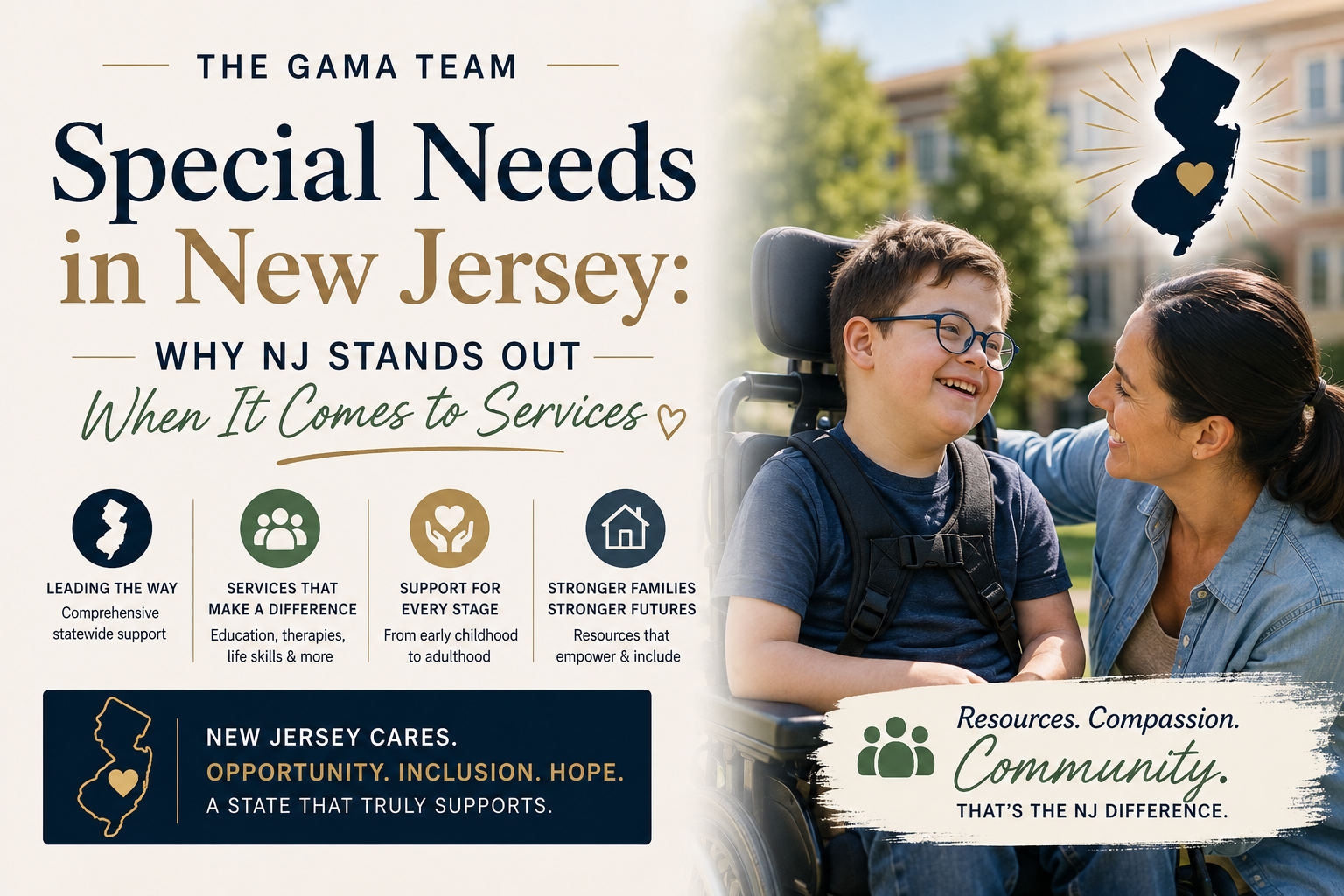
A complete guide to special needs services in New Jersey — why the state's reputation is genuinely earned, what the law requires of schools, why so many parents hire advocates and consultants, and how special education budgets actually work.
Special Needs Services in New Jersey: Why the State Stands Out, What the Law Requires, and What Parents Actually Do to Get Their Kids What They Need
New Jersey consistently ranks among the strongest states in the country for special needs and autism services, driven by a combination of a state-mandated insurance law requiring coverage for autism screening, diagnosis, and Applied Behavior Analysis therapy; one of the highest concentrations of specialized schools, Board Certified Behavior Analysts, and related-service providers per capita in the nation; and a highly identified population, with New Jersey's autism prevalence rate — roughly 1 in 32 children, nearly double the national average of 1 in 54 — reflecting genuinely strong diagnostic and identification infrastructure rather than simply a higher underlying rate. Federally, every New Jersey public school district must follow the Individuals with Disabilities Education Act (IDEA), which entitles eligible children to a free and appropriate public education through an Individualized Education Program, or IEP, built around a strict legal timeline: districts have 90 calendar days from the point evaluation need is established to complete testing, determine eligibility, and implement services. Despite these strong legal protections, the system is adversarial enough, and complex enough, that a substantial share of New Jersey parents — particularly in well-resourced towns — hire independent special education advocates (typically $150 to $250 per hour) or attorneys (typically $250 to $500-plus per hour) to help secure appropriate services, request independent evaluations at district expense, or pursue mediation and due process hearings when disputes arise. Underlying all of it is a genuinely strained budget picture: New Jersey spends over $5 billion annually on special education, uses a controversial "census-based" state aid formula that leaves roughly 60% of districts underfunded relative to their actual special education population, and depends on an "Extraordinary Aid" reimbursement program that, in recent years, has paid out only about 72% of what districts are legally owed — a funding gap that shows up directly in local property tax debates across Central New Jersey.
For families with a child who has a disability, a diagnosed learning difference, or a developmental delay, the quality of a town's special education services isn't a nice-to-have — it's often the single most important factor in deciding where to live. This guide walks through why New Jersey has earned its strong national reputation in this space, exactly what the law requires school districts to do and by when, why so many parents ultimately decide to hire outside help to navigate the process, and how the money behind all of it actually works — information every family evaluating a move to Westfield, Cranford, Scotch Plains, Mountainside, Summit, New Providence, Basking Ridge, Maplewood, or Montclair deserves to have in clear, complete form.
Why New Jersey Genuinely Stands Out for Special Needs Services
New Jersey's reputation as one of the best states in the country for special needs services isn't just local pride — it holds up under independent, national comparison, though it's worth understanding precisely why.
New Jersey combines strong insurance policy with real, on-the-ground service infrastructure, a combination that distinguishes it from states that have similar laws on the books but lack the actual provider capacity to deliver on them. The state's autism insurance mandate requires state-regulated health plans to cover the screening, diagnosis, and medically necessary treatment of autism spectrum disorder, including Applied Behavior Analysis therapy — one of the most evidence-supported interventions available for many autistic children. Just as importantly, New Jersey backs that legal requirement with genuine provider density: the state has one of the highest concentrations of specialized schools (81 reported specialized schools focused on autism and related needs), Board Certified Behavior Analysts, Registered Behavior Technicians, and ABA therapy providers per capita of any state in the country, meaningfully reducing the long waitlists that plague families in states with strong laws but thin provider networks.
Independent national rankings consistently place New Jersey among the top tier. A comprehensive Autism 360 analysis evaluating states across ten indicators — including provider availability, developmental specialist access, sensory-friendly spaces, and cost-of-living factors — ranked New Jersey 10th nationally overall, behind states like Massachusetts (ranked first), Virginia, Colorado, Connecticut, Hawaii, Vermont, New Hampshire, Florida, and Rhode Island, but ahead of the other 40 states in the country. For a state with New Jersey's high population density and correspondingly high demand for services, a top-ten national ranking reflects genuinely strong infrastructure rather than simply a small population being easy to serve well.
New Jersey also offers a genuinely comprehensive support ecosystem beyond insurance and therapy access alone, including sensory gyms, inclusive recreation centers, a robust network of inclusive education programs within public schools, and — as this guide covers in detail below — a legal and regulatory framework for special education that, while imperfect and often adversarial in practice, is genuinely more protective and more procedurally rigorous than what many other states provide.
None of this means the system in New Jersey is easy, cheap, or free of real struggle for families — as later sections of this guide make clear, the funding formula behind all of this is genuinely strained, and many parents still find themselves needing outside help to secure appropriate services. But relative to most of the rest of the country, New Jersey families start from a genuinely stronger baseline than families in the majority of other states.
The Numbers Behind the Reputation: NJ's Autism Prevalence and What It Means
One of the most striking, and frequently misunderstood, facts about New Jersey's special needs landscape is its autism prevalence rate — and understanding what that number actually reflects is important context for everything that follows.
New Jersey's identified autism prevalence rate sits at roughly 1 in 32 children, compared to a national average of roughly 1 in 54 — meaning New Jersey identifies autism in children at nearly double the rate of the country as a whole, placing the state among the highest, and by some counts the very highest, identification rates in the nation. This has held true across multiple CDC surveillance cycles: New Jersey's rate ran at roughly 1 in 34 in 2018, climbed to roughly 1 in 32 by 2020, and continued rising in subsequent surveillance years, tracking a broader national upward trend that saw the overall U.S. rate reach roughly 1 in 31 children by the most recent nationwide CDC report.
It's genuinely important to understand why New Jersey's rate runs so much higher than the national average, because the explanation reflects well on the state rather than suggesting something is uniquely wrong here. According to Autism New Jersey, the state's leading autism advocacy and information organization, this elevated identification rate is best explained by New Jersey's comparatively strong diagnostic infrastructure, more thorough screening practices, and more robust referral pathways to services — meaning New Jersey isn't necessarily generating more autism, so much as it's meaningfully better at recognizing and formally identifying it when it's present, compared to states with thinner diagnostic capacity. A child with the same underlying presentation might go undiagnosed, or diagnosed considerably later, in a state with fewer developmental pediatricians, longer specialist waitlists, and less comprehensive school-based screening.
This elevated identification rate has a direct, practical consequence for the rest of this guide: New Jersey's public school districts collectively serve a genuinely large population of students requiring special education services — roughly 240,000 students statewide, representing about 17.6% of total K-12 enrollment — which is precisely why the funding, staffing, and legal-process questions covered throughout the remainder of this article carry such real, ongoing weight in New Jersey specifically, in a way that simply doesn't apply with the same intensity in states with lower identification rates and correspondingly smaller special education populations to serve.
The Legal Foundation: IDEA, Section 504, and New Jersey's Own Regulations
Before diving into the practical, day-to-day process, it's worth understanding the actual legal architecture that governs special education in New Jersey, since it's this legal foundation that gives parents their leverage throughout the process.
The Individuals with Disabilities Education Act (IDEA) is the primary federal law governing special education nationwide, and it applies fully to every public school district in New Jersey. IDEA guarantees eligible children with disabilities a Free Appropriate Public Education (FAPE), delivered in the Least Restrictive Environment (LRE) appropriate to their individual needs, through an Individualized Education Program tailored specifically to that child. This is a genuine, enforceable federal entitlement, not a discretionary courtesy a district can choose to extend or withhold.
New Jersey has layered its own state-specific regulations on top of the federal IDEA framework, codified primarily in Title 6A, Chapter 14 of the New Jersey Administrative Code, which governs special education specifically. These state regulations are, in a number of meaningful respects, more detailed and more protective than the federal minimums IDEA establishes — including the specific procedural timelines covered in detail throughout this guide, many of which are considerably more concrete and enforceable than IDEA's more general federal timeline language.
Separately, Section 504 of the Rehabilitation Act of 1973 provides a distinct, broader form of protection, covering any student with a disability that substantially limits a major life activity, regardless of whether that disability requires the kind of specialized instruction that triggers IDEA eligibility. A student with a physical health condition, an attention disorder, or a chronic illness who doesn't need specialized instruction but does need classroom accommodations — extended test time, preferential seating, or medication administration, for instance — is typically served through a 504 Plan rather than a full IEP, a distinction covered in more detail in the next section.
Together, these three frameworks — federal IDEA law, New Jersey's own state regulatory code, and Section 504 — form the complete legal foundation underlying everything else in this guide. Understanding which framework applies to a given child, and understanding that New Jersey's own regulations frequently go further than the federal floor, is the essential starting point for any parent navigating this system.
IEP vs. 504 Plan: Understanding the Two Paths
Parents new to this process frequently encounter both "IEP" and "504 Plan" in the same conversation, and understanding the real, practical difference between them is genuinely important.
An IEP (Individualized Education Program) is available to students who meet one of IDEA's specific disability classification categories — which in New Jersey include categories like autism, specific learning disability, other health impairment, communication impairment, emotional regulation impairment, intellectual disability, and several others — and who, because of that disability, require specialized instruction, not merely accommodations, to access their education. An IEP is a legally binding document specifying exact goals, services, service minutes, providers, and placement, developed and reviewed by a formal team that includes the parent as a full, equal member.
A 504 Plan, by contrast, is available to a broader population of students — any student with a physical or mental impairment that substantially limits a major life activity, a considerably lower bar than IDEA's specific classification categories — but it generally provides accommodations to the existing general education curriculum rather than specialized instruction or a formally individualized program of services. A 504 Plan might include things like extended time on tests, a reduced-distraction testing environment, permission to leave class for medical needs, or preferential seating, but it typically does not involve the intensive, individualized instructional programming an IEP provides.
In practical terms, the IEP process carries considerably more procedural weight, more detailed legal protections, and more extensive district obligations than a 504 Plan does — which is precisely why the bulk of this guide, including the evaluation timelines, dispute resolution processes, and advocacy considerations covered below, focuses primarily on the IEP process specifically, even though many of the same underlying principles (parent participation rights, written notice requirements, and dispute resolution options) apply in some form to 504 Plans as well.
How the Process Actually Starts: Referral and the Child Study Team
Every New Jersey special education journey begins with a referral, and understanding exactly how that referral process works — and how quickly the clock starts ticking — is essential for any parent just beginning this process.
A referral for a special education evaluation can come from a parent, a teacher, or another school staff member who has genuine concern that a child may have a disability affecting their education. Parents have an absolute right to request an evaluation directly and in writing at any time; districts cannot simply decline to consider a parent's referral, though they can, and sometimes do, propose alternative interventions (such as a formal Response to Intervention process) before agreeing that a full evaluation is warranted — a point of frequent early friction between parents and districts, and one of the reasons some parents choose to bring in outside help even at this earliest stage.
Once a referral is made, New Jersey's Child Study Team — the multidisciplinary group of professionals responsible for evaluating students and developing IEPs, typically including a school psychologist, a learning disabilities teacher-consultant, and a school social worker — has 20 calendar days to meet and determine whether a formal evaluation is warranted. This 20-day window is itself a hard, regulatory deadline, not a general guideline, and it represents the first of several specific, enforceable timelines that structure the entire New Jersey special education process.
If the Child Study Team agrees an evaluation is warranted, parents must receive written notice at least 15 calendar days before any testing actually begins, giving families a genuine opportunity to understand exactly what assessments are planned, ask questions, and, if they choose, request additional or different assessments before testing gets underway. Parental consent is required before any initial evaluation can proceed — a foundational protection that puts real decision-making authority in parents' hands from the very first step of the process.
The 90-Day Clock: NJ's Evaluation and Eligibility Timeline
The single most important timeline in the entire New Jersey special education process is what's commonly known as "the 90-day clock," and every parent navigating this system should understand it precisely.
From the moment a child's need for evaluation is formally established — either by mutual agreement between the parent and district, or by order following a dispute — the school district has 90 calendar days to complete all evaluations, determine the child's eligibility for special education services, and, if the child is found eligible, develop and begin implementing an Individualized Education Program. This is a genuinely strict, legally enforceable deadline under New Jersey's special education code, and it's one of the most important tools parents and advocates have for holding districts accountable to a concrete timeline rather than an open-ended, indefinitely delayed process.
It's worth being precise about what this 90-day window actually covers, because it's a genuinely demanding standard. Within that single 90-day period, the district must complete every necessary assessment across every area of suspected disability, hold a formal eligibility determination meeting, and — if the child qualifies — actually develop and begin delivering IEP services, not merely draft a plan on paper. Ninety calendar days is not a particularly long window to accomplish all of that, particularly for a child with complex or multiple suspected disability areas requiring several different types of specialized assessment, which is part of why this specific timeline is so frequently cited by parent advocacy organizations as one of the most important legal protections New Jersey families have.
Missing this deadline is a genuine procedural violation that parents and their advocates can raise directly with the district, escalate through a state complaint, or, if necessary, pursue through mediation or due process — the dispute resolution mechanisms covered in detail later in this guide. Districts facing significant staffing shortages on their Child Study Teams, a genuine and ongoing challenge across New Jersey given a persistent shortage of qualified school psychologists and related evaluators statewide, sometimes struggle to meet this deadline consistently, which is one of the more common sources of parent frustration and a frequent trigger for families deciding to seek outside advocacy help.
What a Complete Evaluation Actually Looks Like
Understanding what a legally sufficient evaluation actually requires helps parents recognize whether a district's proposed testing plan is genuinely adequate or potentially incomplete.
New Jersey regulations require a multidisciplinary assessment covering every area of suspected disability, conducted by a minimum of two Child Study Team members with appropriate, relevant professional expertise — meaning a single test administered by a single evaluator can never, on its own, legally serve as the sole basis for an eligibility determination. This multi-assessor, multi-domain requirement exists specifically to prevent exactly the kind of thin, superficial evaluation that could either wrongly deny a child eligible services or wrongly classify a child who doesn't actually need them.
Depending on the child's specific presenting concerns, a complete evaluation may include cognitive and academic achievement testing, speech and language assessment, occupational or physical therapy evaluation, a functional academic assessment (required in every case), and a functional behavioral assessment specifically when behavior is identified as an area of concern. Assessments must, wherever feasible, be conducted in the child's native language, ensuring that a genuine language barrier doesn't get misinterpreted as a cognitive or learning deficit.
Parents have a legally protected right to receive copies of every evaluation report and all supporting documentation at least ten calendar days before the eligibility determination meeting is held — a genuinely important protection that gives parents real time to review, digest, and, if needed, seek outside professional consultation on the findings before walking into a meeting where major decisions about their child's education get made. Parents who receive evaluation reports only moments before, or during, the eligibility meeting itself are being denied a right the law clearly guarantees them, and this is precisely the kind of procedural gap that a knowledgeable advocate or attorney is trained to catch and flag immediately.
The Eligibility Meeting and Building the First IEP
Once evaluations are complete, the process moves to a formal eligibility determination meeting — a critical juncture where genuine legal decision-making authority rests jointly between the district's professional team and the parent.
The eligibility meeting typically includes the parent, the child (when age-appropriate and relevant), a general education teacher, a Child Study Team member, and the case manager who will be responsible for coordinating the child's services going forward, along with any additional specialists relevant to the specific evaluations conducted. Parents are full, equal participants in this meeting, not passive observers receiving a decision that's already been made — a genuinely important distinction, though one that, in practice, requires parents to come prepared, informed, and willing to ask direct questions if they want to fully exercise that equal-participant role.
If the team determines the child meets one of New Jersey's specific eligibility classification categories and requires special education and related services to access their education, the next step is developing the actual IEP — the detailed, individualized document specifying the child's present levels of performance, measurable annual goals, the specific special education and related services to be provided (and how many minutes per week or month of each), the setting in which those services will be delivered, and how progress will be measured and reported to parents throughout the year.
Critically, New Jersey law requires parental consent before a district can implement a child's very first IEP — meaning a district cannot simply begin delivering special education services to a child for the first time without the parent's explicit agreement, giving families genuine, meaningful veto power at this pivotal early stage. It's worth noting, however, that this specific consent requirement applies to the initial implementation of services; for subsequent annual IEP reviews and revisions after that first IEP is in place, districts generally have more latitude to implement changes even over parental objection, provided the parent is given proper notice and the opportunity to pursue mediation or due process within a specified window — typically 15 days — if they disagree with a proposed change.
Procedural Safeguards: The Rights Every NJ Parent Has
Beyond the specific timelines and meeting requirements covered above, New Jersey and federal law together guarantee parents a broader set of procedural rights that run throughout the entire special education relationship, not just at any single decision point.
Parents have the right to written notice of essentially every significant decision a district proposes to make (or refuses to make) regarding their child's evaluation, eligibility, or program, along with a formal explanation of their procedural safeguards — a document districts are legally required to provide parents at multiple specified points throughout the process, laying out every right described in this section in plain, accessible language.
Parents have the right to access their child's complete educational records under the federal Family Educational Rights and Privacy Act (FERPA), meaning a district cannot withhold underlying evaluation data, teacher notes, or other relevant documentation from a parent seeking to fully understand their child's educational file.
Parents have the right to participate fully in every IEP meeting and every evaluation planning discussion, the right to bring outside professionals, advocates, or attorneys of their choosing to any meeting, and the right to formally dispute essentially any decision a district makes regarding their child's identification, evaluation, program, or placement.
These procedural safeguards represent the actual legal machinery beneath everything else described in this guide — they're what gives a parent genuine standing to challenge a district's decision, request an independent evaluation, or pursue formal dispute resolution when disagreements arise, rather than simply having to accept whatever a district proposes.
When Parents and Districts Disagree: Independent Evaluations
One of the most consequential rights available to New Jersey parents is the right to request an Independent Educational Evaluation, commonly abbreviated IEE — a genuinely powerful tool worth understanding in detail.
If a parent disagrees with the results or adequacy of a district's own evaluation, they have the right to request an Independent Educational Evaluation, conducted by a qualified evaluator outside the school district, at the district's expense. This is a meaningful protection: rather than being stuck with only the district's own assessment of their child's needs, parents can bring in a genuinely independent professional perspective, and — critically — the district, not the family, is generally required to pay for it.
Once a parent formally requests an IEE, the district has 20 calendar days to respond, and its options are limited to exactly two: either agree to fund the independent evaluation directly, or initiate a due process hearing to defend the adequacy of its own original evaluation. A district cannot simply ignore or indefinitely delay responding to a parent's IEE request — doing so is itself a procedural violation parents can raise through the complaint or due process channels covered below.
This IEE right is one of the most frequently exercised tools in a New Jersey parent's advocacy toolkit, and it's also one of the most common reasons families bring in an outside advocate or attorney at this stage specifically — both to help identify a genuinely qualified, appropriately specialized independent evaluator, and to ensure the district actually honors its 20-day response obligation and follows through on funding the evaluation once agreed to.
Mediation: The First Stop for Resolving Disputes
When disagreements between parents and districts can't be resolved through ordinary conversation, New Jersey offers a structured, state-funded mediation process as a genuinely useful first formal step.
Mediation in New Jersey's special education context is entirely voluntary for both parties, state-funded (meaning it costs families nothing directly), and conducted by trained, impartial mediators through the Department of Education's Office of Special Education Programs. Either a parent or a district can request mediation, and the request must be scheduled within 10 days.
If mediation results in an agreement, that agreement becomes a legally binding contract enforceable in New Jersey State Superior Court — meaning mediation isn't simply an informal conversation with no teeth, but rather a genuine path to a fully enforceable resolution, without the time, cost, and adversarial intensity of a formal due process hearing. Mediation sessions are also confidential, meaning nothing discussed during the process can later be used as evidence if the dispute proceeds to a formal hearing anyway — a protection designed to encourage genuinely open, good-faith negotiation on both sides.
Parents are not required to attempt mediation before requesting a due process hearing — the two paths are available independently, not sequentially — but many parents, and many of the advocates and attorneys who represent them, choose mediation first specifically because it's faster, less expensive, and less adversarial than a full due process hearing, while still producing a genuinely binding, enforceable outcome when successful.
Due Process Hearings: When Mediation Isn't Enough
For disputes that can't be resolved through mediation, or for parents who choose to bypass mediation entirely, New Jersey's due process hearing system provides a formal, legally binding path to resolution.
A due process hearing is a formal legal proceeding before an Administrative Law Judge at New Jersey's Office of Administrative Law, in which both parent and district present evidence, call witnesses, and make legal arguments on the disputed issue — an eligibility determination, the adequacy of a proposed IEP, a placement disagreement, or another substantive dispute.
The process follows a defined timeline: the district has 10 days to respond to a filed complaint, a resolution session must be held within 15 days, and a broader 30-day resolution period follows before the matter moves to the Office of Administrative Law. Once there, the judge must issue a written decision within 45 days.
Due process decisions are binding and enforceable, with either party retaining the right to appeal to state or federal court — making due process the most powerful but also most time-consuming and adversarial option available. Most families who reach this stage are represented by an attorney rather than navigating it alone.
New Jersey law also provides for "stay-put" protections during an active dispute, generally requiring a child to remain in their current educational placement while a due process case is pending, preventing a district from unilaterally changing a child's placement in the middle of an active legal dispute over that very placement — a genuinely important protection for family stability during what can otherwise be a stressful, drawn-out process.
State Complaint Investigations: A Third Path
Beyond mediation and due process, New Jersey offers a third, distinct dispute resolution mechanism worth understanding, particularly for procedural (rather than substantive) disagreements.
Any person — not only a parent, but also an advocate or educator — can file a written state complaint with the Department of Education's Office of Special Education Programs, alleging a district violated a specific special education law or regulation. This is generally most effective for clear-cut procedural violations — a missed timeline, a failure to provide required notice — rather than substantive disputes over what services a child needs, which are better suited to mediation or due process.
State complaints must generally be filed within one year of the alleged violation, and the Department has 60 days to investigate and issue findings, which can include a formal corrective action plan. If the same issue is already under an active due process dispute, the investigation pauses until that concludes.
For a clear, well-documented procedural failure — a missed 90-day deadline, a missing safeguards notice, an unanswered IEE request — a state complaint is often a genuinely efficient, lower-cost tool than mediation or due process, particularly when the underlying facts aren't seriously in dispute.
Why So Many Parents Hire Advocates and Consultants
With the legal framework and dispute resolution landscape now covered in detail, it's worth addressing directly the central practical reality this guide set out to explain: why do so many New Jersey parents, even in towns with genuinely strong, well-funded school districts, end up hiring outside professional help to navigate this process?
The honest answer is that the special education process, even in a state with New Jersey's genuinely strong legal protections, is structurally adversarial in ways that can catch well-intentioned parents off guard. School districts, however well-meaning individual staff members may be, are also managing real budget constraints (covered in detail later in this guide) and have institutional incentives to propose the least costly appropriate service level, while parents are advocating for what they believe their specific child genuinely needs — a dynamic that, even absent any bad faith on either side, creates real tension virtually built into the system's basic structure.
Beyond that structural tension, the process itself is genuinely complex, deadline-driven, and full of specialized terminology and procedural nuance that most parents, however intelligent and well-informed, simply haven't encountered before their own child's evaluation process began. Understanding exactly what a functional behavioral assessment should include, recognizing when an IEP's proposed service minutes are genuinely inadequate for a child's documented needs, or knowing precisely how to invoke the IEE right effectively — these are the kinds of specialized knowledge that take real time and experience to develop, and most parents are learning this system for the first time precisely when their own child's needs are most acute and their own stress and time pressure are highest.
For families in well-resourced Central New Jersey communities specifically, hiring outside help has become an increasingly normalized, even expected, part of the process — not because these districts are uniquely uncooperative, but because parents in towns with the financial means to do so have learned that a knowledgeable advocate genuinely changes outcomes, whether by catching a missed procedural deadline, ensuring an evaluation is genuinely comprehensive, or simply providing the confidence and preparation needed to negotiate effectively at an IEP table where school staff attend dozens of these meetings a year and most parents attend only a handful across their child's entire educational career.
What Advocates and Consultants Actually Do
For parents considering this route for the first time, it's worth understanding concretely what a special education advocate or consultant actually provides, since the term covers a genuinely wide range of services.
A typical engagement starts with an initial consultation and case review, during which the advocate examines existing evaluations, IEP documents, report cards, and other relevant records to form an independent assessment of whether the child's current program appears appropriate, flagging any procedural gaps or missed deadlines along the way.
Advocates commonly prepare parents before IEP or eligibility meetings, helping them understand what to expect, what language to use when raising concerns, and what red flags to watch for in the district's proposed goals and services — practical coaching that can make a real difference in how a meeting unfolds.
Many advocates attend IEP meetings directly alongside parents, serving as a knowledgeable second voice who can flag when a proposed service level seems inconsistent with the evaluation data, or when a draft IEP's language is vague enough to create future implementation problems. Having an experienced advocate at the table meaningfully changes the dynamic for families who would otherwise be the only person in the room without institutional experience navigating this process.
Beyond meeting attendance, advocates typically help draft clear, legally precise written requests and objections, along with genuine emotional support throughout what is, for most families, a stressful and emotionally significant process — a dimension of advocacy work worth taking seriously in its own right.
It's worth being clear about the boundary between advocates and attorneys. Advocates are not licensed attorneys and cannot provide formal legal representation in a due process hearing or in court, though many bring deep, specialized expertise in special education process. For families anticipating a formal due process hearing specifically, a special education attorney — not simply an advocate — becomes the appropriate choice.
What It Costs: Advocate and Attorney Fee Breakdown
Given how central the cost question is to most families' decision-making, it's worth laying out current, specific pricing information as clearly as possible.
Special education advocates nationally charge, on average, between $100 and $200 per hour, with a broader range of roughly $75 to $250 depending on state and experience. New Jersey sits among the more expensive states for advocacy services — alongside Alaska, California, Connecticut, Hawaii, Massachusetts, New York, and Washington — with typical rates running $150 to $250 per hour.
In practical terms, a routine annual IEP meeting with advocate support typically runs two to four billed hours, or roughly $300 to $800. A more involved initial eligibility evaluation and first IEP, requiring six to ten hours, typically runs $900 to $2,000. A complex IEP overhaul, often nine to twelve hours, runs roughly $1,350 to $2,400. And a formal state complaint or mediation process with advocate support, typically fifteen to twenty hours, runs $2,250 to $4,000.
Special education attorneys charge meaningfully more than advocates, averaging $250 to $400 per hour nationally, with the most expensive markets (led by Washington, D.C.) running $344 to $462 per hour. Attorneys typically require substantial upfront retainers, often $5,000 or more, and a full due process case pursued through to hearing with attorney representation commonly runs $15,000 to $50,000 in total legal fees — a genuinely significant financial commitment that puts full due process litigation out of reach for many families without either substantial personal resources or, in some circumstances, the prospect of fee-shifting if they ultimately prevail (a nuanced area of IDEA law worth discussing directly with an attorney rather than assuming applies automatically).
One genuinely important cost distinction: advocate fees are generally not recoverable under IDEA even if a family ultimately prevails in a dispute, while attorney fees, in certain circumstances, can be recovered from the district if the parent is the "prevailing party" in a due process action — a meaningful structural difference that some families weigh directly when deciding whether to engage an advocate or an attorney for a higher-stakes dispute specifically.
Free and Low-Cost Alternatives to Paid Advocacy
For families for whom hiring a paid advocate or attorney isn't financially realistic, New Jersey offers genuine, substantive free and low-cost alternatives worth knowing about.
Disability Rights New Jersey serves as the state's federally designated Protection and Advocacy organization, providing free information, guidance, and, in certain qualifying cases, direct advocacy or legal representation — a valuable resource particularly for lower-income families who'd otherwise have no realistic path to professional advocacy support.
New Jersey's federally funded Parent Training and Information Center provides free guidance, workshops, and informational resources statewide, though these organizations generally don't attend individual IEP meetings the way a paid advocate would.
The Arc of New Jersey Family Institute offers a formal program connecting families directly with trained special education advocates, often at reduced or no cost depending on circumstances and program capacity — a useful bridge for families needing more hands-on support than a general information center provides.
Legal aid organizations and disability-focused nonprofits across the state frequently offer sliding-scale or free consultation for qualifying families, particularly for cases involving alleged discrimination or a clear denial of a child's rights. The honest trade-off is capacity: these organizations serve high demand with limited staff, so wait times can run longer than working with a private-pay advocate — worth factoring in when facing a time-sensitive deadline like an upcoming eligibility meeting.
SEPAG: The Built-In Parent Voice Every District Must Have
Beyond individual advocacy for a specific child, New Jersey law requires every school district to maintain a structured, ongoing channel for collective parent input into special education policy — a resource many parents don't realize exists.
New Jersey Administrative Code requires every board of education to ensure a Special Education Parent Advisory Group, commonly abbreviated SEPAG, operates within the district, specifically to provide organized parent and community input on issues concerning students with disabilities. This is a genuine, legally mandated structure, not an optional community group districts can choose to skip.
A well-functioning SEPAG serves several distinct, genuinely valuable purposes: giving parents and community members a structured channel to influence district-wide special education policies, programs, and practices; increasing overall parental engagement in special education planning beyond just individual IEP meetings; and helping surface systemic concerns — a persistent staffing shortage on the Child Study Team, a pattern of missed evaluation deadlines, or a gap in available related services — that might not be visible from any single family's individual experience alone, but that become clear when multiple families compare notes through a structured group setting.
For parents beginning this process, attending a local SEPAG meeting — even before their own child has an active IEP — is often a genuinely underused, low-cost way to learn from other families' direct experience with the specific district in question, gathering practical, ground-level insight about how responsive a particular district's Child Study Team actually is, which outside providers other local families have found helpful, and what systemic issues, if any, other parents in the same district have encountered — information that's often considerably more specific and immediately useful than general statewide guidance alone.
Early Intervention: The Services That Start Before Kindergarten
For many New Jersey families, the special needs services journey actually begins well before a child ever enters a public school building, through the state's Early Intervention System.
The New Jersey Early Intervention System (NJEIS) serves children from birth through age three who have a developmental delay or diagnosed condition likely to result in a developmental delay, operating under a different legal framework — Part C of IDEA, rather than the Part B framework that governs school-age special education — with services typically delivered through a family-centered Individualized Family Service Plan (IFSP) rather than a school-based IEP.
As a child approaches their third birthday, the Early Intervention System is responsible for supporting a formal transition process into the local school district's Child Study Team system, since children generally exit NJEIS coverage at age three and, if still eligible for services, move into the school-age special education framework covered throughout the rest of this guide. This transition point is widely recognized among New Jersey special education professionals and advocates as one of the more challenging junctures in the entire system — families who've built a genuinely trusting relationship with their early intervention providers over one to three years suddenly need to navigate an entirely new system, a new evaluation process, and often an entirely new set of providers and points of contact, all during a developmentally significant period for their child.
Families anticipating this transition are frequently advised, by pediatricians, early intervention providers, and advocates alike, to begin engaging with their local school district's Child Study Team well before their child's third birthday — generally starting the conversation around age two and a half — specifically to help ensure a smoother handoff and to avoid any gap in services during the transition period itself.
Insurance, ABA, and the NJ Autism Mandate
Beyond the public school system, insurance coverage represents another major piece of New Jersey's overall special needs services landscape, one worth understanding in its own right.
New Jersey's autism insurance mandate requires state-regulated health insurance plans to cover the screening, diagnosis, and medically necessary treatment of autism spectrum disorder, explicitly including Applied Behavior Analysis therapy — one of the most extensively researched and widely recommended interventions for many autistic children, and historically one of the most expensive therapies for families to access without insurance coverage.
It's genuinely important for families to understand that this mandate applies to state-regulated insurance plans specifically, and does not automatically extend to all employer-sponsored health plans. Many larger employers offer self-funded health plans that are regulated under federal law (ERISA) rather than New Jersey state insurance law, and these self-funded plans are not automatically bound by New Jersey's state-level autism mandate — though many self-funded employer plans voluntarily choose to cover ABA therapy and other autism-related treatment anyway, recognizing both the genuine medical necessity and the competitive value of offering this coverage to employees. Families should always directly verify their own specific plan's coverage details, limits, and any prior-authorization requirements rather than assuming state-mandate coverage automatically applies, since the specific answer genuinely depends on plan type.
Beyond ABA therapy specifically, families frequently coordinate a combination of insurance-funded therapies (speech, occupational, and physical therapy, along with psychiatric and behavioral health services) alongside school-based special education services, since insurance-funded medical therapies and school-based educational services operate under entirely separate legal frameworks, funding sources, and eligibility standards — meaning a child can, and often does, receive genuinely complementary services from both systems simultaneously, coordinated (ideally) by an engaged parent who understands how the two systems relate to, and differ from, one another.
DDD and What Happens After Age 21
For families of children with more significant, lifelong developmental disabilities, New Jersey's Division of Developmental Disabilities (DDD) represents an entirely separate, adult-services system worth understanding well before it becomes immediately relevant.
Public school special education entitlements under IDEA generally end at age 21 in New Jersey (a meaningfully later cutoff than many other states, itself another example of New Jersey's comparatively strong legal protections), at which point families of individuals with more significant developmental disabilities typically transition to New Jersey's Division of Developmental Disabilities for ongoing adult services and supports.
DDD offers a range of services for eligible adults with intellectual and developmental disabilities, including day programs, supported employment services, residential support options, and — for many families — a Self-Directed Services option, allowing families and individuals meaningful control over how their allocated service budget gets spent and which specific providers deliver services, rather than being limited to a fixed menu of agency-provided options alone.
Because DDD eligibility determination and service planning is itself a genuinely lengthy, document-intensive process, special education advocates and disability planning professionals frequently recommend that families of children with more significant developmental disabilities begin exploring DDD eligibility requirements and initiating any necessary documentation well before the child's public school entitlement actually ends — ideally starting this planning process in the child's mid-teens rather than waiting until the transition is imminent, given how much lead time proper transition planning genuinely requires to avoid a service gap right at the moment a young adult exits the school system.
How NJ Actually Pays for All of This: Budgets and the Funding Formula
With the legal process and advocacy landscape now covered thoroughly, it's time to address the underlying financial reality that shapes nearly every decision a New Jersey school district makes regarding special education — because understanding the money is genuinely essential to understanding why the process so often feels adversarial.
New Jersey spends more than $5 billion annually on special education across the state, serving that roughly 240,000-student population representing 17.6% of total K-12 enrollment — a genuinely enormous ongoing public expenditure, funded through a combination of federal IDEA funding, state categorical aid, and substantial local school district budget contributions.
Since 2008, New Jersey has funded special education through what's known as a "census-based" model under the School Funding Reform Act (SFRA), rather than funding districts based on their actual, individually counted number of classified special education students. Under this model, the state simply assumes that 15.9% of students in every district need special education services, and calculates state aid using a statewide average "excess cost" figure — $19,524 per student, as of the most recent 2023 data — applied uniformly across every district in New Jersey, regardless of that specific district's actual classification rate or the actual severity mix of its special education population.
This census-based approach creates a genuinely significant structural problem, one that education finance researchers and advocacy organizations have documented extensively: actual district classification rates vary enormously, ranging from as low as 3% to as high as 34% of enrollment across different New Jersey districts, meaning the state's flat 15.9% assumption is wildly inaccurate for a large share of individual districts. According to a detailed analysis from the Education Law Center, roughly 60% of New Jersey school districts were funded, under this formula, for fewer special education students than they actually enrolled as of the most recent data — a meaningful increase from 50% back in 2009–10, suggesting the mismatch between the funding formula's assumptions and districts' actual realities has been getting worse over time, not better.
Districts with special education populations exceeding the statewide average absorb a very real, quantified funding gap as a result — researchers identified a combined $378 million funding shortfall across over-average districts statewide. In practical terms, this means districts serving a genuinely higher-than-average share of students with disabilities — which, given New Jersey's overall elevated identification rate discussed earlier in this guide, describes a meaningful number of Central New Jersey communities — must make up that funding gap somewhere else in their budget, typically through local property tax levies, since the census-based state aid formula simply doesn't scale up to match their actual documented need.
Extraordinary Aid: The Safety Valve That Doesn't Always Work
For the highest-cost individual special education cases, New Jersey maintains a separate reimbursement program specifically designed to prevent any single expensive placement from devastating a district's overall budget — though, as this section makes clear, that safety valve has genuine, well-documented limitations.
New Jersey's Extraordinary Aid program reimburses districts for a portion of costs above specific dollar thresholds tied to an individual student's placement type. For a student educated in a general education building setting alongside non-disabled peers, the state reimburses 90% of documented costs exceeding $40,000 annually. For a student placed in a separate, special-education-only public school program, the state reimburses 75% of costs above that same $40,000 threshold. And for a student placed in a private special education school, the state reimburses 75% of costs above a higher $55,000 threshold.
On paper, this represents a meaningful financial backstop for districts facing extremely high-cost individual placements — without it, a single student requiring an intensive residential placement could consume a disproportionate share of a smaller district's entire budget. In practice, the program has a well-documented, chronic shortfall: the state has never fully appropriated what districts are legally entitled to, and in the most recent year available, it provided only about 71.7% of what was owed.
This shortfall matters in practical terms, because it means districts must budget conservatively for special education costs, generally assuming they won't receive full reimbursement even for legitimately qualifying placements — a real source of strain that ultimately gets passed along to local taxpayers or other parts of a district's budget.
Out-of-District Placement: When a Town Can't Do It Alone
For some children with more significant or highly specialized needs, no single K-12 district, however well-resourced, can realistically build and staff an appropriate in-house program — leading to out-of-district placement, one of the most expensive and consequential decisions in the entire special education system.
When a Child Study Team determines a child's needs cannot be appropriately met within the district's own programs, the district must fund an appropriate out-of-district placement, typically at a specialized private school or an approved public program such as a County Special Services School District, plus transportation — an obligation that may become eligible for Extraordinary Aid reimbursement once costs exceed the relevant threshold.
These placements are genuinely expensive: out-of-district tuition frequently runs $70,000 or more annually per student, with high-cost specialized placements exceeding $175,000 per year, plus transportation costs that can themselves run into the tens of thousands annually for a single student.
Public County Special Services School District placements generally cost meaningfully less than private special education school placements for comparable services, largely because these public programs benefit from state pension and employee benefit funding structures unavailable to private providers — a dynamic that has led some education finance analysts to describe a real, if unintended, "funding incentive" favoring public over private out-of-district placements, independent of which specific option is genuinely most appropriate for an individual child's needs.
For a sense of just how significant these costs can become in aggregate, Lakewood Township — an admittedly extreme, well-documented outlier case given its unusually large private school population — paid a combined $60.2 million in private school tuition and $47.5 million in associated transportation costs from a total operating budget of roughly $264 million, illustrating just how dramatically out-of-district and nonpublic-school-related special education costs can dominate a district's overall budget picture under the right (or, from a budget perspective, genuinely difficult) circumstances.
The Real Budget Tension: Why This Shows Up in Local Property Tax Debates
Bringing together everything covered in the previous several sections, it's worth stating plainly why special education funding has become a genuinely recurring, sometimes contentious topic at local school board meetings and budget hearings across Central New Jersey specifically.
New Jersey school districts collectively spend roughly 24 to 26% of their total instructional budgets on special education, despite an overall statewide classification rate of about 17.6% — meaning special education spending is genuinely disproportionate to enrollment share almost everywhere in the state, a direct, mathematical reflection of the reality that intensive, individualized special education services simply cost considerably more per student than standard general education instruction does.
Combine that inherent cost disparity with the census-based funding formula's well-documented tendency to underfund districts with above-average classification rates, and the Extraordinary Aid program's chronic underfunding at roughly 72% of what's legally owed, and the practical result is a genuine, ongoing structural budget pressure that district administrators across New Jersey — including in many of GAMA's own core coverage towns — must actively manage every single budget cycle.
This is precisely why special education funding periodically surfaces as a visible, sometimes contentious topic during local school budget season, when residents see proposed tax levy increases and school administrators explain that a meaningful share of that increase is tied directly to rising special education costs — new high-cost placements, expanding in-district program needs, or simply a growing overall student population requiring services — layered on top of a state funding formula that, as this guide has documented in detail, frequently fails to keep pace with individual districts' actual documented needs.
None of this reflects poorly on New Jersey's overall commitment to special education — if anything, the state's willingness to spend disproportionately on special education, relative to its overall enrollment share, reflects a genuine policy commitment to serving this population well, consistent with the strong national reputation covered at the start of this guide. But it does mean that residents and prospective homebuyers evaluating a town's overall tax picture should understand special education funding as one of the genuine, structural cost drivers behind local school tax levies — not an unusual anomaly, but a real, ongoing, statewide dynamic that touches virtually every New Jersey school district to one degree or another.
How This Plays Out Differently Town to Town in Our Coverage Area
Given everything covered above, it's worth addressing directly how these dynamics can differ meaningfully from one town to the next within GAMA's own core coverage area, without overgeneralizing about any single specific district's current budget situation.
Larger, full K-12 districts with bigger overall enrollment — like Westfield, Cranford, and Bernards Township (Basking Ridge) — generally have more internal capacity to build robust in-district special education programs, reducing reliance on the highest-cost out-of-district placements for at least some portion of their population, since a larger student body makes specialized in-house staffing more financially feasible.
Smaller districts, including towns like Mountainside with its K-8-only structure covered in a separate guide, generally have less flexibility to build extensive in-house specialized programming, leading to greater reliance on shared-services arrangements, county-level programs, or out-of-district placements — though this isn't necessarily a disadvantage, since smaller districts sometimes offer a more individualized, closely coordinated experience for the students they do serve in-house.
Families with a child who has, or may develop, significant special education needs are well served by asking specific questions of any district they're considering — Child Study Team staffing levels and typical evaluation timelines, the range of in-district programs actually available, the district's general approach to out-of-district placement, and, ideally, a conversation with the district's SEPAG or other local families navigating a similar situation.
What This Means for Families Considering a Move to Central New Jersey
Bringing this guide's full scope back to its most practical, real estate-relevant conclusion: how should a family with a child who has, or may develop, special needs actually use all of this information when evaluating a potential move?
Start with New Jersey's genuinely strong overall baseline, established at the outset of this guide, as real reassurance. Relative to the vast majority of other states, New Jersey offers stronger insurance mandates, deeper provider density, more detailed and more protective procedural special education law, and a demonstrably higher rate of successful identification and diagnosis — meaning a family relocating to nearly any town in GAMA's core coverage area starts from a genuinely stronger baseline than they would in most of the rest of the country.
At the same time, take the specific district-level questions covered in the previous section seriously, rather than assuming every town within a strong state automatically delivers an equally strong individual district experience. Genuine differences in Child Study Team staffing, program breadth, and budget capacity do exist from one Central New Jersey town to the next, and a family's own specific circumstances — the nature and severity of their child's needs, their financial capacity to supplement district services with private therapies or outside advocacy if needed, and their own comfort level navigating a complex bureaucratic process — should genuinely inform which specific town, among several strong overall options, ends up being the best fit.
Finally, understand clearly that hiring an advocate, requesting an independent evaluation, or even pursuing mediation is a genuinely normal, unremarkable part of how many well-informed New Jersey families navigate this system successfully — not a sign that something has gone unusually wrong, and not a step to feel embarrassed about needing. The system, even at its strongest and most well-resourced, remains complex enough, and structurally adversarial enough, that outside support meaningfully improves outcomes for a great many families, and knowing that going in is itself a genuinely useful piece of preparation for any family beginning this journey.
A Case Study: A Family Relocating for Better Services
A family relocating to Central New Jersey from a state with considerably thinner special education infrastructure arrived with a rising second-grader who had an existing autism diagnosis and an active IEP built around a limited service menu.
After reviewing several towns within GAMA's coverage area, the family prioritized districts with documented in-house autism programming and asked pointed questions during their home search about Child Study Team staffing continuity and timeline adherence — informed directly by the kind of process knowledge covered in this guide. Upon relocating, they requested a re-evaluation to establish New Jersey eligibility (a required step whenever a family moves between states, since IEPs don't automatically transfer), and, having read about the IEE right and the 90-day timeline in advance, they tracked the district's compliance with each deadline as it came due.
The family found their new district's proposed IEP meaningfully more robust than what their child had received previously — expanded therapy minutes, a structured social skills group unavailable in their prior state, and a more experienced case manager — and credited their advance research into New Jersey's framework, gathered before the move rather than scrambled together afterward, with helping them advocate confidently from their very first meeting.
A Second Case Study: A Family Navigating a Dispute
A longtime Central New Jersey family whose child had an existing IEP for a specific learning disability grew concerned, over the course of a school year, that their child's reading intervention wasn't producing the progress the original IEP goals had projected.
Rather than escalating immediately, the family first requested a data review meeting with their case manager — a good-faith, lower-intensity step many advocates recommend before moving to formal channels. When that meeting didn't produce a satisfactory revised plan, they consulted a local special education advocate for a single paid session, roughly three hours, to review the data and assess whether the district's proposed continued approach was defensible given the documented lack of progress.
Armed with the advocate's written feedback and clearer, data-driven language, the family requested a full IEP meeting, came prepared with pointed questions about the evidence base for the current reading model, and successfully negotiated a revised IEP with a more intensive intervention approach — without escalating to mediation or due process. Their total advocacy cost ran under $500, illustrating that effective advocacy doesn't always require the most expensive path; sometimes a single, well-informed consultation is enough to shift a district's approach.
A Practical Glossary
IDEA (Individuals with Disabilities Education Act): The primary federal law guaranteeing eligible children with disabilities a free appropriate public education through an Individualized Education Program.
IEP (Individualized Education Program): A legally binding, individualized document specifying a child's goals, services, and placement, developed by a team including the parent.
504 Plan: A plan under Section 504 of the Rehabilitation Act providing classroom accommodations to a broader population of students with disabilities who don't require the specialized instruction an IEP provides.
Child Study Team (CST): New Jersey's multidisciplinary team of professionals, typically including a school psychologist, learning disabilities teacher-consultant, and school social worker, responsible for evaluations and IEP development.
FAPE (Free Appropriate Public Education): The core entitlement IDEA guarantees to eligible children with disabilities.
LRE (Least Restrictive Environment): The IDEA principle requiring that children with disabilities be educated alongside their non-disabled peers to the greatest extent appropriate for their individual needs.
IEE (Independent Educational Evaluation): An evaluation conducted by a qualified outside evaluator, at district expense, when a parent disagrees with the district's own evaluation.
Mediation: A voluntary, state-funded, confidential dispute resolution process using a trained impartial mediator, resulting in a legally binding agreement if successful.
Due process hearing: A formal legal proceeding before an Administrative Law Judge resulting in a binding written decision on a special education dispute.
Stay-put: The legal protection generally requiring a child to remain in their current placement while a due process dispute is pending.
SEPAG (Special Education Parent Advisory Group): A legally mandated parent input group every New Jersey school district must maintain.
Census-based funding: New Jersey's state aid model, adopted in 2008, that funds districts using a statewide average classification rate and cost figure rather than each district's actual classified student count.
Extraordinary Aid: New Jersey's state reimbursement program for districts' highest-cost individual special education placements, chronically funded below its full legal entitlement.
Out-of-district placement: A specialized public or private program outside a student's home district, used when the home district cannot appropriately meet a student's needs in-house.
NJEIS (New Jersey Early Intervention System): New Jersey's Part C program serving children from birth through age three with developmental delays.
DDD (Division of Developmental Disabilities): New Jersey's state agency providing adult services to eligible individuals with intellectual and developmental disabilities, generally beginning around age 21.
Frequently Asked Questions
Why does New Jersey have such a strong reputation for special needs services? New Jersey combines a state insurance mandate requiring coverage for autism screening, diagnosis, and ABA therapy with genuinely deep provider infrastructure — one of the highest concentrations of specialized schools and behavior analysts per capita nationally — earning it a top-ten national ranking in independent comparisons.
Why is New Jersey's autism prevalence rate so much higher than the national average? New Jersey's roughly 1 in 32 identification rate, compared to the national average of roughly 1 in 54, primarily reflects the state's stronger diagnostic infrastructure, more thorough screening, and more robust referral pathways — meaning better identification, not necessarily a higher underlying rate.
What's the difference between an IEP and a 504 Plan? An IEP is available to students who meet a specific IDEA disability classification and require specialized instruction, providing a detailed, individualized program of services. A 504 Plan covers a broader population with any disability substantially limiting a major life activity, typically providing classroom accommodations rather than specialized instruction.
How long does a school district have to complete an evaluation once one is requested? New Jersey's "90-day clock" requires districts to complete all evaluations, determine eligibility, and implement an IEP within 90 calendar days from when the need for evaluation is established.
Can I request an independent evaluation if I disagree with the school's testing? Yes. Parents can request an Independent Educational Evaluation at district expense. The district has 20 calendar days to either agree to fund it or initiate a due process hearing to defend its own evaluation.
What is mediation, and is it required before due process? Mediation is a voluntary, state-funded, confidential process using a trained impartial mediator. It is not required before requesting due process — both paths are available independently.
How much does a special education advocate cost in New Jersey? New Jersey advocates typically charge $150 to $250 per hour, among the higher rates nationally. A routine IEP meeting with advocate support typically runs $300 to $800; a full due process case with attorney representation can run $15,000 to $50,000.
Are there free options if I can't afford an advocate or attorney? Yes. Disability Rights New Jersey (the state's federally designated Protection and Advocacy organization), the state's Parent Training and Information Center, and the Arc of New Jersey Family Institute all offer free or reduced-cost guidance and, in some cases, direct advocacy support.
What is SEPAG, and do I have to attend? SEPAG (Special Education Parent Advisory Group) is a legally required parent input group every New Jersey district must maintain. Attendance isn't required, but it's a genuinely useful, low-cost way to learn from other local families' direct experience with a district.
How does New Jersey fund special education? New Jersey uses a "census-based" formula that assumes 15.9% of students statewide need special education, funding districts based on that statewide average rather than their actual classified student count — a model that leaves roughly 60% of districts underfunded relative to their actual population.
What is Extraordinary Aid, and does it fully cover high-cost placements? Extraordinary Aid reimburses districts 75-90% of costs above set thresholds ($40,000 or $55,000 depending on placement type) for the highest-cost individual students. In recent years, the state has funded only about 71.7% of what districts are legally entitled to under this formula.
What happens if my district can't meet my child's needs in-house? The district must fund an appropriate out-of-district placement, typically at a specialized private school or public County Special Services School District program, plus transportation — placements that frequently cost $70,000 or more annually per student.
Does my child's IEP transfer automatically if we move to New Jersey from another state? No. Families relocating to New Jersey generally need to request a re-evaluation to establish eligibility under New Jersey's own regulations, since an out-of-state IEP or eligibility determination doesn't automatically transfer.
What happens to special education services after age 21? Public school special education entitlements generally end at age 21 in New Jersey. Families of individuals with more significant developmental disabilities typically transition to the Division of Developmental Disabilities (DDD) for ongoing adult services.
Does my health insurance cover ABA therapy in New Jersey? State-regulated insurance plans must cover autism screening, diagnosis, and medically necessary treatment including ABA therapy under New Jersey's autism insurance mandate. Self-funded employer plans regulated under federal law are not automatically bound by this mandate, though many voluntarily cover ABA anyway — always verify your specific plan's coverage directly.
Is it normal to hire an advocate even without a major dispute? Yes. Many well-informed New Jersey families hire an advocate for meeting preparation, evaluation review, or a single consultation well before any formal dispute arises, simply to ensure they're approaching the process as effectively and confidently as possible.
Where can I learn more about a specific district's special education program before moving there? Beyond published district data, direct conversations with a district's SEPAG, other local families, and a knowledgeable local real estate agent familiar with the town's schools can provide genuinely useful, current, ground-level information beyond what statewide statistics alone can capture.
Making an Informed Move for Your Whole Family
Understanding a town's special education landscape in real depth — not just a general sense of "good schools," but the specific legal protections, budget realities, and practical process every family will eventually navigate — is exactly the kind of substantive guidance The GAMA Team believes every family deserves when considering a move to Central New Jersey.
Whether you're evaluating Westfield, Cranford, Scotch Plains, Mountainside, Summit, New Providence, Basking Ridge, Maplewood, or Montclair specifically for a child with an existing IEP, or simply want to understand how any of these towns' districts generally approach special education before you need the answer, The GAMA Team is glad to share what we know and help connect you with the local resources and current, ground-level information that matter most for your family's specific situation.
Reach out to The GAMA Team at Corcoran Sawyer Smith, 52a Elm Street, Westfield, NJ, or call or text 908-379-0525, or connect through thegamateam.com to start an informed conversation about your family's move.
The GAMA Team | Corcoran Sawyer Smith | 52a Elm Street, Westfield, NJ 07090 | 908-379-0525 | thegamateam.com
This article is for general informational purposes only and does not constitute legal, medical, or educational advice. Special education law, funding formulas, insurance requirements, and district-specific programs are subject to change and vary based on individual circumstances. Families should consult directly with qualified special education attorneys, advocates, or their school district's Child Study Team, and always confirm current information with the New Jersey Department of Education, before making decisions based on this content.
Sources
- New Jersey Special Education Advocacy Guide — Disability Rights New Jersey
- Initial Special Education Evaluations and Eligibility — NJCommonGround.org
- Paying for Special Education — NJCommonGround.org
- Explainer: How Does Special Education Funding Work in NJ? — NJ Education Report
- The Time to Fix Special Education Funding in NJ Is Now — Education Law Center
- How Much Does a Special Education Advocate Cost? 2026 Rates — Find Parent Advocates
- New Jersey Ranks 10th for Autism Services — NJ 101.5
- Top States for Autism Support — Why NJ Stands Out — Pops ABA Therapy
- New Jersey Autism Prevalence Rises to 1 in 32 in New CDC Report — Autism New Jersey
- NJ's Autism Insurance Mandate, Explained — Autumn ABA
- SEPAG Overview 2025 — SPAN (Statewide Parent Advocacy Network)
- Request a Special Education Advocate — The Arc of New Jersey Family Institute
Check out this article next