The real story of Sole, downtown Westfield's beloved Italian shoe boutique — how owner Anna Mastroianni went from off-Broadway theater to Hollywood stunt work on The Sopranos to building a 25-year neighborhood institution known for hand-crafted Italian shoes and one of the best baby and toddler shoe selections in Central Jersey.
Sole Shoes: How a Former Sopranos Stunt Double Built Downtown Westfield's Most Beloved Small Business — 25 Years and Counting
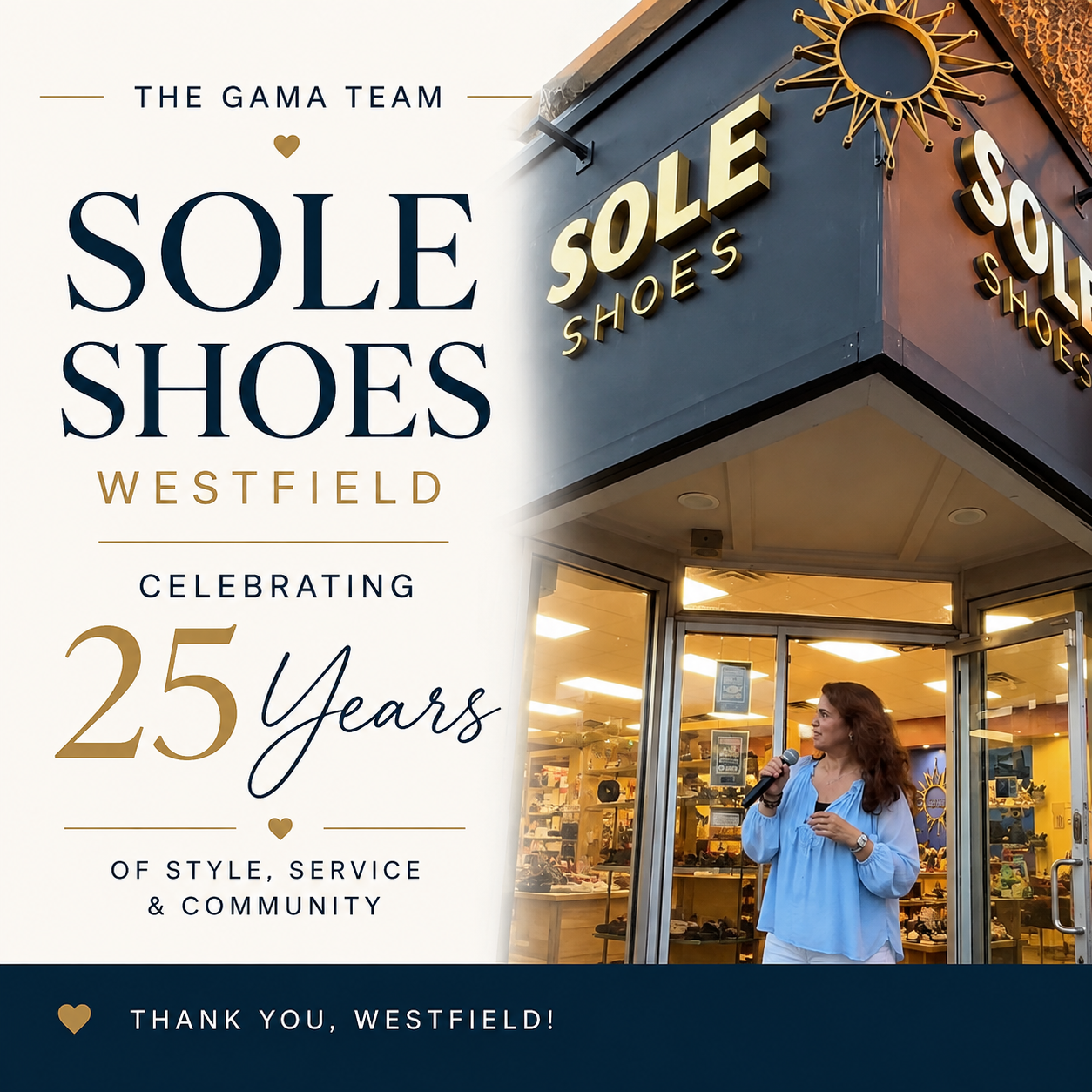
Sole, the Italian shoe boutique at 201 East Broad Street in downtown Westfield, New Jersey, is celebrating 25 years in business in 2026 — a milestone that makes it one of the longest continuously operating independent retailers on Westfield's Elm Street and East Broad Street shopping corridor. Founded in 2001 by Anna Mastroianni, a former off-Broadway actress and Hollywood stunt performer whose credits include doubling for Adriana on The Sopranos and for Goldie Hawn in First Wives Club, Sole has built its reputation on hand-selected, family-factory-made Italian footwear for women, men, and — especially — babies and children, with Anna personally traveling to Italy twice a year to source inventory and develop the store's own exclusive SOLE house brand. Housed since 2009 in the historic Arcanum Hall building at the corner of Elm and East Broad Streets, a structure dating to 1892, Sole has drawn loyal customers from across New Jersey and, remarkably, from as far away as Paris, Texas, upstate New York, and Ireland. This is the full story of how a market-research employee's aborted wine-import idea turned into one of Westfield's most genuinely beloved small businesses — and why a shop like Sole says something real about what makes a downtown worth walking.
There's a particular kind of small business that a downtown either has or doesn't — the kind where the owner knows your kid's shoe size before you say it out loud, where the same face has greeted three generations of a family, and where twenty-five years in one town isn't a marketing statistic but a genuinely earned milestone in an industry that chews up independent retailers for breakfast. Sole is exactly that kind of business. And the story of how it got there — through a failed wine venture, a bakery basement sales marathon, and an improbable second career doing car stunts alongside some of the biggest names in film and television — is worth telling in full.
The Honest Bottom Line: What Makes Sole Worth Knowing About
Before getting into the full story, it's worth stating plainly what distinguishes Sole from a typical shoe store, since the specifics genuinely matter here.
Sole has operated continuously in downtown Westfield since 2001, marking 25 years in business in 2026 — a genuine rarity in independent retail, where most small specialty shops don't survive a single decade, let alone outlast two economic recessions, a pandemic-driven retail collapse, and the ongoing rise of e-commerce. The store is currently located at 201 East Broad Street, at the highly visible corner of Elm and East Broad Streets, inside the historic Arcanum Hall building.
Owner Anna Mastroianni personally travels to Italy twice a year to hand-select inventory directly from small, family-owned factories — not a buyer working off a wholesale catalog, but the owner herself building relationships with the actual artisans producing the shoes, a level of direct sourcing that's genuinely uncommon even among boutique footwear retailers.
Before she ever sold a single shoe, Anna spent roughly a decade as a working off-Broadway actress, and after opening Sole, she built a genuinely remarkable second career as a Hollywood stunt performer — with screen credits including Independence Day, The First Wives Club, multiple Spider-Man films, NYPD Blue, Law & Order, The Rebound, and The Sopranos, where she doubled for the actress playing Adriana and sustained real injuries in the process. It's a genuinely unusual biography for a Main Street shoe store owner, and it's a real, well-documented part of who built this business.
Sole is especially well known — and, per the store's own account, especially proud of — its selection for the youngest customers: a dedicated First Steps collection for babies just learning to walk, alongside a full range of girls' and boys' shoes, in the same hand-crafted Italian quality the store applies to its adult footwear. For Westfield parents specifically, this is frequently the first thing that comes up when the store's name enters conversation.
How It Started: An Italian Wine Idea That Became an Italian Shoe Business
Every good small-business origin story has a moment where the plan changes completely, and Sole's is genuinely worth telling in detail, because almost none of it went the way it originally started.
Anna Mastroianni was born one of six children to Italian farmers, and her family moved to Plainfield, New Jersey when she was seven years old. From that point, her path ran nowhere near retail: she pursued acting throughout high school, then trained formally at the William Esper Studio for Acting in Manhattan — a well-regarded, rigorous training program — and spent roughly a decade working as a professional off-Broadway actress, including a role in the production "Sweatshop."
The idea for what eventually became Sole started with a completely different product: wine, not shoes. While Anna was working a day job at a market research firm, a co-star from one of her theater productions proposed the two of them start selling Italian wines online together — a genuinely of-the-moment idea for the early days of e-commerce. Anna dug into what it would actually take to sell alcohol online and ran headlong into the maze of state-by-state liquor licensing law, which made a small-scale online wine business impractical almost immediately.
Rather than abandon the idea of Italian imports altogether, Anna pivoted the concept from wine to footwear — reasoning, in her own words, that Italian products "mean quality and they're hard to come by." That single insight — that "Italian-made" was a genuine, recognizable signal of quality worth building a business around, even if the specific product category had to change — turned out to be the founding idea for everything that came after.
Anna launched a website, italianbaby.com, and placed an initial order of Italian children's shoes worth roughly $1,000 — a small, genuinely modest first bet on an idea that, at the time, had no guarantee of working at all.
The Bakery Basement Sales Marathon: How Sole Almost Didn't Happen
What happened next is the part of the story that separates Sole from a typical tidy founder narrative, and it's worth telling honestly, because the business very nearly ended before it began.
In 2000, Anna's business partner in the shoe venture withdrew from the arrangement, leaving her holding hundreds of unsold pairs of children's shoes and no clear plan for what to do with them. This is, genuinely, the moment most side-business ideas quietly die — a partner exits, the inventory sits in boxes, and the founder moves on. That's not what happened here.
Anna's brother owned a local bakery, Bovella's, and she arranged to sell her unsold shoe inventory out of the bakery space after hours — turning a bread-and-pastry shop into an impromptu after-hours shoe outlet, entirely out of necessity rather than any strategic retail plan. The results were immediate and, by any standard, genuinely striking: Anna generated $1,200 in sales within two days selling children's Italian shoes out of her brother's bakery.
That two-day burst of real, tangible demand — proof that people would actually buy this specific product, in this specific style, at this specific price point — is what gave Anna the confidence to open an actual storefront, rather than treating the whole venture as a failed side project to be written off. She opened her first true retail location on Prospect Street in downtown Westfield, specializing initially in imported Italian children's shoes before gradually expanding into women's and men's collections as the customer base grew.
It's worth pausing on what this origin story actually demonstrates, because it's easy to romanticize "the bakery basement" detail without crediting what it actually required: real resourcefulness under genuine pressure, a willingness to sell shoes out of a borrowed retail space rather than simply absorbing a loss, and — critically — enough confidence in the underlying product (genuinely well-made Italian children's shoes) to bet a second time after the first plan had already collapsed. That's the version of entrepreneurship that doesn't usually make it into a polished "our story" page, and it's worth crediting directly.
An Unexpected Second Career: From Shoe Store Owner to Hollywood Stunt Performer
Here is where Sole's story takes a turn that has almost nothing to do with retail at all, and everything to do with the same bakery connection that helped launch the shoe business in the first place.
Peter Bucossi, a stunt coordinator, was both a regular customer at Bovella's Bakery and a high school classmate of Anna's — the kind of small-town, everybody-knows-everybody connection that, in this case, led somewhere genuinely unusual. Bucossi hired Anna for a stunt driving role on the soap opera "Another World," despite the fact that she had no prior stunt experience whatsoever.
Her first assignment put her behind the wheel of a 1957 Chevrolet for a driving stunt, and by all accounts, she performed it with a level of confidence that startled the people watching. The director's reported reaction afterward, in Anna's own retelling, captures the moment well: "You, you're crazy! But you're a professional and that's what we paid you for." That single performance opened the door to a genuinely remarkable run of stunt and acting work across major film and television productions.
Anna's screen credits over the following years included some of the most recognizable film and television titles of the era: Independence Day (the Will Smith blockbuster), The First Wives Club (where she doubled for Goldie Hawn), multiple Spider-Man sequels, NYPD Blue, Law & Order, and The Rebound (the 2009 Catherine Zeta-Jones film). For a Westfield small-business owner running a shoe store on the side — or, depending on how you look at it, a stunt performer running a shoe store on the side — that's a genuinely unusual, well-documented body of screen work.
Her most locally famous credit, and the one Westfield neighbors and customers ask about most, is her work on The Sopranos — the HBO series largely filmed in and around New Jersey, doubling for both a 73-year-old character struck by a car in one storyline and for the actress playing Adriana in another, sustaining real physical injuries on both occasions. Stunt work is, genuinely, dangerous work, even when it looks controlled on screen, and Anna's account of her time on the show reflects that reality directly rather than glamorizing it.
Describing her own rapid, almost accidental rise from novice stunt driver to working regularly on major studio productions, Anna has said: "The progression was crazy! I work on a $60 million budget movie knowing nothing about what I'm doing." It's a genuinely candid admission from someone who, by the time she was doing that work, was also running a small Italian shoe boutique on the side back home in Westfield — two entirely different professional worlds, running in parallel, for years.
The Off-Broadway Years: Training That Shaped Everything Afterward
Before turning to Anna's stunt career and its unexpected local fame, it's worth understanding the theatrical training that came first, since it genuinely shaped how she's approached both of her later, very different careers.
Anna trained formally at the William Esper Studio for Acting in Manhattan — a genuinely well-regarded, rigorous professional training program built around the Meisner technique, a specific approach to actor training developed by Sanford Meisner that emphasizes truthful, spontaneous reaction to a scene partner over rehearsed, presentational performance. Actors trained in this tradition are specifically taught to respond authentically in the moment rather than executing a predetermined performance — a discipline that, read alongside Anna's later career, offers a genuinely interesting throughline: both her stunt work (reacting authentically and safely to unpredictable, physically demanding situations in real time) and her retail approach (Sole's stated "come uno" philosophy of genuine, present connection with each individual customer) reflect a similar underlying skill of authentic, in-the-moment engagement rather than a rehearsed script.
Over roughly a decade as a working actress, Anna appeared in off-Broadway productions including "Sweatshop" — genuine, sustained professional theater work, not a brief hobby pursued alongside a "real" career. It's worth crediting this decade directly: by the time Anna pivoted first into retail and then into stunt work, she'd already built and sustained one full, legitimate professional career in a notoriously difficult industry, suggesting a level of persistence and professional discipline that shows up again in how she's since built both Sole and her stunt career.
Why She Always Came Back to Main Street
Given a Hollywood stunt career that included work on some of the biggest productions of the era, it's worth asking directly why Anna never left the shoe business behind — and her own explanation is genuinely consistent with everything else about how she's built Sole.
Asked what she finds most rewarding across her two very different professions, Anna has framed both in strikingly similar terms: "For me, interacting with people is the most fun — whether it's selling them a pair of shoes or hanging out on the set or acting." That's a genuinely telling answer. It's not "the shoe business pays the bills while the film work is the real passion," or the reverse — it's an honest statement that the actual thing she enjoys, across both careers, is the same: connecting directly with people.
Anna has also credited family support, a measure of good luck, and what she describes as an adventurous spirit for her ability to build both a stunt career and a retail business simultaneously — a combination that, read plainly, suggests someone who was never particularly interested in choosing a single, conventional professional lane in the first place.
For Westfield specifically, this matters beyond simple biographical trivia: it means the woman behind the counter at Sole, hand-selecting Italian children's shoes twice a year in small factories, is the same person who has stood in for major actresses in stunt sequences on some of the most-watched television and film productions of the last two decades — a genuinely unusual, genuinely real detail that shapes how many longtime customers describe their relationship with the store. It's not a manufactured "quirky owner" marketing angle; it's simply true, and well documented across local press coverage.
What Stunt Performers Actually Do: A Real Explanation
Because Anna's stunt career is such a distinctive part of Sole's story, and because most customers walking into the store have only a vague pop-culture sense of what "stunt double" actually means in practice, it's worth explaining the profession in genuine educational detail.
A stunt performer is a trained professional who physically executes dangerous, technically demanding, or specialized physical action on behalf of an on-screen actor — falls, car stunts, fight choreography, fire work, high work (stunts performed at height), and precision driving among them — allowing productions to capture physically dramatic sequences without placing the credited, insured principal actor at direct physical risk. Contrary to a common misconception, stunt work isn't a single generalized skill; performers frequently specialize in specific categories (precision or high-speed driving, high falls, fight choreography, fire work), with a performer's specific specialty determining which stunt coordinators and productions bring them in for a given job.
Stunt coordinators, like Peter Bucossi — the family friend and former classmate who first hired Anna for stunt driving work — are responsible for designing a production's stunt sequences, assessing and mitigating genuine physical risk, and casting appropriate stunt performers for each specific sequence, often working with performers they already know and trust for safety-critical work rather than unknown talent. This is precisely the professional structure that explains how Anna's career actually started: not through a formal audition process, but through an existing personal relationship with a stunt coordinator who had direct, firsthand confidence in her.
Doubling — performing a stunt in place of a credited actor, in costume and typically shot from angles that obscure the substitution — requires a stunt performer to closely match the credited actor's build, movement, and general physical presentation, in addition to possessing the specific stunt skill the sequence requires. This is exactly the work Anna performed doubling for Goldie Hawn in The First Wives Club and for the actress playing Adriana on The Sopranos — matching physical presentation closely enough that, combined with careful camera work and editing, the audience perceives a single continuous performance rather than a substitution.
It's worth being honest about the genuine physical risk involved, consistent with Anna's own account of sustaining real injuries during her Sopranos stunt work: even carefully planned, professionally coordinated stunt sequences carry real risk of injury, which is precisely why the profession requires specialized training, experienced coordination, and — as reflected in Anna's own account of her first stunt driving assignment — a genuine measure of the "adventurous spirit" she's credited as central to her own career.
The Sopranos and New Jersey: Why This Particular Credit Resonates Locally
Of all the film and television credits covered throughout this guide, Anna's work on The Sopranos is consistently the one that generates the most immediate recognition from Westfield neighbors and customers — and it's worth explaining why that specific credit lands so differently locally than her other, arguably higher-profile blockbuster work.
The Sopranos, HBO's landmark series about a fictional New Jersey organized-crime family, was extensively filmed on location throughout real New Jersey towns and neighborhoods rather than on a soundstage standing in for the state — a production choice that made the show feel distinctly, specifically New Jersey to audiences across the state in a way relatively few major television productions of that era did. For New Jersey viewers generally, and Central Jersey viewers specifically, the show carried a level of direct local recognition — actual local streets, actual local landmarks — that a stunt credit on a more geographically generic production like Independence Day or a Spider-Man film simply doesn't carry in the same way.
That's precisely why Anna's Sopranos stunt work resonates so specifically with Westfield neighbors: it's not simply "she worked on a famous show," but "she worked on the show that was filmed right here, in towns like ours, playing characters and stories that felt specifically, recognizably New Jersey." For a business owner whose entire retail philosophy is built around genuine local connection — the "come uno" ethos covered earlier in this guide — having a marquee screen credit on the single most quintessentially New Jersey television production of the era is a genuinely fitting, if entirely coincidental, alignment between her two careers.
The Move to Arcanum Hall: A More Visible Home in 2009
Sole's current, highly visible location at the corner of Elm and East Broad Streets wasn't where the story started — and the move itself is worth understanding, both for what it says about the store's growth and for the building's own genuine local history.
Sole originally operated out of a smaller storefront on Prospect Street in downtown Westfield. By Anna's own account, the store had genuinely outgrown that original space well before the eventual move: "This is a much better location and people can see us. We out grew our old space five years ago," she said at the time of the relocation — meaning Sole had been operating in cramped quarters for roughly half a decade before finally making the jump to a larger, more prominent storefront.
On Saturday, August 2, 2009, Sole celebrated its reopening at 201 East Broad Street, in the space formerly occupied by a Liberty Travel branch, at the highly trafficked corner of East Broad and Elm Streets — with an official grand opening soiree following in September. The new location offered roughly 1,000 square feet of showroom space plus an additional 300 square feet for storage, compared to just 500 square feet total at the original Prospect Street location — meaning Sole's usable retail footprint more than doubled with the move, a genuinely significant expansion for a small independent boutique.
The building Sole moved into carries real local history of its own: Arcanum Hall, at the corner of Elm and East Broad Streets, has stood since 1892, and has been documented, per local historic accounts and downtown Westfield's own archival materials, as a site where important town meetings were held in the late nineteenth century. For a downtown as proud of its historic architecture as Westfield's, housing a beloved 25-year-old local business inside a building with its own century-plus history is a genuinely fitting pairing — one storefront's history nested inside a much older building's own.
At the time of the 2009 relocation, coverage of the move also noted that Sole maintained a second location on South Street in Morristown, New Jersey — worth mentioning as part of the store's documented history, though it's worth being honest that the store's current public presence centers entirely on the Westfield location, and this guide isn't going to assert one way or the other whether that Morristown location remains open today without more current confirmation.
Twice a Year in Italy: How Sole Actually Sources Its Shoes
The phrase "Italian-made" gets used loosely by a lot of retailers. It's worth explaining, in real detail, what that phrase actually means specifically at Sole, because the sourcing process is genuinely more hands-on than most boutique retail buying.
Anna personally travels to Italy twice each year specifically to hand-select the store's inventory, working directly with small, family-owned factories rather than ordering through a wholesale distributor or an anonymous international supply chain. This is a meaningfully different buying model from how most American shoe retailers operate: rather than selecting from a manufacturer's pre-set wholesale catalog, Anna is directly involved in choosing which specific styles, leathers, and details make it into Sole's inventory each season, working face-to-face with the same artisan families season after season.
This direct, relationship-based sourcing model led to something most small independent retailers never attempt: the creation of Sole's own exclusive house brand, SOLE, produced for men, women, and children through Anna's direct collaboration with the Italian factories she's built relationships with over years of buying trips. A house brand isn't simply a private-label rebadging exercise; it reflects genuine design input from the retailer into what gets manufactured, meaning Sole's own-brand shoes are, in a real sense, co-designed by Anna herself rather than simply selected from an existing catalog.
What this sourcing model means practically for a customer walking into the Westfield store is that the shoes on Sole's shelves genuinely aren't available at other retailers, in New Jersey or otherwise — a level of merchandise exclusivity that's a genuine point of differentiation from mall-based national chains, where the same handful of mass-market brands show up in every location coast to coast.
What "Italian-Made Quality" Actually Means: A Real Explanation
Because "Italian craftsmanship" gets used as a marketing phrase so often it risks becoming meaningless, it's worth explaining, in genuine educational detail, what actually distinguishes well-made Italian footwear from typical mass-market shoe manufacturing — since understanding this is what makes a store like Sole's specific value proposition legible rather than just a vague claim of prestige.
Italy's shoemaking regions — particularly areas in the Marche, Tuscany, and Veneto regions — are home to a genuinely dense concentration of small, family-run footwear factories, many operating as multi-generational businesses passing specific technical skills down within the same families for decades. This regional concentration of specialized skill is a genuinely different manufacturing model from large-scale, highly automated mass production: smaller factories generally mean more hands-on quality control at each stage, more willingness to produce smaller batch runs and custom details, and closer, more direct relationships between a factory and the retailers it supplies — precisely the kind of relationship Anna has built through her twice-yearly buying trips.
Construction method is one of the most concrete, technical differences between well-made and mass-market footwear, and it's worth explaining plainly: many higher-quality Italian shoes use Blake stitching or Goodyear welt construction, both methods that stitch the shoe's upper directly to its sole in a way that's genuinely more durable and, critically, resoleable — meaning a well-constructed pair of Italian shoes can be professionally resoled and repaired multiple times over its life, rather than being discarded once the sole wears through, the way most cemented, glued-construction mass-market shoes are designed to be replaced rather than repaired. This distinction matters enormously for anyone thinking about cost-per-wear over a shoe's actual usable lifespan, not simply the sticker price at purchase.
Material quality is the other core differentiator: full-grain leather — leather that retains the complete, unaltered outer layer of the hide, rather than sanded or corrected lower-grade leather — develops a genuine, individual patina over years of wear, remains more breathable and comfortable over long-term use, and is considerably more durable than the corrected-grain or bonded leather typically used in lower-cost mass-market footwear. Well-made Italian leather goods, generally speaking, prioritize this kind of higher-grade material specifically because the smaller-scale production model doesn't depend on driving material costs to the absolute minimum the way large-volume mass manufacturing does.
None of this is to suggest every single pair of shoes at Sole represents museum-quality artisanal work — a retail boutique serving everyday Westfield families, including plenty of children's first-walker shoes that will be outgrown within months, has to balance genuine quality against real, practical family budgets. But the sourcing model — small family factories, direct owner-level buying relationships, an exclusive house brand co-developed with those same factories — reflects a genuinely different approach from a big-box retailer stocking whatever a wholesale distributor happens to be moving that season, and it's worth understanding specifically why that difference is real rather than purely a marketing claim.
Understanding Italy's Shoemaking Regions: The Real Geography Behind "Italian-Made"
Because Anna's twice-yearly buying trips are such a central part of how Sole actually operates, it's worth explaining, in genuine educational detail, the real geography and history behind Italian footwear manufacturing — since "Italian-made" isn't a single, uniform industry, but a set of genuinely distinct regional traditions, each with its own specific history.
Several regions of Italy have developed concentrated, multi-generational footwear manufacturing traditions, but the Marche region — along the Adriatic coast, encompassing towns like Fermo, Montegranaro, Sant'Elpidio a Mare, and Monte Urano — is frequently described within the industry as Italy's premier "shoe valley." Documented shoemaking activity in this specific district traces back centuries: the Fermano-Maceratese Footwear District's origins are generally traced to the 15th century, with some scholars placing the modern district's emergence in the early 19th century — though the exceptional quality of shoes from towns like Montegranaro and Sant'Elpidio a Mare was recognized even earlier, referenced directly by the medieval Italian writer Boccaccio.
What distinguishes a region like Marche from large-scale, anonymous mass manufacturing is precisely the structure covered throughout this guide's discussion of Sole's own buying model: small, often family-owned workshops passing specific technical skills down across generations, combined with a regional density of specialized suppliers (tanneries, sole manufacturers, hardware producers) that allows even a small individual workshop to produce genuinely high-quality, technically sophisticated footwear without needing the scale of a large industrial manufacturer. This is the same basic manufacturing structure Anna has described building relationships with directly through her own buying trips — smaller, family-run operations rather than large industrial suppliers.
This context matters for understanding what a customer is actually buying at a store like Sole: not simply a product stamped "Made in Italy" as a generic quality marker, but footwear connected to specific, documented regional manufacturing traditions that, in some cases, trace back literally centuries, sustained today by exactly the kind of small family workshops that a large-volume international retailer generally can't or won't work with directly, but that a hands-on, owner-operated boutique like Sole genuinely can.
The Baby and Toddler Specialty: Why Little Feet Get Serious Attention at Sole
For many Westfield parents, this is the single most important thing to know about Sole, and it's worth covering in real depth, both because it reflects the store's own stated origins and because proper-fitting children's footwear is a genuinely more consequential decision than it might seem from the outside.
Sole's own account of its history is explicit that the business began with imported Italian children's shoes specifically, before later expanding into women's and men's collections — meaning the store's baby and toddler specialty isn't a later add-on category, but genuinely the founding core of the entire business, dating back to Anna's original italianbaby.com website and that first $1,000 order of children's inventory.
The store maintains a dedicated First Steps collection specifically for babies just learning to walk, alongside separate, fully developed girls' and boys' shoe categories spanning from toddlerhood through older childhood — covering sneakers, sandals, and winter boots, per the store's own description of remaining "true to our origins looking after all the little feet, from first walkers to sneakers, sandals, and winter boots."
It's worth explaining, in genuine educational detail, why proper-fitting, well-constructed shoes matter more for young children's feet than casual shoppers might assume. A child's foot is still developing bone structure well into early childhood — the bones in a toddler's foot are considerably softer and more cartilaginous than an adult's, gradually hardening and taking their adult shape over years rather than being fully formed at birth. Poorly fitted shoes — too tight, too stiff, made from non-breathable synthetic materials, or lacking adequate room for a growing foot to move and flex naturally — can genuinely affect how a young child's foot develops over time, whereas well-fitted, flexible, breathable shoes support natural foot development rather than constraining it.
This is precisely the kind of consideration that a specialty children's shoe retailer, staffed by people trained specifically in children's shoe fitting, can address in a way a big-box retailer's self-service shoe wall generally can't — proper measurement, genuine attention to how a specific child's foot is shaped and how it moves, and honest guidance about sizing up appropriately for growth without sizing so far up that the shoe no longer supports the foot properly in the meantime.
Brand-wise, Sole's children's offerings include GEOX (an Italian brand specifically known for its patented breathable, perforated rubber sole technology, popular among parents specifically because it addresses the sweaty-feet problem common with synthetic children's shoes), Skechers, FRODDO (a European children's shoe brand known for soft, flexible leather construction), Birkenstock, and Mini Melissa (the children's line of the Brazilian jelly-shoe and sandal brand, popular for colorful, budget-friendly options), alongside Sole's own exclusive SOLE-brand children's shoes developed directly with the store's Italian factory partners. That's a genuinely broad range spanning everyday durability (Skechers), technical comfort features (GEOX), and the same hand-crafted Italian sourcing that defines the rest of the store's offerings (the SOLE house brand and other Italian imports).
The Exclusive SOLE House Brand: A Closer Look
Because Sole's own exclusive house brand comes up repeatedly throughout this guide, it's worth explaining more specifically what actually distinguishes a genuine, owner-developed house brand from the kind of generic private-label merchandise many retailers sell.
A typical private-label product is usually just an existing manufacturer's stock item, rebadged with a retailer's own name — the retailer selects from an existing catalog of pre-designed options and simply asks for their own label sewn in, with little to no actual design input into the product itself. What Anna has built with the SOLE brand, based on her own described sourcing process, appears to reflect something meaningfully different: direct, ongoing collaboration with the same small Italian factories she's built relationships with over years of twice-yearly buying trips, developing styles specifically for her own store rather than simply relabeling an existing catalog item.
This distinction matters practically for a shopper: a genuine house brand developed this way reflects the retailer's own accumulated expertise about what actually works for her specific customer base — years of direct feedback from Westfield parents about what holds up on an active toddler, years of fitting adult customers and learning which construction details actually matter for comfort and durability — translated directly into product design, rather than a generic style selected off a wholesale sheet with no connection to the specific community it's ultimately sold to.
Because the SOLE brand spans men's, women's, and children's sizing, it also gives the store a genuinely consistent core offering that sits alongside its curated selection of other Italian designer labels and recognized children's brands like GEOX and FRODDO — meaning a customer can choose between established, recognizable brand names and Sole's own house-developed line, depending on what matters most for a given purchase, whether that's brand recognition, a specific technical feature, or simply Anna's own direct design input.
Beyond the Kids' Section: Women's and Men's Footwear
While the children's and baby selection is frequently what Sole is most associated with in casual Westfield conversation, it's worth covering the store's adult offerings in their own right, since they reflect the same sourcing philosophy applied to a different customer.
Sole carries Italian designer footwear for both women and men, alongside its own exclusive SOLE house brand extended across adult sizing as well as children's — meaning a customer who discovered the store buying their toddler's first walking shoes can, in many cases, return years later to outfit themselves in the same hand-selected Italian inventory model.
The store's own stated mission frames this consistently across every category it carries: the belief that "the right shoes can walk the moments that are most meaningful to you" — a mission statement that, read alongside everything else covered in this guide, reflects something more specific than typical retail marketing language: an actual emphasis on footwear as something people wear through genuinely significant life moments, not simply a commodity purchase.
That emphasis on significant moments isn't purely aspirational marketing copy, either: Sole's footwear has reportedly appeared at some of the most visible fashion and entertainment events in the world, including the Met Gala, the Oscars, and the Emmys — a genuinely notable level of visibility for a small, family-run Westfield boutique operating out of a converted 1892 building on a New Jersey Main Street, and one that speaks directly to the actual design quality of the store's curated and house-brand inventory, independent of its small-town retail setting.
Special Occasions at Sole: From First Communion to Wedding Day
Sole's own stated mission — that "the right shoes can walk the moments that are most meaningful to you" — is worth taking seriously as a specific description of how the store actually serves its customers across major life milestones, not simply an abstract tagline.
In a Central New Jersey community with a substantial Catholic population, First Communion season represents a genuinely significant annual milestone for local families, and proper, well-fitted formal shoes are a real, specific need every spring for families with children making their First Communion — precisely the kind of specialty, occasion-specific footwear need that a general big-box retailer's limited formal-shoe selection often doesn't serve especially well, but that a store built around genuine children's shoe expertise, like Sole, is specifically positioned to handle.
Beyond First Communion, the same logic extends across a full calendar of milestone events that Central Jersey families navigate over the years: confirmation, school formals and proms for older children, and — as children grow into adulthood — the full range of adult milestone events where proper footwear genuinely matters, including weddings, both as a guest and, eventually, for the family members directly involved in a wedding party. A store carrying genuine Italian designer footwear for women and men, alongside its own exclusive SOLE brand, is well-positioned to serve exactly this kind of occasion-specific need across a family's full life stages, not simply the baby and toddler category the store is perhaps best known for locally.
This is precisely the throughline connecting Sole's origin story to its present-day reality: a store that started by outfitting the smallest, most literal "first steps" a family experiences has grown, over twenty-five years, into a resource many of those same families return to for essentially every major footwear-relevant milestone that follows — a genuinely rare kind of multi-generational, multi-occasion relationship for a single small retailer to sustain.
Visiting Sole: What First-Time Customers Should Know
For readers considering a first visit, it's worth covering the practical details, while being appropriately honest about which of these details should be double-checked directly with the store before visiting, since hours and offerings at any small business can change.
Sole is located at 201 East Broad Street, Westfield, NJ 07090, at the highly visible corner of Elm and East Broad Streets inside the historic Arcanum Hall building — an easy landmark to navigate to for anyone even loosely familiar with downtown Westfield's core shopping corridor, and within easy walking distance of Westfield's train station and the bulk of the town's other downtown retail and dining.
Published hours at the time of this guide's research list the store as open Tuesday through Saturday from 10 a.m. to 5 p.m. and Sunday from noon to 5 p.m., closed Mondays — though, consistent with this guide's approach throughout, readers planning a visit around a specific time should confirm current hours directly with the store at 908-654-7800, since small-business hours can shift seasonally or around specific holidays.
For parents specifically planning a children's shoe-fitting visit, it's generally worth bringing along any shoes your child has recently outgrown (helpful for a staff member gauging actual growth and fit history), planning the visit for a time when your child is reasonably rested and not overdue for a nap, and allowing enough time for the kind of unhurried, hands-on fitting process described earlier in this guide's new-parent case study — precisely the kind of individualized attention that distinguishes a specialty children's shoe fitting from a quick, self-service shopping trip.
Recognition and Reputation: What Outside Observers Say About Sole
Beyond the store's own account of itself, it's worth covering how Sole has been recognized and described by outside publications and organizations, since that kind of third-party validation carries real weight.
Sole has been named "Best Shoe Store in New Jersey" by multiple publications over the years — a recurring, repeated recognition rather than a single one-time award, suggesting a sustained reputation for quality and service rather than a momentary press mention that faded.
The store has also been featured in fashion magazine coverage specifically highlighting its unique, hard-to-find footwear selection — coverage that reinforces the same point made earlier in this guide about Sole's merchandise exclusivity: because Anna is directly, personally selecting inventory from small Italian factories rather than ordering from the same wholesale catalogs available to every other national retailer, the specific shoes on Sole's shelves genuinely stand out to fashion press covering the broader footwear industry.
Locally, Sole has also been the subject of repeated feature coverage specifically focused on Anna Mastroianni's own unusual dual career — as both the store's owner and a working Hollywood stunt performer — including a dedicated profile through TAPinto Westfield's own community coverage, a Westfield Patch feature specifically framed around her transition "from shoes to stunts," and an on-camera interview about her film career trajectory presented at the 2018 Westfield International Film Festival. That kind of sustained, repeated local media interest in one small-business owner's personal story is itself a meaningful signal of just how genuinely embedded Anna and Sole have become in Westfield's broader community identity, well beyond simple retail commerce.
A Quick-Reference Gift and Occasion Guide
For readers who want a fast, practical summary of what Sole is genuinely well suited for at each life stage, here's a condensed reference pulling together everything covered throughout this guide.
For expecting and new parents: The First Steps collection, sized and constructed specifically for babies just beginning to pull up, cruise, and take their first independent steps, with staff experienced in assessing an individual baby's actual developmental stage rather than simply matching a numeric size.
For toddlers and young children: A full range of everyday sneakers, sandals, and winter boots across recognized brands like GEOX, Skechers, FRODDO, and Mini Melissa, alongside the exclusive SOLE children's line, all benefiting from the same hands-on fitting approach.
For First Communion, Confirmation, and formal school events: Formal children's dress footwear selected with an eye toward genuine all-day wearability, not just how a shoe looks in a single photograph, as covered in this guide's confirmation-season case study.
For teens and young adults: A transition point where Sole's offerings begin overlapping into its adult Italian designer and SOLE-brand selections, appropriate for both everyday wear and the first round of genuinely significant formal occasions — school dances, graduations, and similar milestones.
For weddings and other major adult milestones: Italian designer footwear and the adult SOLE line, reflecting the store's stated mission around shoes for "the moments that are most meaningful to you," with the added long-term value of genuinely repairable, resoleable construction for a piece meant to be worn for years rather than a single event.
For anyone shopping for a Westfield-connected gift: A gift card or a specific, well-chosen pair from a twenty-five-year-old, genuinely locally owned business carries a different kind of meaning than a generic mall-brand gift card — precisely the kind of thoughtful, community-connected gift this guide's broader discussion of Sole's local reputation would suggest many longtime Westfield residents already understand instinctively.
The "Come Uno" Philosophy: What Makes Sole Feel Like a Neighborhood Institution
Beyond the specific products, sourcing, and recognition covered throughout this guide, it's worth addressing directly what customers most consistently describe when talking about why they keep coming back to Sole — because it has less to do with any single shoe and more to do with how the store actually operates day to day.
Sole's own stated philosophy centers on the Italian phrase "come uno" — meaning, roughly, "as one" — reflecting an emphasis on community, personal connection, and treating customers and staff alike as part of a single extended relationship rather than a series of individual, anonymous transactions. For a store built by someone whose own stated favorite part of both her retail and stunt careers is "interacting with people," that philosophy reads as considerably more than a nice tagline; it's consistent, specific evidence of how the business has actually been run for twenty-five years.
This kind of personal, relationship-driven service model shows up concretely in the store's documented customer base: coverage of Sole's 2009 relocation specifically noted a regular customer who traveled from Paris twice a year to shop there, alongside customers from Texas, upstate New York, and Ireland — a genuinely remarkable geographic reach for a Main Street boutique, and one that only makes sense in the context of a store where customers feel a personal, ongoing relationship with the owner and staff, not simply a one-time transactional purchase they could make anywhere.
It's this combination — a hand-picked, genuinely exclusive product selection, twenty-five years of consistency in one location, and an owner whose stated approach to both of her very different careers is built around personal connection — that explains why Sole shows up so consistently in Westfield residents' own descriptions of what makes their downtown special, rather than simply being one shoe store among several in a town with a genuinely strong retail corridor.
How Sole Compares to Big-Box and Online Shoe Shopping
It's worth addressing directly a question a reasonably budget-conscious Westfield family might genuinely ask: with so much shoe shopping now happening online or at large discount retailers, why does a store like Sole still matter, and what does a family actually give up by defaulting to the cheaper or more convenient option?
Online shoe shopping offers real, genuine advantages — broader selection browsable from home, frequently lower prices, and none of the friction of getting a squirming toddler in and out of a car seat for a shopping trip — and this guide isn't going to pretend those advantages don't matter to real families managing real budgets and real schedules. But it's worth being honest about what online shopping specifically cannot replicate: the hands-on measurement and fit assessment covered in this guide's new-parent case study, in-person guidance from staff who do this kind of fitting daily, and the ability to have a child actually stand, walk, and move in a shoe before committing to the purchase — genuinely important considerations for a still-developing foot, and precisely the kind of assessment a screen and a size chart can't fully substitute for.
Big-box and mass-market retailers, meanwhile, generally offer real convenience and lower price points, but typically stock a narrower range of specifically constructed, higher-quality options, and rarely offer the kind of individualized, expert fitting attention a dedicated specialty retailer provides — the self-service shoe wall model covered earlier in this guide, where a parent is largely left to estimate sizing without professional guidance.
None of this means every shoe purchase for every family needs to happen at a specialty boutique — a family managing a tight budget, buying a pair of everyday sneakers a child will outgrow within a few months regardless of construction quality, has a genuinely reasonable case for prioritizing cost and convenience for that specific purchase. But for the specific moments this guide has covered throughout — a baby's actual first walking shoes, a child's feet during the years of most active bone development, a formal occasion shoe meant to last and be handed down, or an adult investment piece meant to be resoled and repaired rather than replaced — the case for a specialty retailer's hands-on expertise and genuinely higher-quality construction is a real, substantive one, not simply marketing preference.
Twenty-Five Years in an Era That's Been Brutal to Independent Retail
It's worth being direct and honest about just how significant a twenty-five-year run actually is for a small, independent specialty retailer, because the broader retail environment over that exact period has been genuinely difficult for businesses like Sole.
Since Sole opened in 2001, independent retail has weathered the 2008 financial crisis and subsequent recession, the accelerating rise of e-commerce and specifically Amazon's growing dominance over general merchandise shopping, the near-total collapse of the traditional American shopping mall as a retail format, and the acute, sudden disruption of the COVID-19 pandemic, which forced an extended closure of in-person retail and permanently altered many consumers' shopping habits toward online purchasing. Industry data across this entire period has consistently shown declining numbers of independent specialty retailers nationally, with small, single-location boutiques representing one of the most vulnerable categories of small business to exactly these pressures.
Against that backdrop, a small, independently owned shoe boutique not only surviving but apparently thriving — expanding its physical footprint in 2009, developing its own exclusive house brand, building a customer base that spans multiple states and at least one European country, and earning repeated "best shoe store" recognition — represents something genuinely notable, not simply a nostalgic "local business hangs on" story. It suggests a business model that's actually well-adapted to surviving exactly the pressures that have eliminated so many comparable independent retailers elsewhere: a genuinely differentiated, hard-to-replicate product (Anna's direct Italian sourcing relationships and exclusive house brand), a service model built around real personal relationships rather than pure price competition, and a specific category (specialty children's and family footwear) where in-person fitting expertise still provides a genuine value e-commerce struggles to fully replace.
This is precisely the kind of twenty-five-year track record that distinguishes a business genuinely embedded in a community's identity from one simply operating within its borders — and it's worth naming why that distinction matters for anyone thinking about what makes a downtown like Westfield's worth living near in the first place, a point covered directly in the next section.
Twenty-Five Years of Downtown Westfield's Own Evolution
Sole's twenty-five years in business have unfolded alongside twenty-five years of downtown Westfield's own change, and it's worth situating the store's longevity within that broader local context.
Across the roughly quarter-century Sole has operated in downtown Westfield, the town's retail corridor has itself experienced real, sustained change: national chain turnover as different mall-style retailers have entered and exited the downtown footprint, the broader restaurant and dining scene's substantial growth as downtown Westfield has increasingly positioned itself as a dining destination alongside a shopping one, and the same broad e-commerce and big-box competitive pressure covered earlier in this guide, which has reshaped independent retail nationally over this same period. Organizations like the Downtown Westfield Corporation, the town's Special Improvement District covering marketing, streetscape, and community programming for the downtown business district, have worked over this same period to sustain and grow downtown foot traffic through recurring community events — Sidewalk Sale Days, Restaurant Week, and the town's seasonal holiday programming among them — precisely the kind of sustained, organized effort that helps give a store like Sole the consistent foot traffic a small independent boutique depends on to survive.
Against that backdrop of real, ongoing downtown change, Sole's own twenty-five-year run in one town, spanning two different physical locations, reflects genuine adaptability rather than simple static longevity — moving to a larger, more visible location in 2009 specifically because the original space could no longer accommodate the business's growth, expanding from a purely children's specialty shop into a full family footwear destination, and developing an exclusive house brand along the way. That's a business that has actively evolved alongside its downtown, not simply persisted unchanged within it.
The Real Estate Angle: Why Businesses Like Sole Matter to Home Buyers and Sellers
Bringing this guide back to its most direct real estate relevance, it's worth stating plainly why a business like Sole deserves a genuine place in any family's understanding of what makes Westfield, specifically, worth considering as a place to live.
A downtown's genuine character isn't built primarily by its chain retailers — the same national brands appear in downtowns and shopping centers everywhere — but by exactly the kind of long-tenured, genuinely distinctive independent businesses that give a specific Main Street its own identity. A store like Sole, with twenty-five years in one location, an owner whose own life story is genuinely woven into the local community's broader narrative, and a product offering that literally cannot be replicated at any other retailer in New Jersey, is precisely the kind of business that makes "downtown Westfield" mean something more specific than simply "a collection of shops."
For families specifically evaluating Westfield against other Central New Jersey towns, walkable access to a downtown with this kind of retail depth and longevity is a genuinely material quality-of-life factor, not simply an aesthetic preference — being able to walk your toddler down Elm Street for their first pair of properly fitted walking shoes, at the same store where you might buy your own shoes for a family wedding years later, at the same store that's been there since before your own childhood in some cases, reflects the kind of continuity and community fabric that's genuinely difficult to build in a newer, more auto-dependent suburban development pattern.
A well-informed local agent should be able to speak to exactly this kind of specific, textured detail about a town's downtown — not simply "Westfield has great shopping," but the actual businesses, their actual histories, and what those specific histories say about the broader community — precisely the kind of honest, granular, deeply human information The GAMA Team believes every family deserves before and during a move to Westfield or any of our coverage towns.
For current Westfield residents and sellers, a milestone like Sole's twenty-fifth anniversary is worth genuine local pride: it reflects a downtown healthy enough, and a community loyal enough, to sustain a specialty independent retailer through twenty-five years of genuinely difficult conditions for businesses exactly like it — the kind of substantive, specific evidence behind a claim about community character that might otherwise sound like unsupported marketing language.
What Twenty-Five Years Actually Represents
Stepping back from the specific product details, sourcing model, and biographical color covered throughout this guide, it's worth naming plainly what a milestone like this genuinely represents, both for Sole specifically and for what it says about downtown Westfield more broadly.
A quarter-century in one town, through two recessions, a pandemic, and the ongoing structural disruption of e-commerce, is not an outcome that happens passively — it reflects a genuinely sound underlying business built around real differentiation (direct, owner-level Italian sourcing and an exclusive house brand no other regional retailer carries), real expertise (specialty children's shoe fitting that a self-service retail model can't replicate), and a real, sustained relationship with its community, built by an owner whose own stated priority, across two entirely different careers, has consistently been genuine connection with people.
It's also worth naming the less quantifiable part of this story directly: Anna Mastroianni's own biography — the off-Broadway training, the improbable bakery-basement sales marathon that saved the business before it properly started, the stunt-double career that put her in some of the most-watched film and television productions of the last two decades — isn't incidental color layered onto a shoe store's marketing. It's a genuinely unusual, well-documented life story that happens to have produced, as one of its outcomes, one of downtown Westfield's most enduring and best-loved small businesses. Twenty-five years in, that's a genuinely remarkable thing for any neighborhood to be able to say about one of its own.
A Case Study: A New Mother's First Visit for Baby's First Walking Shoes
A Westfield mother, expecting her first child and having heard about Sole's baby and toddler selection from several other neighborhood parents before her daughter was even born, describes walking into the store for the first time roughly a year later, once her daughter was starting to pull up and take her first tentative steps, as a genuinely different experience from anything she'd tried at larger retailers.
Rather than being directed to a self-service wall of boxed shoes organized loosely by size, she describes a staff member taking real time to measure her daughter's foot directly, ask specific questions about how she was moving (crawling, cruising along furniture, or already attempting independent steps), and recommend specific styles from the store's First Steps collection based on that actual assessment rather than simply asking what size she thought her daughter wore. She specifically credits this hands-on approach with catching that her daughter's feet were actually two slightly different sizes — a common but easy-to-miss detail — and getting properly guided toward a fit that worked for both feet rather than defaulting to a single size that would have been too tight on one side. She has since returned to the store roughly every few months as her daughter's feet have continued growing, describing the relationship as feeling less like repeat retail transactions and more like an ongoing, genuinely helpful resource for a specific, real parenting concern she hadn't fully appreciated the complexity of before becoming a parent herself.
A Second Case Study: A Twenty-Year Customer's Perspective
A longtime Westfield resident, who first started shopping at Sole not long after its 2001 founding, describes having outfitted three children through the store's baby, toddler, and older children's shoe categories over roughly two decades, and having gradually shifted to shopping there for her own footwear as well as the children grew older and the family's needs changed.
She specifically describes the twice-yearly rhythm of Anna's Italy buying trips as something she's come to genuinely anticipate, comparing the excitement of a new seasonal shipment arriving to "waiting for a friend to come back from vacation and tell you what she found" rather than a typical retail restock. She credits the store's consistency — the same owner, the same attentive approach to fitting, the same emphasis on genuine quality over trend-chasing — with making it one of the only local businesses she's shopped at continuously since her oldest child, now in her twenties, was still learning to walk. Asked what she'd tell a new Westfield family about the store, she describes it simply: "Go in once, and you'll understand why everyone who lives here already knows about it."
A Third Case Study: A Film Fan Who Found the Store Through Anna's Other Career
A relatively new Westfield resident describes having first learned about Sole not through its shoes at all, but through a chance conversation at a community event where Anna's stunt and acting career came up — having independently recognized her name from film credits after mentioning a general interest in movie production work.
Genuinely surprised to learn that a working Hollywood stunt performer with credits on productions like The Sopranos and Independence Day also owned and personally ran a small children's and family shoe boutique in downtown Westfield, the resident describes visiting the store shortly afterward specifically out of curiosity, and staying as a regular customer once she experienced the actual in-store service and product quality for herself. She describes the experience as a genuinely good example of how a small town's most interesting stories often aren't advertised outright, but surface through exactly the kind of organic, person-to-person conversation that a genuinely connected community — the kind Sole's own "come uno" philosophy is explicitly built around — makes possible in the first place.
A Fourth Case Study: A Confirmation Season Rush
A Westfield family with three children close in age describes a particularly memorable spring where two of their children were making their sacraments — one First Communion, one Confirmation — within a few weeks of each other, creating exactly the kind of compressed, high-stakes formal-shoe shopping need this guide's special occasions section describes.
Rather than making two separate rushed trips to a big-box retailer hoping to find appropriately formal children's dress shoes in stock in the right sizes, the family describes calling Sole ahead of their visit, explaining both children's needs and approximate sizes, and arriving to find the staff had already pulled a reasonable starting selection in both sizes based on that phone call — saving real time during an already busy, stressful season of family logistics. They specifically credit the staff's genuine familiarity with what formal dress-shoe styles actually hold up through a full day of church services, family photos, and a subsequent celebratory lunch, steering them away from a style one child had initially wanted that the staff gently flagged as likely to rub and cause blistering by the end of a long day. Both pairs of shoes, the family notes, are still in wearable condition more than a year later, having been passed down informally to a younger cousin rather than discarded — a small, concrete illustration of the durability argument covered earlier in this guide's discussion of Italian shoe construction.
A Practical Glossary
Blake stitch: A shoe construction method that stitches the upper directly to the sole from the inside, producing a flexible, lightweight, resoleable shoe common in higher-quality Italian footwear.
Goodyear welt: A more traditional, highly durable shoe construction method using a strip of leather (the welt) to join the upper, insole, and outsole, allowing for multiple resoling over a shoe's lifetime.
Full-grain leather: Leather that retains the complete, unaltered outer layer of the hide, offering greater durability, breathability, and a natural aging patina compared to corrected or bonded leather.
First Steps collection: Sole's dedicated shoe category for babies just beginning to walk, designed around the specific developmental and fit needs of a child's still-forming foot.
House brand: A retailer's own exclusive product line, in Sole's case the SOLE brand, co-developed directly with the store's Italian factory partners rather than simply purchased from an existing manufacturer catalog.
Come uno: Italian for "as one" — the community-and-connection-focused philosophy Sole's owner has described as central to how the store operates and treats both customers and staff.
Stunt double: A trained stunt performer who executes physically demanding or dangerous action on screen in place of a credited actor, closely matching that actor's build and movement while performing the sequence safely.
Meisner technique: An actor-training approach, developed by Sanford Meisner and taught at programs like the William Esper Studio, emphasizing truthful, spontaneous reaction to a scene partner over rehearsed, presentational performance.
Shoe Valley (Marche): The Adriatic-coast region of Italy, encompassing towns like Fermo, Montegranaro, and Sant'Elpidio a Mare, widely recognized within the footwear industry for a centuries-old concentration of family-run shoemaking workshops.
Special Improvement District (SID): A municipally designated district, like downtown Westfield's own, funded through a special property-tax assessment on district businesses to support marketing, streetscape upkeep, and community programming for a defined commercial corridor.
Frequently Asked Questions
Where is Sole Shoes located in Westfield, NJ? Sole is located at 201 East Broad Street, at the corner of Elm and East Broad Streets, inside the historic Arcanum Hall building in downtown Westfield.
Who owns Sole Shoes? Anna Mastroianni, who founded the store in 2001 after an earlier, unrelated career as an off-Broadway actress, and who has simultaneously built a career as a Hollywood stunt performer with credits including The Sopranos, Independence Day, and The First Wives Club.
Is it true the owner worked on The Sopranos? Yes. Anna Mastroianni doubled for both a 73-year-old character struck by a car and for the actress playing Adriana, sustaining real injuries on both stunts.
How long has Sole been in business? Sole opened in 2001 and is celebrating 25 years in business in 2026, making it one of the longest-tenured independent retailers in downtown Westfield.
Where does Sole source its shoes? Owner Anna Mastroianni personally travels to Italy twice a year to hand-select inventory directly from small, family-owned factories, and has developed an exclusive SOLE house brand through those same relationships.
Does Sole carry baby and toddler shoes? Yes — children's footwear was the store's founding specialty, and it maintains a dedicated First Steps collection for babies learning to walk, alongside full girls' and boys' shoe selections.
What children's shoe brands does Sole carry? GEOX, Skechers, FRODDO, Birkenstock, and Mini Melissa, alongside the store's own exclusive SOLE brand for children.
Does Sole carry shoes for adults too? Yes — Italian designer footwear for both women and men, alongside the SOLE house brand extended across adult sizing.
Has Sole always been at its current location? No. The store originally operated on Prospect Street in downtown Westfield before relocating to its current, more prominent corner location at 201 East Broad Street in August 2009.
What is Arcanum Hall? The historic building at the corner of Elm and East Broad Streets that has housed Sole since 2009, dating to 1892 and documented as a site where important town meetings were held in the building's early history.
Why is Italian-made footwear considered higher quality? Many well-made Italian shoes use durable, resoleable construction methods like Blake stitching or Goodyear welt, and prioritize full-grain leather — factors that support genuine long-term durability and repairability, unlike typical mass-market cemented-construction footwear.
Has Sole received any recognition or awards? The store has been named "Best Shoe Store in New Jersey" by multiple publications, and its footwear has reportedly appeared at high-profile events including the Met Gala, the Oscars, and the Emmys.
Did Sole always sell shoes for the whole family, or just children? Sole began as a children's specialty retailer, launched through Anna Mastroianni's original italianbaby.com website, before gradually expanding into women's and men's footwear as the business grew.
What other films or shows has the owner of Sole worked on? Beyond The Sopranos, Anna Mastroianni's stunt and acting credits include Independence Day, The First Wives Club (doubling for Goldie Hawn), multiple Spider-Man films, NYPD Blue, Law & Order, and The Rebound.
Does Sole offer formal or occasion shoes for children? Yes — the store's selection extends to formal footwear appropriate for occasions like First Communion, Confirmation, and school events, alongside its everyday children's shoe categories.
Is Sole's exclusive SOLE brand available for both children and adults? Yes. The SOLE house brand, developed directly with Anna's Italian factory partners, is produced across men's, women's, and children's sizing.
How did Anna Mastroianni get started in stunt work? Through a personal connection: stunt coordinator Peter Bucossi, a regular customer at her brother's bakery and a former high school classmate, hired her for a stunt driving role despite her having no prior stunt experience.
What should I bring to a children's shoe fitting at Sole? Bringing a recently outgrown pair of your child's shoes can help staff gauge growth and fit history, and visiting when your child is rested tends to make for a smoother fitting experience.
Does Sole ship or serve customers outside New Jersey? The store has documented customers traveling from as far as Paris, Texas, upstate New York, and Ireland, reflecting a loyal customer base well beyond the immediate Westfield area.
Considering a Move to a Community Like Westfield?
Understanding a town's real character — not just its schools and commute times, but the specific, decades-old small businesses and the genuinely remarkable people behind them — is exactly the kind of honest, human guidance The GAMA Team believes every family deserves before and during a move to Westfield or any of our coverage towns.
Reach out to The GAMA Team at Corcoran Sawyer Smith, 52a Elm Street, Westfield, NJ, or call or text 908-379-0525, or connect through thegamateam.com to start planning your move with real, current information in hand.
The GAMA Team | Corcoran Sawyer Smith | 52a Elm Street, Westfield, NJ 07090 | 908-379-0525 | thegamateam.com
This article is for general informational purposes only. Business history, ownership details, and store offerings are current as of this article's most recent research and are subject to change; please contact Sole directly to confirm current hours, inventory, and services before visiting.
Sources
- Sole Shoes — Official Website
- About — Sole Shoes
- Contact — Sole Shoes
- From Shoes to Stunts: Spotlight on Anna Mastroianni — Westfield, NJ Patch
- Sole Reopens in Center of Downtown — Westfield, NJ Patch
- Meet Anna Mastroianni — Westfield, NJ TAPinto
- SOLE Shoes — Facebook
- SOLE Shoes — Instagram
- Sole Italian Shoes — NJ Family
- Anna Mastroianni — LinkedIn
- Anna Mastroianni, Stunt Performer, Actress and Westfield Business Owner — Westfield International Film Festival
- Did You Know Arcanum Hall at 201 East Broad Street Has Been Around Since 1892 — Downtown Westfield NJ
- Anna Mastroianni — IMDb
- Anna Mastroianni at the 2018 Westfield International Film Festival — YouTube
- The Storied Legacy of Marche: Italy's Premier Shoe Valley — Gianni Gallucci
Check out this article next