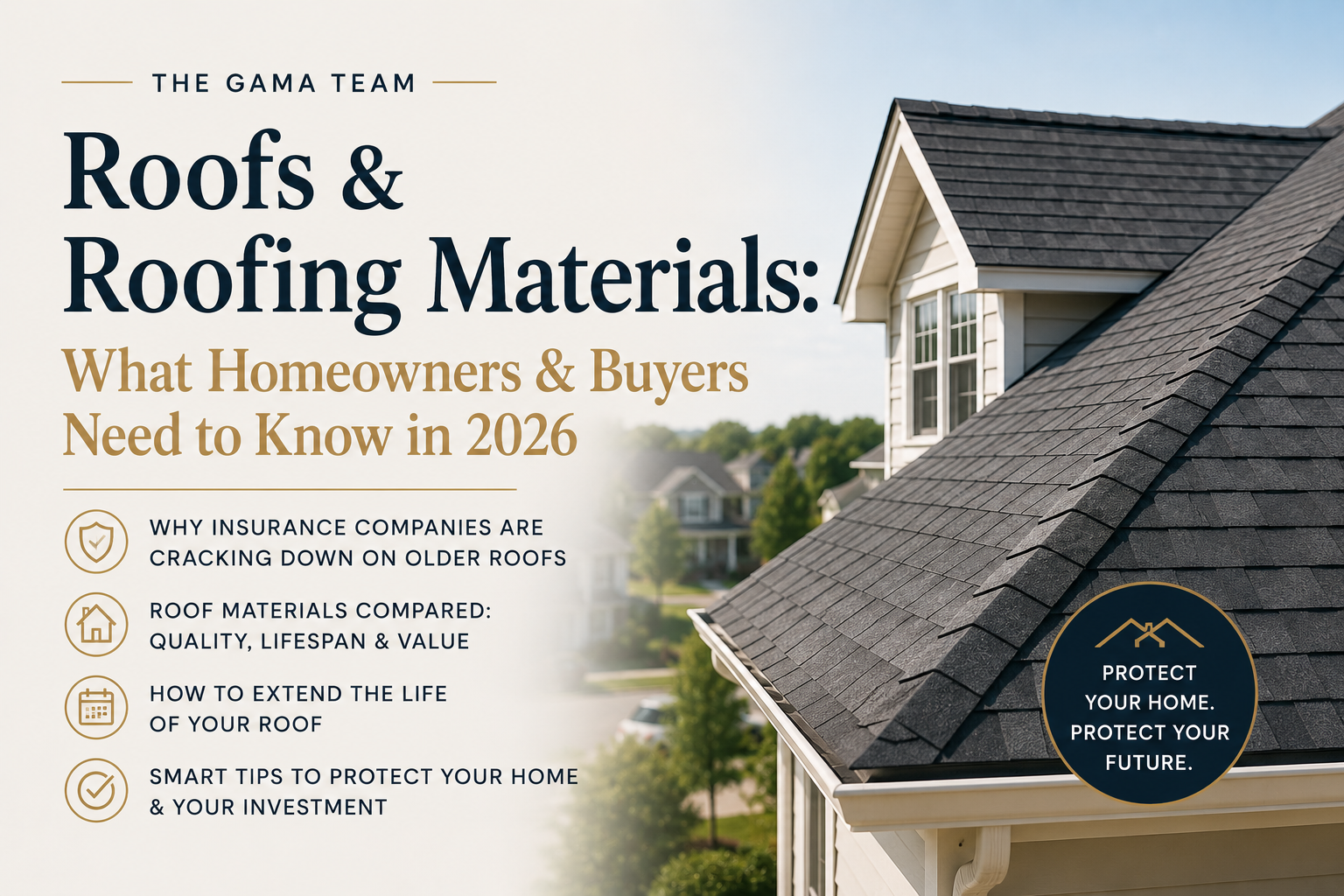
Roof Age, Homeowners Insurance, and Your New Jersey Closing: What Every Buyer and Seller Needs to Understand
Why are homeowners insurance companies suddenly so strict about roof age in New Jersey? Rising storm losses and reinsurance costs have pushed most carriers to set firm age cutoffs by roofing material — often 15–20 years for standard asphalt shingles — after which they shift a policy to depreciated (ACV) coverage, decline to write a new policy at all, or non-renew an existing one, regardless of whether the roof is actually leaking.
If you're buying, selling, or already own a home in Westfield, Cranford, Mountainside, Scotch Plains, Summit, New Providence, Basking Ridge, Maplewood, or Montclair, there's a good chance you've either already run into this directly or you're about to. We've seen it happen at the closing table more times in the past two years than in the previous decade combined: a buyer's mortgage lender requires a homeowners insurance binder before closing, the buyer's insurance agent runs the address, and the carrier comes back with a flat "no" — not because there's a leak, not because a home inspector flagged anything structural, but because the roof is 17 years old and that alone is now enough to trigger a decline, an ACV-only offer, or a demand for a roof certification before the carrier will even quote the policy.
This is a genuinely new dynamic in the New Jersey real estate process, and it catches a lot of buyers and sellers off guard, because it has almost nothing to do with whether the roof is actually functioning fine. A perfectly weathertight, non-leaking roof that's simply reached a certain age on a carrier's internal underwriting chart can now be enough to complicate — or, in a worst case, threaten — a closing that has nothing else wrong with it. This guide walks through exactly why this is happening, what age thresholds actually matter and for which roofing materials, how New Jersey law protects you and where it doesn't, what buyers and sellers should each be doing differently because of this shift, a detailed look at roofing material types and how insurers treat each one differently, and a practical, research-backed set of maintenance steps that can genuinely extend a roof's useful life and keep you ahead of this issue rather than discovering it during attorney review.
Why Insurers Have Gotten So Aggressive About Roof Age
This isn't a New Jersey-specific overreaction, and it isn't arbitrary — it's a direct, and fairly recent, response to claims data. Roughly 39% of all homeowners insurance claims nationally are roof-related, and insurers' own loss data shows a sharp increase in wind, hail, and water-intrusion claims on asphalt shingle roofs specifically once they pass the 12-to-15-year mark, as the shingles' waterproofing layer degrades, granules wear away, and sealant strips lose adhesion. Combine that claims trend with several years of elevated reinsurance costs (the insurance that insurance companies themselves buy to cover catastrophic losses) and a broader hardening of the property insurance market nationally, and the result is that carriers have moved from treating roof age as one minor underwriting factor among many to treating it as one of the single most consequential variables in whether they'll write — or keep — a policy at all.
The practical shift shows up in three distinct ways, and it's worth understanding all three separately, because they trigger at different points and require different responses.
New-business underwriting cutoffs are the age past which a carrier won't write a brand-new policy at all — this is the one that shows up most disruptively during a home purchase, when a buyer's insurance shopping runs into a wall because the roof on the home they're buying exceeds the carrier's threshold.
ACV (actual cash value) conversion triggers are an earlier, less dramatic threshold — often five to ten years younger than the outright new-business cutoff — past which a carrier will still write or renew the policy, but only with roof coverage settled at depreciated value rather than full replacement cost if a covered loss occurs, which we'll walk through with real numbers below.
Non-renewal risk applies to policies already in force — a homeowner who's had the same policy for years can still receive a non-renewal notice specifically citing roof age once the roof crosses a carrier's internal risk threshold, even with no claims history at all.
The Age Thresholds That Actually Matter, By Material
This is the part that surprises people most: the age at which each of these three triggers kicks in varies enormously depending on what the roof is actually made of, not just how many years have passed. A 20-year-old asphalt shingle roof and a 20-year-old metal or slate roof are treated completely differently by the same carrier.
Asphalt Shingles (the Roofing Material on the Large Majority of NJ Homes)
Standard three-tab asphalt shingles — the most basic, lowest-cost option — tend to draw the strictest scrutiny: many carriers begin ACV conversion consideration around 10–12 years, decline new business around 15 years, and treat anything approaching 18–20 years as a serious non-renewal risk. Architectural (also called dimensional or laminated) asphalt shingles, which are heavier, more wind-resistant, and generally better-built, get meaningfully more room: ACV triggers often don't kick in until 15 years, new-business cutoffs often extend to 20 years, and non-renewal risk typically doesn't become serious until 25–30 years. Because architectural shingles have become the dominant asphalt product installed over roughly the last two decades — representing the large majority of new residential installations — a meaningful share of the roofs on homes currently being bought and sold across our towns fall into this architectural category rather than the older three-tab standard, which matters directly for how a given roof will actually be underwritten.
Metal, Slate, Tile, and Wood Shake
Metal roofing — standing seam or metal shingle — is treated far more leniently, with non-renewal concern typically not arising until somewhere around the 40-year mark, reflecting both metal's genuinely longer service life and its stronger wind and impact performance. Natural slate, which is common on a number of the older, architecturally significant homes throughout Westfield, Montclair, and other established Central New Jersey towns, is treated more leniently still — a well-maintained slate roof can be 80 to 100 years old before it draws serious underwriting concern, since correctly installed slate is one of the longest-lived roofing materials available and insurers' own loss data reflects that. Clay and concrete tile fall somewhere in between, generally following a similar multi-decade timeline to metal rather than the compressed asphalt timeline. Wood shake and shingle roofs, by contrast, tend to draw their own distinct scrutiny — not primarily for age, but for fire risk, particularly in wildfire-exposed regions, which is less of a factor in Central New Jersey but can still affect availability and pricing with certain carriers.
Flat and Low-Slope Roofing
Flat and low-slope roofing systems — EPDM rubber membrane, TPO, and similar materials, common on additions, garages, and certain architectural styles — tend to be underwritten on a timeline similar to standard asphalt shingles, with cutoffs commonly in the 12–15 year range for new business, reflecting the generally shorter, more maintenance-intensive service life of membrane roofing compared to pitched shingle or metal systems.
ACV vs. RCV: The Distinction That Determines How Much You Actually Get Paid
This is, in our experience, the single least understood piece of this entire issue, and it's worth walking through with real numbers, because the gap between the two isn't a minor technicality — it can be tens of thousands of dollars.
Replacement Cost Value (RCV) coverage pays what it actually costs to replace your roof with new materials, at current prices, regardless of how old the damaged roof was — this is the coverage type most homeowners assume they have, and the type most policies provide automatically when a roof is newer.
Actual Cash Value (ACV) coverage pays only the roof's depreciated value at the time of the loss — replacement cost minus accumulated depreciation based on the roof's age relative to its expected useful life. This is the coverage type carriers increasingly shift older roofs to, either through a specific policy endorsement (often titled something like "Roof Surfacing — Actual Cash Value Loss Settlement," which can appear on a renewal declarations page without much fanfare) or as a condition of writing the policy in the first place.
Working Through the Math
Here's a concrete illustration. Say a standard asphalt shingle roof cost $18,000 to install new and has a 30-year expected useful life. If that roof is 15 years old — halfway through its expected life — at the time of a covered wind or hail loss, straight-line depreciation would value it at roughly 50% of replacement cost, or about $9,000. Under an ACV policy, that's what the claim pays, minus your deductible — leaving you with perhaps $8,000 after a $1,000 deductible, even though replacing the roof still costs the full $18,000 at today's prices. That's a $10,000 gap between what the insurance company pays and what you actually need to spend, out of pocket, to get a new roof.
Under an RCV policy, the same claim on the same roof would pay closer to the full $18,000 (minus deductible), because replacement cost coverage doesn't subtract depreciation for the aging of the roof itself. This is exactly why the ACV-versus-RCV distinction matters so much more than most homeowners realize when they're simply told their premium is going up, or staying flat, at renewal — a flat or modestly higher premium with a quiet shift to ACV coverage can represent a dramatically worse deal than a homeowner recognizes until the moment they actually need to file a claim.
How This Actually Plays Out at a New Jersey Closing
This is the part most directly relevant to anyone buying or selling right now, and it's worth walking through the realistic timeline, because the roof-insurance issue tends to surface at a specific, predictable, and often inconvenient point in the process.
The Typical Sequence
A buyer goes under contract on a home. Their mortgage lender, as a standard condition of closing, requires proof of an active homeowners insurance policy — specifically, a signed binder — before the loan can fund. The buyer or their loan officer connects them with an insurance agent, who runs the property's address and basic details through the carriers they represent. If the roof is beyond a given carrier's new-business age cutoff for its material type, the quote comes back declined, or comes back only with an ACV-only structure and, frequently, a materially higher premium than the buyer expected based on comparable listings or their prior home. Because this typically happens well after the home inspection period has already closed and the purchase contract is already fully executed, it can feel like a last-minute surprise even though, in reality, the roof's age was knowable — and often was actually disclosed in some form — from the very beginning of the transaction.
Why This Isn't (Usually) a Home Inspection Issue
This is a genuinely important distinction. A home inspector's job is to assess a roof's current condition and function — evidence of leaks, damaged or missing shingles, flashing problems, structural concerns. A roof can pass a home inspection cleanly, with no functional issues identified at all, and still be old enough, by chronological age alone, to trigger an insurance decline or an ACV-only offer. This is precisely the scenario the person asking about this topic is describing, and it's become common enough that we now specifically flag roof age as its own separate consideration, distinct from roof condition, for every buyer we work with — because a clean inspection report is no longer, on its own, a guarantee that insurance won't become an issue.
What Options a Buyer Actually Has at This Point
If insurance becomes a roadblock mid-transaction, buyers generally have several paths, and which one makes sense depends heavily on timing, the specific carrier's requirements, and how much flexibility remains in the contract.
Get a professional roof certification. Many carriers that decline based on chronological age alone will reconsider if a licensed roofer provides a written certification documenting the roof's actual remaining useful life, current condition, and any recent repairs or partial replacement — this is sometimes bundled with, or similar to, what's called a four-point inspection (covering roof, electrical, plumbing, and HVAC systems), a relatively inexpensive report (commonly in the $75–$200 range) that can be the difference between an outright decline and an accepted policy.
Shop more broadly, through an independent agent. A captive agent representing a single carrier can only offer that carrier's underwriting rules. An independent agent who can quote across five or more carriers has a meaningfully better chance of finding one whose specific age threshold the roof still falls under, since these cutoffs genuinely vary by carrier, not just by material and age.
Negotiate directly with the seller. Depending on the contract stage and the specific terms already negotiated, a buyer facing a genuine insurance roadblock can sometimes negotiate a credit at closing, a price adjustment, or, in some cases, ask the seller to complete a roof replacement before closing — though how much leverage exists here depends heavily on how far along the transaction already is and what the original contract terms allow.
Consider the New Jersey FAIR Plan as a last resort. The New Jersey Insurance Underwriting Association, commonly known as the FAIR Plan, exists specifically for property owners who can't obtain coverage through the standard admitted insurance market — including, commonly, because of roof age or condition. It's explicitly meant to be a last-resort option: it provides basic property coverage but does not include liability or theft protection as standard (theft coverage is available only as a separate optional endorsement), and it's generally priced above what a standard-market policy would cost for a comparable, newer-roofed home. It's a genuine safety net, but not a first choice, and buyers should treat it as a backstop to keep a closing moving rather than a long-term insurance solution.
Replace the roof. For a buyer with enough flexibility in their timeline and budget — or a seller willing to handle it before listing, which we'll cover separately below — replacing the roof resolves the underlying issue directly, restores full RCV eligibility across essentially every carrier, and, particularly if paired with impact-resistant materials or a formal wind-mitigation certification (covered below), can actually reduce the ongoing premium relative to what an older roof, even a functioning one, was costing.
New Jersey's Specific Legal Protections — and Their Limits
New Jersey does provide homeowners with some real, specific protections around how and when a carrier can act on roof age, and it's worth understanding both what those protections cover and where they stop.
Under New Jersey insurance regulation, a carrier that intends not to renew a homeowners policy must provide written notice at least 30 days before the renewal date, and that notice must state a specific reason — not generic boilerplate language. Mid-term cancellation of an existing policy citing roof age alone is generally not permitted; carriers can only cancel a policy mid-term for reasons like non-payment, material misrepresentation on the application, fraud, or a substantial change in the risk itself. This means a carrier generally cannot simply cancel your existing policy the moment your roof crosses an internal age threshold — but it absolutely can decline to renew that policy at your next renewal date, or decline to write a new policy for a buyer purchasing a home with an aging roof, and neither of those situations is prohibited by this notice requirement.
If you believe a carrier has acted outside these rules — an improperly short notice period, a vague or unsupported non-renewal reason, or any other apparent violation — the New Jersey Department of Banking and Insurance accepts consumer complaints directly, and pursuing that channel is a legitimate, and sometimes effective, option when something about a non-renewal or decline genuinely doesn't seem to follow the rules.
Separately, New Jersey's Home Improvement Contractor Act requires any contractor performing residential work — including roof replacement — to provide a written contract listing their New Jersey HIC license number, along with a three-day right to cancel. This is worth knowing regardless of the insurance angle, simply as a baseline consumer protection any time you're hiring a roofer, whether the work is insurance-driven or a straightforward voluntary replacement.
What Sellers Should Actually Do About This Before Listing
If you're planning to sell a home with a roof that's approaching, or has already crossed, one of the age thresholds described above, the insurance dynamic covered throughout this guide is worth addressing proactively rather than waiting for it to surface as a problem during someone else's mortgage process.
Get Ahead of It With Documentation
Even a roof with real remaining useful life left in it can trigger an unnecessary insurance roadblock for a buyer if all a carrier has to go on is the property's construction-permit year or a generic age estimate. A professional roof inspection and written certification — the same kind of document a buyer might scramble to obtain mid-transaction — is inexpensive relative to the deal risk it can prevent, and having it ready to hand to a buyer's insurance agent proactively, rather than after a decline has already happened, can keep a transaction moving smoothly instead of stalling during what's often already a tight closing timeline.
Weigh Replacement Against a Closing Credit
For a roof genuinely near the end of its practical life — not just its insurance-underwriting life — replacing it before listing is often the cleaner path: it removes the age issue entirely for whoever buys the home, it can be a genuine selling point in listing marketing, and it avoids the negotiation friction of a buyer discovering an insurance roadblock mid-contract and coming back to renegotiate price or credits under time pressure. For a roof that still has meaningful, well-documented remaining life but is simply old enough on paper to draw underwriting scrutiny, a seller might instead choose to get ahead of the issue with the certification described above, potentially paired with a modest closing credit held in reserve for exactly this kind of insurance-driven negotiation, rather than assuming a full replacement is automatically the right call.
Don't Assume Your Own Current Coverage Reflects What a Buyer Will Be Offered
It's a common and understandable assumption — "I've had insurance on this roof for years without any problem, so a buyer will too" — but it doesn't hold up, because non-renewal protections and ACV grandfathering that may apply to an existing, long-held policy generally do not carry over to a brand-new policy a buyer has to apply for from scratch. A seller's own current, possibly years-old policy terms are not a reliable predictor of what a new buyer's insurance shopping will actually turn up.
Roofing Materials, Explained: What You're Actually Buying (or Inheriting)
Understanding the roofing material landscape in real depth helps with two separate decisions: evaluating a roof you're considering buying a home with, and choosing a material if you're the one replacing a roof, whether as a seller preparing to list or a homeowner planning ahead.
Three-Tab Asphalt Shingles: The Budget Baseline
Three-tab shingles are the most basic, flattest-profile, and least expensive asphalt shingle product on the market, typically running roughly $90–$100 per square (a "square" covers 100 square feet) in material cost, with a real-world New Jersey lifespan generally in the 15–20 year range and a wind rating around 60–70 mph. They carry either no impact rating or the lowest available classification. Given how compressed their insurance-underwriting timeline is — often drawing ACV scrutiny within a decade and outright decline consideration by 15 years — three-tab shingles have become an increasingly hard sell for a primary residence roof replacement in a market where insurance underwriting has gotten this strict, even though they remain a reasonable, low-cost option for detached structures like sheds or garages where insurance underwriting typically isn't a factor at all.
Architectural (Dimensional) Asphalt Shingles: The Current Standard
Architectural, or dimensional, shingles are heavier, multi-layered, and textured to mimic the look of wood shake or slate at a fraction of the cost, typically running $150–$200 per square in material cost, with a real-world lifespan of 20–30 years and wind ratings commonly in the 110–130 mph range. This category now represents the large majority of new asphalt roofing installations nationally, and it's what you'll find on most recently re-roofed homes across our towns. Critically, this is also the material category that draws meaningfully more insurance-underwriting leniency than three-tab shingles at an equivalent chronological age, which is one of several reasons architectural shingles have become the practical default choice for most homeowners weighing options today.
Premium and Luxury Asphalt Shingles
At the top of the asphalt category, premium or "luxury" shingle lines — thicker, more dimensional, often designed to closely mimic natural slate or shake — run roughly $250–$400 per square, with manufacturer-rated lifespans of 30–50 years, wind ratings of 130+ mph, and frequently a lifetime manufacturer warranty. These products increasingly qualify for Class 3 or Class 4 impact ratings (covered below), which can translate directly into insurance premium discounts on top of their extended underwriting runway.
Impact-Resistant (Class 4) Shingles
Class 4 is the highest impact-resistance rating in the UL 2218 testing standard used industry-wide, measuring a shingle's ability to withstand simulated hail impact without cracking or granule loss. Class 4 shingles — available in both architectural and premium asphalt lines, as well as many synthetic and composite products — typically cost 15–25% more than a standard architectural shingle of similar quality, but a growing number of insurance carriers offer specific premium discounts, in some markets in the 10–30% range, for homes with a documented Class 4 roof, meaning the upfront premium can be substantially offset, sometimes fully, over five to ten years of reduced premiums.
Synthetic and Composite Shingles
Synthetic and composite roofing products — often engineered to closely replicate the appearance of natural slate, shake, or tile while weighing considerably less and costing meaningfully less than the natural material — have become an increasingly popular middle path for homeowners who want the traditional look without the cost, weight, or maintenance demands of true slate or shake. These products commonly carry 30–50 year lifespans, Class 4 impact ratings in most product lines, and strong wind ratings, along with the practical advantage of resisting salt-air and moisture-related degradation better than some natural materials in certain conditions.
Metal Roofing
Metal roofing — whether standing-seam panels or metal shingles designed to mimic shingle, shake, or tile profiles — represents a significantly larger upfront investment, commonly $700–$1,000 per square installed for metal shingles and comparable or somewhat higher for standing seam systems, but delivers a genuinely long service life, typically 40–70 years, along with wind ratings frequently exceeding 140 mph. This is precisely the combination of durability and wind performance that earns metal roofing such favorable insurance-underwriting treatment relative to asphalt — a metal roof installed today is realistically a once-in-a-homeownership-lifetime investment for most buyers, with an insurance-underwriting runway measured in decades rather than years.
Clay and Concrete Tile
Tile roofing, more common historically in warmer climates but present on a meaningful number of architecturally distinctive homes in our region as well, offers an exceptionally long service life — commonly cited in the 40–70 year range, with some concrete and clay tile installations well exceeding that — at a material cost generally running $8–$22 per square foot depending on tile type and installation complexity, translating to a considerably higher total project cost than shingle roofing on an equivalent-sized home. Tile's weight is a genuine structural consideration; not every roof structure is engineered to support it without reinforcement, which is worth having specifically evaluated by a structural professional before committing to a tile replacement on an older home not originally built with tile in mind.
Natural Slate
Slate is, by a meaningful margin, the longest-lived common roofing material available, with a well-installed, well-maintained slate roof commonly reaching 75–100+ years of service life — which is exactly why insurance carriers extend such a long underwriting runway to slate roofs relative to asphalt. This matters directly for a number of the older, architecturally significant homes throughout Westfield, Montclair, and other established Central New Jersey towns with genuine original slate roofing still in service. Slate is also, correspondingly, the most expensive common roofing material, generally running $15–$30 per square foot installed, or roughly $30,000–$60,000-plus for a full replacement on an average-sized home — a real consideration for a buyer evaluating an older home where the original slate is reaching the point of needing significant repair or replacement, since slate repair and replacement work also requires a genuinely specialized contractor with real slate-specific experience, not a general roofing crew, given how differently slate is installed and maintained compared to asphalt or metal.
Wood Shake and Shingle
Wood shake and shingle roofing offers a distinctive, traditional aesthetic, with a service life commonly in the 25–30 year range depending on wood species, climate, and maintenance, though it demands more active maintenance than most alternatives to avoid moss, algae, and moisture-related decay. Insurance treatment of wood roofing tends to focus heavily on fire risk considerations, which varies significantly by region — a more significant underwriting factor in wildfire-exposed parts of the country than in Central New Jersey, though it's still worth confirming directly with a specific carrier if you're considering or currently have a wood shake roof.
Flat and Low-Slope Membrane Roofing
EPDM rubber membrane and TPO are the two dominant flat and low-slope roofing systems, commonly found on additions, garages, and certain architectural styles throughout our towns, typically running $4–$8 per square foot installed with a service life generally in the 20–30 year range depending on specific product and installation quality. As noted above, these systems tend to draw an insurance-underwriting timeline closer to standard asphalt shingles than to the longer-lived pitched materials, given their generally shorter, more maintenance-intensive service life.
Algae Streaking, Copper Granules, and Why Your Roof's Discoloration Isn't Necessarily a Problem
One detail worth understanding, because it comes up constantly during home inspections and can cause unnecessary alarm: the dark streaking many asphalt shingle roofs develop over time, especially on the north-facing slope, is typically caused by a specific type of algae (Gloeocapsa magna) rather than dirt, soot, or a sign of shingle failure. This algae feeds on the limestone filler in asphalt shingles and is most visible in humid climates — including the mid-Atlantic — particularly on roofs with less direct sun exposure.
Most major shingle manufacturers now embed algae-resistant technology directly into their products, most commonly in the form of copper or zinc granules blended into the shingle surface, which release ions over time that inhibit algae growth. This is typically marketed under a specific brand name (CertainTeed's StreakFighter technology and various copper-granule product lines from companies like 3M are common examples) and is now standard on the large majority of quality architectural and premium shingle lines, though it's worth confirming specifically if algae staining is a concern in your area or on a specific home, since older roofs, and some lower-cost shingle lines, may not include this technology. Algae staining alone is a cosmetic issue, not a sign of structural or waterproofing failure — but it's a detail worth understanding so it doesn't get conflated, during a home inspection or a buyer's own visual assessment, with actual roof deterioration.
The FORTIFIED Roof Standard and Wind-Mitigation Discounts
Beyond material selection, there's a specific construction and certification standard worth understanding if you're planning a roof replacement with insurance costs in mind: the FORTIFIED Roof designation, developed and administered by the Insurance Institute for Business & Home Safety (IBHS), a research organization funded by the insurance industry itself specifically to study and reduce storm-related property losses.
A FORTIFIED Roof certification requires specific construction practices beyond standard building code — a fully sealed roof deck (taped seams that prevent water intrusion even if shingles are lost), enhanced shingle or fastener attachment specifications, and continuous, reinforced roof-edge metal flashing designed to resist wind uplift at the roof's most vulnerable points. These upgrades typically add roughly $500–$2,500 to a standard roof replacement project, depending on roof size and complexity, but a growing number of carriers offer meaningful premium discounts — in some markets ranging from roughly 5% to 25%, and in certain states considerably higher — specifically for FORTIFIED-certified roofs, making it a genuinely worthwhile conversation to have with your roofer and your insurance agent together before, not after, a replacement project is finalized, since certification requirements need to be built into the installation itself rather than added afterward.
How to Actually Extend Your Roof's Lifespan
Regardless of which material sits on your roof today, a consistent, research-backed set of maintenance practices can meaningfully extend its useful life — often by years — and, just as importantly for the purposes of this guide, can produce exactly the kind of documentation that helps during an insurance underwriting conversation or a certification request.
Attic Ventilation and Insulation
Proper attic ventilation is one of the single most important, and most commonly overlooked, factors in roof longevity. Without adequate airflow, heat and moisture build up beneath the roof deck — in summer, trapped heat accelerates shingle aging from underneath, well beyond what sun exposure alone would cause, and in winter, escaping heat from an inadequately insulated attic can melt snow on the roof surface, which then refreezes at the colder eaves, creating ice dams that force water backward under shingles. A properly balanced ventilation system — intake vents at the eaves paired with exhaust ventilation at or near the ridge — combined with adequate attic insulation to keep escaping heat to a minimum, addresses both problems simultaneously and is genuinely one of the highest-value maintenance investments a homeowner can make relative to its cost.
Gutter Maintenance
Clogged gutters force water to back up under roof edges and shingles rather than draining away as designed, accelerating rot at the fascia and roof edge and contributing directly to ice dam formation in winter. Cleaning gutters at least twice a year — commonly recommended in spring and fall, and more often if the property has significant nearby tree cover — along with confirming downspouts drain freely and gutters aren't sagging or pulling away from the fascia, is a low-cost, high-value maintenance task that directly protects roof edges from a genuinely common and preventable source of premature deterioration.
Moss, Algae, and Vegetation Management
Beyond the cosmetic algae streaking discussed above, actual moss growth is a more serious concern — moss retains moisture directly against the shingle surface, accelerating granule loss and, over time, can work its way under shingle edges, compromising the roof's water-shedding capability. Prompt moss removal (using appropriate, shingle-safe methods rather than aggressive pressure washing, which can itself damage shingle granules) and trimming overhanging tree branches to reduce both moss-promoting shade and the risk of storm-related limb damage are both genuinely preventive, relatively low-cost maintenance steps.
Regular Professional Inspections
A twice-yearly professional inspection rhythm — commonly recommended in spring and fall, with an additional inspection after any significant storm event — catches small, easily and cheaply repaired issues (a lifted shingle tab, a small area of failed flashing sealant, a minor debris accumulation) before they progress into the kind of larger, more expensive problems that can also trigger insurance claims and, ironically, contribute to exactly the claims-history and condition concerns that make future insurance underwriting more difficult. This is also, not incidentally, exactly the kind of documented inspection history that supports a roof certification request if you ever need one for insurance purposes, whether you're a current homeowner facing a renewal question or a seller preparing to list.
Prompt Repairs Rather Than Deferred Maintenance
Small roofing issues reliably become larger, more expensive ones if left unaddressed — a single damaged or missing shingle exposes the underlayment beneath it to direct weather exposure, and what would have been a simple, inexpensive spot repair can become a much larger underlayment or decking repair within a single storm season. Addressing issues promptly, ideally identified through the regular inspection rhythm described above rather than discovered only when an active leak appears inside the home, is consistently the single most cost-effective roof-maintenance principle across every material type covered in this guide.
Leave the Actual Work to Licensed Professionals
Roof work carries genuine fall-risk safety concerns, and DIY roof repairs — beyond very basic, ground-level gutter cleaning — carry real risk both to the person doing the work and, from a documentation standpoint, to any future insurance or resale conversation, since professional, licensed repair work (with the invoice and licensing documentation New Jersey's Home Improvement Contractor Act requires) carries far more weight with an insurance carrier or a future buyer's inspector than undocumented homeowner repairs.
Recognizing the Signs a Roof Is Actually Nearing the End of Its Useful Life
Separate from chronological age alone, several visible signs suggest a roof's functional lifespan — not just its insurance-underwriting age — is genuinely running short, and these are worth understanding whether you're evaluating a home to buy or assessing your own roof's timeline.
Granule loss, visible as bald or thinning patches on shingles, or as a heavy accumulation of granules in gutters and downspouts, indicates the protective, UV-resistant surface layer has significantly worn away, accelerating the underlying asphalt's degradation.
Curling or cupping shingle edges — either edges turning upward (cupping) or the shingle surface losing flatness across its middle (clawing) — signal the shingle has lost flexibility and is more vulnerable to wind uplift and water infiltration at the compromised edges.
Missing or visibly damaged shingles, obviously, indicate direct exposure of the underlayment beneath, and, if left unaddressed, a rapidly accelerating deterioration timeline for that specific area.
Visible daylight or water stains in the attic, particularly around roof penetrations like chimneys, vent pipes, and skylights, indicate active water intrusion, which should be addressed immediately rather than monitored, given how quickly water damage can spread to structural framing and insulation.
Interior ceiling stains are a later-stage sign than attic staining — by the time water intrusion is visible on a finished ceiling, it's generally already progressed through the attic space and insulation, meaning both the roofing issue and likely some degree of secondary interior damage need addressing.
A noticeable increase in energy bills, particularly in summer, can indicate a ventilation or insulation issue connected to roof performance, even absent any visible leak — worth investigating alongside, not instead of, a direct roof inspection.
What Roof Replacement Actually Costs in Central New Jersey Right Now
Pulling from current New Jersey-specific contractor and market data, here's a realistic range of what full roof replacement runs by material, for a typical single-family home in our market area, along with the general lifespan each material delivers under normal Central New Jersey conditions.
Three-tab asphalt shingles run roughly $7,000–$10,000 for an average-sized home, with a realistic 15–20 year New Jersey lifespan. Architectural shingles, the current standard for most replacements, run roughly $9,000–$13,000 for a comparable home (with some larger or more complex Essex County-area homes running $12,000–$18,000), delivering 25–30 years of service life. Flat or low-slope membrane roofing on additions or garages runs roughly $8,000–$16,000 depending on size and material, lasting 20–30 years. Standing-seam metal roofing runs considerably higher, roughly $20,000–$34,000 for a full residential project, but delivers 40–70 years of service. Clay or concrete tile runs roughly $16,000–$44,000 depending on tile type and project complexity, with a 40–70-plus year lifespan. Natural slate, the longest-lived and most expensive common option, runs roughly $30,000–$60,000 or more, delivering 75–100-plus years of service under proper maintenance. Labor rates across the region commonly run $60–$95 per hour, with municipal permit costs typically in the $250–$500 range — both worth confirming directly with your specific town and contractor, since permit requirements and fees are set locally.
A Worked Scenario: A Buyer Relocating to Westfield Runs Into This Mid-Contract
Consider a family relocating from Brooklyn, under contract on a Westfield colonial with a roof that, per the seller's disclosure and the home inspection report, is approximately 19 years old — architectural shingles, no active leaks, no deficiencies noted in the inspection report. Their lender requires a signed insurance binder ten days before closing. Their insurance agent runs the address through their primary carrier, which declines to write a new policy on any roof over 18 years old regardless of condition.
Rather than treating this as a transaction-ending problem, the family's agent (working alongside their insurance agent) pursues two paths simultaneously. First, they request a professional roof certification from a licensed roofer, documenting the shingle's actual remaining useful life and confirming no repair needs — this alone is enough for a second carrier, with a 20-year cutoff for architectural shingles paired with a satisfactory certification, to issue a policy, though on an ACV rather than RCV basis given the roof's age. Second, because the certification and the ACV-only terms are now documented specifics rather than a vague concern, the family's attorney raises a modest closing credit in ongoing attorney review correspondence with the seller's attorney, reflecting the real financial exposure the ACV structure represents relative to what a newer-roofed comparable home's buyer would face — not framed as a renegotiation of the entire deal, but as a specific, documented, insurance-driven cost shift. The closing proceeds on schedule, with the family entering ownership fully aware of their roof's insurance status and with a modest credit in hand to begin setting aside toward an eventual replacement, rather than being surprised by either the insurance terms or the underlying cost math after the fact.
A Worked Scenario: A Cranford Seller Weighs Replacement Before Listing
A seller in Cranford is preparing to list a home with an architectural shingle roof installed 17 years ago — within normal service life, with no known leaks, but old enough to be approaching several carriers' new-business cutoffs for that material. Rather than waiting to discover this dynamic through a buyer's mid-contract insurance shopping, the seller's agent recommends a professional roof inspection and certification before listing, at a cost of a few hundred dollars, specifically so the documentation is ready to hand to any buyer's insurance agent proactively.
The inspection confirms genuine remaining useful life with no repair needs, and the seller chooses not to replace the roof outright, instead listing with the certification available and disclosed, along with a modest allowance built into their pricing strategy in case a buyer's specific insurance situation still requires a credit conversation. This approach — documentation and transparency rather than either an unnecessary full replacement or an undisclosed risk — keeps the seller's options open, avoids an unnecessary five-figure expense on a roof with real remaining life, and meaningfully reduces the odds of a late-stage insurance surprise derailing or delaying the eventual sale.
How Roof Age Interacts With Your Mortgage, Separate From Insurance
Insurance underwriting isn't the only place roof age shows up during a New Jersey purchase — it can also surface directly through the mortgage and appraisal process itself, on a somewhat different timeline and for somewhat different reasons.
Appraisal and Loan-Type-Specific Requirements
Conventional mortgage appraisals generally focus on current condition rather than chronological age alone, similar to a home inspection — an appraiser noting a functioning, non-deteriorated roof typically won't flag it regardless of age. Government-backed loan programs, however, can apply stricter standards: FHA and VA appraisals in particular have historically scrutinized roof condition more closely, and an appraiser working under either program who identifies visible deterioration, or a roof clearly nearing the end of its functional life, can require repair or replacement as a condition of loan approval — a requirement entirely separate from, and sometimes arriving on a different timeline than, any insurance-driven roof issue. A buyer using FHA or VA financing on a home with an older roof should expect this as a genuine possibility worth planning for from the outset, not just an insurance-side risk.
Why the Insurance and Lending Timelines Don't Always Line Up
Because the insurance binder requirement and the appraisal process typically happen on separate, sometimes non-overlapping timelines during a transaction, it's entirely possible for a roof to pass appraisal review cleanly while still triggering an insurance decline, or vice versa in less common cases. This is exactly why we recommend buyers raise roof age as its own explicit topic with both their lender and their insurance agent early in the process, rather than assuming that clearing one review means the other is automatically resolved.
Understanding Roofing Warranties: Three Different Things Often Confused as One
Roofing warranties are a genuinely confusing area, partly because the term covers several distinct types of coverage that protect against different things, on different timelines, from different parties — and understanding the difference matters both when evaluating a home's existing roof and when planning a replacement of your own.
Manufacturer Material Warranties
This warranty covers defects in the shingle or roofing material itself — not installation quality, and generally not storm or impact damage. Standard architectural shingle lines commonly carry 30-year material warranties; premium and luxury lines frequently carry lifetime material warranties (typically defined as the original homeowner's ownership period, with a specified, shorter transferable term for subsequent owners). It's worth understanding that most material warranties are prorated after an initial full-coverage period — meaning a claim made in year 20 of a 30-year warranty may be paid at a fraction of full replacement cost, similar in concept to the insurance ACV depreciation discussed earlier in this guide, just administered by the manufacturer rather than an insurer.
Contractor Workmanship Warranties
This separate warranty, provided by the installing contractor rather than the shingle manufacturer, covers installation errors — improper flashing, inadequate fastening, and similar issues stemming from how the roof was actually installed rather than a defect in the materials themselves. Workmanship warranty terms vary enormously by contractor, commonly ranging from just a year or two on the low end to 10, 20, or even lifetime terms from established, reputable roofing companies — and this variation is exactly why the specific contractor's reputation, licensing (confirm their New Jersey HIC license number directly), and workmanship warranty terms deserve real scrutiny, separate from whatever material warranty comes with the shingle brand itself.
Manufacturer-Backed "System" Warranties
Some manufacturers offer an enhanced, longer-term warranty combining both material and limited workmanship coverage into a single package — but only when every component of the roofing system (underlayment, ventilation products, starter strips, ridge cap, and the shingles themselves) comes from that same manufacturer and the installing contractor holds that manufacturer's specific certification. These system warranties are generally the strongest protection available, but they only apply when the entire installation genuinely meets the manufacturer's certified-system requirements — worth confirming explicitly with your contractor before assuming a "lifetime warranty" claim on a quote actually means the strongest available coverage tier.
Warranty Transferability When You Sell
If you're selling a home with a relatively recent roof replacement, confirm the transferability terms of whatever warranties are in place — many material and system warranties transfer to a new owner if formally registered within a specific window after the sale (commonly 30–60 days), which can be a genuine, documentable selling point worth highlighting in your listing, but only if you actually complete the transfer paperwork rather than assuming it happens automatically at closing.
Solar Panels and Roof Replacement Timing
An increasingly common wrinkle, particularly relevant for a segment of homes across our towns: roofs with rooftop solar panel systems already installed, which adds real complexity to both the insurance-age conversation and any eventual replacement decision.
If you're buying a home with solar panels on a roof that's approaching the age thresholds discussed throughout this guide, it's worth understanding upfront that removing and reinstalling an existing solar array to accommodate a full roof replacement is a genuinely significant added cost and logistical step — commonly requiring coordination between the roofing contractor and the original solar installer (or a qualified alternative), and adding real time to the project timeline beyond a standard reroof. This is worth factoring into both your insurance conversation (since a roof with solar panels can complicate a certification or inspection in its own right) and your longer-term ownership planning, ideally well before the roof actually needs replacing rather than as an emergency discovery. If you're a seller with an existing solar array, having documentation ready on the panel system's own age, warranty status, and the original installer's roof-removal-and-reinstallation policies can meaningfully smooth this exact conversation for a buyer evaluating your home.
Questions Worth Asking Your Roofer and Your Insurance Agent, Together
Because roof material choice, certification, and insurance underwriting are now so directly connected, it's worth having a roofer and an insurance agent — ideally in the same conversation, or at least each aware of the other's input — address a specific set of questions before any replacement decision or listing strategy is finalized: what specific material and product line is being proposed, and what impact rating (Class 3 or Class 4) does it carry; does the proposed installation meet, or can it reasonably be upgraded to meet, FORTIFIED Roof or comparable wind-mitigation certification standards, and what would that add to project cost; what specific insurance premium impact, if any, can the agent confirm in writing for the proposed material and certification level, rather than a general estimate; and what documentation — permit, final inspection, contractor invoice with HIC license number, manufacturer warranty registration, and any certification paperwork — will be provided at project completion for both the homeowner's own records and any future buyer's insurance conversation.
What This Looks Like Across the Towns We Serve
Housing stock age and architectural style vary meaningfully across Westfield, Cranford, Mountainside, Scotch Plains, Summit, New Providence, Basking Ridge, Maplewood, and Montclair, and that variation directly affects how often the roof-insurance dynamic covered in this guide actually comes up in a given transaction — purely as a function of when homes in a given area were typically built and re-roofed, not as any characterization of the towns themselves.
Towns with a larger concentration of homes built in the early-to-mid twentieth century — including established neighborhoods throughout Westfield, Montclair, Maplewood, and South Orange — are more likely to include original or early-generation slate roofing on at least some homes, along with a broader mix of asphalt reroofs completed at various points over the decades since. This means the roof-age conversation in these towns often splits into two very different tracks: a well-maintained original slate roof, which, as covered above, draws a genuinely long insurance-underwriting runway, versus a asphalt reroof completed at some point in the home's history, which follows the more compressed asphalt timeline regardless of the home's overall age. Confirming which situation actually applies to a specific home — not assuming based on the home's construction year alone — is essential, since a home built in 1925 could have either an aging original slate roof or a five-year-old architectural shingle reroof, with two entirely different insurance profiles.
Towns and neighborhoods with more mid-century and later construction, including significant portions of Scotch Plains, Cranford, Summit, New Providence, and Basking Ridge, more commonly feature asphalt shingle roofing as the original or long-standing material, making the specific asphalt age thresholds discussed throughout this guide especially directly relevant, since there's less likelihood of an original slate or tile roof changing the underwriting picture entirely.
Across every one of these towns, the practical research step is the same regardless of the town's general housing-stock era: confirm the actual roofing material and actual installation or last-replacement date for a specific home you're considering, directly through the seller's disclosure, a professional inspection, or (when available) permit records with the municipality, rather than estimating based on the home's general age or the town's typical housing stock.
A Glossary of Terms Used in This Guide
ACV (Actual Cash Value) — Insurance coverage that pays a roof's depreciated value at the time of a covered loss, calculated as replacement cost minus accumulated depreciation based on the roof's age relative to its expected useful life.
RCV (Replacement Cost Value) — Insurance coverage that pays the full current cost to replace a damaged roof, without subtracting depreciation for the roof's age.
New-business underwriting cutoff — The maximum roof age (by material) at which a carrier will still write a brand-new policy for a property.
Non-renewal — A carrier's decision not to continue an existing policy at its next renewal date, distinct from mid-term cancellation, which is far more restricted under New Jersey law.
Four-point inspection — A limited-scope professional inspection covering roof, electrical, plumbing, and HVAC systems, commonly used by insurers to assess older-home risk without a full home inspection.
Roof certification — A licensed roofer's written assessment of a roof's current condition and estimated remaining useful life, often used to support an insurance underwriting decision.
Class 4 impact rating — The highest hail-impact resistance classification under the UL 2218 testing standard, applicable to certain shingle and roofing products.
FORTIFIED Roof — A construction and certification standard developed by the Insurance Institute for Business & Home Safety (IBHS), involving a sealed roof deck, enhanced fastening, and reinforced edge flashing, often tied to insurance premium discounts.
Square (roofing) — A unit of roofing measurement equal to 100 square feet, commonly used in material and labor cost estimates.
NJ FAIR Plan (NJIU A) — The New Jersey Insurance Underwriting Association, a last-resort insurer for properties that cannot obtain coverage through the standard admitted insurance market.
A Few More Practical Notes Before You Sign Anything
A handful of additional, genuinely practical details are worth keeping in mind as you navigate any of the scenarios described throughout this guide.
Get insurance quotes early in your search, not after you're under contract. Nothing prevents a prospective buyer from asking an insurance agent to run a preliminary quote on a specific listing's address and approximate roof age before making an offer at all — this is a small extra step that can surface a potential insurance roadblock while you still have full negotiating flexibility, rather than discovering it after you've already waived contingencies or narrowed your options.
A seller's disclosure form is a starting point, not a guarantee. New Jersey seller disclosure practices vary, and roof age or replacement history isn't always captured with full precision — a seller who doesn't personally recall the exact installation year, or who inherited a home without detailed records, may provide a good-faith estimate rather than a documented fact. Treat disclosed roof age as a starting point for your own inspection and insurance-shopping process, not a substitute for it.
Municipal permit records can help confirm actual replacement dates. Because roof replacement typically requires a municipal building permit in New Jersey, a town's building department records can sometimes independently confirm when a roof was last replaced — a useful cross-check when a seller's disclosed date and a home's apparent condition don't quite seem to match up, or when no clear documentation exists otherwise.
Don't let an insurance-driven roof conversation overshadow the rest of your inspection findings. It's easy, once roof age becomes a live issue, to let it dominate the conversation — but a roof issue is one factor among many in evaluating a home, and it's worth keeping in proportion to the rest of your inspection and negotiation priorities rather than letting it become the sole focus of an otherwise strong transaction.
Frequently Asked Questions
Can an insurance company really refuse to cover a home just because of roof age, even if it's not leaking? Yes. Roof age alone, independent of current condition or a passing home inspection, is now a primary underwriting factor for most carriers, and a chronologically old roof can trigger a decline, an ACV-only offer, or a non-renewal even with no active leaks or reported issues.
What's the practical difference between ACV and RCV roof coverage? RCV pays the full current cost to replace your roof. ACV pays only the roof's depreciated value based on its age relative to its expected lifespan — often thousands of dollars less than what replacement actually costs, with the gap growing larger as the roof ages.
How old is "too old" for insurance in New Jersey? It depends heavily on material. Standard asphalt shingles often draw serious scrutiny by 15–18 years; architectural shingles typically get more room, into the low-to-mid 20s; metal, tile, and slate roofs are treated far more leniently, often not drawing concern until several decades of age.
If my current insurer non-renews me over roof age, do I have any recourse? New Jersey requires at least 30 days' written notice with a specific stated reason for non-renewal, and you can file a complaint with the state Department of Banking and Insurance if you believe a carrier hasn't followed the rules — but a properly issued, properly timed non-renewal based on roof age itself is generally permitted.
What is the New Jersey FAIR Plan, and should I use it? It's a last-resort insurer of properties that can't get coverage through the standard market, including for roof-age reasons. It provides basic property coverage, generally at a higher cost than standard-market insurance, without liability or theft coverage included by default — a genuine option to keep a closing or an existing policy from lapsing, but not typically a first choice.
Do impact-resistant Class 4 shingles actually save money on insurance? Often yes — many carriers offer specific premium discounts for documented Class 4 roofs, and in markets where those discounts are meaningful, the added upfront cost (typically 15–25% over standard architectural shingles) can be offset within roughly five to ten years through reduced premiums, separate from the underlying durability benefit.
Should I replace my roof before listing my home for sale? It depends on the roof's actual remaining useful life versus its chronological age relative to common insurance cutoffs. A roof with genuine remaining life but an age that draws underwriting scrutiny may be better served by a certification and disclosure strategy; a roof genuinely near the end of its functional life is usually better replaced proactively than left for a buyer to discover as a problem mid-contract.
Is dark streaking on my roof a sign it needs to be replaced? Usually not on its own. Dark streaking is most commonly algae growth, a cosmetic issue rather than a structural or waterproofing failure, though it's worth having a professional confirm that during any broader roof assessment, since algae staining and genuine granule loss or shingle deterioration can sometimes appear together.
How much does a roof certification cost, and how long does it take? Costs commonly run in the $75–$200 range for a basic certification or four-point inspection, and most licensed roofers can typically turn one around within a matter of days — fast enough to address a mid-transaction insurance issue if raised promptly, though building it into your timeline proactively, rather than reactively, gives considerably more flexibility.
What's the single highest-value thing I can do to extend my roof's life? Proper attic ventilation paired with adequate insulation addresses more root causes of premature roof deterioration — heat damage from underneath, ice dam formation, moisture buildup — than almost any other single maintenance factor, and it's a relatively modest investment compared to the years of service life it can add.
Buying or Selling and Want to Get Ahead of a Roof-Insurance Issue?
Roof age and insurance underwriting have become genuinely intertwined with the New Jersey home-buying and selling process in a way that simply wasn't true a decade ago, and getting ahead of it — with documentation, the right timing, and a clear understanding of your specific roof's material and age relative to current underwriting standards — is almost always easier and less expensive than addressing it under the time pressure of a closing already in progress.
Whether you're evaluating a home in Westfield, Cranford, Mountainside, Scotch Plains, Summit, New Providence, Basking Ridge, Maplewood, or Montclair with an aging roof, or preparing your own home for sale, Marina Fridman-Rybner and Galina Kaplan of The GAMA Team would welcome the chance to walk through your specific situation and connect you with the right resources before it becomes a closing-week surprise.
Reach out to The GAMA Team at Corcoran Sawyer Smith, 52a Elm Street, Westfield, NJ, or call or text 908-379-0525, or connect through thegamateam.com to talk through your specific home, timeline, and priorities.
Marina Fridman-Rybner & Galina Kaplan The GAMA Team | Corcoran New Jersey Real Estate | Home Sellers | Home Buyers | NYC to NJ Relocation
This article is intended for general informational purposes and reflects our understanding of homeowners insurance underwriting practices, New Jersey insurance regulation, and roofing materials as of August 2026. It is not insurance, legal, or contracting advice, and specific underwriting rules, age thresholds, premium discounts, and regulations vary by carrier and are subject to change; confirm current requirements directly with a licensed insurance agent, the New Jersey Department of Banking and Insurance, and a licensed New Jersey roofing contractor before making decisions based on this guide.
Sources
- NJ Roof Age & Insurance Non-Renewal: 2026 Homeowner Guide — R&E Roofing
- Roof Replacement Cost vs. Actual Cash Value — SageSure
- New Roof Cost NJ: $8,500-$17,000 by County (2026) — R&E Roofing
- New Jersey Department of Banking and Insurance — FAIR Plan
- Types of Roof Shingles: 7 Types Compared by Cost, Life & Wind Rating (2026) — WeatherShield Roofers
- How to Extend the Life of Your Roof: Comprehensive Guide and Checklist — WIN Home Inspection
- Frequently Asked Questions — FORTIFIED, A Program of IBHS
- CertainTeed StreakFighter Algae-Resistant Technology — CertainTeed
- How to File a Roof Insurance Claim in New Jersey — R&E Roofing
Check out this article next