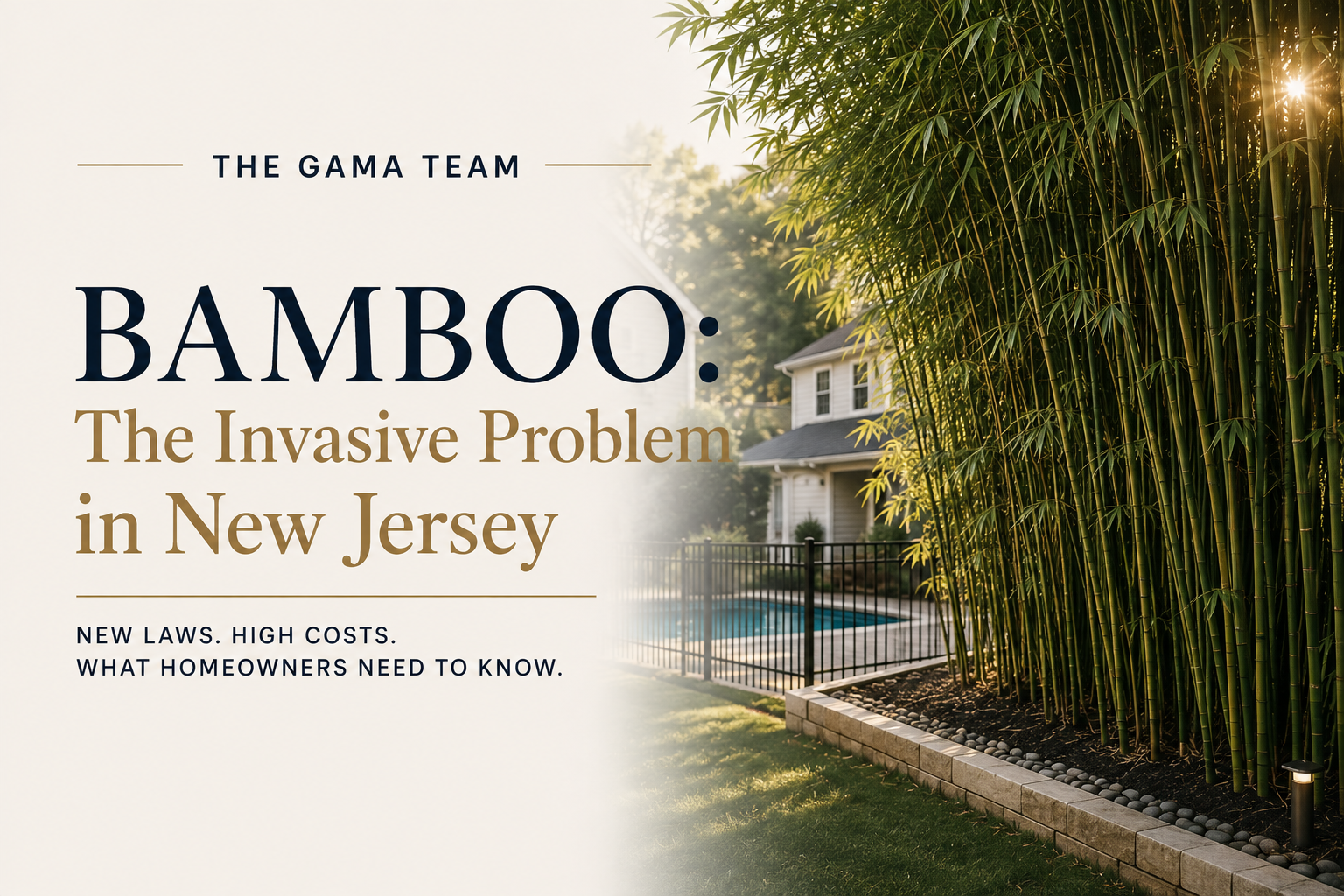
New Jersey's new invasive species law targets running bamboo, and towns across the state are passing their own ordinances. Here's what it means for property value, neighbor disputes, and the real cost of removal — including trees, fences, and pool equipment caught in the way.
Bamboo in New Jersey: The Invasive Species Laws Are Changing, and Removal Can Cost Far More Than You Think
New Jersey is actively tightening its rules on running bamboo. A new statewide law, the Invasive Species Management Act (S1029, P.L.2025, c.290), formally lists running bamboo (Phyllostachys species) as a prohibited invasive species and phases in restrictions on propagating, importing, selling, and distributing it — while dozens of individual towns, from Edison to Mahwah to Manville, have gone further with their own local ordinances that regulate bamboo already growing on private property, often with daily fines and mandatory setbacks from property lines. For homeowners, buyers, and sellers, the practical reality is this: professional bamboo removal in New Jersey typically runs $5,000 to $30,000 or more, and when a mature bamboo grove has grown up against a tree line, wrapped around a fence, or crowded a pool pad, the real total cost — factoring in tree removal, fence relocation, and pool equipment moves — can climb well past that range.
If you're buying a home in Westfield, Cranford, Mountainside, Scotch Plains, Summit, New Providence, Basking Ridge, Maplewood, or Montclair and you spot a dense green wall of cane along a property line, or you're selling a home where a decades-old bamboo planting has quietly spread into a neighbor's yard, this guide walks through what's actually changing in New Jersey law, what it costs to fix, and how to handle it as a real estate matter rather than just a landscaping headache.
Why Bamboo Became a New Jersey Real Estate Problem
Bamboo has been a popular privacy screen in New Jersey backyards for decades. It grows fast, stays green year-round, and creates a dense visual and sound barrier between properties in a state where lots in towns like Westfield, Cranford, and Maplewood are often close together. The problem is that the vast majority of bamboo planted for this purpose in the Northeast is "running bamboo" — genus Phyllostachys — and running bamboo does not behave like a normal shrub or hedge.
Running bamboo spreads through an underground stem system called a rhizome network. Unlike "clumping bamboo" (genus Fargesia and similar), which grows in a slowly expanding clump and stays relatively contained, running bamboo rhizomes travel horizontally underground — often 10, 20, or more feet from the original planting — and send up new culms (the woody canes) wherever they surface. A planting that started as a tidy 10-foot screen along a fence line can, within five to ten years of neglect, become a monoculture that has crossed under a fence, come up through a neighbor's flower bed, pushed against a foundation, or infiltrated a septic field. Because the spread happens underground, it is often invisible until new shoots break the surface, by which point the rhizome system may already be well established on the neighboring property.
This is precisely why bamboo has become a real estate issue and not just a gardening one. It affects boundary lines, it affects what a buyer is inheriting, it affects what a seller may be legally and financially responsible for, and — as of the past two years — it is now the subject of both a new statewide law and a rapidly growing patchwork of local town ordinances.
The New Statewide Law: New Jersey's Invasive Species Management Act (S1029, P.L.2025, c.290)
The single biggest legal development is the New Jersey Invasive Species Management Act, Senate Bill S1029, enacted as P.L.2025, c.290. This is a comprehensive, statewide framework aimed at invasive species generally — plants and organisms whose introduction "causes, or is likely to cause, economic or environmental harm, or harm to human, animal, or plant health" — and running bamboo (Phyllostachys) is specifically named among the prohibited invasive species covered under the act.
Here is what the law actually does, in plain terms:
It creates a formal classification system. The act distinguishes between "non-native species" broadly and a narrower category of "prohibited invasive species" that are judged to pose substantial ecological or economic harm. Running bamboo falls into the latter, more restricted category, alongside roughly thirty other named species.
It phases in restrictions over time rather than imposing them all at once. Beginning 13 months after enactment, propagating or intentionally introducing a prohibited invasive species like running bamboo requires a written conditional-use waiver — meaning you generally cannot deliberately plant or propagate new running bamboo without state authorization. Beginning 49 months after enactment, the restriction expands to selling, distributing, importing, and exporting prohibited invasive species, which will functionally end the retail nursery trade in running bamboo within New Jersey absent a waiver.
It establishes a New Jersey Invasive Species Council. A 19-member council made up of state officials, scientific experts, and public representatives is tasked with advising the Department of Environmental Protection, reviewing and updating the prohibited species list on a recurring basis (generally every three years), and recommending management and control strategies statewide.
It creates real penalties. Civil administrative penalties for violations of the act generally run $1,000 to $2,000 per violation, with civil court penalties reaching up to $2,000 per day of continued violation — and each day a violation continues can be treated as a separate offense, which is how penalty totals can escalate quickly for a property owner who ignores a notice.
What it does NOT do — and this is the detail that matters most for anyone who already has bamboo on their property. The Act does not, on its own, require homeowners to remove bamboo that already exists on their land. It does not automatically fine a homeowner simply because bamboo is present. It does not mandate a home inspection disclosure specifically for bamboo, and it does not create an automatic statewide enforcement mechanism that targets individual residential properties the way a local zoning violation would. The Act's teeth are aimed primarily at the supply chain — nurseries, landscapers, and anyone deliberately propagating or selling the plant going forward — not at retroactively punishing homeowners for bamboo planted years or decades ago.
That distinction matters enormously for real estate transactions. A property with an existing, well-contained bamboo planting is not automatically in violation of state law. But a property where that bamboo has spread uncontrolled onto a neighbor's land, or where a local ordinance imposes its own separate containment and removal requirements, is a different story entirely — and that's where municipal ordinances take over.
The Bigger Day-to-Day Issue: A Growing Patchwork of Local Bamboo Ordinances
While the state framework grabs headlines, the ordinances that actually reach into most residential bamboo situations are municipal — passed town by town, with real variation in what they require. Industry estimates suggest that somewhere between one-fifth and one-quarter of New Jersey municipalities now have some form of bamboo-specific ordinance on the books, and that number has been climbing steadily as more towns respond to constituent complaints about spreading canes.
Mike Cerra, executive director of the New Jersey State League of Municipalities, has described the municipal approach to bamboo regulation as functionally similar to how towns already regulate any overgrown vegetation: "This is no different" than requiring a homeowner to maintain other plantings that could encroach on a neighbor. The difference with bamboo is the scale and speed of the problem once it takes hold, which is why so many towns have chosen to write bamboo-specific rules rather than relying on generic property-maintenance codes.
A sample of how this looks on the ground, town by town:
Edison Township unanimously adopted an ordinance (effective March 2025) that prohibits new bamboo plantings on private property outright. Existing bamboo is grandfathered in and may be kept, but only if it is properly contained — the ordinance specifically requires that bamboo be planted in above-ground containers or vessels and stay at least 10 feet from property lines and public rights-of-way. Violations carry a $100-per-day fine, and if a property owner fails to correct a violation, the municipality is authorized to enter the property, remove the bamboo itself, and place a lien on the property for the full cost of that removal.
Mahwah Township modeled its ordinance on a similar approach used in Lake Como, imposing daily fines of up to $1,000 for planting new running bamboo or for allowing existing bamboo to spread within 10 feet of a road or a neighboring property line.
Manville Borough prohibits new plantings of invasive bamboo species, requires existing bamboo to be either confined or removed, and gives property owners a 30-day abatement window after receiving a violation notice before the borough can step in — again with removal costs recoverable as a lien against the property.
Aberdeen Township folds bamboo into its broader property-maintenance code, requiring a minimum 5-foot buffer from property lines and roadways, mandating mechanical (not chemical) control methods, and allowing the township to recover removal costs from non-compliant owners.
Ho-Ho-Kus Borough bans new bamboo planting entirely and requires that any existing bamboo encroaching on a neighboring property or a public right-of-way be confined or removed, with its own notice-and-enforcement procedure.
Other New Jersey towns that have adopted or are actively developing bamboo-specific rules include South Plainfield, Brick Township, Lacey Township, Palisades Park, Raritan Borough, Toms River, Belmar, Hawthorne, and West Windsor, among others — and that list is not static. Municipal bamboo ordinances have been one of the fastest-growing categories of new local environmental regulation in New Jersey over the past three years, and it would not be surprising to see additional towns across Union, Somerset, Essex, and Morris counties — the heart of GAMA's own coverage area — take up similar measures in the coming budget cycles as more residents file complaints.
The practical takeaway for our coverage towns specifically: as of this writing, Westfield, Cranford, Mountainside, Scotch Plains, Summit, New Providence, Basking Ridge, Maplewood, and Montclair do not all have identical bamboo ordinances on the books, and the details of any local rule can change from one council session to the next. If you are buying or selling a property with bamboo on it — or bordering a neighbor's bamboo — the single most useful step is a direct call to that municipality's zoning or code enforcement office to ask two questions: does the town have a bamboo-specific ordinance, and if so, what does it require for setback, containment, and abatement timelines? This is a five-minute phone call that can save a buyer from an unpleasant post-closing surprise, and it's exactly the kind of due diligence step your agent should be walking through with you before an offer goes in.
Why Every Town's Approach Looks a Little Different
There is no single statewide setback distance or containment standard for bamboo the way there is, for example, for pool fencing height. Some towns require a 5-foot buffer from a property line; others require 10 feet; some ban new plantings but grandfather existing groves; others require full removal regardless of when the bamboo was planted. This patchwork exists because bamboo regulation in New Jersey has developed primarily as a home-rule, municipal-level response to specific local complaints rather than a coordinated statewide standard — the new Invasive Species Management Act sets a supply-side floor (you generally can't propagate or sell it going forward), but it deliberately leaves most of the day-to-day, property-level enforcement to individual towns. For a real estate transaction, this means "check the local ordinance" is not optional boilerplate advice — it is often the single fact that determines whether a bamboo planting on a listing is a minor landscaping note or a five-figure remediation project a buyer needs to budget for before closing.
How to Tell If You Actually Have Running Bamboo
Not every dense green screen along a property line is running bamboo, and not every bamboo is the aggressive, spreading type the new law and most municipal ordinances are targeting. Before assuming the worst — or before dismissing a planting as harmless — it's worth understanding what you're actually looking at, since misidentification runs in both directions and can lead either to unnecessary panic or to a genuinely serious problem going unaddressed.
Running bamboo (genus Phyllostachys) is by far the most common type planted for privacy screening in New Jersey, and it is the type specifically named in the new state law. A few identifying characteristics: individual canes tend to emerge somewhat spread apart rather than in a tight cluster, often in a loose line or scattered pattern rather than a dense knot; new shoots can appear well away from the main planting, sometimes 10, 20, or more feet distant, particularly in loose or sandy soil; the canes themselves are typically hollow, jointed, and can reach considerable heights — some Phyllostachys varieties common in the Northeast, like golden bamboo (Phyllostachys aurea) and black bamboo (Phyllostachys nigra), can reach 15 to 25 feet or more under good growing conditions.
Clumping bamboo (genus Fargesia and similar) grows in a tight, slowly expanding clump, with new canes emerging close to the existing base rather than popping up unpredictably across a yard. Clumping varieties are far less likely to trigger a municipal ordinance violation or cross a property line unexpectedly, though homeowners should still confirm with their specific municipality, since some local ordinances define "bamboo" broadly enough to cover any variety.
Common look-alikes that get mistaken for bamboo include certain ornamental grasses, giant reed (Arundo donax, itself sometimes separately regulated as an invasive species), and Japanese knotweed — which, notably, is an entirely different plant with its own separate and often even more aggressive spreading behavior, and is subject to its own regulatory attention in New Jersey and neighboring states. If you're not certain what you're looking at, a quick evaluation from a landscaper or a bamboo removal specialist (many offer free initial site visits) is a faster and more reliable path than guessing, particularly if the identification will factor into an offer, a listing price, or a neighbor conversation.
Removal Methods Compared: What Actually Works
Homeowners researching bamboo removal will run across several different approaches, and it's worth understanding what each one actually accomplishes before choosing — because the cheapest-looking option on paper is very often the most expensive option in practice once regrowth is factored in.
Full mechanical excavation. This is the industry-standard, most reliable approach: physically digging out the entire rhizome mass using excavation equipment, tracing rhizomes to their extent rather than simply digging a fixed radius around visible canes. This is the most labor- and equipment-intensive method, and therefore the most expensive up front, but it is also the only method that reliably prevents regrowth in a single treatment, since it physically removes the plant material capable of resprouting. Most New Jersey municipal ordinances that specify a removal method require mechanical rather than chemical control specifically to avoid herbicide runoff into neighboring yards, storm drains, or nearby waterways — a meaningful consideration in flood-prone areas of our coverage towns near the Rahway River and other local waterways.
Cutting and mowing (repeated suppression). Repeatedly cutting bamboo canes at ground level, sometimes combined with covering the area to block light, can eventually exhaust a planting's energy reserves over a period of one to several growing seasons. This is dramatically cheaper than excavation but is slow, requires real discipline and consistency (a single missed season can allow the planting to fully recover), and does not work at all as a solution once rhizomes have already spread onto a neighboring property, since it does nothing to address rhizome material outside the treated area.
Herbicide treatment. Systemic herbicides can be effective against bamboo when properly applied — typically requiring the canes to be cut and the herbicide applied directly to the freshly cut stems so it's drawn down into the root system, sometimes over multiple applications across a season or more. This method is generally less expensive than full excavation but carries real drawbacks for a residential setting: many New Jersey municipal ordinances restrict or prohibit chemical control specifically, herbicide use near a property line raises drift and runoff concerns for neighboring yards and pets, and even a successful herbicide treatment leaves the dead rhizome mass in the ground, which does not solve any structural concerns about root interference with a foundation, fence, or hardscaping — it only stops further spread.
Solarization. Covering a cut-back planting area with heavy-duty black or clear plastic to trap heat and block light can weaken and eventually kill bamboo rhizomes over one or more growing seasons, in situations where excavation isn't practical. This method requires patience, consistent maintenance of the covering, and generally works best on smaller, more isolated plantings rather than an extensive, established grove.
Grazing (goats). Some homeowners and even a few municipalities have experimented with targeted goat grazing to suppress bamboo growth, since goats will readily eat bamboo shoots and leaves. This can help control above-ground growth over time but, like cutting and mowing, does not address the underground rhizome system and is not a standalone solution for a spreading or boundary-crossing situation.
The bottom line for real estate purposes: if a bamboo situation is significant enough to be a real estate consideration — crossing a boundary, triggering an ordinance concern, or entangled with structures — full mechanical excavation is almost always the method that actually resolves the problem in a way that supports a clean sale or a confident purchase. The slower, cheaper alternatives can make sense for a homeowner planning to stay in the property for years and willing to manage an ongoing suppression process, but they generally don't provide the kind of definitive resolution a real estate transaction calls for.
Timing Matters: When to Tackle a Bamboo Project
Bamboo removal and remediation work is generally most effective, and often less expensive, during the plant's dormant season — typically late fall through early spring in New Jersey's climate, when the plant is not actively pushing new growth and rhizomes are easier for excavation crews to trace and fully remove. Attempting removal during peak growing season (roughly May through August) can be more difficult and, in some cases, less complete, since actively growing rhizomes are harder to fully track and the plant is better positioned to recover from a partial removal.
For sellers, this creates a practical planning consideration: if a bamboo remediation project is going to happen before a listing goes live, working backward from a spring or summer listing date to a fall or winter removal window can mean the difference between a clean, fully-resolved yard by the time photos are taken and a still-recovering, freshly-excavated area that doesn't show as well. For buyers negotiating a post-closing credit instead of a pre-closing removal, understanding this seasonal reality is useful context for setting a realistic completion timeline with your contractor.
What Professional Bamboo Removal Actually Costs in New Jersey
This is the number that surprises most homeowners: professional bamboo removal in New Jersey and the surrounding region typically runs $5,000 to $30,000 or more, and quotes for the same job can vary by 50% or more between contractors depending on exactly what's included. Several factors drive that wide range:
The size and age of the planting. A young, contained 10-foot planting is a very different job from a mature, decades-old grove that has spread across a quarter-acre. Older plantings have denser, deeper, more extensive rhizome networks, and removal crews need to trace and excavate that entire underground system — not just cut the visible canes — or the bamboo will simply regrow from any surviving rhizome fragment.
Access and site conditions. Bamboo growing along a fence line, up against a foundation, over a septic field, or intertwined with the root systems of established trees is significantly more labor-intensive and expensive to remove than an open, easily accessible planting. Excavation equipment may not be able to reach a backyard grove without disassembling a fence section or removing landscaping first, which adds its own line item to the project.
Regulatory compliance requirements. If a municipal ordinance requires a specific abatement timeline, a particular removal method (many towns mandate mechanical rather than chemical control, for example, to limit herbicide runoff), or inspection sign-off, that compliance layer adds both cost and complexity to the job.
Debris volume and disposal. Removed bamboo canes and root mass generate substantial debris. Most contractor quotes include a standard dumpster allotment — often around 4 tons — with significant overage fees once a job exceeds that volume, which mature groves frequently do.
What a legitimate quote should include. A thorough removal job involves site evaluation, careful excavation that traces rhizomes rather than just chopping through them, skilled labor from crews experienced specifically with bamboo (not general landscapers), debris sorting and hauling, disposal and tonnage fees, regrading and site restoration once the root mass is gone, and often some form of workmanship guarantee against regrowth. Homeowners should be cautious of unusually low bids: as removal specialists in the region frequently note, "many low quotes simply exclude several of these items, whether intentionally or not" — and a bargain removal that leaves rhizome fragments behind can mean paying for the job twice, since even small surviving root sections can regenerate new growth within a season.
Containment as a lower-cost alternative. For homeowners who want to keep an existing bamboo planting rather than remove it entirely — often because it provides valuable privacy screening between adjacent yards — professional installation of an underground rhizome barrier (typically a heavy-duty polypropylene or HDPE barrier trenched around the planting's perimeter, usually 24 to 30 inches deep with a few inches exposed above grade) is generally less expensive than full removal, though it requires periodic inspection and maintenance, since even a properly installed barrier can eventually be breached if it is damaged, incorrectly installed, or simply outlived by an aggressive rhizome system that grows over or under it.
The Real Cost Multiplier: When Bamboo Removal Becomes a Bigger Remediation Project
The $5,000-to-$30,000 range above assumes a relatively straightforward bamboo-only removal. In practice, especially on older Central New Jersey properties where bamboo has been established for a decade or more, the bamboo removal is rarely the entire project. Here is where costs escalate — and where buyers and sellers alike need to think about total remediation cost, not just the bamboo line item.
Tree Removal
Mature bamboo groves frequently grow in and around established trees, particularly along rear property lines where a homeowner originally wanted a combined privacy screen. When bamboo rhizomes have wrapped through a tree's root zone, or when a tree has been damaged, destabilized, or crowded out by an aggressive bamboo stand, tree removal often becomes a necessary companion project rather than an optional one. New Jersey tree removal costs in 2026 generally break down as follows:
- Small trees (under 30 feet): roughly $300–$900
- Medium trees (30–60 feet): roughly $900–$2,500
- Large trees (60–80 feet): roughly $2,500–$5,500
- Very large or mature trees (80+ feet): roughly $5,500–$15,000 or more
Several factors push these numbers higher on a bamboo-adjacent removal specifically. Trees near structures, fences, or utility lines require more careful, piece-by-piece dismantling rather than a straightforward fell, which typically adds 20% to 50% to the baseline cost. If the tree is near overhead power lines, coordination with the local utility (JCP&L or PSE&G, depending on the town) may be required before work can proceed. Crane-assisted removal, sometimes necessary when a tree can't be safely dropped in sections due to a tight yard or an adjacent bamboo grove blocking access, can add another $1,000 to $4,000 or more, and may require a road closure permit if the crane needs to set up in the street. Municipal tree removal permits in this region often run $50 to $200 per tree, and some towns require replacement plantings as a condition of approval — worth checking with the local shade tree commission or code office before budgeting a final number. Add stump grinding (roughly $150–$500 per stump) and debris hauling (roughly $75–$250 or more per load) on top of the base removal cost, and a single mature tree tangled up in a bamboo remediation project can easily add several thousand dollars to the total job.
Fence Relocation or Replacement
Running bamboo has a well-documented tendency to grow directly through, under, and around fence lines — the fence itself provides no real barrier to an underground rhizome system, and in many cases the fence is exactly where a homeowner planted the bamboo in the first place, to reinforce privacy along that boundary. When a bamboo removal crew needs to excavate along a fence line to trace and remove rhizomes, the fence frequently has to come down, at least in sections, to allow equipment access — and depending on its age and condition, it may not be worth reinstalling versus replacing outright.
Fence installation costs in New Jersey vary substantially by material — wood, vinyl, aluminum, and chain-link all carry different per-linear-foot pricing, and homeowners should get town-specific quotes rather than relying on national averages, since permitting requirements and material costs vary by municipality. Fence removal alone (without replacement) generally runs in the range of a few dollars per linear foot, but a bamboo-driven project typically isn't a simple removal — it's a removal-and-reinstallation, since the whole point of the original fence was the privacy or containment it provided. For a typical suburban side or rear yard section (75 to 150 linear feet), homeowners should budget for both the fence work itself and the coordination cost of having the fence contractor and the bamboo removal crew sequence their work properly — pulling the fence before excavation and reinstalling after backfill and regrading are complete.
Pool Equipment Relocation
This is the remediation cost that catches the most homeowners off guard. On many properties in our coverage towns, bamboo was originally planted specifically to screen a pool equipment pad — the pump, filter, and heater — from view or to buffer the noise for both the homeowner and their neighbors. When that bamboo has to come out, and especially when the equipment pad itself sits within the rhizome zone that needs to be excavated, relocating the pool equipment can become part of the project.
Pool equipment relocation is a genuinely involved job, not a simple "unplug and move" task. It typically requires:
- Plumbing work: excavating a trench (commonly around 24 inches deep) between the old and new equipment locations, disconnecting the existing suction and return lines, rerouting them to the new pad, and pressure-testing the new plumbing before backfilling.
- Electrical work: a licensed electrician disconnecting the equipment from its existing breaker circuit, running new wiring to a relocated sub-panel or disconnect box, and — critically for pool safety — properly re-bonding all metal components and pool lighting per code.
- Gas line work, if applicable: for gas-heated pools, a licensed gas contractor needs to extend or reroute the gas line in its own trench, and depending on the new distance, the line diameter itself may need to increase.
- Permitting: most New Jersey municipalities require a permit for pool equipment relocation given the electrical and plumbing work involved, and a call to 811 (New Jersey's utility mark-out service) is required before any excavation to identify underground utility lines.
Industry pricing for a full pool equipment relocation in this region generally runs $3,000 to $6,000, varying with distance moved and whether gas heater relocation is involved — costs drop meaningfully if the move is short and no gas work is needed. This is not a DIY project; licensed electrical and gas work is required both for safety and for the job to pass inspection, and skipping that step can create real liability and insurance issues down the road, particularly for a pool that will need to be represented accurately in a future sale.
Putting the Full Remediation Budget Together
For a homeowner facing a genuinely mature, spread bamboo situation that has grown into a rear-yard tree line, along a fenced boundary, and near a pool equipment pad, a realistic "everything included" remediation budget looks something like this:
- Bamboo removal and rhizome excavation: $5,000–$30,000+
- Companion tree removal (one or more mature trees): $2,500–$15,000+
- Fence removal and reinstallation along the affected boundary: typically several thousand dollars depending on length and material
- Pool equipment relocation (if applicable): $3,000–$6,000
- Site regrading, restoration, and replanting: a few hundred to a few thousand dollars depending on scope
Taken together, a full-scope bamboo remediation project touching all of these elements can realistically land anywhere from $15,000 on the low end to $50,000 or more for a large, long-neglected planting on a property with multiple affected structures. That is a significant number to discover mid-transaction — which is exactly why this needs to be addressed as a due diligence item, not a post-closing surprise.
HOA and Condo Communities: An Extra Layer of Rules
For buyers and sellers in one of the growing number of planned communities, townhouse developments, and condo associations across our coverage towns, bamboo can involve a third layer of regulation on top of state law and municipal ordinance: the homeowners association's own governing documents. Many HOAs and condo associations have architectural control provisions that regulate what can be planted, particularly along shared property lines, common areas, or areas visible from shared roadways — and some associations have adopted bamboo-specific restrictions independent of, and sometimes stricter than, the local municipal ordinance.
If you're buying into an HOA or condo community and you notice bamboo on a property or along a common boundary, it's worth reviewing the association's governing documents (covenants, conditions, and restrictions, commonly abbreviated CC&Rs, along with any architectural guidelines) specifically for a bamboo or invasive-plant provision, in addition to checking the municipal ordinance. Associations often have their own enforcement mechanisms — fines, required remediation timelines, and in some cases the ability to perform the work themselves and assess the cost back to the homeowner — that operate independently of, and sometimes faster than, municipal code enforcement. For sellers in an HOA community, an existing bamboo planting that violates association rules can also surface during the association's standard resale certification or transfer document process, so it's worth confirming compliance before that paperwork is requested.
Title, Survey, and Boundary Considerations
Bamboo disputes intersect with real estate transactions in one more way that's easy to overlook: boundary and survey questions. Because rhizome spread is invisible until canes surface above ground, a homeowner can genuinely be unaware that bamboo has crossed onto a neighboring property, or unaware that a neighbor's bamboo has crossed onto theirs, especially on larger or more heavily wooded lots common in towns like Basking Ridge, Mountainside, and parts of Montclair.
A current, accurate survey is useful context in any bamboo situation that involves a boundary dispute, since informal assumptions about where a property line actually falls can be wrong — and a bamboo planting installed years or decades ago along what an owner believed was the property line may, on a fresh survey, turn out to sit partly or entirely on the neighboring lot. For buyers evaluating a property with a boundary-adjacent bamboo planting, requesting a current survey (or reviewing an existing one, if available, alongside the title commitment) as part of due diligence can clarify whether the planting is fully on the subject property, straddling the line, or entirely on a neighbor's land — which materially changes who bears legal and financial responsibility for it.
It's also worth noting that a municipal lien placed against a property for unpaid bamboo removal costs — the enforcement mechanism used in several of the ordinances detailed earlier in this guide — is the kind of encumbrance that should surface during a standard title search. If you're buying a property and a title report reveals a lien related to a code enforcement matter, bamboo or otherwise, that needs to be resolved (typically paid off by the seller) before or at closing, and your real estate attorney should be looped in immediately if one appears.
Insurance, Liability, and Financing Considerations
A few additional practical questions come up often enough with bamboo situations to be worth addressing directly.
Does homeowners insurance cover bamboo removal? Generally, no. Bamboo removal and containment are treated as a landscaping and property-maintenance matter under most standard homeowners policies, not a covered peril like fire, wind, or water damage. If bamboo has caused demonstrable physical damage to a covered structure — for example, root intrusion that has cracked a fence footing or a hardscape feature — it's worth a direct conversation with your specific carrier, but homeowners should not expect a policy to fund a removal or remediation project as a matter of course.
Can a spreading bamboo dispute create personal liability? In principle, yes. If a property owner is aware that their bamboo has spread onto a neighbor's property and takes no reasonable action to address it, and that inaction causes provable damage to the neighbor's property (to a fence, a foundation, hardscaping, or another structure), that can form the basis of a nuisance or negligence claim. This is part of why documenting communication and addressing a known spreading situation promptly — even informally, before it escalates to a municipal complaint — is the lower-risk path for the property where the bamboo originated.
Can a bamboo situation affect financing or an appraisal? It can, indirectly. A conventional appraisal isn't typically going to flag bamboo as a standalone line item the way it would a structural defect, but an appraiser conducting a standard exterior walkthrough may note visible property condition issues — including a clearly encroaching or damaging bamboo situation — as part of their overall condition assessment, particularly if it appears to be affecting a fence, outbuilding, or other improvement being valued. More directly relevant: if a buyer's inspection or a specialist evaluation identifies a significant remediation cost, that number often becomes part of the negotiation over price, seller credits, or repair requirements well before it would ever show up as an appraisal issue — which is exactly why getting a real contractor number early, as discussed throughout this guide, matters more than waiting to see how an appraisal handles it.
Real Estate Implications: What This Means If You're Selling
If you're selling a home with bamboo on the property — whether it's a tidy, well-contained privacy screen or a grove that has clearly gotten away from you — there are a few things worth doing before you list.
Get ahead of the disclosure question. New Jersey does not currently have a bamboo-specific mandatory disclosure requirement the way it does for certain structural or environmental conditions, but material facts that a reasonable buyer would want to know — and that could affect a home's value or create post-closing liability — are generally the kind of thing sellers and their agents should address proactively rather than let a buyer's inspector discover independently. If your bamboo has spread onto a neighbor's property, if you've received a violation notice or a complaint from the municipality, or if a neighbor has raised the issue directly with you, those are facts worth disclosing and addressing before you're under contract, not after.
Consider whether to remediate before listing or price it into the negotiation. For a well-contained planting that isn't crossing any property lines and isn't violating a local ordinance, there's often no need to touch it before selling — plenty of buyers value the privacy screening bamboo provides. But for a spreading, encroaching, or ordinance-violating planting, sellers generally have two paths: invest in professional removal or containment before listing (which protects your negotiating position and avoids the issue surfacing during a buyer's inspection or a title search that reveals a municipal lien), or disclose the situation and reasonably price the home to reflect the buyer's expected removal cost. Neither path is automatically better — it depends on your timeline, your budget, and how the local market is responding to homes with known remediation items — but going in with eyes open, and a real contractor quote in hand rather than a guess, puts you in a much stronger negotiating position either way.
Check for existing liens or violation notices before you list. If your municipality has previously sent a bamboo-related violation notice, or if a neighbor dispute has escalated to a formal complaint, that history can surface during a title search and create a closing delay if it isn't resolved beforehand. A quick call to your town's code enforcement office to confirm there's no open violation or lien related to the property is a smart, low-cost step to take before you go to market.
Real Estate Implications: What This Means If You're Buying
If you're touring a home with bamboo on the property, or a home that borders a neighboring property with a visible bamboo planting, a few practical steps belong on your due diligence checklist:
Ask directly, and ask early. Your agent should be raising the bamboo question with the listing agent before an offer goes in, not after an inspection turns up a surprise. Has the bamboo spread beyond the property line? Has the town issued any notices? Is there an existing containment barrier, and if so, when was it installed and by whom?
Have your inspector look specifically at proximity to structures. A general home inspector isn't a bamboo specialist, but they should be noting bamboo's proximity to the foundation, any outbuildings, fencing, and pool equipment as part of a standard exterior walkthrough — and flagging it for a specialist follow-up if the planting looks extensive or close to structures.
Get an actual contractor quote before closing, not a guess. If a bamboo situation looks like it will require remediation, it's worth having a bamboo removal specialist walk the property and provide a real estimate before you finalize your offer, rather than discovering the true cost after you own the problem. Given how wide the pricing range is — a contained planting might cost a few thousand dollars to remove, while a spread, tangled, tree-and-fence-adjacent situation can run into the tens of thousands — a real number changes the negotiation meaningfully.
Check the specific municipal ordinance for the town you're buying in. As covered above, requirements vary significantly from town to town, and a property that's in full compliance in one municipality could be in violation of a different town's ordinance if the bamboo is positioned differently relative to the property line. A five-minute call to the local zoning or code office answers this definitively.
Factor remediation cost into your offer, not just your wish list. If a seller is unwilling to remediate a spreading bamboo problem before closing, and you still want the property, treat the estimated removal and remediation cost the same way you'd treat a needed roof replacement or an outdated electrical panel — a real number that belongs in your offer price or your post-closing repair credit request.
Neighbor Disputes: What Happens When Bamboo Crosses the Property Line
One of the most common and most contentious real estate-adjacent bamboo scenarios isn't a purchase at all — it's an existing homeowner discovering that a neighbor's bamboo has spread onto their property, sometimes years after the original planting and often well after the original neighbor who planted it has sold and moved on.
Both New Jersey and neighboring Pennsylvania increasingly treat uncontrolled bamboo encroachment as a form of private nuisance — a legal category covering conditions on one property that unreasonably interfere with a neighboring owner's use and enjoyment of their own land. In towns with a bamboo-specific ordinance, that ordinance typically requires the property where the bamboo originated to remove or properly contain any growth that has spread beyond the property line, and gives the municipality enforcement authority — fines, entry-and-removal rights, and lien placement — to back that requirement up. In towns without a bamboo-specific ordinance, an affected neighbor generally has to rely on general nuisance law and, if informal resolution fails, potentially a civil claim, which is a slower and more expensive path than a municipal enforcement process.
A few practical realities are worth understanding if you find yourself on either side of this situation:
Cutting bamboo on your own side of the property line does not solve the problem. Because the plant spreads through underground rhizomes, mowing or cutting the visible canes on your property does nothing to stop rhizomes that have already crossed underground from your neighbor's planting — and in some cases, suppressing above-ground growth can actually redirect the plant's energy into further underground spread, making the problem worse rather than better.
Responsibility often ends up shared in practice, even when it technically originates on one side. Bamboo specialists in the region note that once a planting has established on both properties, the most effective and least contentious path forward is usually a shared-cost containment or removal project between the two homeowners, rather than a protracted dispute over whose responsibility it "really" is. When a neighbor is uncooperative, the affected homeowner is often left paying for removal and containment on their own property regardless of where the bamboo originated — which is part of why addressing bamboo early, before it crosses a property line, is so much less expensive and less contentious than waiting.
Municipal ordinances can shift the practical dynamic, regardless of intent. Even where bamboo was planted decades ago by a previous owner with no ill intent, a current ordinance violation notice doesn't care about the planting's history — it applies to the current owner of the property where the bamboo now exists. This is an important point for buyers: if you purchase a property with bamboo that later triggers an ordinance violation because it has continued spreading, you are the one who will receive that notice, not the seller who owned the property when the bamboo was originally planted.
Document everything if a dispute develops. If you're dealing with a neighbor's spreading bamboo, photograph the encroachment over time, keep records of any communication with the neighbor, and involve your municipality's code enforcement office early if informal conversation doesn't resolve things — a paper trail matters considerably if the situation eventually requires formal enforcement or, in a worst case, litigation.
How Bamboo Affects a Home's Value
Bamboo's effect on value is genuinely two-sided, and which side dominates depends heavily on condition and containment.
Where it can help: A well-maintained, properly contained bamboo planting provides mature, immediate, year-round privacy screening — something that takes most other landscaping a decade or more to achieve. In tightly-spaced suburban lots common throughout our coverage towns, that kind of instant, dense screening between yards can be a genuine selling point, particularly for buyers prioritizing outdoor privacy for a pool, patio, or primary living space that faces a neighboring yard.
Where it hurts: An uncontained, spreading bamboo grove is a liability, not an asset, in a buyer's eyes once they understand what they're looking at. It signals a deferred maintenance problem, a potential neighbor dispute, a potential ordinance violation, and — as detailed throughout this guide — a real, sometimes substantial removal cost. Buyers who are bamboo-aware (a growing share of the market, given how much local news coverage this issue has received across New Jersey towns) will often either factor a real remediation number into their offer or walk away from a property where the bamboo situation looks extensive and unaddressed. Structurally, an unchecked planting adjacent to a foundation, driveway, patio, or pool deck can also raise legitimate concerns about physical damage — rhizomes are strong enough to exploit small cracks and gaps in hardscaping and, less commonly, to interfere with foundation drainage systems, which is the kind of thing a sharp-eyed inspector or a buyer's structural engineer will flag.
Case Study: A Cranford Property With a Multi-Decade Bamboo Planting
Consider a fairly typical scenario in one of our coverage towns: a mid-century colonial on a standard suburban lot, where the original owners planted a bamboo screen along the rear property line sometime in the 1980s to buffer their yard from a newer development going in behind them. Over four decades, with no containment barrier ever installed, that planting spread roughly 25 feet from its original line — crossing entirely under the rear fence, coming up in patches throughout a neighbor's lawn, growing in and around two mature maple trees along the boundary, and encroaching to within a few feet of the current owners' pool equipment pad.
When the current owners decided to sell, their agent flagged the bamboo situation during the pre-listing walkthrough and recommended a contractor evaluation before going to market rather than waiting for a buyer's inspector to raise it. The removal specialist's assessment: full rhizome excavation across both the seller's and the affected neighbor's yards, given how established the cross-boundary spread had become; removal of one of the two maples, which had been significantly destabilized by root competition with the bamboo and posed its own separate hazard; a section of rear fence that needed to come down for equipment access and was old enough that reinstallation rather than repair made more sense; and relocation of the pool equipment pad, which sat directly in the excavation zone.
The total remediation estimate came to just under $28,000 — split, after negotiation with the neighboring homeowner and with input from both households' attorneys on a cost-sharing arrangement, roughly 60/40 in favor of the original planting owner, reflecting where the bamboo had originated. The sellers ultimately chose to complete the remediation before listing rather than disclose and negotiate a credit, reasoning that a "before" and "after" story — mature trees preserved, clean fence line, refreshed pool area — was a stronger showing than asking a buyer to imagine a construction project. The home sold within three weeks of listing, and the listing description specifically highlighted the completed remediation as a selling point rather than treating it as a topic to avoid.
Case Study: A Buyer's Due Diligence Catch in Scotch Plains
In a second, more cautionary scenario, a buyer touring a well-priced split-level in Scotch Plains noticed a dense bamboo stand along one side yard, close to both a wood privacy fence and what appeared to be an older pool equipment enclosure. Rather than assuming it was a simple landscaping item, the buyer's agent recommended a bamboo removal specialist walk the property as part of the due diligence period, alongside the standard home inspection.
The specialist's evaluation found that the bamboo had not yet crossed the property line — the neighboring yard was clear — but the rhizome mass had grown directly beneath and around the wood fence's posts, likely contributing to visible fence-post heaving the general home inspector had separately flagged as a minor item. The specialist's removal quote, including fence-section removal and reinstallation but not requiring tree work or pool equipment relocation since neither was affected, came to roughly $9,200.
Armed with that real number, the buyer's agent negotiated a $9,000 credit at closing rather than asking the seller to complete the work themselves — a path that let the buyer control the timeline and choice of contractor after taking ownership, while still being made financially whole for a cost that would otherwise have been an unpleasant surprise discovered only after move-in, once the bamboo's role in the fence damage became obvious.
Bamboo Considerations Across GAMA's Coverage Towns
Because so much of the practical answer here depends on the specific municipality, it's worth thinking through what bamboo means town by town across the areas we cover most. Ordinance details shift regularly, so treat the following as a starting framework for the conversation with your agent and the relevant code office, not a substitute for confirming current rules directly with each town.
Westfield. Westfield's housing stock includes a substantial number of older colonials and Tudors on established, tree-lined lots, many of which back up to a neighboring yard rather than open space — exactly the kind of layout where a rear-yard bamboo screen was a popular choice for prior generations of homeowners seeking privacy. Given Westfield's density and the number of homes with rear neighbors in close proximity, a boundary-crossing bamboo situation is a real possibility worth checking for on any listing with mature landscaping along the rear or side lot lines. Confirm current ordinance status directly with Westfield's zoning office.
Cranford. Cranford's mix of riverside properties and traditional suburban blocks means bamboo sometimes shows up near the Rahway River corridor as well as in standard backyard settings. Given Cranford's flood-prone areas (covered in depth in our separate guide to Cranford flood zones and insurance), any bamboo remediation project near a waterway is worth coordinating with an eye toward the town's flood zone and stormwater regulations in addition to any bamboo-specific rule, since excavation work near a regulated waterway can carry its own permitting requirements.
Mountainside. Mountainside's larger-lot, more wooded parcels in some sections mean bamboo plantings here can sometimes be more extensive and further from view than in tighter in-town settings, which can allow a spreading situation to go unnoticed longer before it's discovered. Larger, more wooded lots are also exactly the setting where bamboo is more likely to be tangled with mature trees, making the combined tree-and-bamboo remediation scenario described earlier in this guide a realistic consideration.
Scotch Plains. Scotch Plains' broad mix of housing stock, from older established neighborhoods to newer construction, means bamboo prevalence varies significantly block by block. As in our case study above, a due diligence-minded buyer's agent flagging a bamboo planting for specialist evaluation during the inspection period is a low-cost, high-value step regardless of which part of town a listing is in.
Summit. Summit's more urban, walkable core and closely-spaced lots in several neighborhoods create similar boundary-proximity dynamics to Westfield, where a rear or side yard bamboo planting has real potential to affect an adjacent property. Summit's active downtown redevelopment and generally strong demand also mean that a well-documented, already-resolved bamboo situation can be a genuine point of confidence for buyers evaluating a competitive listing.
New Providence. New Providence's family-oriented, suburban character and generally consistent lot sizes make it a good example of a town where a straightforward call to the zoning office resolves the bamboo question quickly — there's less variability in lot layout and landscaping history here than in some of our more architecturally varied coverage towns, which tends to make bamboo situations more predictable when they do occur.
Basking Ridge (Bernards Township). Basking Ridge's larger-lot, more heavily wooded properties in many neighborhoods create real potential for the kind of extensive, long-established bamboo plantings that come with a bigger remediation price tag — the tree-and-bamboo combination scenario detailed earlier in this guide is a realistic possibility on Basking Ridge's more heavily landscaped properties. Given the recent, significant local attention Bernards Township has received for its regulatory activity on other environmental and land-use matters (notably its 2026 data center ordinance, covered in our separate guide to power lines, substations, and data centers), it's a town where checking current environmental and property-maintenance ordinances as part of any purchase is a generally good habit, bamboo included.
Maplewood. Maplewood's dense, walkable neighborhoods and close-set Tudor and colonial homes create tight boundary conditions similar to Westfield, where a bamboo planting along a shared property line has meaningful potential to reach a neighboring yard. Maplewood's active, engaged civic culture also means neighbor-to-neighbor bamboo conversations here are more likely to get resolved informally and early, before reaching a formal dispute — a genuine community advantage worth factoring into how you'd expect a bamboo situation to play out here versus a less tightly-knit setting.
Montclair. Montclair's large and architecturally diverse housing stock, including many older, larger properties with extensive, mature landscaping, is another environment where a long-established bamboo planting can be significant in scale by the time it's identified. Montclair's size and the number of distinct neighborhoods within the township also mean it's worth confirming whether any bamboo-related property-maintenance rule applies townshipwide or varies by specific zoning district.
Across all of these towns, the consistent theme is the same: bamboo's real estate impact is highly local and highly property-specific, and the fastest way to get a reliable answer for a specific listing is a direct call to that municipality's code enforcement or zoning office, paired with an on-site evaluation from a bamboo removal specialist if the planting looks at all extensive.
Case Study: A Basking Ridge Property Where Bamboo Met a Larger Land-Use Conversation
A third scenario illustrates how bamboo can intersect with a broader property evaluation rather than standing alone as an isolated issue. A family relocating to Basking Ridge for the school district toured a spacious colonial on just under an acre, with a heavily wooded rear portion of the lot that included a substantial bamboo planting running along nearly the entire rear property line, clearly established for well over twenty years based on its extent.
Because the lot was large and heavily wooded, the buyers' initial instinct was that the bamboo, tucked well back from the house itself, wasn't worth worrying about. Their agent recommended a specialist evaluation anyway, given how extensive the planting appeared in aerial imagery pulled before the showing. The evaluation turned up two findings that changed the buyers' approach: first, the bamboo had already crossed the rear property line into a wooded buffer owned by the township as part of an adjacent open space parcel — meaning the municipality itself was a stakeholder in any resolution, not just a private neighbor; and second, several mature trees within the bamboo zone showed root stress consistent with long-term competition from the rhizome mass, raising a legitimate concern about tree health and potential future removal needs independent of the bamboo issue itself.
Because a municipal open space parcel was involved, the resolution process took longer than a typical private neighbor negotiation — the buyers' attorney coordinated with the township's environmental commission to confirm the town's expectations for containment versus removal along the shared boundary before the buyers finalized their approach. Ultimately, the sellers agreed to a closing credit reflecting a professional containment-barrier installation (rather than full removal, given the scale of the planting and the buyers' interest in preserving some of the privacy screening) along with remediation of the two stressed trees, and the buyers proceeded with the purchase with a clear, documented plan and cost estimate in hand rather than an open-ended unknown. The case is a useful reminder that when a property borders municipal or shared open space, a boundary-crossing landscaping issue can bring in a third party — the town itself — that a purely private neighbor-to-neighbor bamboo situation would not.
A Step-by-Step Timeline for a Full Remediation Project
For buyers or sellers trying to picture what an actual bamboo remediation project looks like in practice, here's a realistic sequence for a full-scope project involving bamboo removal, companion tree work, fence relocation, and pool equipment relocation:
Weeks 1–2: Evaluation and quoting. A bamboo removal specialist walks the property, maps the extent of the rhizome system (often using probing and, for larger or more ambiguous plantings, sometimes ground-penetrating equipment), and identifies which structures — trees, fencing, pool equipment, hardscaping — fall within or adjacent to the excavation zone. Separate quotes are gathered from a tree removal contractor, a fence contractor, and a pool equipment specialist for their respective portions of the work, since a single contractor rarely handles all of these trades directly.
Weeks 2–4: Permitting. Municipal permits are pulled as needed — tree removal permits from the shade tree commission or code office, electrical and plumbing permits for pool equipment relocation, and any permit specifically required under a local bamboo ordinance for the removal method being used. An 811 utility mark-out is scheduled ahead of any excavation.
Weeks 4–5: Sequencing and site prep. Trades are sequenced to avoid redundant work — typically tree removal first (to clear the canopy and root competition), followed by fence removal for equipment access, followed by bamboo excavation, with pool equipment disconnection coordinated to occur just before the excavation reaches that area of the yard.
Weeks 5–7: Core removal work. Bamboo rhizome excavation proceeds across the mapped area, with the removal crew tracing and extracting rhizome material rather than working to a fixed boundary. Tree removal and stump grinding typically wrap up within this window as well.
Weeks 6–8: Utility and structure relocation. Pool equipment relocation — trenching, plumbing rerouting, electrical relocation, and any gas line work — proceeds once the surrounding excavation is complete, followed by inspection and testing before the system is brought back online.
Weeks 7–9: Regrading, restoration, and reinstallation. The site is regraded and restored, fence sections are reinstalled or newly installed, and any agreed-upon replanting or landscaping restoration is completed.
Weeks 8–10: Final inspections and sign-off. Municipal inspections are completed as required (particularly for the electrical and plumbing work involved in pool equipment relocation), and any required documentation confirming ordinance compliance is obtained for the property file — useful both for peace of mind and for a future resale.
A project of this full scope realistically takes two to two and a half months from initial evaluation to completion, which is an important planning input for both a seller trying to complete remediation before a target listing date and a buyer negotiating a post-closing completion timeline as part of a purchase agreement.
How Bamboo Compares to Other Regulated Invasive Plants in New Jersey
Running bamboo is one of roughly thirty species specifically named as a prohibited invasive species under the new Invasive Species Management Act, and it's useful to understand how it fits alongside some of the other plants New Jersey homeowners are increasingly likely to encounter in a real estate context.
Japanese knotweed is, if anything, an even more aggressive spreader than running bamboo and has drawn significant regulatory and legal attention in neighboring states and in the UK, where its presence can affect mortgage lending decisions. Knotweed spreads through both rhizomes and any cut fragment of stem or root, making it notoriously difficult to eradicate, and it is frequently confused with bamboo by homeowners due to its tall, jointed, cane-like stems — though botanically it's an entirely different plant. If you encounter what looks like bamboo but has broader, heart-shaped leaves and produces small white flower clusters in late summer, it may actually be knotweed, which warrants its own specialist evaluation.
Japanese barberry, a common ornamental shrub, is also addressed under the new Act, though with temporary exemptions for certain cultivars. Unlike bamboo, barberry's real estate relevance is less about boundary disputes and more about ecological concerns (it's associated with tick habitat), but it illustrates that the new Act's reach extends well beyond bamboo alone, and homeowners with extensive older ornamental plantings may want to have a broader invasive-species walkthrough done rather than focusing on bamboo in isolation.
Porcelain berry, English ivy, and Norway maple are among other commonly encountered New Jersey invasives that can affect a property's landscaping value and maintenance obligations, though none carry bamboo's specific combination of aggressive underground spread and structural interference potential with fences, foundations, and hardscaping — which is part of why bamboo draws outsized attention in a real estate context relative to some other regulated species.
The broader takeaway: the new Invasive Species Management Act signals a general direction in New Jersey environmental policy toward more active management of aggressive non-native plantings, and bamboo, while the most immediately consequential for most residential real estate transactions, is unlikely to be the last plant homeowners in our coverage towns need to think about in this light.
A Practical Glossary
Running bamboo: Bamboo species, most commonly in the genus Phyllostachys, that spread aggressively through underground rhizomes rather than growing in a contained clump. This is the type targeted by New Jersey's new state law and most municipal ordinances.
Clumping bamboo: Bamboo species, commonly genus Fargesia, that grow in a slowly expanding clump rather than spreading via long-distance rhizomes. Generally not the subject of invasive species regulation, though local ordinances should still be checked, since definitions vary by town.
Rhizome: The underground stem system through which running bamboo spreads. Rhizomes can travel many feet from the original planting and send up new above-ground canes (culms) wherever they surface.
Rhizome barrier: A physical underground barrier, typically heavy-duty polypropylene or HDPE, installed around a bamboo planting's perimeter to contain rhizome spread. Requires periodic inspection and maintenance to remain effective.
Invasive Species Management Act (S1029, P.L.2025, c.290): New Jersey's statewide law establishing a framework for regulating invasive species, including running bamboo, primarily through phased restrictions on propagation, sale, import, and export rather than mandatory removal of existing plantings.
Prohibited invasive species: The narrower, more restricted classification under the Act, reserved for species judged to pose substantial harm — running bamboo is specifically named in this category.
Conditional use waiver: The written authorization the Act requires before propagating, importing, selling, or distributing a prohibited invasive species once the relevant phase-in deadline has passed.
Municipal bamboo ordinance: A town-specific local law regulating bamboo planting, containment, and removal on private property. Requirements vary significantly from town to town and are separate from, and generally more immediately enforceable than, the statewide Act.
Abatement period: The window of time, specified in many municipal ordinances, that a property owner has to correct a bamboo violation after receiving formal notice before the municipality can take direct enforcement action.
Nuisance (private nuisance): A legal category covering conditions on one property that unreasonably interfere with a neighboring owner's use and enjoyment of their own property — the general legal framework often applied to cross-boundary bamboo disputes, particularly in areas without a bamboo-specific ordinance.
Setback: The minimum required distance a bamboo planting must be kept from a property line or right-of-way under a given municipal ordinance; varies by town, commonly 5 to 10 feet where specified.
Frequently Asked Questions
Is bamboo illegal in New Jersey? Not exactly. New Jersey's new Invasive Species Management Act (S1029, P.L.2025, c.290) restricts propagating, importing, selling, and distributing running bamboo on a phased statewide timeline, but it does not require homeowners to remove bamboo that already exists on their property. Separately, many individual New Jersey towns have their own ordinances that do regulate existing bamboo — often requiring containment or removal if it spreads beyond a certain distance from the property line — so the practical answer depends heavily on which municipality the property is in.
Do I have to remove bamboo before I sell my house in New Jersey? Not automatically under state law. Whether removal or disclosure is the better path depends on whether the bamboo is contained, whether it violates any local ordinance, and whether it has become a source of dispute with a neighbor. A well-contained planting generally doesn't need to be addressed before a sale; a spreading or ordinance-violating one is worth resolving, or at minimum disclosing and pricing into the deal, before you go to market.
How much does it cost to remove bamboo in New Jersey? Professional bamboo removal in New Jersey typically costs $5,000 to $30,000 or more, depending on the size and age of the planting, site accessibility, and disposal volume. When removal also requires tree removal, fence relocation, or pool equipment relocation because those structures are tangled up with the rhizome zone, total project costs commonly land in the $15,000 to $50,000-plus range.
Can my neighbor make me remove my bamboo? If your bamboo has spread onto their property, and especially if your town has a bamboo-specific ordinance, yes — your neighbor generally has both a nuisance-law basis and, where an ordinance exists, a municipal enforcement path to compel removal or containment, potentially including fines and a lien against your property if you don't comply after formal notice.
Can I be fined for having bamboo on my property? Only under a municipal ordinance, and only if your bamboo violates that ordinance's specific terms — most commonly by spreading within a prohibited distance of a property line or right-of-way, or by being newly planted where a town has banned new plantings. State law does not impose a direct fine simply for possessing existing bamboo. Local fines vary significantly, from roughly $100 per day in some towns to as much as $1,000 per day in others.
What's the difference between running bamboo and clumping bamboo? Running bamboo (genus Phyllostachys) spreads aggressively through underground rhizomes that can travel many feet from the original planting. Clumping bamboo (genus Fargesia and similar) grows in a slowly expanding clump and stays much more contained. Nearly all of the bamboo causing real estate and neighbor-dispute problems in New Jersey is running bamboo; clumping varieties are far less likely to trigger ordinance issues, though it's still worth confirming with your municipality.
Does cutting bamboo down get rid of it? No. Cutting or mowing visible canes does not kill the underground rhizome system, which will simply send up new shoots. In some cases, cutting back above-ground growth can redirect the plant's energy into further underground spread. Effective removal requires excavating and removing the rhizome mass itself, not just the visible canes.
Will my homeowners insurance cover bamboo removal or damage? Generally no. Bamboo removal and remediation are typically treated as a landscaping and maintenance matter, not a covered peril, under standard homeowners policies. If bamboo has caused physical damage to a structure (a fence, a foundation, a hardscape feature), it's worth checking with your specific carrier, but this is not a cost most homeowners should expect their policy to absorb.
Is bamboo something a home inspector will flag? A general home inspector will typically note visible bamboo and its proximity to structures as part of a standard exterior walkthrough, but most are not bamboo specialists and won't be able to estimate rhizome spread or removal cost. If a planting looks extensive, is close to a foundation, fence, pool equipment, or trees, or shows signs of crossing a property line, it's worth bringing in a bamboo removal specialist for a dedicated evaluation before finalizing an offer.
Does a rhizome barrier permanently solve the problem? Not permanently, but it significantly reduces the risk when properly installed and maintained. A quality rhizome barrier, correctly installed to adequate depth around a planting's full perimeter, can contain a running bamboo planting for many years. However, barriers can be breached if damaged, if installed too shallow, or if rhizomes eventually grow over the top of an exposed edge — periodic inspection is recommended.
What towns in Central New Jersey have bamboo ordinances? The list is expanding regularly and varies year to year. Towns with documented bamboo ordinances as of this writing include Edison, Mahwah, Manville, Aberdeen, Ho-Ho-Kus, South Plainfield, Brick, Lacey, Palisades Park, Raritan Borough, Toms River, Belmar, Hawthorne, and West Windsor, among others. Because ordinances change and new ones are adopted regularly, the most reliable way to confirm a specific town's current rules — including any of GAMA's core coverage towns — is a direct call to that municipality's zoning or code enforcement office.
Who pays for bamboo removal when it spans two properties? This is often resolved practically rather than through strict legal fault-finding. Where bamboo clearly originated on one property, that owner is generally expected to bear primary responsibility, but once a planting is established on both sides of a boundary, a shared-cost removal or containment project is usually the most effective and least contentious resolution. Where a municipal ordinance exists, the municipality's enforcement process can also apply direct pressure and cost-recovery mechanisms regardless of how the dispute would otherwise be negotiated.
If I buy a home and later find out the bamboo violates a town ordinance, am I responsible even though I didn't plant it? Generally, yes. Municipal ordinance violations attach to the current property and its current owner, not to whoever originally planted the bamboo. This is exactly why bamboo due diligence before closing matters — inheriting an ordinance violation, along with its associated fines and remediation cost, is a real possibility if the issue isn't identified and addressed before you take title.
Should I get a bamboo-specific inspection before buying a home with bamboo on it? If the planting looks extensive, mature, or close to structures — fences, foundations, pools, trees — yes, it's a reasonable and relatively low-cost step (often free for an initial evaluation from a removal specialist) that can prevent a much larger financial surprise after closing.
Considering a Property With Bamboo — Or Dealing With a Bamboo Situation of Your Own?
Whether you're evaluating a listing with a mature bamboo planting, navigating a spreading bamboo situation with a neighbor before you sell, or simply want a straight answer about how a specific New Jersey town's ordinance applies to a property you're considering, The GAMA Team can help you think through it as the real estate matter it actually is — not just a landscaping question.
Reach out to The GAMA Team at Corcoran Sawyer Smith, 52a Elm Street, Westfield, NJ, or call or text 908-379-0525, or connect through thegamateam.com to talk through a specific property before you buy, or how to position your own home if bamboo is part of the picture as you sell.
The GAMA Team | Corcoran Sawyer Smith | 52a Elm Street, Westfield, NJ 07090 | 908-379-0525 | thegamateam.com
This article is for general informational purposes only and does not constitute legal, environmental, or financial advice. New Jersey's Invasive Species Management Act, as well as individual municipal bamboo ordinances, are subject to amendment, and specific requirements, penalties, and timelines can change. Always confirm current requirements directly with the relevant municipality's zoning or code enforcement office, and consult a licensed attorney for guidance on a specific neighbor dispute or disclosure question, before making a transaction decision based on anything covered in this guide.
Sources
- New Jersey S1029 Bill Text — NJ Legislature
- New Jersey S1029 Bill Text — LegiScan
- New Jersey Bamboo Laws Explained: Senate Bill S1029 (P.L.2025, c.290), Assembly Bills A5112 and A4137 — Professional Bamboo Landscapers
- New Jersey's Invasive Species Management Act (Senate Bill S1029): What It Means for Bamboo — and What It Doesn't - NJ Bamboo Landscaping
- New Jersey Bamboo Ordinances & Local Municipal Regulations - NJ Bamboo Landscaping
- How Bamboo Spreads to Neighboring Properties (And What NJ & PA Law Says) - NJ Bamboo Landscaping
- Who Pays for Bamboo Removal When It Spreads Between Properties? (NJ & PA Reality Check) - NJ Bamboo Landscaping
- Bamboo Removal Cost — NJ Bamboo Landscaping
- NJ Towns Aren't Banning Bamboo, But Cracking Down On Overgrowth — NJ 101.5
- It's Official, Edison Adopts Ordinance Banning Planting Of Bamboo — Edison, NJ Patch
- Edison Homeowners Say Invasive Bamboo Is Taking Over Backyards as $100-a-Day Fines Loom — Yahoo News
- Tree Removal Cost in Central NJ: 2026 Pricing Guide — Wayne's Tree Service
- Relocating Pool Equipment — In The Swim
- Fence Removal Cost 2026: $3-$8 Per Linear Foot — Ergeon
Check out this article next