
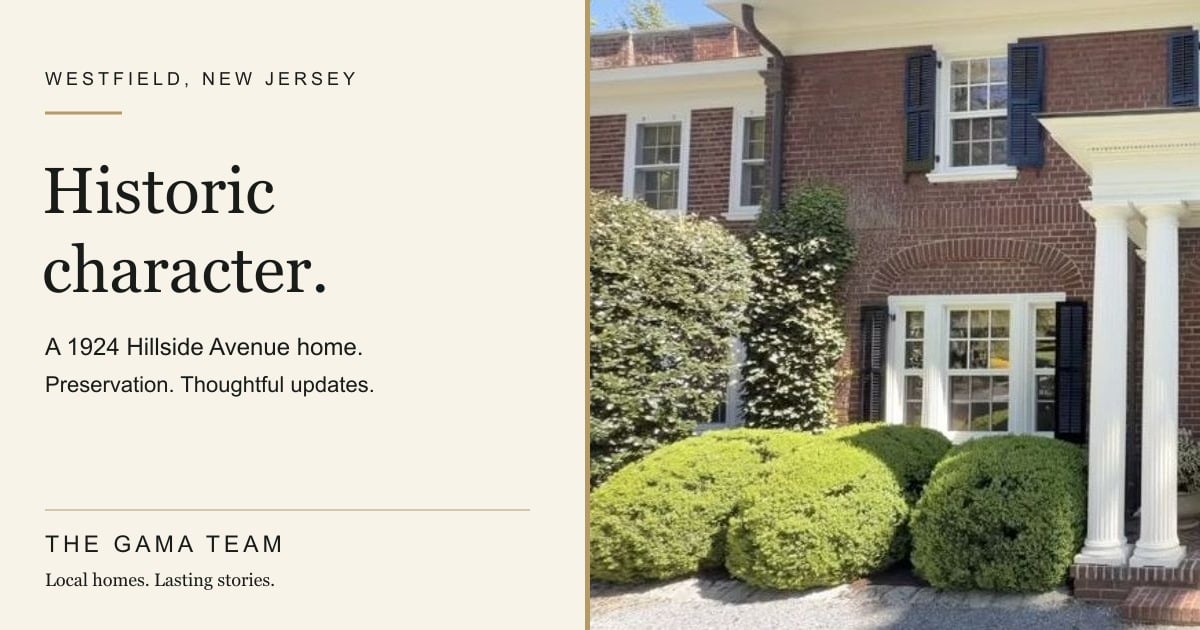
A brick Colonial on Hillside Avenue offers a useful way to think about historic homes in Westfield: look at what has survived, understand what has changed, and ask how the two work together. In our conversation with homeowner Kelly, a house she admired growing up becomes a story about preserving original rooms while making space for everyday life.
The home dates to 1924, according to Kelly, who says her family purchased it in 2003. Our video was published on April 29, 2026, as a preview of Westfield’s Tour of Notable Homes. It is a homeowner interview about the property’s history and design, rather than a current listing or availability announcement.
The details that give this Westfield home its character
Kelly’s connection to the house began long before she owned it. She grew up in Westfield and remembers passing it on the way to a friend’s home in high school. Its elevated setting and substantial construction were part of the attraction. In the interview, she describes the main house’s gable end walls as 18 inches thick and made of solid brick. That measurement is the homeowner’s account, rather than an independent building assessment.
She says the main portion of the first floor retains its original layout, moldings, butler’s pantry and coat room. Those are useful details to notice in an older home because they explain how its rooms were intended to connect. The pantry sits within a service arrangement that once linked the kitchen and dining room; a back stairway joins the main staircase at a landing. Kelly also recalls finding an old call button in the pantry.
The original hardwood floors have been stained, she explains. The conversation about a diamond pattern is less clear, so we would not use it to establish the pattern’s age. That distinction matters when describing a historic property: original material, later decoration and restoration work can each contribute to a room without having the same history.
Kelly also describes original radiators and a brick garage built for automobiles, rather than a converted barn. These details contribute to the house’s story, while their present condition still calls for property-specific review.
A two-story addition designed to feel connected
The owner’s approach to expanding the house is one of the most practical parts of the interview. She describes designing a two-story addition where a one-story kitchen had stood, with walkout basement space below. Her aim was for the transition from the original house to the addition to feel natural.
She discusses thicker walls and deeper framing as part of creating that sense of continuity. These are descriptions of her project, not specifications to copy into another home. For a buyer looking at an expanded older property, the useful questions are how the rooms connect, whether the proportions feel consistent, and what records document the work.
The interior style she describes mixes traditional surroundings with some modern furniture. She says she drew the cabinetry designs and had cabinetmakers build them. The family room and kitchen are the spaces the household uses most, while the sunroom, used as an office at filming, is her favorite place to sit.
Personal design choices with a local story
Kelly credits a magazine image of a ship captain’s house as the inspiration for her family room. She says she hired two muralists to paint an Italian landscape. It is a reminder that a historic house can carry both its original architectural identity and the preferences of the people who live there.
The interview also includes her recollections about Hillside Avenue’s spruce trees and losses during Sandy. We treat those as homeowner memories. Likewise, her account of a Manhattan architectural firm is not a verified attribution to a named architect. Establishing an architectural history would require records such as original plans, permits or archival research.
What to consider when buying or updating an older Westfield home
Start with the building and the records. Ask which features are original, which were repaired and which were replaced. Review documentation for additions and systems work. Arrange inspections appropriate to the house, including its structure, roof, electrical system, heating equipment and visible moisture concerns.
Look closely at transitions. Ceiling heights, floor levels, trim and circulation can help you understand how an addition relates to the original rooms. A beautiful finish is only one part of evaluating the work. For another perspective, read our guide to a Westfield home renovation.
Check the property’s designation before planning changes. Westfield’s Historic Preservation Commission reviews proposed work on designated historic properties and provides design guidance. An older home’s age alone does not establish its designation. Confirm the status and review process for the specific address with the town before committing to a project.
Compare the full ownership picture. Consider condition, completed updates, layout, maintenance needs and recent comparable sales. Original details do not establish a fixed premium or guarantee future value. If you are weighing preservation against a larger project, our guide to building a custom home in Westfield offers useful context.
The home-tour context, with the dates kept clear
The video promoted the 2026 Tour of Notable Homes and its historic-home theme celebrating 250 years of American history. Although the introduction loosely refers to Mother’s Day, the closing identifies Saturday, May 9. The 2026 event flyer also lists Saturday, May 9, 2026. That event is in the past; ticket instructions in the video are historical, not a current invitation.
Talk through your next move with The GAMA Team
Galina Kaplan and Marina Fridman-Rybner help buyers and sellers compare homes in Westfield and nearby communities. Whether you are drawn to original millwork or deciding how to present a thoughtfully updated home, we can help you organize the questions and compare your options. Contact The GAMA Team, call 908-379-0525 or email [email protected].
Source note: Based on our April 29, 2026 video, its full available English automatic transcript, description and exterior footage. Automatic captions contain ambiguities, so uncertain names, neighboring-property stories and construction details are not independently asserted. Useful chapters: home history at 0:13; original layout at 1:51; architectural recollections at 3:17; spruce-tree story at 4:45; design and addition at 5:33. The featured image is a cropped architectural detail from the actual home’s opening video frame.
Five questions about this historic Westfield home
1. When was the Hillside Avenue home built?
Homeowner Kelly says it was built in 1924 and that her family purchased it in 2003. These dates come from the interview; we have not independently reviewed the property’s original construction records.
2. Which original features does the owner say she preserved?
She identifies the main first-floor layout, moldings, butler’s pantry, coat room, hardwood floors and radiators. The floors were stained, and the transcript does not clearly establish the age of their decorative diamond pattern.
3. How did the owner approach the addition?
She describes replacing a one-story kitchen with a two-story addition and walkout basement space, aiming to make the new rooms feel consistent with the original house. She also designed cabinetry that cabinetmakers built.
4. Does an older Westfield home automatically have historic designation?
No. Age and formal designation are different matters. Confirm the specific property’s status with Westfield’s Historic Preservation Commission and ask what review applies to proposed changes.
5. Can I still attend the tour mentioned in this video?
The promoted tour was scheduled for May 9, 2026, and that date has passed. Treat the video as a record of the home and its owner’s design choices. Check the New Jersey Festival Orchestra for future event announcements.
Check out this article next